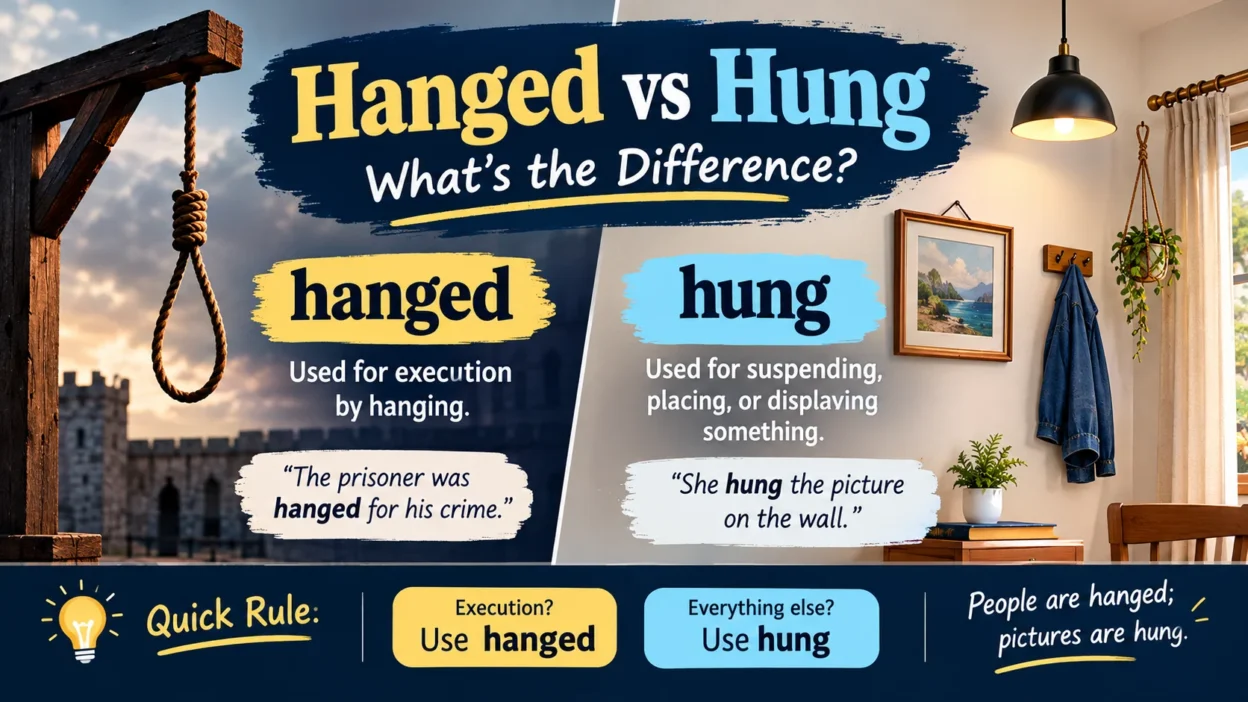
If you are unsure if to say “hanged” or “hung,” you are not alone. Both are forms of the verb hang, but they are generally used in different situations. The key distinction is simple: hanged is mainly used when referring to a person who was executed by hanging, while hung is used for most other meanings of hang, such as putting something on a wall or suspending an object.
For example, we say, “The prisoner was hanged for his crime,” but “She hung the picture on the wall.” Understanding this difference will help you choose the correct word in everyday writing, historical descriptions, and formal contexts. Once you learn the basic rule, hanged vs hung becomes much easier to remember.
Quick Answer: Hanged vs Hung
Hanged is traditionally used for execution by hanging: The prisoner was hanged. Hung is used for almost every other meaning of hang: She hung her coat on the hook. So, hanged = executed by hanging, while hung = suspended or placed somewhere.
Why Do People Confuse Hanged and Hung?
The confusion comes from the fact that hanged and hung are both past forms of hang, but they developed different uses.
The verb hang can describe several actions:
- Putting something in a higher position
- Suspending something from a hook, wall, or ceiling
- Allowing something to remain suspended
- Executing a person by hanging
For most of these meanings, hung is the usual past tense and past participle.
The special historical use is hanged, which refers specifically to execution by hanging.
Compare:
- She hung the painting in the hallway.
- The prisoner was hanged.
The first sentence describes placing an object somewhere. The second describes an execution.
First Word: Hanged
Hanged is primarily used when a person is executed by hanging.
Meaning
Hanged means executed by being suspended by the neck from a rope or similar device.
Examples
- The criminal was hanged for murder.
- The prisoner was hanged after being convicted.
- The historical figure was hanged in the town square.
In modern everyday English, this meaning is relatively uncommon because it is associated with capital punishment and historical events.
Is “Hanged” Always About Execution?
In standard usage, hanged is strongly associated with execution.
So, if you are describing someone putting a picture on a wall, hanged is not normally correct.
❌ She hanged the picture on the wall.
✅ She hung the picture on the wall.
Second Word: Hung
Hung is the usual past tense and past participle of hang for most meanings.
Meaning
Hung means placed, suspended, or left in a position where something is supported from above or attached to something.
Examples
- I hung my coat by the door.
- She hung a picture on the wall.
- They hung decorations around the room.
- The clothes were hung outside to dry.
It can also describe something that was already suspended:
- The painting hung above the fireplace.
- A lantern hung from the ceiling.
Hanged vs Hung: Comparison Table
| Word | Main use | Example |
|---|---|---|
| Hanged | Execution by hanging | The prisoner was hanged. |
| Hung | Suspending or placing something | She hung the picture. |
| Hung | Something remaining suspended | The lamp hung from the ceiling. |
| Hung | Hanging clothes or objects | He hung his coat on the hook. |
The Basic Rule
Execution → hanged
Everything else → usually hung
This is the easiest rule for most learners.
When Should You Use Each?
Use “Hanged” for Execution
Use hanged when the sentence describes a person being executed by hanging.
Examples:
- The convicted murderer was hanged.
- The prisoner was hanged at dawn.
- Several historical criminals were hanged for their crimes.
Use “Hung” for Objects
Use hung when someone places or suspends an object.
Examples:
- She hung the curtains.
- We hung the photograph.
- He hung his jacket on the chair.
Use “Hung” for Something Suspended
Use hung when something remains suspended.
- The chandelier hung from the ceiling.
- A sign hung above the entrance.
- The branches hung over the road.
Hanged vs Hung: 12 Examples
- She hung the painting above the sofa.
- He hung his coat on the hook.
- We hung decorations around the room.
- They hung curtains in the bedroom.
- The lamp hung from the ceiling.
- A large sign hung above the door.
- The clothes were hung outside to dry.
- The picture hung crookedly on the wall.
- The prisoner was hanged for his crimes.
- The historical criminal was hanged after his trial.
- Several prisoners were hanged during that period.
- The executioner hanged the condemned man.
Notice that the first eight examples involve ordinary meanings of hang, while the final four refer to execution.
Common Mistakes
Mistake 1: Using “Hanged” for Pictures
❌ I hanged the picture on the wall.
✅ I hung the picture on the wall.
Mistake 2: Using “Hung” for Execution
In traditional standard usage:
❌ The prisoner was hung for murder.
✅ The prisoner was hanged for murder.
Mistake 3: Thinking “Hanged” Is Always the Past Tense
It is tempting to think that because hang has the past form hanged, it should be used everywhere.
However, English uses hung for ordinary meanings and hanged for the execution sense.
Mistake 4: Forgetting the Meaning
The spelling alone does not tell you which form to choose. First identify what hang means in the sentence.
Ask yourself:
Is this about execution?
- Yes → hanged
- No → hung in ordinary standard usage
Memory Trick
Remember this simple formula:
Hanged = a person executed.
Hung = things suspended.
You can also remember:
“People are hanged; pictures are hung.”
This is not a complete rule for every imaginable context, but it is a useful memory aid for the main distinction.
American vs British English
The basic distinction between hanged and hung is broadly shared in both American and British English.
In both varieties:
- hanged is associated with execution.
- hung is used for ordinary meanings of hang.
For example:
American English:
The picture was hung on the wall.
British English:
The picture was hung on the wall.
The same distinction applies to historical references to execution.
Similar Words
Several words can appear in contexts related to hanged vs hung, but they do not have exactly the same meaning.
Suspended
Suspended means held or supported from above.
- The light was suspended from the ceiling.
Attached
Attached means joined or fastened to something.
- The notice was attached to the door.
Displayed
Displayed means placed somewhere so people can see it.
- The photographs were displayed on the wall.
Executed
Executed can mean legally killed as a punishment.
- The prisoner was executed after being sentenced to death.
In this context, executed is broader than hanged because execution can be carried out by different methods.
Final Verdict
The main difference between hanged and hung depends on the meaning of hang.
- Hanged → traditionally used for execution by hanging.
- Hung → used for ordinary meanings, such as suspending, displaying, or placing something.
So write:
“The picture was hung on the wall.”
But:
“The prisoner was hanged.”
FAQs About Hanged vs Hung
Is “hanged” or “hung” correct for a person?
It depends on the meaning. If the person was executed by hanging, hanged is the traditional standard form. For ordinary uses of hang, hung is used.
Is it “hung for murder” or “hanged for murder”?
When referring to execution by hanging, hanged for murder is the traditional standard expression.
Is “I hanged the picture” correct?
No, not in ordinary standard usage. Say “I hung the picture.”
What is the past tense of “hang”?
For ordinary meanings, the past tense is hung. For the execution sense, hanged is traditionally used.
Is “hung” always correct?
No. Hanged is used for the specific meaning involving execution by hanging.
Why are there two past forms of “hang”?
English developed different forms for different meanings of the verb. Hung became the normal form for ordinary meanings, while hanged remained associated with execution.
Can “hung” refer to a person?
Yes, depending on the meaning. For example, “He hung his coat on the hook” uses hung normally. But when referring to execution, traditional standard usage is “He was hanged.”
What is an easy way to remember hanged vs hung?
Remember: “People are hanged; things are hung.” More precisely, hanged refers to execution, while hung covers ordinary meanings of hang.
Remember This
The easiest rule is:
Hanged = executed by hanging.
Hung = suspended, placed, or displayed.
If you are talking about a painting, coat, curtain, photograph, lamp, decoration, or other ordinary object, hung is normally the correct choice.
If you are talking about execution by hanging, use hanged.
Conclusion
Although hanged and hung look like competing past forms of the same verb, they normally have different uses. Hung is the standard form for ordinary actions involving suspension or placement, while hanged is traditionally reserved for the execution sense.
When you encounter hanged vs hung, focus on the meaning of the sentence rather than simply memorizing two spellings. If something is being suspended or placed somewhere, choose hung. If the sentence refers to execution by hanging, choose hanged.

David Henry is a language enthusiast and content writer specializing in synonyms, vocabulary, and word meanings. He creates clear, engaging resources that help readers improve their writing, communication, and English skills.