
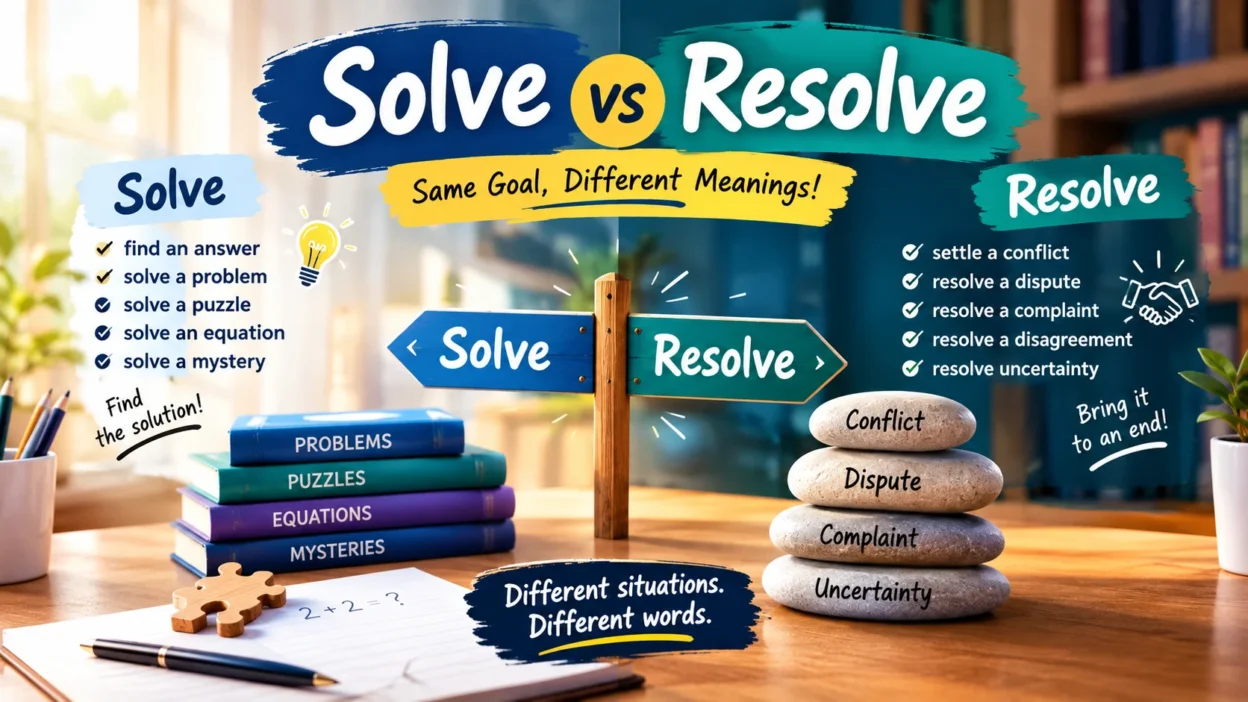
If you are unsure whether to say “solve” or “resolve,” you are not alone. These two verbs are closely related because both can describe dealing with a problem, difficulty, or disagreement. However, they are not always interchangeable. Solve usually means finding an answer or solution to a problem, while resolve often means settling a problem, conflict, uncertainty, or disagreement.
Understanding the difference becomes easier when you focus on the type of situation. We usually solve a math problem, puzzle, or technical issue, but we often resolve a dispute, conflict, complaint, or uncertainty. In some contexts, either word can work, but the meaning and emphasis may change slightly.
Quick Answer
Solve means to find an answer or solution to a problem, question, puzzle, or difficulty. Resolve means to settle, fix, or bring a problem, conflict, disagreement, or uncertainty to an end. For example, you solve a math problem but resolve a disagreement.
Why Do People Confuse “Solve” and “Resolve”?
People confuse these words because both can mean dealing successfully with a problem.
For example:
- We need to solve this technical problem.
- We need to resolve this technical problem.
Both sentences can be correct. However, solve emphasizes finding a solution, while resolve often emphasizes bringing an issue to a satisfactory conclusion.
The distinction becomes clearer with certain nouns:
- solve a puzzle
- solve an equation
- solve a mystery
- resolve a conflict
- resolve a dispute
- resolve an argument
- resolve an uncertainty
What Does “Solve” Mean?
Solve means to find an answer to a problem or to find a way to deal successfully with a difficult situation.
It is especially common with problems that have an identifiable answer or solution.
Common Uses of “Solve”
You can:
- solve a math problem
- solve an equation
- solve a puzzle
- solve a mystery
- solve a crime
- solve a technical problem
- solve a difficult question
- solve a practical problem
Examples
- I cannot solve this equation.
- The detective finally solved the mystery.
- We need to solve the technical problem quickly.
- She found a clever way to solve the issue.
What Does “Resolve” Mean?
Resolve means to settle, fix, or bring something difficult to a satisfactory conclusion.
It is particularly common for conflicts, disagreements, disputes, complaints, uncertainty, and ongoing issues.
Common Uses of “Resolve”
You can:
- resolve a conflict
- resolve a dispute
- resolve a disagreement
- resolve an argument
- resolve a complaint
- resolve an issue
- resolve uncertainty
- resolve a misunderstanding
Examples
- They met to resolve their disagreement.
- The company quickly resolved the customer’s complaint.
- We need to resolve this conflict peacefully.
- The new evidence helped resolve the uncertainty.
Solve vs Resolve: Comparison Table
| Feature | Solve | Resolve |
|---|---|---|
| Basic meaning | Find an answer or solution | Settle or bring something to an end |
| Common with | Problems, puzzles, equations, mysteries | Conflicts, disputes, complaints, uncertainty |
| Main emphasis | Finding the solution | Settling the situation |
| Example | Solve a math problem | Resolve a disagreement |
| Can describe problems? | Yes | Yes |
| Can describe conflicts? | Sometimes | Very commonly |
| Can describe puzzles? | Very commonly | Rarely |
When Should You Use “Solve”?
Use solve when you are talking about finding an answer, solution, or method for something.
Use “solve” for:
Problems
We need to solve this problem.
Puzzles
Can you solve this puzzle?
Equations
She solved the equation in a few minutes.
Mysteries
The detective solved the mystery.
Technical difficulties
The engineer solved the software problem.
Practical challenges
We need to solve the transportation problem.
When Should You Use “Resolve”?
Use resolve when you want to emphasize settling an issue or bringing a difficult situation to a conclusion.
Use “resolve” for:
Conflicts
The two groups resolved their conflict.
Disputes
The lawyers helped resolve the dispute.
Disagreements
They talked calmly to resolve their disagreement.
Complaints
The manager resolved the customer’s complaint.
Misunderstandings
We should talk and resolve this misunderstanding.
Uncertainty
The investigation resolved the uncertainty surrounding the case.
10+ Examples of Solve vs Resolve
- I need to solve this math problem.
Use solve because the problem has an answer. - They finally resolved their disagreement.
Use resolve because the disagreement needed to be settled. - Can you solve this puzzle?
Solve is the natural choice for a puzzle. - The manager resolved the customer’s complaint.
Resolve emphasizes settling the complaint. - Scientists are trying to solve the mystery.
Solve works because the goal is to discover an answer. - The two countries worked together to resolve the dispute.
Resolve is natural for a dispute. - We need to solve this technical problem.
Solve focuses on finding a technical solution. - The meeting helped resolve the conflict.
Resolve emphasizes settling the conflict. - This new evidence may solve the case.
Solve means finding the answer to the case or mystery. - The discussion helped resolve the misunderstanding.
Resolve means clearing up the misunderstanding. - Engineers are trying to solve the design problem.
Solve emphasizes finding a workable solution. - The company promised to resolve the issue quickly.
Resolve emphasizes dealing with the issue and bringing it to a satisfactory conclusion.
Common Mistakes
Mistake 1: Using “resolve” for every type of problem
Not every problem naturally takes resolve.
I resolved this math equation.
I solved this math equation.
Mistake 2: Thinking “solve” is only used for mathematics
Solve is much broader than math.
You can solve:
- mysteries
- puzzles
- crimes
- technical problems
- practical problems
- difficult questions
Mistake 3: Assuming “solve” and “resolve” always mean exactly the same thing
They overlap, but their usual contexts differ.
We solved the mystery.
This focuses on discovering the answer.
We resolved the dispute.
This focuses on settling the disagreement.
Mistake 4: Using “solve a disagreement”
Although solve can sometimes be understood in connection with a disagreement, resolve a disagreement is generally the more natural expression.
Memory Trick: Solve = Solution, Resolve = Settlement
A simple way to remember the difference is:
Solve → solution
Think: What is the answer?
Resolve → resolution
Think: How can we settle this?
For example:
- Solve an equation → find the answer.
- Resolve a conflict → settle the conflict.
American vs British English
The distinction between solve and resolve is broadly the same in American and British English.
Both varieties commonly use:
- solve a problem
- solve a puzzle
- solve a mystery
- resolve a conflict
- resolve a dispute
- resolve an issue
There is no major American-versus-British difference that changes the basic meaning of these two verbs.
Similar Words
Several other words are related to solve and resolve, but their meanings are slightly different.
Fix
Fix means to repair something or make a problem stop causing trouble.
The technician fixed my computer.
Settle
Settle means to bring a disagreement, dispute, or question to an agreement or conclusion.
They settled the dispute outside court.
Address
Address means to deal with a problem or situation, but it does not necessarily mean that the problem has been completely solved.
The company needs to address the safety concerns.
Handle
Handle means to manage or deal with a situation.
She handled the difficult customer professionally.
Answer
Answer is often used for questions.
Please answer the question.
Final Verdict
Solve and resolve both involve dealing with something difficult, but they are normally used in different situations.
Use solve when you are finding an answer or solution to a problem, puzzle, mystery, equation, or similar challenge.
Use resolve when you are settling a conflict, disagreement, dispute, complaint, uncertainty, or ongoing issue.
When both are grammatically possible, consider what you want to emphasize: finding a solution or settling the situation.
Frequently Asked Questions
Is it correct to say “solve an issue” or “resolve an issue”?
Both are possible. Solve an issue emphasizes finding a solution, while resolve an issue emphasizes dealing with it and bringing it to a satisfactory conclusion.
Is it “solve a problem” or “resolve a problem”?
Both expressions are correct. Solve a problem is extremely common when you mean finding a solution. Resolve a problem can emphasize successfully dealing with and concluding the problem.
Is it “solve a conflict” or “resolve a conflict”?
Resolve a conflict is the more natural and common expression because conflicts are generally settled rather than answered like puzzles.
Can you solve a disagreement?
It is understandable, but resolve a disagreement is usually the more natural phrase.
Is “resolve” stronger than “solve”?
Not necessarily. The words emphasize different aspects. Solve focuses on finding a solution, while resolve often focuses on settling or concluding an issue.
Can you use “solve” for a mystery?
Yes. Solve a mystery is a standard English expression.
Can you use “resolve” for a complaint?
Yes. Resolve a complaint is a common expression, especially in customer service and business contexts.
Remember This
Solve = find the answer or solution.
Resolve = settle or bring an issue to a conclusion.
So:
- Solve a puzzle.
- Solve an equation.
- Solve a mystery.
- Resolve a conflict.
- Resolve a dispute.
- Resolve a complaint.
Conclusion
The difference between solve and resolve is mainly about context and emphasis. Solve usually refers to finding an answer or solution, while resolve commonly refers to settling a conflict, disagreement, complaint, uncertainty, or other issue.
When choosing between them, ask yourself what you are dealing with. If it is something that needs an answer, solve is often the natural choice. If it is something that needs to be settled or brought to an end, resolve is usually more appropriate.

David Henry is a language enthusiast and content writer specializing in synonyms, vocabulary, and word meanings. He creates clear, engaging resources that help readers improve their writing, communication, and English skills.