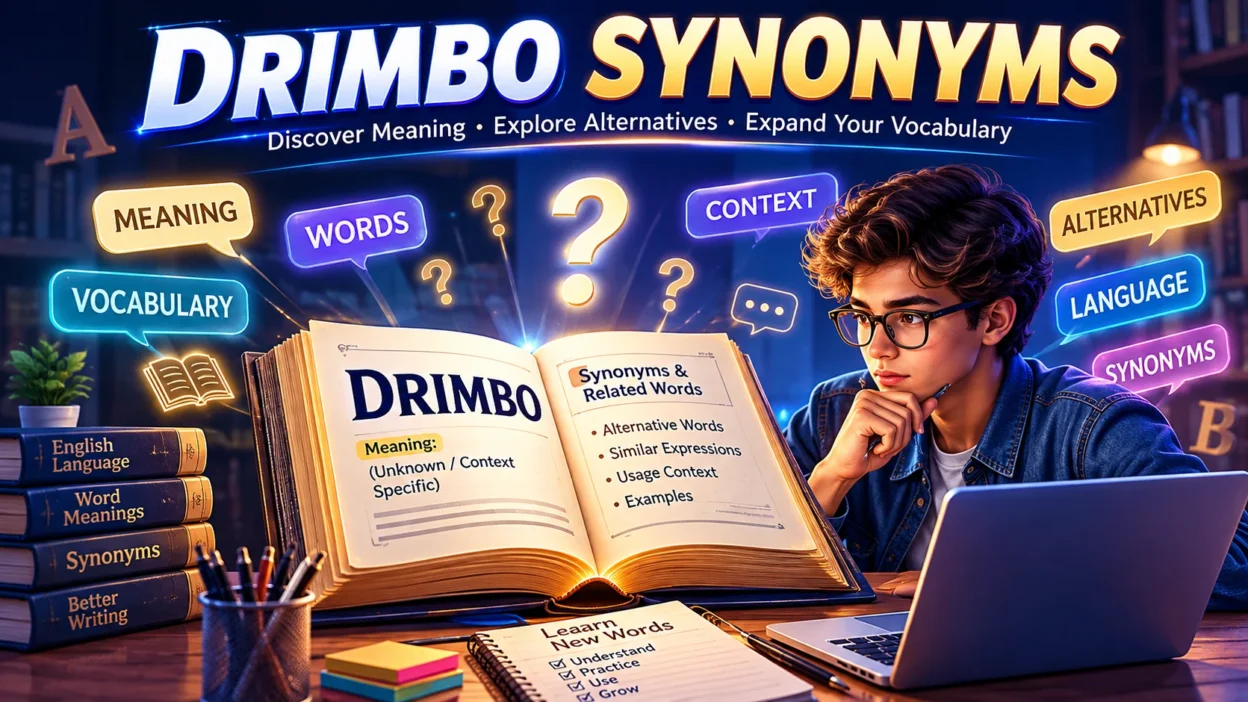
The phrase “drimbo synonyms” can be confusing because drimbo is not a standard English dictionary word with a widely established meaning. It may be a coined expression, slang term, username, brand name, typo, or context-specific word.
For students, ESL learners, writers, and content creators, understanding the context behind an unfamiliar word is important before choosing a synonym. A synonym should match the intended meaning, tone, and situation rather than simply look similar.
What Does “Drimbo” Mean?
There is no broadly recognized standard-English definition of drimbo. If you found this word online, in a conversation, game, social-media post, or a particular community, its meaning may depend entirely on that context.
For example, a person may use drimbo as a playful invented word. Another person might use it as a nickname or typo. In such cases, replacing it with a conventional synonym without knowing the intended meaning could change the original message.
If your intended keyword is “demure synonyms,” however, the meaning is much clearer.
What Does “Demure” Mean?
Demure describes someone who is quiet, modest, reserved, and not overly confident or attention-seeking, especially in appearance or behavior.
It often suggests a calm, polite, and somewhat shy manner.
Simple definition
Demure = modest, quiet, reserved, and graceful in behavior or appearance.
Example
She gave a demure smile when everyone complimented her dress.
Here, demure suggests that her smile was modest and restrained rather than loud or highly expressive.
Tone and usage
Demure is usually positive or gently complimentary, although its tone can vary depending on context. It is commonly used to describe:
- A person’s behavior
- Facial expressions
- Clothing or appearance
- A quiet manner
- Modest social behavior
It is more formal and literary than everyday words such as shy or quiet.
30 Synonyms of Demure
Below are 30 useful alternatives, with simple meanings, examples, and guidance on when each word works best.
1. Modest
Meaning: Not showing off or seeking too much attention.
Example:
She wore a modest dress to the formal event.
Best usage: Clothing, behavior, appearance, or attitude.
2. Reserved
Meaning: Quiet and unlikely to express feelings openly.
Example:
He was reserved during the first few minutes of the meeting.
Best usage: Personality and social behavior.
3. Shy
Meaning: Nervous or uncomfortable around other people.
Example:
The shy student avoided speaking in front of the class.
Best usage: Everyday English and social situations.
4. Bashful
Meaning: Easily embarrassed or shy, especially when receiving attention.
Example:
She became bashful when her friends praised her performance.
Best usage: Friendly, gentle descriptions.
5. Retiring
Meaning: Quiet and not interested in attracting attention.
Example:
Despite his talent, he had a retiring personality.
Best usage: Formal or literary writing.
6. Unassuming
Meaning: Not trying to appear important or impressive.
Example:
The professor was surprisingly unassuming despite her achievements.
Best usage: Personality and character.
7. Quiet
Meaning: Not loud, talkative, or expressive.
Example:
She was quiet and thoughtful during dinner.
Best usage: General everyday descriptions.
8. Gentle
Meaning: Calm, kind, and soft in manner.
Example:
His gentle manner made everyone feel comfortable.
Best usage: Personality and behavior.
9. Mild
Meaning: Calm and not extreme in behavior or expression.
Example:
She responded with a mild smile.
Best usage: Reactions, expressions, and temperament.
10. Subdued
Meaning: Restrained, quiet, or less energetic than usual.
Example:
Her subdued response suggested that she was embarrassed.
Best usage: Emotions, reactions, atmosphere, and behavior.
11. Unobtrusive
Meaning: Not attracting unwanted attention.
Example:
She chose an unobtrusive style for the ceremony.
Best usage: Appearance, design, behavior, and presence.
12. Self-effacing
Meaning: Not wanting to draw attention to one’s own achievements.
Example:
The successful author remained self-effacing during the interview.
Best usage: Character and professional writing.
13. Humble
Meaning: Not believing that you are better or more important than others.
Example:
Despite winning the award, she remained humble.
Best usage: Character and attitude.
14. Unpretentious
Meaning: Simple and not designed to impress others.
Example:
He preferred an unpretentious style of clothing.
Best usage: Appearance, lifestyle, writing, and personality.
15. Dignified
Meaning: Calm, respectable, and controlled.
Example:
She maintained a dignified posture throughout the ceremony.
Best usage: Formal behavior and appearance.
16. Composed
Meaning: Calm and in control of your emotions.
Example:
She remained composed despite the difficult question.
Best usage: Emotional control and professional situations.
17. Demure
Meaning: Quiet, modest, reserved, and graceful.
Example:
The actress gave a demure smile to the audience.
Best usage: Modest behavior, appearance, and expressions.
18. Discreet
Meaning: Careful not to attract attention or reveal too much.
Example:
She was discreet about her personal affairs.
Best usage: Privacy and careful behavior.
19. Proper
Meaning: Behaving in a socially acceptable and respectful way.
Example:
The children were expected to remain proper during the ceremony.
Best usage: Manners and social expectations.
20. Ladylike
Meaning: Traditionally associated with polite, graceful, and refined feminine behavior.
Example:
Her ladylike manners impressed the guests.
Best usage: Traditional descriptions; use carefully because the term can sound old-fashioned.
21. Prim
Meaning: Very proper, neat, and formal, sometimes excessively so.
Example:
She appeared prim and perfectly organized.
Best usage: Formal appearance or behavior, sometimes with a slightly critical tone.
22. Primly
Meaning: In an overly proper or reserved manner.
Example:
She primly adjusted her collar before entering the room.
Best usage: Literary descriptions of behavior.
23. Refined
Meaning: Elegant, polished, and socially graceful.
Example:
Her refined manners made a strong impression.
Best usage: Style, manners, speech, and taste.
24. Elegant
Meaning: Graceful, stylish, and attractive in a sophisticated way.
Example:
She looked elegant in her simple evening dress.
Best usage: Appearance, clothing, and manner.
25. Graceful
Meaning: Moving or behaving in a smooth, attractive, and controlled way.
Example:
Her graceful manner made her stand out.
Best usage: Movement, behavior, and appearance.
26. Unobtrusive
Meaning: Present without demanding attention.
Example:
His unobtrusive personality allowed others to feel relaxed around him.
Best usage: Personality, behavior, design, and presence.
27. Restrained
Meaning: Controlled and not overly emotional or expressive.
Example:
She gave a restrained response to the unexpected compliment.
Best usage: Emotions, reactions, speech, and style.
28. Soft-spoken
Meaning: Speaking quietly and gently.
Example:
The soft-spoken teacher explained the lesson patiently.
Best usage: Voice and communication style.
29. Unassertive
Meaning: Not forceful or strongly demanding attention.
Example:
His unassertive manner sometimes made it difficult for others to notice his ideas.
Best usage: Personality and communication.
30. Modest-mannered
Meaning: Behaving in a quiet, respectful, and non-showy way.
Example:
The modest-mannered guest thanked everyone without making a fuss.
Best usage: Descriptive or creative writing.
Quick Comparison of Demure Synonyms
| Synonym | Main idea | Tone | Best context |
|---|---|---|---|
| Modest | Not showy | Positive | Appearance, behavior |
| Reserved | Emotionally quiet | Neutral | Personality |
| Shy | Uncomfortable with attention | Neutral | Social situations |
| Bashful | Easily embarrassed | Warm | Personal interactions |
| Unassuming | Not self-important | Positive | Character |
| Humble | Not boastful | Positive | Achievements |
| Composed | Emotionally controlled | Positive | Difficult situations |
| Subdued | Quiet or restrained | Neutral | Reactions |
| Dignified | Calm and respectable | Formal | Public behavior |
| Refined | Polished and elegant | Positive | Manners and style |
| Restrained | Controlled expression | Neutral/Formal | Emotions |
| Soft-spoken | Quiet voice | Positive | Communication |
| Unobtrusive | Does not attract attention | Neutral | Behavior or presence |
| Prim | Extremely proper | Sometimes critical | Appearance/behavior |
| Elegant | Graceful and stylish | Positive | Appearance |
Demure vs. Shy
These words are related, but they are not identical.
Shy usually describes someone who feels nervous, uncomfortable, or hesitant around other people.
Demure emphasizes modesty, reserve, and controlled behavior or appearance.
For example:
The shy child hid behind her mother.
This suggests nervousness.
The woman gave a demure smile.
This suggests modest and restrained behavior rather than fear.
Demure vs. Reserved
Reserved focuses mainly on a person’s tendency to keep thoughts and feelings private.
Demure can describe reserve, but it often adds an idea of modesty and graceful behavior.
He is reserved and rarely talks about his personal life.
She gave a demure response to the compliment.
Demure vs. Modest
Modest is broader than demure. It can describe clothing, behavior, achievements, expectations, or personality.
Demure is more strongly connected with quiet, restrained, and traditionally graceful behavior or appearance.
How to Choose the Right Synonym
Choosing the right synonym depends on what you actually want to communicate.
If you mean “not showing off”
Use:
- Modest
- Humble
- Unassuming
- Unpretentious
If you mean “quiet around people”
Use:
- Shy
- Reserved
- Retiring
- Soft-spoken
If you mean “calm and controlled”
Use:
- Composed
- Restrained
- Subdued
- Dignified
If you mean “graceful and polished”
Use:
- Elegant
- Refined
- Graceful
- Dignified
If you mean “embarrassed in a sweet or gentle way”
Use:
- Bashful
- Shy
- Demure
If you mean “not attracting attention”
Use:
- Unobtrusive
- Discreet
- Unassuming
- Reserved
Using Demure Synonyms in Writing
Writers should choose synonyms according to the exact image they want to create.
For example, shy works well in casual stories:
The shy girl avoided the crowded room.
Reserved works better when describing a personality:
His reserved nature made him difficult to read.
Elegant emphasizes appearance:
She wore an elegant black dress.
Composed focuses on emotional control:
She remained composed under pressure.
Bashful gives the sentence a softer and more playful feeling:
He gave a bashful grin after receiving the compliment.
This small difference in meaning can make writing much more precise.
Are “Drimbo Synonyms” and “Demure Synonyms” the Same?
No. Drimbo and demure should not automatically be treated as synonyms.
Demure is an established English adjective meaning modest, reserved, and quiet in manner or appearance. Drimbo, by contrast, does not have a single widely accepted standard-English meaning.
If you are researching drimbo synonyms, first identify how the word is being used in the original sentence. Once the intended meaning is known, a suitable replacement can be selected.
For SEO content, this distinction is especially important. A page should answer the meaning users actually intend rather than mixing unrelated vocabulary.
Frequently Asked Questions
What is the meaning of demure?
Demure means quiet, modest, reserved, and controlled in behavior or appearance.
What is the closest synonym for demure?
Modest and reserved are two of the closest common alternatives, depending on context.
Is shy a synonym for demure?
Sometimes, but not always. Shy emphasizes nervousness or social discomfort, while demure emphasizes modesty and reserve.
Is demure a positive word?
Usually, yes. It often describes someone as modest, graceful, or pleasantly reserved, although the exact tone depends on context.
What is the difference between demure and modest?
Modest has a broader meaning, while demure specifically suggests quiet, reserved, and graceful behavior or appearance.
Is “drimbo” a standard English word?
There is no broadly established standard-English definition for drimbo. Its meaning may depend on the context where it appears.
Final Thoughts
Understanding synonyms is not simply about finding words that look interchangeable. Good vocabulary choices depend on meaning, tone, context, and audience.
For demure, useful alternatives include modest, reserved, shy, bashful, unassuming, humble, composed, dignified, and refined. However, each word creates a slightly different impression.
If your target phrase is specifically “drimbo synonyms,” remember that drimbo does not have one universally recognized English meaning. Check the original context first. If the intended word was demure, the 30 alternatives in this guide provide a useful starting point for students, ESL learners, writers, and content creators.

Amber Amy is a passionate writer at SynonymLot, dedicated to helping readers discover better words, expand their vocabulary, and improve their writing through clear, accurate, and easy-to-understand synonym guides.