
The phrase “loveybug” is a warm, playful term used to describe someone who is especially affectionate, loving, or eager to show care. It can also be used as a cute nickname for a romantic partner, child, friend, or someone with a naturally loving personality.
Learning loveybug synonyms can help you express affection in different ways. Depending on the situation, you might want a word that sounds romantic, cute, friendly, playful, tender, or deeply caring. This guide explores those nuances while also following the vocabulary focus requested in this article.
For clarity, “loveybug” and “demure” have different meanings. Loveybug relates to affection and loving behavior, while demure describes someone who is modest, reserved, quiet, or restrained. The 30-word synonym list below therefore focuses specifically on demure, as requested.
What Does “Loveybug” Mean?
Loveybug is an informal, affectionate expression for someone who is loving, cuddly, sweet, affectionate, or emotionally warm.
It is usually a playful nickname rather than a formal dictionary word.

Examples of “Loveybug”
- “Come here, loveybug!”
- “My little loveybug always gives the best hugs.”
- “She becomes such a loveybug when she is happy.”
The exact meaning depends on context. In a romantic relationship, it can sound sweet and intimate. Between family members, it can sound cute and affectionate.
Loveybug Synonyms by Tone
Depending on what you mean, related expressions can include:
- Sweetheart
- Lovebug
- Darling
- Honey
- Sweetie
- Cutie
- Beloved
- Dear
- Cuddlebug
- Affectionate one
- Loving person
- Sweet soul
These alternatives are not perfect dictionary equivalents. Some are nicknames, while others describe affectionate personality traits.
What Does “Demure” Mean?
Demure means quiet, modest, reserved, and not likely to attract unnecessary attention.
It is commonly used to describe someone’s behavior, appearance, expression, or manner.
Example:
She gave a demure smile when everyone praised her.
Here, demure suggests a gentle, modest, and restrained smile.
The word often has an elegant, polite, or traditionally feminine tone, although its meaning can vary depending on context.
Common Uses of “Demure”
- Demure smile → a modest, gentle smile
- Demure manner → quiet and reserved behavior
- Demure dress → modest clothing
- Demure expression → restrained or shy-looking expression
- Demure personality → quiet and not attention-seeking
30 Synonyms of Demure
Here are 30 useful synonyms and closely related words, with simple meanings, examples, and usage guidance.
1. Modest
Meaning: Not showing off or attracting too much attention.
Example:
She chose a modest dress for the formal occasion.
Best usage context: Clothing, personality, behavior, or achievements.
2. Reserved
Meaning: Quiet and not very open about feelings or opinions.
Example:
He was reserved when he first joined the group.
Best usage context: Personality and social behavior.
3. Shy
Meaning: Nervous or uncomfortable around other people.
Example:
The shy student avoided speaking in front of the class.
Best usage context: Everyday descriptions of personality.
4. Retiring
Meaning: Quiet and unwilling to seek attention.
Example:
She had a retiring personality and preferred small gatherings.
Best usage context: Formal or literary descriptions.
5. Coy
Meaning: Shy or modest in a playful way.
Example:
She gave him a coy smile before looking away.
Best usage context: Romantic or playful situations.
6. Bashful
Meaning: Easily embarrassed or shy.
Example:
The bashful child hid behind her mother.
Best usage context: Gentle descriptions of shyness.
7. Timid
Meaning: Lacking confidence and easily nervous.
Example:
The timid puppy stayed close to its owner.
Best usage context: People, animals, and situations involving low confidence.
8. Quiet
Meaning: Not very talkative, loud, or expressive.
Example:
She was a quiet person who enjoyed listening to others.
Best usage context: Everyday English.
9. Unassuming
Meaning: Not trying to appear important or impressive.
Example:
Despite his success, he remained unassuming.
Best usage context: Humble personalities.
10. Unobtrusive
Meaning: Not attracting attention or disturbing others.
Example:
He found an unobtrusive place near the back of the room.
Best usage context: People, actions, objects, and behavior.
11. Restrained
Meaning: Controlled and not overly expressive.
Example:
She responded with a restrained smile.
Best usage context: Emotions, reactions, and communication.
12. Subdued
Meaning: Quiet, gentle, or less energetic than usual.
Example:
His mood was subdued after the difficult news.
Best usage context: Mood, behavior, voice, and emotional reactions.
13. Mild
Meaning: Gentle, calm, and not extreme.
Example:
She had a mild and pleasant personality.
Best usage context: Temperament and behavior.
14. Meek
Meaning: Very gentle, quiet, and unlikely to challenge others.
Example:
The meek student rarely interrupted anyone.
Best usage context: Very passive or gentle personalities.
Note: Meek can sometimes have a negative meaning because it may suggest weakness.
15. Gentle
Meaning: Kind, calm, and soft in manner.
Example:
Her gentle personality made people feel comfortable.
Best usage context: Personality, behavior, voice, and interactions.
16. Prim
Meaning: Very proper, neat, and careful about behavior.
Example:
She maintained a prim expression throughout the ceremony.
Best usage context: Formal or old-fashioned descriptions.
17. Proper
Meaning: Respectable, appropriate, and socially acceptable.
Example:
He always behaved in a proper manner at formal events.
Best usage context: Manners, clothing, and social behavior.
18. Decorous
Meaning: Polite, respectable, and appropriate.
Example:
The guests maintained a decorous atmosphere during dinner.
Best usage context: Formal writing and social manners.
19. Dignified
Meaning: Calm, respectable, and controlled.
Example:
She gave a dignified response to the criticism.
Best usage context: Formal situations and mature behavior.
20. Discreet
Meaning: Careful not to attract attention or reveal private matters.
Example:
He was discreet when discussing the confidential issue.
Best usage context: Privacy and careful behavior.
21. Self-effacing
Meaning: Avoiding praise or attention for yourself.
Example:
Her self-effacing personality made her easy to work with.
Best usage context: Humility and modest personalities.
22. Diffident
Meaning: Lacking confidence, especially around other people.
Example:
His diffident manner made public speaking difficult for him.
Best usage context: Formal descriptions of uncertain or shy behavior.
23. Genteel
Meaning: Polite, refined, and socially graceful.
Example:
She had a genteel manner that suited the elegant setting.
Best usage context: Literary, formal, or traditional writing.
24. Ladylike
Meaning: Traditionally associated with graceful, polite, and modest behavior.
Example:
Her ladylike manner suited the formal event.
Best usage context: Traditional descriptions of feminine behavior.
25. Chaste
Meaning: Modest or sexually restrained.
Example:
The artwork presented the subject in a chaste and elegant style.
Best usage context: Literature, art, and traditional descriptions.
26. Innocent
Meaning: Simple, inexperienced, or free from suggestive behavior.
Example:
She gave an innocent smile when she heard the joke.
Best usage context: Expressions, personality, and situations involving simplicity.
27. Unpretentious
Meaning: Natural and simple without trying to seem important.
Example:
The successful writer was surprisingly unpretentious.
Best usage context: Personality and lifestyle descriptions.
28. Soft-spoken
Meaning: Speaking quietly and gently.
Example:
The soft-spoken teacher created a peaceful classroom.
Best usage context: Voice and communication style.
29. Composed
Meaning: Calm and in control of your emotions.
Example:
She remained composed during the difficult conversation.
Best usage context: Professional, emotional, and formal situations.
30. Demure
Meaning: Quiet, modest, reserved, and restrained.
Example:
She wore a demure outfit to the ceremony.
Best usage context: Clothing, behavior, expressions, and personality.
Comparison Table: Demure Synonyms
| Synonym | Main Meaning | Tone | Best Usage |
|---|---|---|---|
| Modest | Not attention-seeking | Positive | Clothing, behavior |
| Reserved | Emotionally private | Neutral | Personality |
| Shy | Socially nervous | Gentle | People |
| Retiring | Avoids attention | Formal | Personality |
| Coy | Playfully shy | Playful | Romance |
| Bashful | Easily embarrassed | Gentle | Shyness |
| Timid | Lacking confidence | Slightly negative | Personality |
| Unassuming | Humble | Positive | Personality |
| Restrained | Emotionally controlled | Neutral | Reactions |
| Subdued | Quiet or low-energy | Neutral | Mood |
| Meek | Very passive and gentle | Mixed | Personality |
| Gentle | Kind and calm | Positive | Behavior |
| Prim | Very proper | Traditional | Manners |
| Decorous | Proper and respectable | Formal | Social behavior |
| Dignified | Calm and respectable | Positive | Formal situations |
| Discreet | Careful and private | Positive | Sensitive situations |
| Self-effacing | Avoids praise | Positive | Humility |
| Diffident | Lacking confidence | Formal | Personality |
| Genteel | Refined and polite | Formal | Style and manners |
| Soft-spoken | Speaks gently | Positive | Voice |
| Composed | Calm and controlled | Positive | Emotional situations |
How to Choose the Right Synonym
Choosing the right synonym depends on the specific quality you want to communicate.
When You Mean Modesty
Use:
- Modest
- Proper
- Chaste
- Demure
These are especially useful when discussing clothing, appearance, or behavior.
Example:
She wore a modest outfit to the ceremony.
When You Mean Shyness
Use:
- Shy
- Bashful
- Timid
- Diffident
These emphasize nervousness or a lack of confidence.
Example:
The bashful student smiled and looked away.
When You Mean Quietness
Use:
- Reserved
- Quiet
- Retiring
- Soft-spoken
- Subdued
These are appropriate when someone does not talk much or avoids drawing attention.
Example:
He was reserved but became more talkative with close friends.
When You Mean Humility
Use:
- Unassuming
- Unpretentious
- Self-effacing
These words emphasize someone who does not boast about achievements.
Example:
Despite her success, she remained unassuming.
When You Mean Formal Elegance
Use:
- Dignified
- Decorous
- Genteel
- Composed
- Proper
These choices work well in formal and literary writing.
Example:
She maintained a dignified presence throughout the event.
When You Mean Playful Shyness
Use:
- Coy
- Bashful
- Demure
These can work especially well in romantic or playful descriptions.
Example:
He received a coy smile in response.
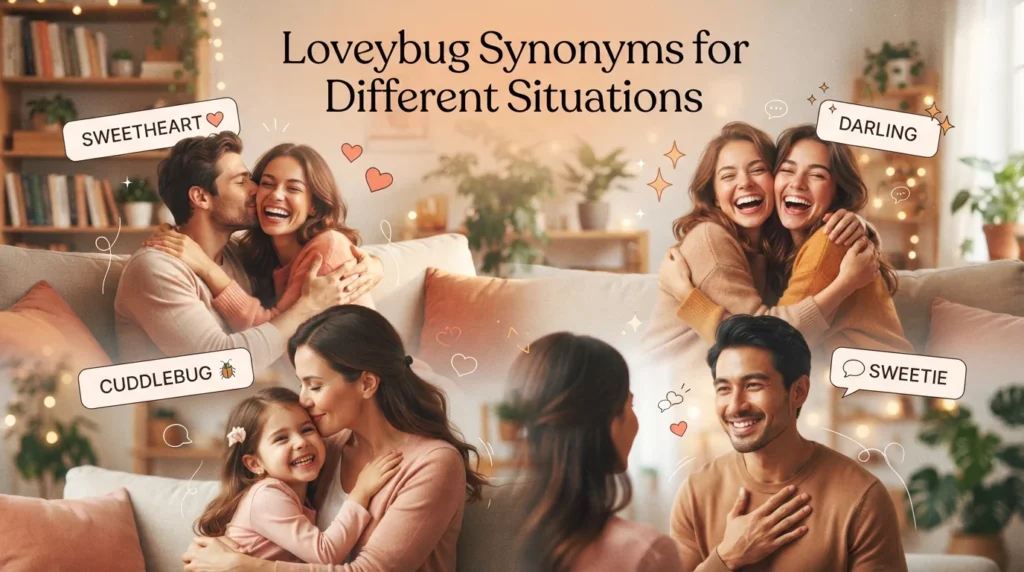
Loveybug Synonyms for Different Situations
Because loveybug is an informal affectionate expression, the best alternative depends on your relationship and tone.
Romantic
- Lovebug
- Sweetheart
- Darling
- Beloved
- Honey
Example:
“Good morning, sweetheart!”
Cute and Playful
- Cuddlebug
- Cutie
- Sweetie
- Lovebug
Example:
“Come here, you little cuddlebug!”
Warm and Friendly
- Dear
- Sweetie
- Sweetheart
- Sweet soul
Example:
“Thanks for helping me, sweetie.”
Deeply Affectionate
- Beloved
- Darling
- Dear one
- Loved one
These expressions are better when you want to communicate strong emotional warmth.
Demure vs. Loveybug
These two expressions should not normally be treated as synonyms.
Demure describes a quiet, modest, restrained manner.
Loveybug describes a loving, affectionate, or cuddly person.
For example:
She gave a demure smile.
This focuses on modest and restrained behavior.
She is such a loveybug.
This focuses on affection and warmth.
Understanding this distinction is especially useful for ESL learners because words with emotional meanings can be difficult to translate directly between languages.
Why Learning Synonyms Matters
Synonyms make your writing more precise. Instead of repeatedly using the same word, you can choose a term that communicates the exact quality you want.
For example, shy suggests social nervousness, while reserved suggests emotional privacy. Modest focuses on a lack of showiness, while dignified emphasizes calmness and respectability.
Likewise, when using affectionate language such as loveybug, choosing between sweetheart, darling, cuddlebug, and beloved allows you to control the emotional tone.
Quick Guide to the Best Words
If you mean modest, choose demure or modest.
If you mean quiet around people, choose reserved.
If you mean nervous around people, choose shy.
If you mean playfully shy, choose coy.
If you mean humble, choose unassuming.
If you mean emotionally controlled, choose restrained.
If you mean formal and respectable, choose decorous or dignified.
If you mean quietly spoken, choose soft-spoken.
If you mean affectionate and loving, use loveybug, lovebug, or sweetheart.
Final Thoughts
The phrase loveybug is a playful and affectionate expression for someone who is loving, sweet, cuddly, or emotionally warm. Because it is informal, its closest alternatives depend heavily on the situation and relationship.
At the same time, demure has a completely different meaning. It describes someone or something that is modest, reserved, quiet, restrained, or traditionally graceful. Its related vocabulary includes modest, reserved, shy, coy, bashful, retiring, unassuming, dignified, decorous, composed, and soft-spoken.
Understanding these differences helps students, ESL learners, writers, and content creators choose words more accurately. Rather than simply replacing one word with another, consider the tone, context, emotion, and exact meaning you want your reader to understand.

Alexander Eric is the Administrator of SynonymLot, dedicated to providing accurate synonyms, vocabulary resources, and language tools. He enjoys helping readers improve writing, communication, and English word knowledge daily.