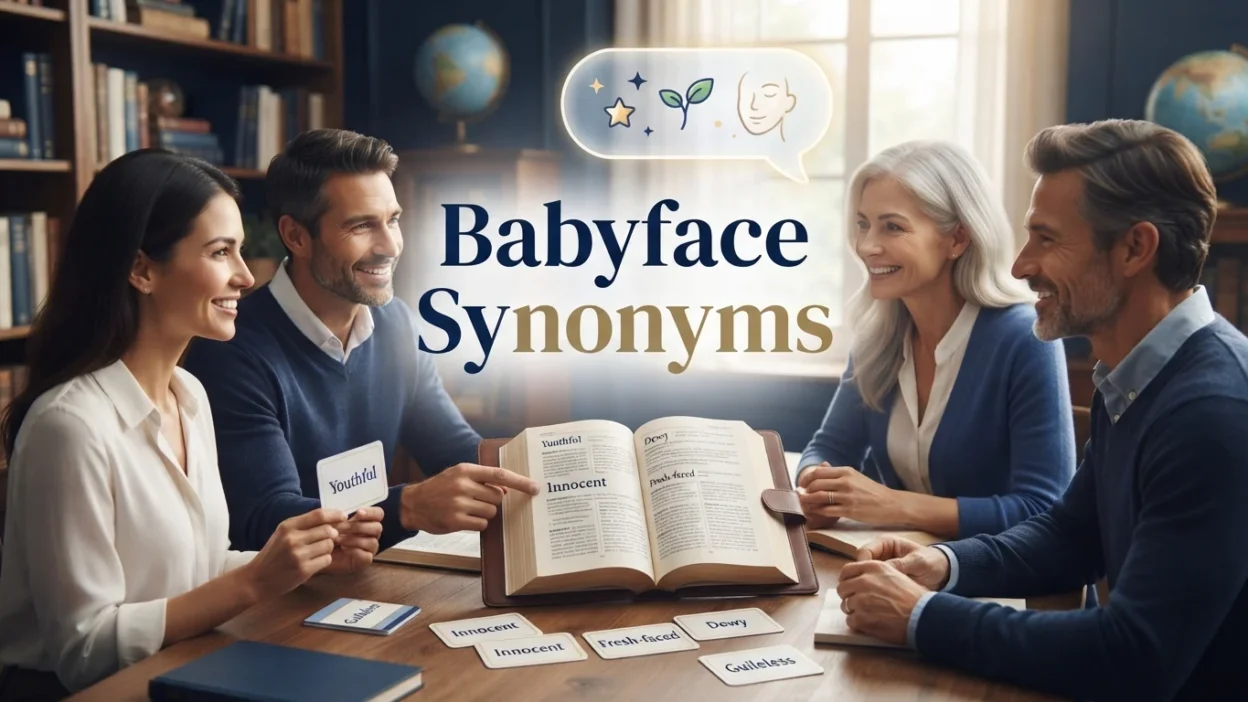
If you are looking for babyface synonyms, you may want a word that describes someone with a youthful, soft, innocent, or naturally young-looking appearance. The word “babyface” is common in everyday English, but the best alternative depends on the exact meaning and tone you want.
For students, ESL learners, writers, and content creators, knowing related vocabulary can make descriptions more precise. For example, youthful sounds positive and neutral, while boyish, girlish, or innocent-looking can create a more specific impression.
It is also important to understand that not every synonym has exactly the same meaning. Some describe physical appearance, while others suggest personality, innocence, softness, or youthfulness. Choosing the right word helps your writing sound natural rather than repetitive.
What Does “Babyface” Mean?
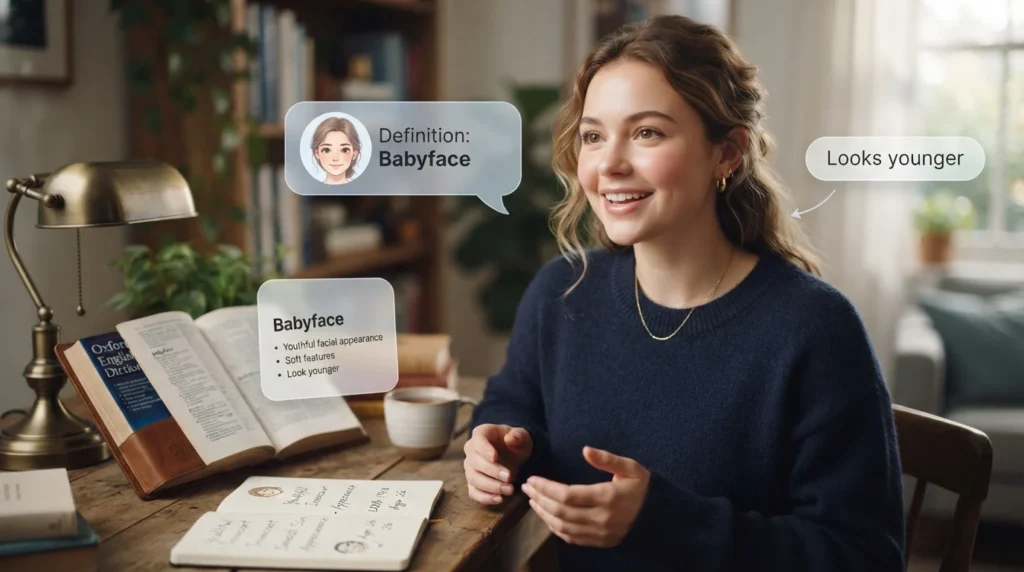
Babyface is an informal word used to describe a person whose face looks unusually young, soft, round, smooth, or innocent.
Someone with a babyface may look younger than their actual age. The term is often used casually and can be positive, playful, or affectionate.
For example:
- “He has a babyface, so people often think he is younger.”
- “Her babyface makes her look very youthful.”
- “Even at thirty, he still has a babyface.”
The word does not necessarily mean that someone behaves like a baby. It mainly refers to facial appearance.
30 Babyface Synonyms and Related Words
Because “babyface” has several shades of meaning, the following words are useful alternatives depending on your context.
1. Youthful
Meaning: Looking young, fresh, or energetic.
Example: “She has a youthful appearance that makes her seem years younger.”
Best usage: Neutral or positive descriptions.
2. Young-looking
Meaning: Appearing younger than one’s actual age.
Example: “He is very young-looking for someone in his forties.”
Best usage: Everyday descriptions.
3. Boyish
Meaning: Having a youthful appearance or qualities traditionally associated with a young boy.
Example: “His boyish smile made him look friendly and approachable.”
Best usage: Describing men or masculine appearances.
4. Girlish
Meaning: Having a youthful or traditionally young-feminine appearance or quality.
Example: “Her girlish expression gave her a cheerful appearance.”
Best usage: Describing a youthful feminine style or appearance.
5. Childlike
Meaning: Having qualities associated with children, especially innocence or openness.
Example: “His childlike smile made everyone feel comfortable.”
Best usage: When innocence is more important than physical appearance.
6. Innocent-looking
Meaning: Appearing harmless, pure, or inexperienced.
Example: “His innocent-looking face made him seem very trustworthy.”
Best usage: Descriptions involving facial expression or first impressions.
7. Fresh-faced
Meaning: Looking young, healthy, clean, and energetic.
Example: “The fresh-faced student confidently walked into the classroom.”
Best usage: Positive descriptions of youthful appearance.
8. Juvenile
Meaning: Related to youth or resembling something young.
Example: “His juvenile appearance made people underestimate his age.”
Best usage: Formal or descriptive writing; use carefully because it can sound negative.
9. Adolescent-looking
Meaning: Having an appearance similar to a teenager.
Example: “Despite being an adult, he still has an adolescent-looking face.”
Best usage: Precise descriptions of youthful facial features.
10. Petite-faced
Meaning: Having a small, delicate-looking face.
Example: “Her petite face gave her a soft and youthful appearance.”
Best usage: Descriptions emphasizing delicate facial structure.
11. Round-faced
Meaning: Having a face with a noticeably rounded shape.
Example: “The round-faced actor is often cast as younger characters.”
Best usage: Physical descriptions.
12. Soft-featured
Meaning: Having gentle, smooth, or delicate facial features.
Example: “His soft-featured appearance made him look younger than he was.”
Best usage: Artistic and descriptive writing.
13. Sweet-faced
Meaning: Having a pleasant, gentle, or innocent-looking face.
Example: “The sweet-faced child smiled at everyone.”
Best usage: Warm and affectionate descriptions.
14. Angelic
Meaning: Extremely innocent, beautiful, or pure-looking.
Example: “Her angelic expression gave her a peaceful appearance.”
Best usage: Positive, expressive, or literary writing.
15. Innocent
Meaning: Appearing pure, harmless, or inexperienced.
Example: “He had an innocent expression that immediately attracted attention.”
Best usage: When describing an impression rather than age alone.
16. Babyish
Meaning: Resembling a baby in appearance or behavior.
Example: “Her babyish features made her look much younger.”
Best usage: Informal descriptions; can sometimes sound slightly negative.
17. Youthful-looking
Meaning: Having a noticeably young appearance.
Example: “His youthful-looking face often surprises people when they learn his age.”
Best usage: Clear, neutral descriptions.
18. Childlike-looking
Meaning: Having facial features that appear young or childlike.
Example: “Her childlike-looking face gives her a naturally gentle appearance.”
Best usage: Informal or descriptive writing.
19. Tender-looking
Meaning: Appearing gentle, soft, or emotionally warm.
Example: “The tender-looking expression softened his serious personality.”
Best usage: Emotional and literary descriptions.
20. Delicate
Meaning: Fine, soft, or gently formed in appearance.
Example: “She has delicate facial features that give her a youthful look.”
Best usage: Elegant or artistic descriptions.
21. Soft-faced
Meaning: Having a gentle or smooth-looking face.
Example: “The soft-faced character looked much younger than the other adults.”
Best usage: Creative and descriptive writing.
22. Cherubic
Meaning: Having a round, innocent, sweet appearance resembling the traditional image of a cherub.
Example: “The child had cherubic cheeks and a bright smile.”
Best usage: Literary, affectionate, or expressive writing.
23. Innocent-faced
Meaning: Having a face that looks pure, harmless, or inexperienced.
Example: “His innocent-faced appearance contrasted with his confident personality.”
Best usage: Character descriptions.
24. Fresh
Meaning: Looking healthy, lively, clean, and youthful.
Example: “Her fresh appearance made her look younger than her colleagues.”
Best usage: Casual or positive descriptions.
25. Youthlike
Meaning: Resembling the qualities or appearance of youth.
Example: “His youthlike features remained noticeable even as he grew older.”
Best usage: Formal or creative writing.
26. Naive-looking
Meaning: Appearing inexperienced or unfamiliar with the world.
Example: “The naive-looking expression made him seem younger than he really was.”
Best usage: When innocence or inexperience is intended.
27. Sweet
Meaning: Pleasant, gentle, charming, or innocent in appearance.
Example: “She has such a sweet face that people naturally smile at her.”
Best usage: Casual and affectionate language.
28. Endearing
Meaning: Pleasant or charming in a way that creates affection.
Example: “His endearing smile made the character instantly likable.”
Best usage: Character descriptions and warm writing.
29. Cute
Meaning: Attractive in a charming, pleasant, or youthful way.
Example: “His cute, youthful face made him popular with the audience.”
Best usage: Informal conversations and casual writing.
30. Baby-faced
Meaning: Having facial features that make a person look younger than their actual age.
Example: “The baby-faced actor was surprised when people guessed his age incorrectly.”
Best usage: Directly describing the appearance associated with “babyface.”
Babyface Synonyms by Meaning
Not every alternative works in every sentence. The best choice depends on what you want to emphasize.
| Word | Main Meaning | Tone | Best Context |
|---|---|---|---|
| Youthful | Young appearance | Positive | General writing |
| Young-looking | Looks younger | Neutral | Everyday English |
| Boyish | Young male appearance | Friendly | Men and boys |
| Girlish | Young feminine appearance | Light | Women and girls |
| Fresh-faced | Healthy and youthful | Positive | People and characters |
| Innocent-looking | Pure or harmless appearance | Neutral | First impressions |
| Round-faced | Round facial shape | Neutral | Physical description |
| Soft-featured | Gentle facial features | Elegant | Descriptive writing |
| Cherubic | Sweet and innocent | Expressive | Literary writing |
| Cute | Charming and youthful | Casual | Conversations |
| Endearing | Creates affection | Warm | Character descriptions |
| Delicate | Fine and soft features | Elegant | Creative writing |
Babyface Synonyms for Different Writing Situations
For Academic or Formal Writing
Choose neutral expressions such as:
- youthful
- young-looking
- adolescent-looking
- youthful-looking
- delicate
These words are generally clearer and more appropriate for formal descriptions.
For Casual Conversation
Use:
- baby-faced
- cute
- sweet
- fresh-faced
- young-looking
- boyish
These sound natural in everyday speech.
For Creative Writing
Writers can use more expressive choices such as:
- cherubic
- angelic
- soft-featured
- sweet-faced
- delicate
- endearing
These alternatives can help create a stronger mental image.
For Character Descriptions
Useful choices include:
- innocent-looking
- boyish
- girlish
- childlike
- fresh-faced
- round-faced
- baby-faced
The best option depends on whether you want to emphasize age, innocence, facial shape, or personality.
How to Choose the Right Babyface Synonym
If You Mean “Looks Younger Than Their Age”
Use:
youthful, young-looking, youthful-looking, baby-faced
Example:
“Although she was forty, her youthful appearance made people guess that she was much younger.”
If You Mean “Looks Innocent”
Use:
innocent-looking, innocent-faced, childlike, cherubic
Example:
“His innocent-looking expression made him seem harmless.”
If You Mean “Has Soft Facial Features”
Use:
soft-featured, soft-faced, delicate, round-faced
Example:
“The actress has soft features that give her a naturally youthful appearance.”
If You Mean “Looks Cute or Charming”
Use:
cute, sweet, endearing, angelic
Example:
“Her sweet smile gave the character an endearing quality.”
If You Mean “Has a Young Masculine Appearance”
Use:
boyish, fresh-faced, baby-faced
Example:
“His boyish appearance made him look like a college student.”
What Does “Demure” Mean?
The word demure is different from “babyface.” It usually describes someone who behaves or appears quiet, modest, reserved, shy, or politely restrained.
A demure person may avoid drawing attention to themselves and may have a calm, modest manner.
For example:
“She gave a demure smile and quietly returned to her seat.”
The tone of demure is generally polite and somewhat formal. It is commonly used in descriptions of behavior, manner, clothing, expressions, or personality.
30 Synonyms of Demure
1. Modest
Meaning: Not showing off and behaving in a restrained way.
Example: “She wore a modest dress to the formal event.”
Best usage: Clothing, behavior, and personality.
2. Reserved
Meaning: Quiet and not very expressive.
Example: “He was reserved during the meeting.”
Best usage: Personality and social behavior.
3. Shy
Meaning: Nervous or uncomfortable around attention or unfamiliar people.
Example: “The shy student avoided speaking first.”
Best usage: Everyday English.
4. Retiring
Meaning: Avoiding attention and preferring a quiet life.
Example: “She had a retiring personality and rarely sought attention.”
Best usage: Formal descriptions.
5. Quiet
Meaning: Not loud, aggressive, or attention-seeking.
Example: “He is a quiet and thoughtful person.”
Best usage: General descriptions.
6. Unassuming
Meaning: Not trying to appear important or impressive.
Example: “Despite her success, she remained unassuming.”
Best usage: Personality and character.
7. Gentle
Meaning: Kind, calm, and soft in manner.
Example: “She spoke in a gentle voice.”
Best usage: Personality and communication.
8. Subdued
Meaning: Calm and restrained rather than energetic or expressive.
Example: “Her subdued manner suited the quiet setting.”
Best usage: Formal and descriptive writing.
9. Restrained
Meaning: Controlled and not overly expressive.
Example: “He gave a restrained response to the criticism.”
Best usage: Formal writing.
10. Mild
Meaning: Gentle and not forceful.
Example: “She has a mild and pleasant personality.”
Best usage: Personality and behavior.
11. Proper
Meaning: Behaving in a socially acceptable and respectable manner.
Example: “She maintained a proper and polite manner.”
Best usage: Formal or traditional contexts.
12. Ladylike
Meaning: Traditionally associated with polite and graceful feminine behavior.
Example: “Her ladylike manner impressed her guests.”
Best usage: Traditional descriptions.
13. Coy
Meaning: Shy or pretending to be shy, sometimes playfully.
Example: “She gave him a coy smile.”
Best usage: Flirtatious or playful contexts.
14. Bashful
Meaning: Easily embarrassed or shy.
Example: “The bashful child hid behind her mother.”
Best usage: Friendly and informal descriptions.
15. Timid
Meaning: Lacking confidence and easily frightened or hesitant.
Example: “The timid student spoke very softly.”
Best usage: Personality and behavior.
16. Soft-spoken
Meaning: Speaking quietly and gently.
Example: “The soft-spoken teacher was respected by her students.”
Best usage: Speech and personality.
17. Refined
Meaning: Polished, elegant, and socially graceful.
Example: “She has a refined and graceful manner.”
Best usage: Formal and sophisticated writing.
18. Dignified
Meaning: Calm, serious, and worthy of respect.
Example: “She maintained a dignified attitude throughout the ceremony.”
Best usage: Formal situations.
19. Unobtrusive
Meaning: Not attracting unnecessary attention.
Example: “He chose an unobtrusive position at the back of the room.”
Best usage: Formal descriptions.
20. Meek
Meaning: Quiet and unwilling to argue or assert authority.
Example: “The meek character rarely challenged anyone.”
Best usage: Personality descriptions; can have a negative tone.
21. Demure-looking
Meaning: Appearing modest, quiet, or reserved.
Example: “Her demure-looking expression suited the traditional setting.”
Best usage: Appearance and style.
22. Properly behaved
Meaning: Acting politely and appropriately.
Example: “The children were properly behaved throughout the ceremony.”
Best usage: Behavior.
23. Discreet
Meaning: Careful not to attract attention or reveal too much.
Example: “She was discreet about her personal life.”
Best usage: Privacy and social behavior.
24. Tactful
Meaning: Careful to avoid offending others.
Example: “He gave a tactful answer to the difficult question.”
Best usage: Communication.
25. Polite
Meaning: Showing good manners and respect.
Example: “The polite student thanked the speaker.”
Best usage: General communication.
26. Graceful
Meaning: Elegant and controlled in movement or behavior.
Example: “She made a graceful entrance into the room.”
Best usage: Appearance, movement, and behavior.
27. Composed
Meaning: Calm and in control of one’s emotions.
Example: “She remained composed during the difficult conversation.”
Best usage: Emotional behavior.
28. Mild-mannered
Meaning: Calm, gentle, and unlikely to become aggressive.
Example: “The mild-mannered professor rarely raised his voice.”
Best usage: Personality descriptions.
29. Modest-looking
Meaning: Having a simple, restrained, or understated appearance.
Example: “She had a modest-looking style that suited her personality.”
Best usage: Appearance and clothing.
30. Unpretentious
Meaning: Simple and natural without trying to impress others.
Example: “His unpretentious personality made him easy to talk to.”
Best usage: Personality and lifestyle descriptions.
Demure Synonyms Comparison Guide
| Synonym | Main Idea | Tone |
|---|---|---|
| Modest | Restrained and respectable | Positive |
| Reserved | Quiet and controlled | Neutral |
| Shy | Uncomfortable with attention | Neutral |
| Coy | Playfully shy | Flirtatious |
| Bashful | Easily embarrassed | Gentle |
| Timid | Lacking confidence | Sometimes negative |
| Unassuming | Not attention-seeking | Positive |
| Refined | Elegant and polished | Positive |
| Composed | Calm and controlled | Positive |
| Graceful | Elegant and smooth | Positive |
How to Choose the Right Demure Synonym
For Shyness
Choose:
shy, bashful, timid, coy
These words focus on a person’s lack of confidence or willingness to attract attention.
For Modesty
Choose:
modest, restrained, proper, modest-looking
These work well when describing appearance, clothing, or behavior.
For Quiet Personality
Choose:
reserved, retiring, quiet, soft-spoken
These emphasize a calm or less expressive personality.
For Elegance
Choose:
refined, graceful, dignified, composed
These are stronger choices for formal or sophisticated writing.
For Avoiding Attention
Choose:
unassuming, unobtrusive, discreet, unpretentious
These emphasize someone who does not seek attention or recognition.
Babyface vs. Youthful: Are They the Same?
Not exactly.
Babyface specifically suggests that someone’s facial features make them look unusually young. Youthful is broader and can describe someone’s appearance, energy, style, or overall impression.
For example:
- “He has a babyface.” → His facial features look very young.
- “He has a youthful appearance.” → He looks young and energetic.
- “She has a fresh-faced look.” → She looks young, healthy, and lively.
This distinction is useful when writing precise descriptions.
Final Takeaway
The best babyface synonyms depend on what you want to communicate. Use youthful or young-looking for a neutral description, fresh-faced for a healthy and energetic impression, boyish or girlish for a more specific youthful style, and innocent-looking, cherubic, or sweet-faced when innocence is the main idea.
For formal and creative writing, choosing a precise synonym can make your descriptions clearer and more engaging. Instead of repeating “babyface,” consider the exact quality you want readers to notice—youth, innocence, softness, charm, or facial shape.
The separate demure section is useful when you need vocabulary for someone who appears modest, reserved, shy, quiet, or gracefully restrained. Understanding these differences will help you select words that fit your intended meaning, audience, and tone.

Daniel Jack is a language enthusiast and content writer who specializes in synonyms, vocabulary, and word meanings. He creates clear, engaging resources that help readers improve communication and expand their English skills.