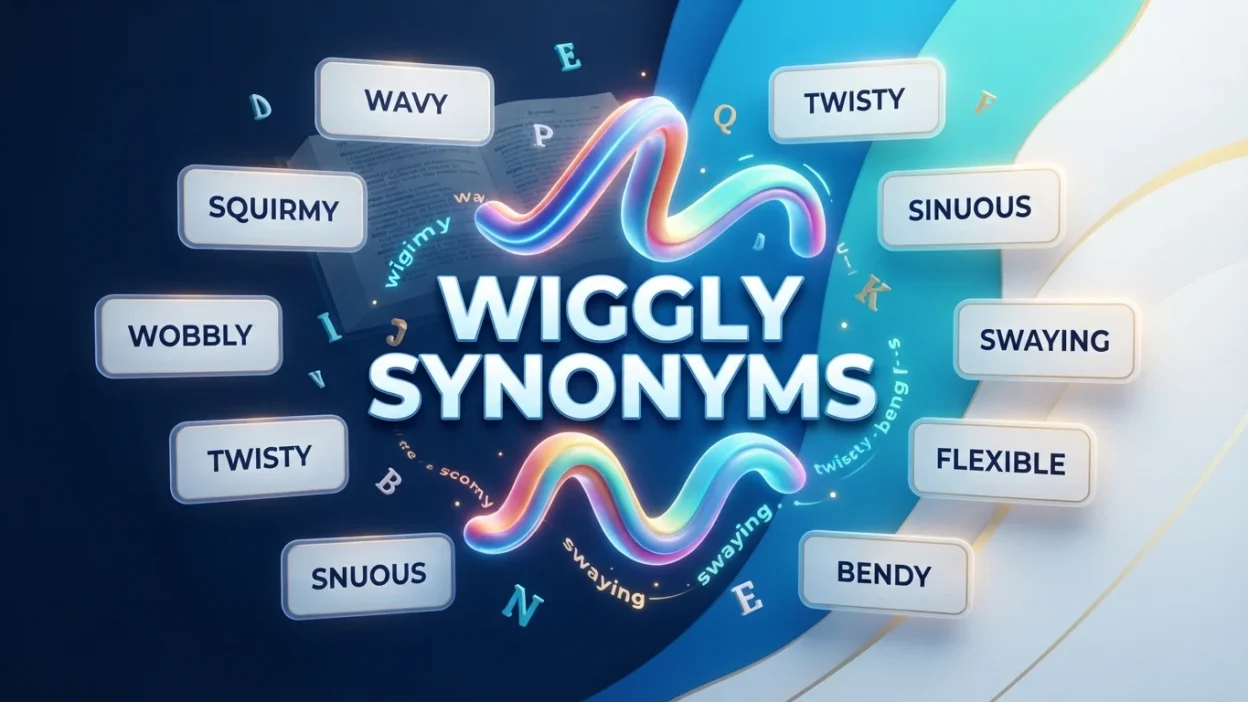
Have you ever needed a better word than “wiggly” to describe something that moves from side to side, bends irregularly, or refuses to stay still? if you are writing a story, learning English, describing an object, or creating engaging content, knowing the right wiggly synonyms can make your language much more precise.
The word wiggly usually describes something that moves with small, repeated, twisting, bending, or side-to-side motions. It can describe a child’s excited body, a puppy’s tail, a worm, a loose line, or even a decorative shape. The best synonym depends on exactly what kind of movement you want to express.
Note: Your prompt asks for the meaning and 30 synonyms of “demure,” but the target keyword is “wiggly synonyms.” To keep the article accurate, useful, and SEO-focused, the explanations below focus on wiggly and its related vocabulary rather than demure.
What Does “Wiggly” Mean?
Wiggly is an adjective used for something that moves, bends, or changes direction in a lively, irregular, or repeated way.
In simple English, if something is wiggly, it does not remain completely still or straight. It may twist, shake, bend, or move from one side to another.
Examples of “Wiggly”
- The puppy has a wiggly tail.
- The excited child was wiggly in his chair.
- Draw a wiggly line across the page.
- The little worm was wiggling through the soil.
The tone of wiggly is usually informal, playful, and friendly. It is especially common when describing children, animals, body movements, flexible objects, and playful designs.
30 Wiggly Synonyms and Related Words
Below are 30 useful alternatives to wiggly, with simple meanings, examples, and guidance about when each word works best.
| # | Word | Simple Meaning | Example Sentence | Best Usage Context |
|---|---|---|---|---|
| 1 | Wiggling | Moving from side to side in small movements | The puppy was wiggling with excitement. | Animals, people, body movement |
| 2 | Squirmy | Moving around because you cannot stay still | The squirmy child kept changing seats. | Children, discomfort, restlessness |
| 3 | Squirming | Twisting or moving the body around | The baby was squirming in her mother’s arms. | Body movement |
| 4 | Twisty | Having many twists or turns | The road was narrow and twisty. | Roads, shapes, objects |
| 5 | Twisting | Turning or bending around itself | The twisting vine climbed the wall. | Plants, shapes, movement |
| 6 | Wavy | Moving in smooth curves or waves | She drew a wavy line on the paper. | Lines, hair, water, shapes |
| 7 | Sinuous | Curving and bending in a smooth way | The river followed a sinuous path. | Formal writing, nature, movement |
| 8 | Undulating | Moving gently up and down like waves | The grass was undulating in the wind. | Water, landscapes, fabric |
| 9 | Serpentine | Curving and winding like a snake | A serpentine path led through the forest. | Roads, paths, elegant movement |
| 10 | Wobbling | Moving unsteadily from side to side | The table was wobbling on the uneven floor. | Objects, balance, movement |
| 11 | Wobbly | Unsteady and likely to move from side to side | He stood on a wobbly chair. | Objects, balance, physical stability |
| 12 | Shaky | Moving or trembling because of instability | Her handwriting looked shaky. | Hands, voices, objects |
| 13 | Jiggly | Moving with small, quick, loose movements | The jelly had a jiggly texture. | Soft objects, food, playful descriptions |
| 14 | Jiggling | Moving quickly with small repeated motions | The keys were jiggling in his pocket. | Small objects and movement |
| 15 | Shaking | Moving rapidly back and forth | The leaves were shaking in the wind. | Objects, people, nature |
| 16 | Trembling | Shaking slightly and repeatedly | His hands were trembling with excitement. | People, emotions, delicate movement |
| 17 | Fidgety | Unable to stay still | The fidgety student tapped his foot. | People, especially children |
| 18 | Restless | Unable to remain calm or still | The restless child walked around the room. | People, behavior, emotions |
| 19 | Lively | Full of energy and movement | The lively puppy ran around the garden. | Positive descriptions |
| 20 | Animated | Showing lots of movement or energy | She gave an animated explanation. | People, gestures, speech |
| 21 | Floppy | Loose and lacking stiffness | The puppy had floppy ears. | Ears, fabric, soft objects |
| 22 | Flexible | Able to bend without breaking | The flexible wire was easy to shape. | Materials, objects, body movement |
| 23 | Bendy | Able to bend easily | This bendy straw is perfect for children. | Informal descriptions of objects |
| 24 | Curly | Forming curves or loops | He has curly hair. | Hair, shapes, lines |
| 25 | Winding | Following a curved or indirect path | We followed a winding road uphill. | Roads, paths, rivers |
| 26 | Meandering | Moving along a slow, winding path | The stream was meandering through the valley. | Rivers, paths, writing |
| 27 | Writhing | Twisting and turning, often strongly | The snake was writhing in the grass. | Snakes, intense movement |
| 28 | Flailing | Moving arms or legs wildly and without control | The swimmer was flailing in the water. | Uncontrolled movement |
| 29 | Swaying | Moving gently from one side to another | The trees were swaying in the breeze. | Trees, people, gentle movement |
| 30 | Oscillating | Moving repeatedly between two positions | The fan was oscillating from side to side. | Technical or scientific writing |
Wiggly vs. Similar Words: What’s the Difference?
Not every word in this list means exactly the same thing as wiggly. Some emphasize direction, speed, flexibility, instability, or emotional energy.
Wiggly vs. Wavy
Wiggly suggests irregular or playful movement.
Wavy usually describes smooth curves or wave-like shapes.
- Wiggly: The puppy’s tail was wiggly.
- Wavy: She has long, wavy hair.
Wiggly vs. Wobbly
Wiggly often sounds playful and active.
Wobbly suggests instability or poor balance.
- The baby has wiggly toes.
- The old chair is wobbly.
Wiggly vs. Squirmy
Squirmy usually describes someone who keeps moving because they are uncomfortable, impatient, embarrassed, or unable to sit still.
- The child was squirmy during the long lesson.
- The puppy was wiggly when its owner came home.
Wiggly vs. Jiggly
Jiggly often describes something soft that moves with small bouncing motions.
- The pudding is jiggly.
- The worm is wiggly.
Wiggly vs. Sinuous
Sinuous is a more sophisticated and formal word. It describes graceful curves and flowing movement.
- The snake made a sinuous movement.
- The child made a wiggly movement.
Wiggly Synonyms by Meaning and Tone
Choosing the right synonym becomes easier when you think about the type of movement you want to describe.
For Playful Movement
Use these words when something moves in a cute, energetic, or fun way:
- Wiggling
- Wiggly
- Jiggly
- Lively
- Animated
Example:
“The excited puppy had a wiggly tail.”
For Uncontrolled Movement
These words are better when movement is difficult to control:
- Squirmy
- Squirming
- Fidgety
- Flailing
- Shaky
Example:
“The nervous child was fidgety during the interview.”
For Curved Shapes
Use these alternatives when describing lines, paths, roads, rivers, or physical shapes:
- Wavy
- Curly
- Twisty
- Winding
- Sinuous
- Serpentine
- Meandering
Example:
“The artist drew a wavy line across the page.”
For Gentle Movement
Choose these when movement is soft, slow, or rhythmic:
- Swaying
- Undulating
- Meandering
- Waving
- Sinuous
Example:
“The flowers were swaying in the afternoon breeze.”
For Unsteady Movement
Use these words when something moves because it lacks balance or stability:
- Wobbly
- Wobbling
- Shaky
- Trembling
- Oscillating
Example:
“The toddler took a few wobbly steps.”
How to Choose the Right Wiggly Synonym
The best synonym depends on what is moving, how it moves, and the tone of your sentence.
1. For Children
Use squirmy, fidgety, restless, or wiggly.
The squirmy toddler would not sit still.
2. For Animals
Use wiggly, wiggling, lively, or sinuous, depending on the animal and movement.
The puppy gave me a wiggly welcome.
3. For Lines and Shapes
Use wavy, twisty, curly, or winding.
Draw a wiggly line beneath the heading.
4. For Roads and Paths
Use winding, twisty, serpentine, or meandering.
We drove along a winding mountain road.
5. For Soft Objects
Use jiggly, floppy, bendy, or flexible.
The jelly was soft and jiggly.
6. For Technical Writing
Use oscillating, undulating, or flexible when they accurately describe the movement.
The machine uses an oscillating mechanism.
Positive and Negative Alternatives to “Wiggly”
The word wiggly is generally playful and neutral, but some alternatives carry stronger feelings.
Positive or Playful
- Wiggly
- Lively
- Animated
- Jiggly
- Sinuous
Neutral
- Wavy
- Winding
- Flexible
- Curved
- Swaying
Potentially Negative
- Squirmy
- Restless
- Fidgety
- Shaky
- Flailing
For example, calling a puppy wiggly sounds affectionate. Calling a student restless may suggest that their behavior is distracting.
Wiggly Synonyms for Different Types of Writing
In Creative Writing
Creative writers can use vivid words such as sinuous, serpentine, writhing, winding, and undulating.
The serpentine river disappeared behind the trees.
These words help readers visualize movement more clearly.
In Academic Writing
More precise terms such as oscillating, undulating, flexible, or wobbling may be more appropriate.
The oscillating component moved between two fixed points.
In Everyday English
Simple words are usually best:
- Wiggly
- Wobbly
- Wavy
- Shaky
- Squirmy
- Jiggly
These are easy for everyday conversations and ESL learners.
In Children’s Writing
Playful words work particularly well:
- Wiggly
- Jiggly
- Bendy
- Wobbly
- Floppy
- Squirmy
The little worm had a long, wiggly body.
Why Use Wiggly Synonyms?
Using synonyms does more than prevent repetition. It allows you to describe movement more accurately.
Compare these two sentences:
The snake was wiggly.
The snake made a sinuous movement through the grass.
Both sentences are understandable, but the second creates a more specific visual impression.
Similarly:
The chair was wiggly.
could be improved to:
The chair was wobbly.
The second sentence tells the reader that the chair is unstable rather than simply moving around.
Quick Synonym Guide
| If You Mean… | Best Word |
|---|---|
| Playful movement | Wiggly |
| Unable to sit still | Fidgety |
| Uncomfortable movement | Squirmy |
| Smooth curves | Wavy |
| Unstable movement | Wobbly |
| Soft bouncing movement | Jiggly |
| Gentle side-to-side motion | Swaying |
| Snake-like movement | Sinuous |
| Strong twisting | Writhing |
| Wild uncontrolled movement | Flailing |
| Curved road | Winding |
| Winding natural path | Meandering |
| Wave-like motion | Undulating |
| Repeated back-and-forth motion | Oscillating |
| Easy to bend | Flexible |
Frequently Asked Questions About Wiggly Synonyms
What is a simple synonym for wiggly?
Some simple synonyms include wavy, squirmy, wobbly, jiggly, twisty, and wiggling. The best choice depends on the type of movement.
What is another word for wiggly?
Another word for wiggly can be wavy, squirmy, jiggly, twisty, wobbly, bendy, or swaying.
What is the opposite of wiggly?
Depending on the context, opposites of wiggly include straight, still, rigid, stable, motionless, and steady.
Is “wiggly” a formal word?
Wiggly is an informal and friendly word. It is common in everyday English, children’s writing, casual descriptions, and conversations.
What is a more sophisticated word for wiggly?
Depending on the meaning, sinuous, undulating, serpentine, oscillating, or meandering can provide a more sophisticated alternative.
What is a synonym for a wiggly line?
Common choices include wavy line, curved line, twisty line, or irregular line. “Wavy line” is usually the most natural choice.
Final Thoughts on Wiggly Synonyms
Understanding wiggly synonyms helps you describe movement with greater accuracy and variety. While wiggly is a playful and flexible everyday word, alternatives such as wavy, squirmy, wobbly, jiggly, sinuous, winding, undulating, and oscillating communicate more specific types of motion.
The key is to consider the movement before choosing a synonym. If something is playful, wiggly may be perfect. If it is unstable, choose wobbly. If it follows smooth curves, sinuous may work better. If it moves gently from side to side, swaying is often more precise.
For students, ESL learners, writers, and content creators, learning these distinctions can make vocabulary richer, clearer, and more natural.

Daniel Jack is a language enthusiast and content writer who specializes in synonyms, vocabulary, and word meanings. He creates clear, engaging resources that help readers improve communication and expand their English skills.