Have you ever wondered if to write “whack” or “wack”? These two words look and sound similar, so it is easy to confuse them. However, they have different uses in modern English. Understanding the difference will help you choose the correct spelling in everyday conversations, school assignments, and informal writing.
The word whack is the standard spelling when you mean to hit something, strike someone, or describe a single blow. It can also refer informally to a large amount, as in “a whack of money,” in some varieties of English. The spelling wack, on the other hand, is informal slang that usually means bad, strange, uncool, or disappointing. You may encounter it in social media posts, music, online chats, and casual conversations. Although both spellings are used in English, they are not interchangeable in every situation. Learning their meanings and seeing them in context will make it easier to use each word naturally and confidently.
Quick Answer: Whack or Wack?
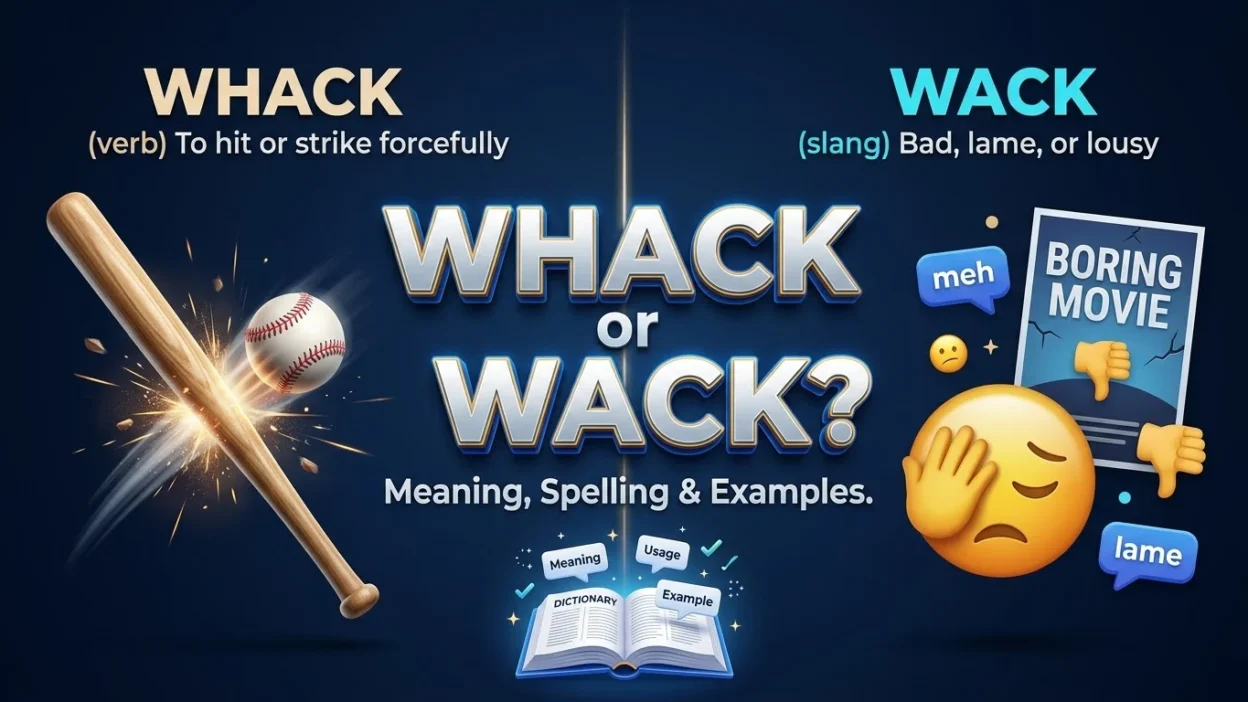
Whack is the standard English spelling for hitting or striking something, as in “Give the ball a whack.” Wack is an informal slang word meaning bad, uncool, strange, or disappointing, as in “That movie was wack.” Use whack in standard writing and wack when the slang meaning fits the context.
Why Do People Confuse Whack and Wack?
People often confuse these words because they are pronounced the same way in many English accents. Both can sound like “wak,” making the difference difficult to hear.
Their meanings also overlap in informal expressions and popular culture. The word whack has several uses, while wack is commonly associated with slang.
Here are the main reasons for the confusion:
- Similar pronunciation: Both words usually sound alike.
- Different contexts: One is a standard word, while the other is mainly slang.
- Online communication: Informal spelling is common in text messages and social media.
- Music and pop culture: The spelling wack appears in hip-hop, entertainment, and casual speech.
The easiest way to remember the difference is to focus on what you want to say.
1. Whack: Meaning, Definition, and Examples
Whack is the standard English spelling of a word that commonly means to hit or strike something with force. It can function as both a verb and a noun.
Whack as a Verb
As a verb, whack means to hit or strike something, often with a quick or forceful movement.
Examples:
- He whacked the ball across the field.
- She accidentally whacked her elbow against the table.
- The player whacked the ball with a racket.
- The farmer whacked the weeds with a tool.
Whack as a Noun
As a noun, whack can mean a hit, strike, or blow.
Examples:
- He gave the drum a whack.
- The branch fell after one hard whack.
- She heard a loud whack against the door.
Other Uses of Whack
In informal English, whack can also appear in expressions such as:
- A fair whack: A reasonable or substantial amount, especially in British English.
- Out of whack: Not working correctly or not in the right balance.
- Have a whack at something: Try doing something, especially in British and other varieties of English.
Examples:
- The schedule is completely out of whack.
- Everyone deserves a fair whack of the available resources.
- I’ll have a whack at solving the puzzle.
2. Wack: Meaning, Definition, and Examples
Wack is an informal slang word that usually means bad, uncool, poor-quality, strange, or disappointing.
It is especially common in casual conversations, online discussions, and some music and youth-culture contexts. It is not the standard spelling for the action of hitting something.
Wack as Slang
People use wack to express a negative opinion about something.
Examples:
- That movie was wack.
- His excuse sounds wack.
- The concert was wack because the sound system kept failing.
- That rule is wack and unfair.
Is Wack a Real Word?
Yes. Wack is an established informal slang word, although it is less suitable for formal or academic writing.
It can be useful when you want to sound casual or express a strong opinion. In formal writing, words such as poor, unreasonable, unimpressive, or unsatisfactory may be more appropriate.
For example:
- Informal: “That new app is wack.”
- Formal: “That new app is disappointing.”
What Does Wack Mean on Social Media?
On social media, wack usually means that something is bad, boring, unfair, disappointing, or not impressive.
For example:
- “This update is wack.”
- “That outfit is wack.”
- “The way they treated him was wack.”
The precise meaning depends on the context. It can express criticism, disapproval, or playful teasing.
Whack vs Wack: Comparison Table
| Feature | Whack | Wack |
|---|---|---|
| Main meaning | To hit or strike; a hit | Bad, uncool, or disappointing |
| Word type | Verb or noun; also used in expressions | Informal slang, usually an adjective |
| Standard spelling | Yes, for the hitting meaning | No, for the hitting meaning |
| Formal writing | Generally acceptable | Usually avoid |
| Informal conversations | Common | Common in slang contexts |
| Example | “He gave the ball a whack.” | “That game is wack.” |
| Related expression | Out of whack | Wack music or a wack idea |
When Should You Use Whack or Wack?
Choose the spelling based on the meaning you intend to communicate.
Use Whack When You Mean Hit or Strike
Use whack when describing a physical action or the sound or result of a hit.
Examples:
- She gave the ball a whack.
- He whacked the box with his hand.
- The machine is out of whack.
It is also the appropriate spelling in expressions such as “a fair whack” and “have a whack at it.”
Use Wack When You Mean Bad or Uncool
Use wack when speaking informally about something you consider poor, strange, unfair, or disappointing.
Examples:
- That song is wack.
- His behavior was wack.
- The new policy seems wack.
Remember that slang can sound too casual or judgmental in professional settings. Choose a more precise alternative when writing an academic paper, business report, or formal email.
12 Examples of Whack and Wack in Sentences
The following examples show how the two words work in everyday English.
- Whack: He gave the tennis ball a powerful whack.
- Whack: I accidentally whacked my knee against the desk.
- Whack: The carpenter gave the wooden peg another whack.
- Whack: My sleep schedule has been out of whack lately.
- Whack: I’ll have a whack at the crossword puzzle.
- Whack: The player whacked the ball toward the goal.
- Wack: That movie was wack, so we left early.
- Wack: I think that excuse is wack.
- Wack: The new game update is wack.
- Wack: His unfair decision was totally wack.
- Wack: She said the song was wack, but her friend loved it.
- Wack: Paying that much for a broken product is wack.
Notice that whack describes a hit or appears in a related expression, while wack communicates a negative judgment.
Common Mistakes to Avoid
Even fluent English speakers sometimes confuse these spellings in casual writing.
Mistake 1: Using Wack for a Physical Hit
Incorrect: He gave the door a wack.
Correct: He gave the door a whack.
Use whack when referring to a strike or blow.
Mistake 2: Using Whack When You Mean Uncool
Less suitable for the intended slang meaning: That song is whack.
More conventional slang spelling: That song is wack.
Although informal spelling varies, wack is the usual choice when you specifically mean bad or uncool.
Mistake 3: Using Wack in Formal Writing
Informal: The company’s new policy is wack.
Formal: The company’s new policy is unreasonable.
Choose vocabulary that suits your audience and purpose.
Mistake 4: Assuming the Words Are Always Interchangeable
The words may sound alike, but their meanings are different. Always consider the sentence before choosing a spelling.
Memory Trick: How to Remember Whack vs Wack
Use this simple memory trick:
- WHACK = HIT: Think of a bat hitting a ball with a loud whack.
- WACK = BAD: Think of someone calling a disappointing movie “wack.”
Remember the phrase: “Whack it, but call it wack.”
The first word describes hitting something; the second expresses a negative opinion.
American vs British English
The distinction between whack and wack is not simply a difference between American and British spelling.
In both American and British English, whack is the standard spelling for hitting or striking something. The slang spelling wack is also understood in informal English, although familiarity and frequency can vary by community and context.
British English has some additional expressions involving whack, including “a fair whack,” meaning a substantial or reasonable amount, and “have a whack at it,” meaning to try something.
American English speakers also use expressions such as “out of whack” to describe something that is not functioning or balanced properly.
The main rule remains the same across both varieties: use whack for a hit and wack for the informal slang meaning bad or uncool.
Similar Words to Whack and Wack
Several words can replace whack or wack, depending on the meaning.
| Word | Meaning | Example |
|---|---|---|
| Hit | To make contact with force | He hit the ball. |
| Strike | To hit something | She struck the target. |
| Smack | To hit sharply | He smacked the table. |
| Blow | A physical hit | The blow damaged the object. |
| Uncool | Not fashionable or socially appealing | That comment was uncool. |
| corny | Unimpressive or disappointing | That excuse was lame. |
| Awful | Very bad | The service was awful. |
| Ridiculous | Absurd or unreasonable | That rule is ridiculous. |
| Cringeworthy | Embarrassing or awkward | His comment was cringeworthy. |
| Substandard | Below an expected level | The product was substandard. |
These alternatives are not perfect replacements in every situation. For instance, strike may sound more formal than whack, while corny and uncool have their own informal tones.
Frequently Asked Questions
1. Is whack or wack the correct spelling?
Both spellings exist, but they have different uses. Whack is the standard spelling for a hit or the act of hitting. Wack is informal slang meaning bad, uncool, or disappointing.
2. Does wack mean bad?
Yes. In slang, wack commonly means bad, boring, strange, unfair, or disappointing. For example, “That movie was wack” means the speaker thought the movie was poor or unimpressive.
3. Is whack a real English word?
Yes. Whack is a standard English word that can function as a verb or noun. It means to hit or strike something, or the hit itself. It also appears in expressions such as “out of whack.”
4. Is wack slang?
Yes. Wack is informal slang commonly used to criticize something as bad, uncool, or disappointing. It is more appropriate in casual conversations and online posts than in formal writing.
5. Is it “out of whack” or “out of wack”?
The standard expression is “out of whack.” It means that something is not working properly, is unbalanced, or is not in its usual condition.
Example: “My daily routine has been out of whack since I started working nights.”
6. Can whack mean shocking ?
In some informal contexts, whack or related expressions may be used to suggest that something is strange or unreasonable. However, wack is the more recognizable slang spelling when describing something as bad or uncool. The exact meaning depends on the context.
7. Is wack appropriate for school or professional writing?
Usually, no. Although wack is a real slang word, it is generally too informal for academic assignments and professional documents. Consider alternatives such as poor, unreasonable, unimpressive, or unsatisfactory.
Remember This
- Whack: The standard spelling for a hit, a strike, or the action of hitting.
- Wack: Informal slang meaning bad, uncool, or disappointing.
- Out of whack: An established expression meaning out of balance or not functioning properly.
- Formal writing: Prefer standard vocabulary over slang when clarity and professionalism matter.
Conclusion
The difference between whack and wack is mainly a matter of meaning and context. Use whack when talking about hitting something, describing a blow, or using established expressions such as “out of whack.” Choose wack when you want to express an informal opinion that something is bad, uncool, or disappointing.
Once you connect whack with hitting and wack with slang criticism, choosing the correct word becomes much easier. Pay attention to your audience, the tone of your writing, and the meaning of the sentence. With these simple rules, you can use both words confidently in everyday English.

David Henry is a language enthusiast and content writer specializing in synonyms, vocabulary, and word meanings. He creates clear, engaging resources that help readers improve their writing, communication, and English skills.