Adsorb and absorb are two words that look almost identical. They sound almost identical. And that is exactly why so many people mix them up. But they describe completely different processes, and using the wrong one can change the meaning of a sentence entirely.
Whether you are a student preparing for a science exam, an ESL learner building vocabulary, or just someone who wants to write more precisely, this guide will help you understand the difference in plain, simple English. You will learn what each word means, when to use each one, and how to remember the difference for good.
Quick Answer
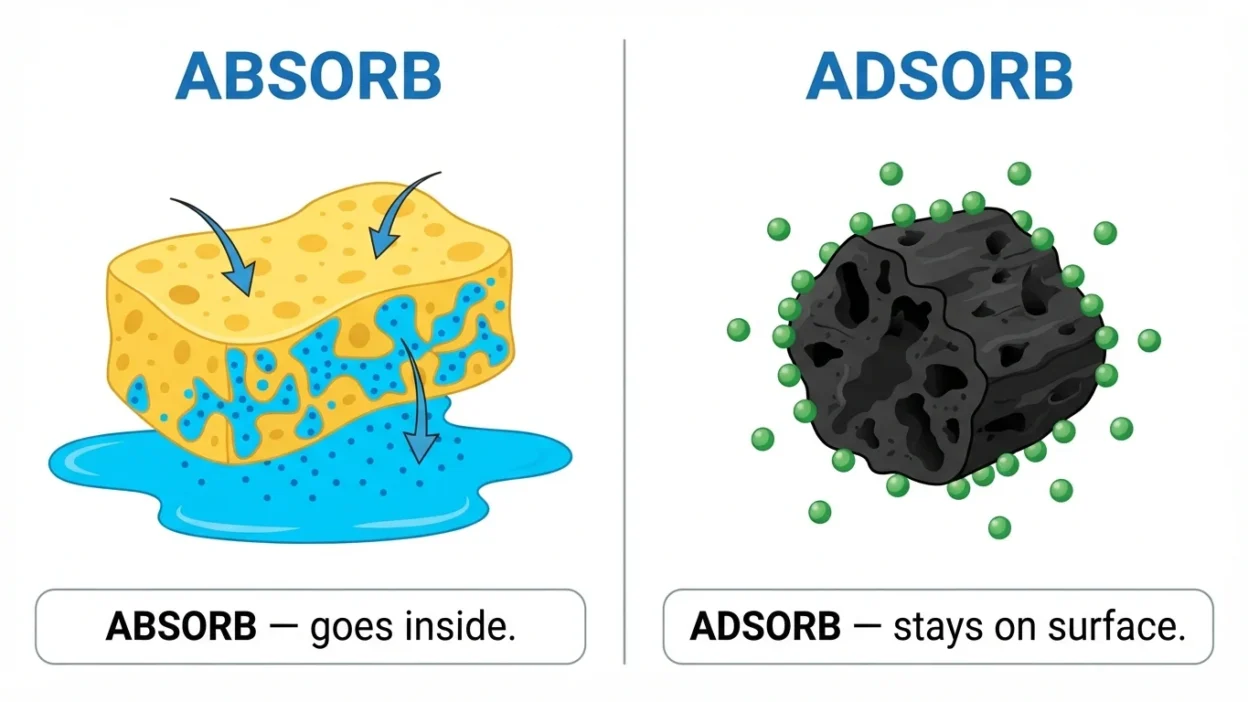
Absorb means to take a substance into the bulk or volume of a material, like a sponge soaking up water. Adsorb means to collect a substance only on the surface of a material, like dust sticking to a window. Absorb goes inside; adsorb stays on the outside.
Why People Confuse Adsorb and Absorb
The confusion between these two words is completely understandable. They differ by just one letter, and they both describe substances being taken up by other substances. For most everyday situations, the word “absorb” is the only one you need. You absorb knowledge. A paper towel absorbs spilled milk. A plant absorbs water through its roots.
The word “adsorb” belongs to a more specialized world. It appears mostly in chemistry, materials science, and engineering. That means most people never encounter it in daily life. When they do see it, they may assume it is a typo or just a fancy version of absorb. Even some technical writers confuse the two, which adds to the problem .
The key is understanding that the difference is not about spelling preference. It is about location: inside versus surface.
What Does Adsorb Mean?
To adsorb means to gather a substance on a surface in a condensed layer. The substance being collected is called the adsorbate, and the material it sticks to is called the adsorbent . This is a surface phenomenon. The molecules do not penetrate into the material. They simply adhere to its outer layer, often forming a film that is only one molecule thick .
Think of it this way: when something adsorbs, it is like guests standing on your front porch. They are at your house, but they have not come inside.
Adsorption happens because of surface energy. Atoms on the surface of a solid are not surrounded by other atoms on all sides, so they have unused bonding capacity. They attract other particles to fill that gap . This is why activated charcoal can adsorb gases, and why silica gel packets can adsorb moisture from the air.
What Does Absorb Mean?
To absorb means to take a substance into the volume or bulk of a material. The substance being taken in is distributed throughout the material, not just on its surface . This is a bulk phenomenon. When something absorbs, it soaks in, assimilates, or incorporates the other substance completely.
Think of it this way: when something absorbs, it is like guests coming inside your house, sitting on your couch, and becoming part of the household.
Absorb has a much wider range of everyday meanings. You can absorb information, absorb a cost, absorb a shock, or be absorbed in a good book . In science, the most common example is a sponge absorbing water. The water does not stay on the surface of the sponge. It fills the internal spaces throughout the material.
Comparison Table
| Feature | Absorb | Adsorb |
|---|---|---|
| Meaning | To take in throughout the volume | To collect on the surface |
| Location | Inside the material (bulk) | On the surface only |
| Process type | Bulk phenomenon | Surface phenomenon |
| Everyday use | Very common | Rare outside science |
| Example | Sponge soaking up water | Charcoal filtering gases |
| What happens | Substance penetrates and spreads | Substance sticks to the outside |
When Should You Use Each Word?
Use Absorb When:
- You are talking about liquids soaking into materials
- You mean taking in knowledge, information, or experiences
- You describe taking in energy, light, heat, or sound
- You mean dealing with costs or impacts without passing them on
- You describe someone being deeply focused on something
Use Adsorb When:
- You are writing about chemistry or materials science
- You describe gases or liquids sticking to a solid surface
- You talk about filtration, purification, or catalysis
- You explain how activated charcoal or silica gel works
- You discuss surface science or nanotechnology
10+ Examples to Make It Clear
Absorb in everyday sentences:
- The paper towel absorbed the spilled coffee quickly.
- Plant roots absorb water and nutrients from the soil .
- It took her a while to absorb all the new information.
- Dark colors absorb more heat from the sun than light colors.
- The company absorbed the extra shipping costs instead of raising prices.
- He was completely absorbed in his book and did not hear the doorbell.
Adsorb in scientific contexts:
- Activated charcoal adsorbs impurities from water, which is why it is used in filters.
- The gas molecules adsorbed onto the surface of the metal catalyst .
- Silica gel packets adsorb moisture to keep products dry during shipping.
- The researchers found that bacteria could adsorb to the mineral surface .
- Hydrogen gas can adsorb onto nickel at certain temperatures and pressures .
- In gas masks, harmful chemicals are adsorbed by the filter material before they reach the wearer.
Common Mistakes to Avoid
Mistake 1: Using “adsorb” when you mean “absorb.”
This is the most common error. If you are talking about a sponge, a towel, or learning something new, the word you want is absorb. Adsorb is only for surface-level attachment in scientific contexts.
Mistake 2: Assuming “adsorb” is just a typo.
If you see “adsorb” in a scientific text, it is not a mistake. It is a deliberate, precise word choice. The writer means something different from absorb.
Mistake 3: Forgetting that both words exist in the same context.
In some situations, both processes can happen at the same time. A material might adsorb a substance on its surface first, and then that substance might absorb into the interior. Scientists use the general term sorption to cover both possibilities when the distinction is not important or is unclear .
Mistake 4: Misspelling the nouns.
The noun for absorb is absorption. The noun for adsorb is adsorption. Notice the “p” in absorption and the “p” in adsorption. This can help you keep them straight.
A Simple Memory Trick
Here is an easy way to remember the difference:
- A-B-sorb = Bulk (inside the material)
- A-D-sorb = Deposit (on the surface)
Another trick: think of the letter “D” in adsorb. The “D” stands for “deposit on top.” When something adsorbs, it deposits itself on the surface and stays there.
American vs British English
Both “adsorb” and “absorb” are spelled the same way in American and British English. There is no difference in spelling or usage between the two variants. The nouns “absorption” and “adsorption” are also spelled identically in both forms of English.
The pronunciation is also the same across regions. “Absorb” is typically pronounced with a “z” sound in the middle: /əbˈzɔːrb/. “Adsorb” is pronounced with an “s” sound: /ædˈsɔːrb/ or /ædˈzɔːrb/. The difference in the first syllable is subtle, which is one more reason the words are so often confused.
Similar Words That Are Easy to Mix Up
Sorption is the general term that covers both absorption and adsorption. When scientists are not sure which process is happening, or when both are happening, they use “sorption” .
Desorption is the opposite of adsorption. It means a substance is being released from a surface where it was previously stuck .
Permeation means a substance passing through a material. This is related to absorption but has a slightly different meaning. Absorption means the substance is taken into the material; permeation means it passes all the way through.
Assimilation is similar to absorption in a biological sense. When your body absorbs nutrients and uses them, that is assimilation.
Final Verdict
The difference between adsorb and absorb comes down to one simple idea: location.
If a substance goes inside another substance, it is absorbed. This is the word you will use almost all the time in everyday English. It covers everything from sponges to learning to energy.
If a substance sticks to the surface of another substance without going inside, it is adsorbed. This word is rare in daily conversation but essential in chemistry, engineering, and materials science.
For students and ESL learners, the safest approach is this: use absorb for general situations. Recognize adsorb when you see it in science texts, and remember that it means surface-level attachment. That simple distinction will keep your writing accurate and clear.
Frequently Asked Questions
What is the main difference between adsorb and absorb?
Absorb means a substance is taken into the volume of a material. Adsorb means a substance collects only on the surface of a material. Absorb goes inside; adsorb stays outside.
Can you use adsorb and absorb interchangeably?
No. They describe different physical processes. Using them interchangeably can make your writing inaccurate, especially in scientific or technical contexts.
Is “adsorb” a real word or just a misspelling of “absorb”?
Adsorb is a real word with a specific scientific meaning. It was first used in the late 1800s and is standard terminology in chemistry and materials science .
What is an example of adsorption in everyday life?
Activated charcoal filters use adsorption to remove impurities from water and air. The impurities stick to the surface of the charcoal rather than being absorbed into it.
What is the noun form of adsorb?
The noun is adsorption. The substance that sticks to the surface is the adsorbate, and the material it sticks to is the adsorbent .
Is absorption always a physical process?
No. Absorption can be physical or chemical. In physical absorption, the absorbed substance stays intact. In chemical absorption, a chemical reaction may occur .
Why do scientists use the word “sorption”?
Sorption is a general term that covers both absorption and adsorption. Scientists use it when they cannot easily tell which process is happening or when both occur together .
How can I remember which word to use?
Remember: A-B-sorb = Bulk (inside). A-D-sorb = Deposit (on the surface). The “D” in adsorb stands for “deposit on top.”
Remember This
Absorb means to soak in. Adsorb means to stick on. One letter changes the meaning from inside to outside. Use absorb for almost everything in daily life. Recognize adsorb as the scientific word for surface attachment.
Conclusion
The English language is full of words that look and sound similar but mean very different things. Adsorb and absorb are a perfect example. They differ by a single letter, yet they describe opposite locations: inside versus surface. For most conversations and writing, absorb is the word you need. It covers soaking, learning, taking in, and dealing with challenges.
Adsorb, on the other hand, is a specialized term that belongs to the world of chemistry and surface science. It describes how gases and liquids stick to solid surfaces, a process that makes air filters, water purifiers, and many industrial applications possible. Understanding the difference will make you a more precise reader and writer, especially when you encounter scientific texts.

David Henry is a language enthusiast and content writer specializing in synonyms, vocabulary, and word meanings. He creates clear, engaging resources that help readers improve their writing, communication, and English skills.