
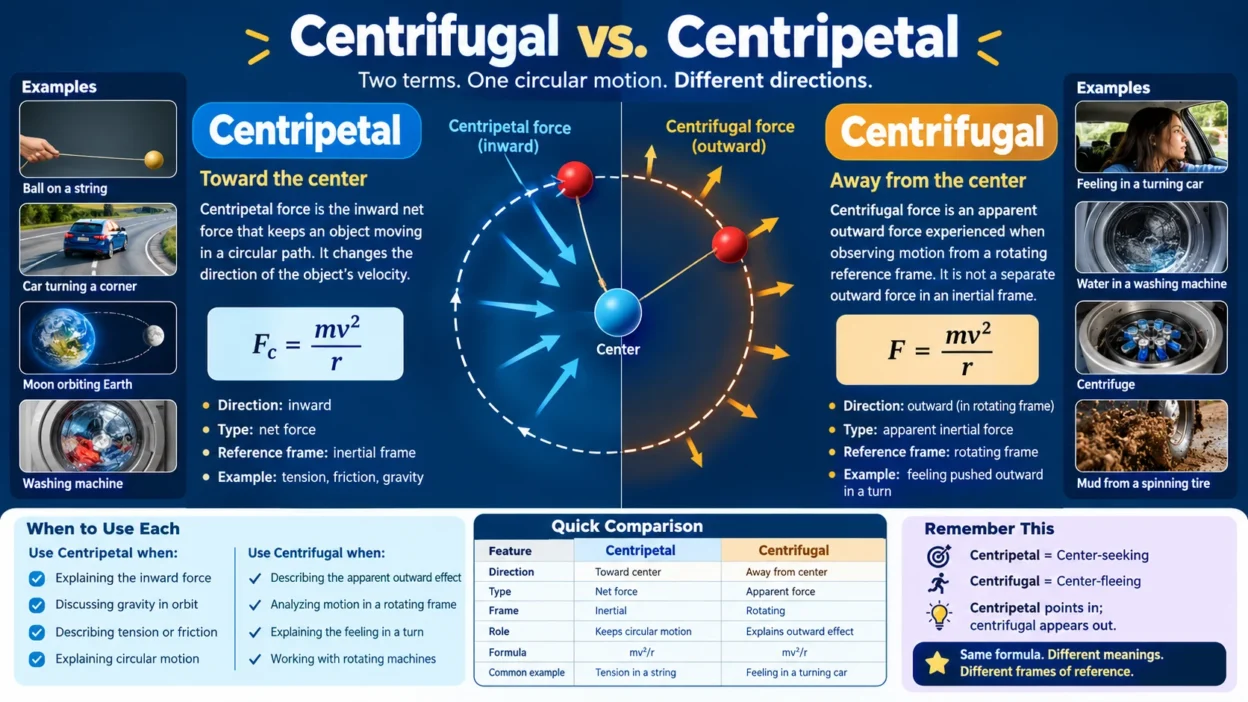
The terms centrifugal and centripetal are often confused because both describe ideas related to circular motion. However, they have different meanings in physics. Understanding the difference helps you explain how objects move in circles, why a car turns on a road, and how a washing machine spins water out of clothes.
Centripetal force is the inward net force that keeps an object moving along a circular path. Centrifugal force, on the other hand, is the apparent outward force experienced when observing motion from a rotating reference frame. These concepts are closely connected, but they are not interchangeable. Learning how each term works makes circular motion much easier to understand, whether you are studying physics, preparing for an exam, or simply exploring everyday science.
Quick Answer: Centrifugal vs. Centripetal
Centripetal means directed toward the center of a circular path, while centrifugal means directed away from the center in a rotating reference frame. Centripetal force is the inward net force required for circular motion. Centrifugal force is an apparent outward force observed from a rotating frame, not a separate outward force in an inertial frame.
Why Do People Confuse Centrifugal and Centripetal?
People often confuse these terms because they describe opposite directions associated with circular motion.
Both words are used when discussing spinning objects, rotating machines, amusement park rides, and vehicles turning around curves. In everyday experience, a person inside a turning car may feel pushed outward, even though the force needed to make the car turn acts inward.
The main difference is the direction and the frame of reference used to describe the motion:
- Centripetal: Toward the center.
- Centrifugal: Away from the center, as described from a rotating frame.
1. What Does Centripetal Mean?
Centripetal describes something directed toward the center of a circular path. In physics, centripetal force is the net inward force that causes an object to follow a circular trajectory.
An object moving in a circle continually changes the direction of its velocity. Even if its speed remains constant, its velocity changes because velocity includes both speed and direction. This change requires an inward acceleration, called centripetal acceleration.
Examples of Centripetal Force
- A string pulls a ball inward as you swing it in a circle.
- Friction helps a car turn around a curved road.
- Gravity keeps the Moon in orbit around Earth.
- The wall of a rotating ride pushes a rider inward.
Centripetal Force Formula
The magnitude of centripetal force is:
\[ F_c=\frac{mv^2}{r} \]
Where:
- \(F_c\) = centripetal net force
- \(m\) = mass of the object
- \(v\) = speed of the object
- \(r\) = radius of the circular path
This formula shows that a heavier or faster-moving object requires a greater inward net force to follow the same circular path. A smaller radius also requires a greater force at the same speed.
2. What Does Centrifugal Mean?
Centrifugal means directed away from the center. In physics, centrifugal force is an apparent force used when describing motion from a rotating reference frame.
For example, when a car turns sharply, a passenger may feel as though they are being pushed toward the outside of the turn. In an inertial reference frame, the passenger’s body tends to continue moving in a straight line because of inertia. The car changes direction beneath them, creating the familiar sensation of being pushed outward.
In the rotating frame of the car, this effect can be described using centrifugal force.
Examples of Centrifugal Effects
- Water moves outward relative to the rotating drum of a washing machine.
- A passenger feels pushed toward the outside of a turn.
- A rotating centrifuge separates materials according to their motion and physical properties.
- Mud can fly outward from a rotating tire.
Strictly speaking, centrifugal force is not a separate outward interaction force in an inertial frame. It is a fictitious or inertial force introduced when analyzing motion from a rotating frame.
Centrifugal vs. Centripetal: Comparison Table
| Feature | Centripetal | Centrifugal |
|---|---|---|
| Basic meaning | Toward the center | Away from the center |
| Direction | Inward | Outward in a rotating frame |
| Physics concept | Net inward force | Apparent inertial force |
| Reference frame | Commonly analyzed in an inertial frame | Rotating reference frame |
| Role | Produces the inward acceleration needed for circular motion | Accounts for the apparent outward effect in a rotating frame |
| Example | Tension pulling a ball inward | Apparent outward force felt by a passenger in a turning car |
| Formula for magnitude | \(mv^2/r\) | \(mv^2/r\) in the corresponding rotating-frame situation |
| Everyday association | Keeping an object moving in a circle | Feeling pushed outward while turning |
Important: The formulas can have equal magnitudes in a suitable steady circular-motion situation, but the forces have different meanings in different reference frames.
When Should You Use Centripetal or Centrifugal?
Choose the word based on the direction and the physical situation you are describing.
Use Centripetal When:
- You are explaining the inward force that maintains circular motion.
- You are describing gravity keeping a satellite in orbit.
- You are discussing tension in a string swinging an object in a circle.
- You are explaining the friction that allows a vehicle to turn.
Example: The tension in the string provides the centripetal force needed to keep the ball moving in a circle.
Use Centrifugal When:
- You are describing the apparent outward force in a rotating reference frame.
- You are discussing how motion is analyzed from inside a rotating system.
- You are explaining the apparent outward effect experienced during a turn.
- You are describing centrifugal force in a rotating-machine calculation.
Example: In the rotating reference frame of the ride, centrifugal force appears to act outward on the passenger.
12 Examples of Centrifugal and Centripetal
These examples show how the two terms are used in science and everyday situations.
1. A ball on a string: The string’s tension provides the centripetal force that keeps the ball moving in a circle.
2. A car turning a corner: Friction between the tires and the road provides the centripetal force needed to change the car’s direction.
3. The Moon orbiting Earth: Earth’s gravity provides the inward force that maintains the Moon’s orbital motion.
4. A passenger in a turning car: The passenger may feel an apparent centrifugal force toward the outside when described from the car’s rotating frame.
5. A washing machine: The rotating drum forces clothes to follow a circular path, while water can pass through the drum’s openings. The process is commonly described as centrifugal spinning.
6. A rotating amusement park ride: The ride’s seat, wall, or restraints provide the inward forces needed to keep riders moving along circular paths.
7. A stone tied to a string: The tension in the string acts toward the center and provides centripetal force.
8. A centrifuge in a laboratory: Centrifugal effects are used to describe the rotating system, helping explain how particles separate according to their properties.
9. A bicycle moving around a bend: Tire-road friction helps supply the centripetal force needed to follow the curve.
10. A rotating space station: Objects moving in a circular path require inward acceleration. An apparent centrifugal effect can be described from the station’s rotating frame.
11. Mud leaving a spinning tire: The mud tends to continue along its instantaneous direction of motion when it loses contact with the tire. Its outward-looking path is not proof of a real outward force in an inertial frame.
12. A satellite orbiting a planet: Gravity provides the inward acceleration required for its orbital path, illustrating centripetal motion.
Common Mistakes to Avoid
1. Treating Both Terms as the Same
Centrifugal and centripetal are not synonyms. One describes an inward direction, while the other describes an apparent outward effect in a rotating frame.
2. Saying Centrifugal Force Always Pushes Objects Outward
Centrifugal force is a frame-dependent apparent force. In an inertial frame, an object moving in a circle needs an inward net force; there is no corresponding outward centrifugal force acting on that object simply because it is moving in a circle.
3. Thinking Centripetal Force Is a Separate Type of Force
Centripetal force is the name for the net inward force required for circular motion. It can be provided by gravity, friction, tension, or a combination of forces.
4. Confusing Speed With Velocity
An object can move at constant speed while its velocity changes. In circular motion, the direction changes continuously, so centripetal acceleration is present even when speed remains constant.
5. Assuming Centrifugal Force Is Always Equal to an Actual Outward Force
In steady circular motion, the apparent centrifugal force in the rotating frame can balance the inward force in that frame. However, the exact force balance depends on the reference frame and the situation being analyzed.
Memory Trick: How to Remember the Difference
Use this simple trick:
- Centripetal = Center-seeking. Think of a force pulling or directing an object toward the center.
- Centrifugal = Center-fleeing. Think of the apparent outward effect seen from a rotating frame.
Another easy reminder is:
Centripetal points in; centrifugal appears out.
Remember that the second phrase describes the apparent force in a rotating reference frame, not an actual outward interaction force in an inertial frame.
American vs. British English
There is no meaningful American-versus-British spelling difference between centripetal and centrifugal.
Both terms are spelled the same way in American English and British English. Their definitions and use in physics are also essentially the same in both varieties.
Examples:
- American English: The centripetal force keeps the car moving around the curve.
- British English: The centripetal force keeps the car moving around the bend.
The vocabulary remains unchanged; only some surrounding words or phrasing may vary.
Similar Words and Related Concepts
Understanding these related terms makes circular motion easier to explain.
- Circular motion: Movement along a circular path.
- Centripetal acceleration: Acceleration directed toward the center of a circular path.
- Inertia: The tendency of an object to maintain its state of motion unless acted on by a net external force.
- Angular velocity: The rate at which an object changes its angular position.
- Tangential velocity: Velocity directed along the tangent to a circular path.
- Radial force: A force directed along the radius of a circular path, either inward or outward.
- Centrifuge: A device that spins samples rapidly to separate components according to their physical properties.
- Coriolis force: Another apparent force used in rotating reference frames, associated with motion relative to the rotating system.
These terms are connected, but each has a distinct meaning.
Final Verdict: Centrifugal or Centripetal?
The difference between centrifugal and centripetal comes down to direction and reference frame.
Centripetal refers to the inward net force needed for circular motion. Centrifugal refers to the apparent outward force used when describing motion from a rotating reference frame.
When explaining why an object follows a circular path, use centripetal force. When explaining why someone feels pushed outward while turning, centrifugal force may be appropriate if you identify the rotating frame of reference.
Frequently Asked Questions
1. What is the main difference between centrifugal and centripetal force?
Centripetal force is the inward net force required for circular motion. Centrifugal force is an apparent outward force introduced when motion is described from a rotating reference frame.
2. Is centrifugal force real or fake?
Centrifugal force is called a fictitious or inertial force because it arises from using a rotating, non-inertial reference frame. It is useful for calculations in that frame, but it is not a separate physical interaction force in an inertial frame.
3. Why do we feel centrifugal force in a turning car?
Your body tends to continue moving in a straight line because of inertia. As the car turns, the car changes direction around you. From inside the rotating car, this relative motion feels like an outward force.
4. Which force keeps planets and satellites in orbit?
Gravity provides the inward force that causes the necessary centripetal acceleration. The term centripetal force describes the role gravity plays in maintaining the orbital path.
5. Are centrifugal and centripetal forces equal?
In a steady circular-motion analysis using a rotating frame, the apparent centrifugal force can balance the inward force. Their magnitudes may be equal in that situation, but they are not a pair of action-reaction forces acting on the same object in an inertial frame.
6. What is the formula for centrifugal and centripetal force?
For an object of mass \(m\), moving at speed \(v\) in a circle of radius \(r\), the magnitude of the required centripetal force is:
\[ F_c=\frac{mv^2}{r} \]
The corresponding centrifugal-force magnitude in a suitable rotating frame is \(mv^2/r\), directed outward.
7. Does a washing machine use centrifugal force?
The term centrifugal force is commonly used to explain the spinning stage of a washing machine. More precisely, the rotating drum constrains the clothes to circular motion, while water can move through openings as the clothes spin. The apparent centrifugal effect is useful when describing the process from the drum’s rotating frame.
Remember This
- Centripetal: Toward the center.
- Centrifugal: Apparently away from the center in a rotating frame.
- Centripetal force: The inward net force required for circular motion.
- Centrifugal force: An apparent inertial force used in a rotating reference frame.
- Easy memory trick: Center-seeking versus center-fleeing.
Conclusion
Centrifugal and centripetal describe two different ways of understanding circular motion. Centripetal force is the inward net force that changes an object’s direction and keeps it moving along a circular path. Centrifugal force is the apparent outward force used when observing the motion from a rotating reference frame.
Once you understand the role of the reference frame, the difference becomes easier to remember. Whether you are studying a spinning ball, a turning car, a satellite, or a washing machine, use centripetal for the required inward force and centrifugal for the apparent outward effect in a rotating frame.

Daniel Jack is a language enthusiast and content writer who specializes in synonyms, vocabulary, and word meanings. He creates clear, engaging resources that help readers improve communication and expand their English skills.