
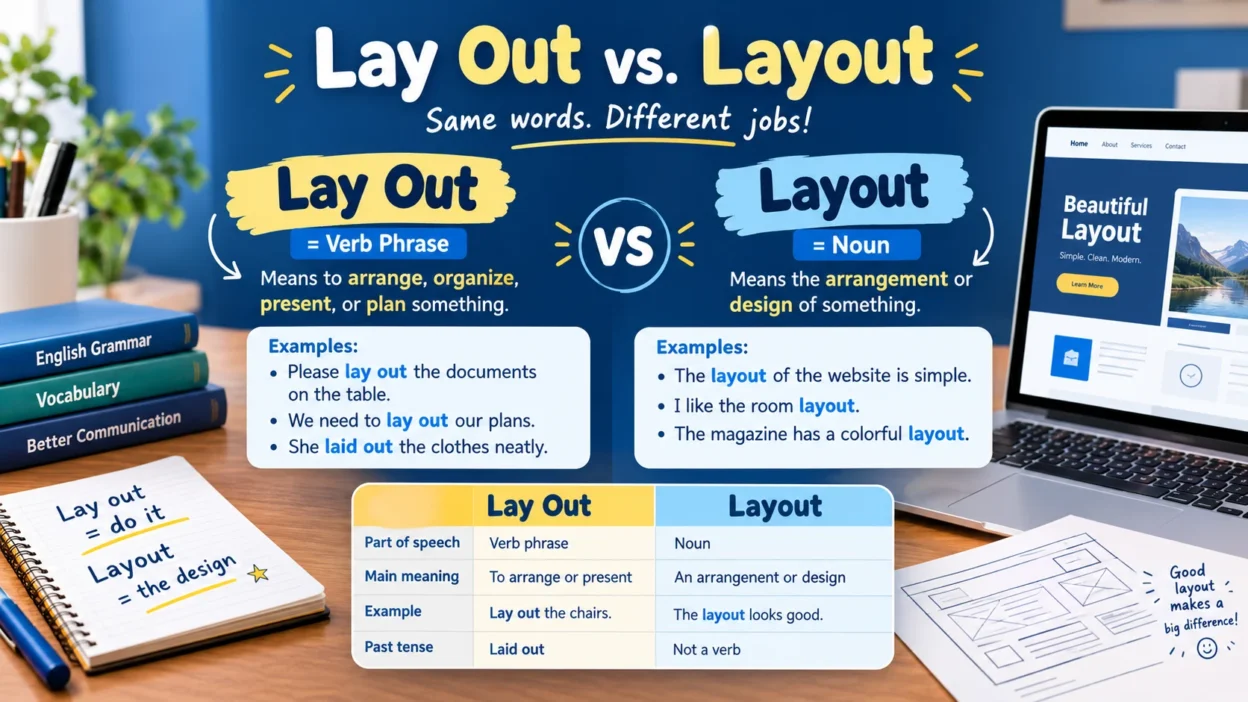
The phrases “lay out” vs. “layout” can be confusing because they contain the same words but have different meanings and grammatical functions. The main difference is that “lay out” is a verb phrase, while “layout” is a noun. Both are correct English, but you must use the right form depending on what you want to say.
For example, “Please lay out the documents on the table” means to arrange the documents. In contrast, “The layout of the documents is easy to follow” refers to their arrangement or design. Understanding this distinction can help you write clearer emails, create better sentences, and avoid common grammar mistakes. These terms are frequently used when discussing page design, websites, presentations, rooms, schedules, and physical objects.
Whether you are a student, an ESL learner, a beginner, or a general reader, learning when to use “lay out” and “layout” will make your English more accurate and natural. Let’s explore their meanings, grammatical roles, examples, and common mistakes.
Quick Answer: Lay Out vs. Layout
“Lay out” is a verb phrase meaning to arrange, organize, present, or explain something. “Layout” is a noun meaning the arrangement or design of something. Use “lay out” when describing an action and “layout” when naming the resulting arrangement or design.
- Correct: Please lay out the books neatly.
- Correct: The layout of the bookshelf looks attractive.
Why Do People Confuse “Lay Out” and “Layout”?
People confuse these terms because they sound alike and share the same basic idea of arrangement. The difference becomes clearer when you look at how each word functions in a sentence.
English often uses two-word verb phrases that have meanings related to nouns. In this case, the verb phrase describes the action of arranging something, while the noun refers to the arrangement itself.
Compare these examples:
- Verb phrase: We need to lay out the website’s content.
- Noun: We need to improve the website’s layout.
The first sentence describes an action. The second identifies something that can be improved.
1. What Does “Lay Out” Mean?
“Lay out” is a phrasal verb that means to arrange, spread, organize, plan, or present something clearly. Its exact meaning depends on the context.
Common meanings of “lay out”
- Arrange objects: Place things in a particular order or position.
- Present information: Explain facts, ideas, or instructions clearly.
- Plan something: Organize the details of a project, event, or strategy.
- Display something: Spread items out so people can see them.
- Spend money: In informal English, “lay out money” means to pay or spend money.
Examples of “lay out” in sentences
- Please lay out the clothes you want to wear tomorrow.
- The teacher will lay out the instructions before the exam.
- We need to lay out our plans for the new project.
- She laid out all the photographs on the floor.
- He had to lay out a lot of money for the repairs.
Notice that “lay out” changes form depending on the tense:
- Present: I lay out the materials every morning.
- Past: I laid out the materials yesterday.
- Present perfect: I have laid out the materials already.
- Future: I will lay out the materials tomorrow.
The past tense is “laid out,” not “layed out.”
2. What Does “Layout” Mean?
“Layout” is a noun that describes the way things are arranged or organized in a space, document, design, or system. It often refers to the placement of elements and how they work together visually or practically.
Common meanings of “layout”
- Page layout: The arrangement of text, images, headings, and margins on a page.
- Website layout: The placement of menus, images, buttons, and other website elements.
- Room layout: The arrangement of furniture and other objects in a room.
- Office layout: The organization of desks, workstations, and shared spaces.
- Plan or arrangement: The overall structure of a building, event, or presentation.
Examples of “layout” in sentences
- The layout of this website is simple and attractive.
- I like the layout of your presentation.
- The room layout makes the space feel larger.
- The magazine has a colorful page layout.
- We changed the office layout to improve teamwork.
“Layout” can also be used as a modifier before another noun, as in “layout design” or “layout software.”
Lay Out vs. Layout: Comparison Table
| Feature | Lay out | Layout |
|---|---|---|
| Part of speech | Phrasal verb | Noun |
| Main meaning | To arrange, organize, or present | An arrangement or design |
| Function | Describes an action | Names a thing or concept |
| Example | Lay out the chairs. | The layout looks good. |
| Past tense | Laid out | No verb tense |
| Common contexts | Planning, arranging, explaining | Websites, rooms, pages, documents |
| Quick test | Can you perform the action? | Can you describe or change the arrangement? |
When Should You Use “Lay Out” or “Layout”?
Choose the correct form by identifying whether your sentence describes an action or refers to an arrangement.
Use “lay out” when describing an action
Use the two-word verb phrase when someone is arranging objects, presenting information, or organizing a plan.
Examples:
- Please lay out the chairs before the guests arrive.
- The manager will lay out the new rules.
- We should lay out our ideas before writing the report.
- She laid out the documents for review.
A useful clue is that “lay out” often takes an object: lay out what? The answer might be documents, plans, clothes, or information.
Use “layout” when referring to an arrangement
Use the one-word noun when talking about the design, structure, or positioning of elements.
Examples:
- The layout of the room is practical.
- The website’s layout needs improvement.
- I prefer the original layout of the document.
- The designer created a new layout for the brochure.
A useful clue is that “layout” can often follow words such as the, a, this, new, or website’s.
12 Examples of “Lay Out” vs. “Layout”
Here are practical examples showing how the two forms work in everyday English.
1. Planning a project
- Verb: We need to lay out our goals.
- Noun: The layout of the project plan is clear.
2. Designing a website
- Verb: The developer will lay out the homepage.
- Noun: The homepage layout is user-friendly.
3. Arranging furniture
- Verb: They will lay out the furniture before moving in.
- Noun: The furniture layout maximizes the available space.
4. Preparing a presentation
- Verb: Please lay out your main points.
- Noun: The presentation layout looks professional.
5. Organizing documents
- Verb: She laid out the papers on the desk.
- Noun: The document layout is easy to read.
6. Creating a magazine
- Verb: The designer will lay out the article.
- Noun: The magazine’s layout includes large photographs.
7. Explaining rules
- Verb: The coach will lay out the rules.
- Noun: The rulebook’s layout makes each section easy to find.
8. Designing a kitchen
- Verb: We should lay out the cabinets carefully.
- Noun: The kitchen layout provides plenty of workspace.
9. Organizing an event
- Verb: The team will lay out the seating plan.
- Noun: The seating layout accommodates all the guests.
10. Planning a schedule
- Verb: Let’s lay out the tasks for next week.
- Noun: The schedule’s layout makes deadlines easy to identify.
11. Arranging a classroom
- Verb: The teacher asked us to lay out the materials.
- Noun: The classroom layout encourages group activities.
12. Spending money
- Verb: He had to lay out $200 for the equipment.
- Noun: The layout of the equipment area is efficient.
These examples demonstrate that both forms can appear in the same topic while serving different grammatical purposes.
Common Mistakes With “Lay Out” and “Layout”
Even fluent English speakers sometimes make mistakes with similar-looking expressions. Here are the main errors to avoid.
Mistake 1: Writing “layout” as a verb
Incorrect: Please layout the documents on the table.
Correct: Please lay out the documents on the table.
Why? The sentence describes an action, so it requires the two-word verb phrase.
Mistake 2: Writing “lay out” as a noun
Incorrect: I like the lay out of this page.
Correct: I like the layout of this page.
Why? The sentence refers to the page’s design, which is a noun.
Mistake 3: Using “layed out”
Incorrect: She layed out the plans yesterday.
Correct: She laid out the plans yesterday.
Why? The past tense of lay is laid, so the phrasal verb becomes “laid out.”
Mistake 4: Confusing the action with its result
Incorrect: The designer will improve how the page layout the images.
Correct: The designer will improve how the page lays out the images.
More naturally: The designer will improve the page’s layout.
Why? The verb form describes what the page does; the noun identifies its arrangement.
Mistake 5: Assuming the terms are interchangeable
Incorrect: The layout the materials carefully.
Correct: Lay out the materials carefully.
Why? A noun cannot replace a verb when the sentence needs an action.
Memory Trick: How to Remember the Difference
Use this simple trick:
- Lay out = do it. You arrange, organize, or present something.
- Layout = the design. You describe the arrangement or structure.
Think of this example:
“First, lay out the furniture. Then check the furniture layout.”
The first phrase tells you what to do. The second tells you what to examine.
If you are unsure, ask yourself: Am I describing an action or naming an arrangement? If it is an action, use “lay out.” If it is an arrangement, use “layout.”
American vs. British English
There is no major spelling difference between American and British English for these terms. Both varieties generally use “lay out” as a verb phrase and “layout” as a noun.
| Context | American English | British English |
|---|---|---|
| Verb | Lay out the pages. | Lay out the pages. |
| Noun | The page layout is clear. | The page layout is clear. |
| Past tense | Laid out the plans. | Laid out the plans. |
The distinction is grammatical, not regional. You should use the same spelling and word forms in American and British English.
Similar Words and Expressions
Understanding related terms can help you choose more precise language.
- Arrange: To put things in a particular order or position. Example: Arrange the books by size.
- Organize: To put things into a useful or logical structure. Example: Organize the files by date.
- Design: To plan how something will look or function. Example: Design a new website.
- Structure: The way parts of something are organized. Example: The structure of the report is logical.
- Format: The way information is presented or organized. Example: Change the format of the document.
- Set out: To present, explain, or arrange something. Example: The report sets out the main findings.
- Lay down: To establish rules or requirements. Example: The school laid down new guidelines.
Although these expressions can overlap in meaning, they are not always interchangeable. Choose the word that best communicates your intended meaning.
Frequently Asked Questions (FAQs)
1. Is “lay out” one word or two?
“Lay out” is two words when used as a verb phrase. “Layout” is one word when used as a noun. For example, “Lay out the design” describes an action, while “The design’s layout is attractive” refers to its arrangement.
2. Is “layout” a noun or a verb?
“Layout” is a noun in standard usage. It refers to the arrangement or design of something, such as a page, website, room, or building. The corresponding verb phrase is “lay out.”
3. Is it correct to say “lay out the plan”?
Yes. “Lay out the plan” is grammatically correct because “lay out” means to organize or explain the plan clearly. For example, “The team will lay out the plan at tomorrow’s meeting.”
4. What is the past tense of “lay out”?
The past tense is “laid out.” For example, “She laid out the documents before the meeting.” The past participle is also “laid out,” as in “She has laid out the documents.”
5. Is “layout” the same as “design”?
Not exactly. A layout refers specifically to the arrangement and positioning of elements. Design is broader and may include appearance, colors, functionality, and the overall creative concept. A layout is often one part of a design.
6. Should I write “website layout” or “website lay out”?
Use “website layout” when referring to the arrangement of website elements. Use “lay out” when describing an action, such as “The developer will lay out the website’s homepage.”
7. Is “laid out” correct?
Yes. “Laid out” is the correct past-tense and past-participle form of the phrasal verb “lay out.” For example, “He laid out the documents neatly” and “He has laid out the documents neatly” are both correct.
8. How can I quickly tell the difference between “lay out” and “layout”?
Check the role the word plays in your sentence. If you mean arranging or presenting something, use “lay out.” If you mean the arrangement or design itself, use “layout.” For example, “Lay out the pages” versus “The page layout is clear.”
Remember This
- Lay out = a verb phrase describing an action.
- Layout = a noun describing an arrangement or design.
- Laid out = the past tense and past participle of “lay out.”
- American and British English use the same forms.
- When in doubt, ask whether your sentence describes an action or names a thing.
Conclusion
The difference between “lay out” and “layout” is simple once you understand their grammatical roles. “Lay out” is a verb phrase used to describe arranging objects, presenting information, or organizing plans. “Layout” is a noun that describes the arrangement or design created by that process. Using the correct form helps make your writing clearer and more professional.
Remember the example: “Lay out the content before finalizing the layout.” The first phrase describes an action, while the second refers to the resulting arrangement. With regular practice and attention to context, you can confidently use both expressions in emails, school assignments, business documents, website design, and everyday conversations.

David Henry is a language enthusiast and content writer specializing in synonyms, vocabulary, and word meanings. He creates clear, engaging resources that help readers improve their writing, communication, and English skills.