The words “anymore” and “any more” look almost identical, but they can have different meanings depending on how they are written and used. Understanding the difference helps you write clearer sentences, avoid common grammar mistakes, and communicate more naturally in English. Although both forms are correct, they are not always interchangeable.
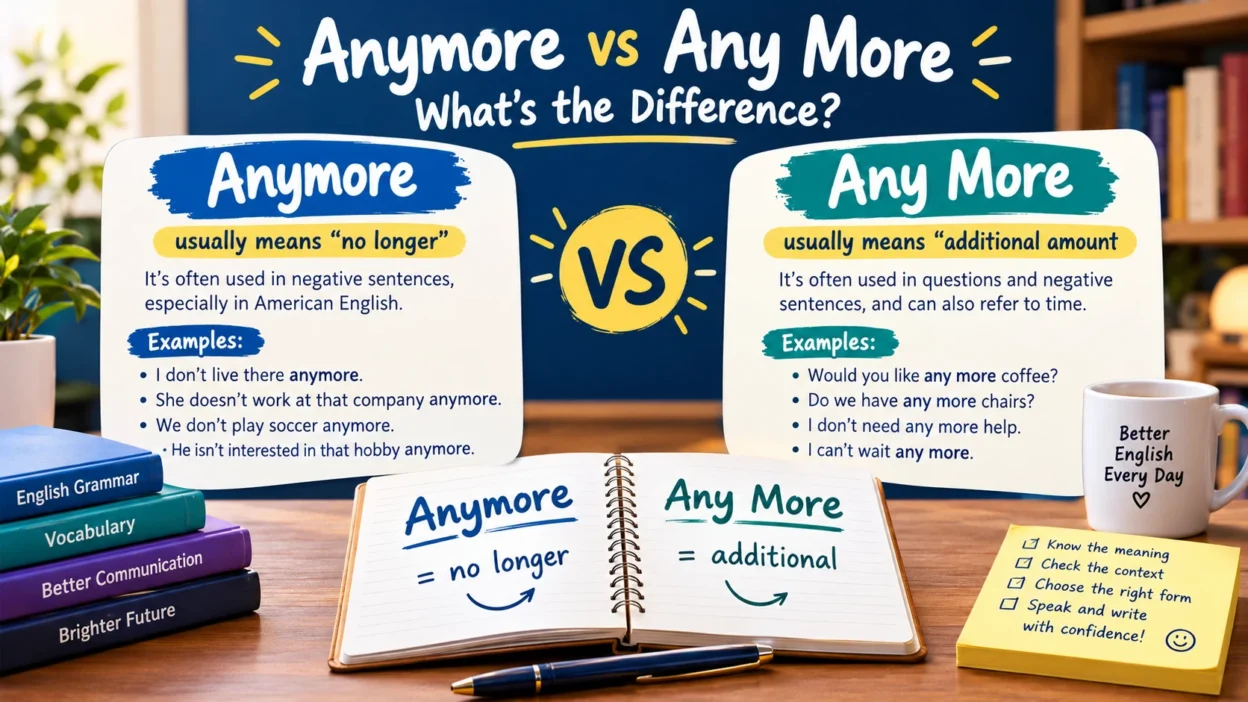
The main difference is that “anymore” usually means “no longer” or “from now on” in negative contexts, especially in American English. In contrast, “any more” generally refers to an additional amount, number, or quantity. For example, “I don’t work there anymore” means I no longer work there, while “Do you need any more time?” asks whether you need additional time. Learning these simple rules will help you choose the right form in everyday conversations, emails, academic writing, and exams.
Quick Answer: Anymore vs Any More
Anymore usually means “no longer,” as in “I don’t live there anymore.” Any more means an additional amount or number, as in “Would you like any more coffee?” Use “anymore” for the idea of something no longer happening and “any more” when referring to an additional quantity.
Why Do People Confuse Anymore and Any More?
People confuse these expressions because they contain the same words and often sound exactly alike when spoken. The difference becomes clear when you look at their meanings and grammatical roles.
There are three main reasons for the confusion:
- Similar spelling: The only visible difference is the space.
- Similar pronunciation: Both forms generally sound the same.
- Different usage conventions: American English commonly uses the single-word form to mean “no longer,” while British English generally prefers “any longer” or “any more” in this sense.
The key is to consider what you want to communicate: a change in a situation or an additional quantity.
1. What Does Anymore Mean?
Anymore is an adverb that usually means “no longer” or “at the present time compared with the past.”
It describes a situation, habit, or action that has stopped or is no longer true.
In American English, it is particularly common in negative sentences.
Examples of Anymore
- I don’t play football anymore.
- She doesn’t work at that company anymore.
- We don’t live in that neighborhood anymore.
- He isn’t interested in that hobby anymore.
- They don’t visit us anymore.
In each sentence, “anymore” indicates that something was true or happened in the past but is no longer true or happening.
Can Anymore Be Used in Positive Sentences?
Yes. In some varieties of American English, particularly regional and informal speech, “anymore” can mean “nowadays” or “these days” in a positive statement.
For example:
- Grocery shopping is expensive anymore.
- People work remotely more often anymore.
This usage is regional and may sound unusual to many English speakers. For broadly understood formal writing, use “nowadays,” “these days,” or “increasingly,” depending on the intended meaning.
2. What Does Any More Mean?
Any more is a two-word expression that usually refers to an additional amount, quantity, or number.
It often appears in questions and negative sentences when discussing whether something extra is needed, available, wanted, or remaining.
Examples of Any More
- Would you like any more tea?
- Do we have any more chairs?
- I don’t need any more help.
- Is there any more food in the kitchen?
- She doesn’t want any more advice.
In these examples, “any more” refers to additional tea, chairs, help, food, or advice.
Can Any More Refer to Time?
Yes. “Any more” can refer to an additional period of time.
Examples:
- Do you need any more time to finish?
- I can’t wait any more.
- We don’t have any more time to waste.
Notice that “any more” can sometimes mean “any longer” when referring to time. This is particularly common in British English and is also found in American English.
Anymore vs Any More: Comparison Table
| Feature | Anymore | Any more |
|---|---|---|
| Main meaning | No longer | An additional amount or number |
| Grammatical role | Adverb | Quantity expression |
| Common use | Negative statements | Questions and negative statements |
| Example | I don’t smoke anymore. | I don’t want any more cigarettes. |
| American English | Common for “no longer” | Common for additional quantity |
| British English | Less common for “no longer” | Common for additional quantity and also “no longer” in some contexts |
Important: The two-word form can also mean “any longer,” especially in British English. Therefore, the distinction is not simply that one form is always correct and the other is always wrong. Meaning and regional convention both matter.
When to Use Anymore vs Any More
Use these practical rules to choose the correct form.
Use Anymore When You Mean “No Longer”
Choose “anymore” when describing something that has stopped happening or is no longer true, especially in American English.
Examples:
- I don’t watch that show anymore.
- He doesn’t call me anymore.
- She doesn’t need my help anymore.
- We aren’t friends anymore.
Quick test: If you can replace the word with “no longer” without changing the intended meaning, “anymore” is generally appropriate in American English.
Use Any More When You Mean “Additional”
Choose “any more” when asking about or referring to an extra amount, number, or quantity.
Examples:
- Would you like any more water?
- Do you have any more questions?
- We need any more information that becomes available.
The last example is awkward in ordinary English. A more natural version is: “We need any additional information that becomes available” or “Do we need any more information?”
Quick test: If you can replace “any more” with “additional,” the two-word form is usually correct.
Use Any More for “Any Longer” When Appropriate
In British English, “any more” can also mean “any longer.”
For example:
- I don’t live here any more.
- She doesn’t work there any more.
These sentences have essentially the same meaning as the American English versions written with “anymore.”
12 Examples of Anymore vs Any More
Here are examples that show how the expressions work in everyday English.
| Sentence | Correct form | Meaning |
|---|---|---|
| I don’t eat meat anymore. | Anymore | I no longer eat meat. |
| Do you need any more paper? | Any more | Additional paper |
| She doesn’t live here anymore. | Anymore | She no longer lives here. |
| Would you like any more coffee? | Any more | Additional coffee |
| We don’t talk anymore. | Anymore | We no longer talk. |
| Are there any more tickets available? | Any more | Additional tickets |
| He doesn’t play video games anymore. | Anymore | He has stopped playing them. |
| I don’t want any more cake. | Any more | Additional cake |
| They aren’t working together anymore. | Anymore | They no longer work together. |
| Do you have any more suggestions? | Any more | Additional suggestions |
| I can’t wait any more. | Any more | I cannot wait any longer. |
| We don’t need any more supplies. | Any more | Additional supplies |
More Examples in Everyday Conversations
Conversation 1
- Mia: Do you still work at the bookstore?
- Alex: No, I don’t work there anymore.
Conversation 2
- Sam: Would you like another slice of pizza?
- Lily: No, thanks. I don’t want any more.
Conversation 3
- Teacher: Do you have any more questions?
- Student: No, I understand everything now.
Conversation 4
- Ben: Do you still play tennis?
- Chris: No, I don’t play anymore.
Common Mistakes to Avoid
Even fluent English speakers sometimes mix up these expressions. The following mistakes are easy to correct.
Mistake 1: Using Anymore for an Additional Quantity
Incorrect: Do you need anymore sugar?
Better: Do you need any more sugar?
Why? The sentence asks about an additional quantity of sugar.
Mistake 2: Using Any More Instead of Anymore in American English
Less standard in American English: I don’t go there any more.
Common American form: I don’t go there anymore.
The two-word version is not universally incorrect. It is standard in British English for this meaning, so consider your audience and preferred variety of English.
Mistake 3: Assuming the Two-Word Form Always Means Quantity
The expression “any more” can also mean “any longer.”
Example: “I can’t stay any more” means that I cannot stay any longer.
Mistake 4: Ignoring the Intended Meaning
Incorrect for the intended meaning: Do you want anymore information?
Better: Do you want any more information?
The question concerns additional information, so the two-word form is appropriate.
Mistake 5: Assuming Anymore Always Belongs in Negative Sentences
“Anymore” is most common in negative sentences in standard American English, but some regional varieties use it in positive statements to mean “nowadays.”
For general writing, use the more widely understood “nowadays” or “these days” for that meaning.
Memory Trick: How to Remember the Difference
Use this simple trick:
- Anymore = no longer. Think of a habit or situation that has ended.
- Any more = additional. Think of something extra that you might want, need, or have.
Remember these two examples:
- “I don’t work there anymore.” = I no longer work there.
- “I need any more time” is usually unnatural as a standalone statement. Say “I need more time” or “Do I have any more time?” when asking about additional time.
A useful question to ask yourself is: Am I talking about something stopping, or am I talking about something extra?
That question will usually help you choose the correct spelling.
American vs British English
The distinction between “anymore” and “any more” partly depends on the variety of English you use.
American English
American English commonly uses “anymore” as one word when it means “no longer.”
Examples:
- I don’t work there anymore.
- She doesn’t call anymore.
- We don’t see them anymore.
When discussing an additional amount or number, American English uses “any more” as two words.
Examples:
- Do you have any more coffee?
- We don’t need any more chairs.
British English
British English generally uses “any more” as two words for both the additional-quantity meaning and the “no longer” meaning.
Examples:
- I don’t work there any more.
- She doesn’t call any more.
- Do you have any more coffee?
British English speakers may also use “any longer” to express the idea of something no longer happening.
Which Form Should You Use?
If you write primarily for an American audience, use “anymore” for “no longer” and “any more” for additional quantity.
If you write primarily for a British audience, “any more” is generally appropriate for both meanings.
When writing for an international audience, clarity matters most. You can use “no longer” or “any longer” to avoid regional differences.
Similar Words and Expressions
Several expressions have meanings related to “anymore” and “any more.” Understanding them can help you choose more precise wording.
| Word or phrase | Meaning | Example |
|---|---|---|
| No longer | Something has stopped or is not true now | I no longer work there. |
| Any longer | For an additional period of time | I can’t wait any longer. |
| More | A greater amount or number | I need more water. |
| Additional | Extra or added | We need additional information. |
| Nowadays | At the present time | People shop online more often nowadays. |
| These days | During the current period | I rarely watch television these days. |
| Still | Continuing until the present time | Do you still work here? |
The most useful alternatives are “no longer” and “any longer.” They make the meaning clear and can help you avoid uncertainty about regional spelling conventions.
Frequently Asked Questions
1. Is anymore one word or two words?
Both forms are correct. “Anymore” is commonly used in American English to mean “no longer.” “Any more” usually refers to an additional amount or number, and British English also uses it to mean “no longer.”
2. Is “I don’t want anymore” correct?
Yes, if you mean that you no longer want something or that you do not want additional things, context matters. In American English, “I don’t want anymore” can mean you do not want anything further. If you are referring to a specific quantity, writing “I don’t want any more” is often clearer.
3. Is “I don’t love you anymore” correct?
Yes. This is a correct and natural sentence in American English. It means “I no longer love you.” In British English, “I don’t love you any more” is also standard.
4. Should I write “anymore” or “any more” in formal writing?
Use “anymore” for “no longer” if you follow American English conventions. Use “any more” for additional quantities. In British English, “any more” is commonly used for both meanings. Consistency with your chosen variety of English is important.
5. Can I use anymore in a question?
Yes. For example, “Don’t you work here anymore?” asks whether someone has stopped working there. In American English, “anymore” is common in questions that express a negative assumption or ask whether a past situation has changed.
6. What is the difference between “any more” and “any longer”?
“Any more” often refers to additional quantity, while “any longer” refers to additional time. However, both can express the idea of something continuing or not continuing, as in “I can’t wait any more” and “I can’t wait any longer.”
7. Is “anymore” British or American English?
“Anymore,” written as one word to mean “no longer,” is especially common in American English. British English generally prefers “any more” for that meaning. Both varieties use “any more” to refer to an additional quantity.
Remember This
- Anymore: Usually means “no longer” in American English.
- Any more: Usually means “additional” or “extra.”
- British English: Commonly uses “any more” to mean “no longer.”
- American English: Commonly uses “anymore” to mean “no longer.”
- Best strategy: Identify the meaning first, then consider your audience.
Conclusion
The difference between “anymore” and “any more” is easier to understand when you focus on meaning rather than spelling. In American English, “anymore” usually means “no longer,” as in “I don’t work there anymore.” Meanwhile, “any more” generally refers to an additional quantity, as in “Would you like any more tea?” These are the main rules to remember when writing and speaking English.
However, regional differences are important. British English commonly uses “any more” to mean “no longer,” too. If you are unsure which form to use for an international audience, expressions such as “no longer,” “any longer,” and “additional” can make your meaning clearer. With a little practice and attention to context, you can confidently choose the correct form in everyday conversations, school assignments, and professional writing.