Have you ever wondered if to use alone or lonely when talking about being by yourself? These two words are closely related, but they do not mean the same thing. Understanding the difference between alone vs lonely can help you express your feelings and situations more clearly in everyday English.
The main difference is that alone describes being by yourself, while lonely describes feeling sad because you lack companionship or emotional connection. You can enjoy being alone without feeling lonely, and you can feel lonely even when you are surrounded by people. For example, a person might spend a peaceful evening alone reading a book, while another person might feel lonely at a crowded party. Both words are common in conversations, writing, and everyday communication. Learning when to use each word will help you avoid common mistakes and communicate your thoughts more naturally.
Quick Answer: Alone vs Lonely
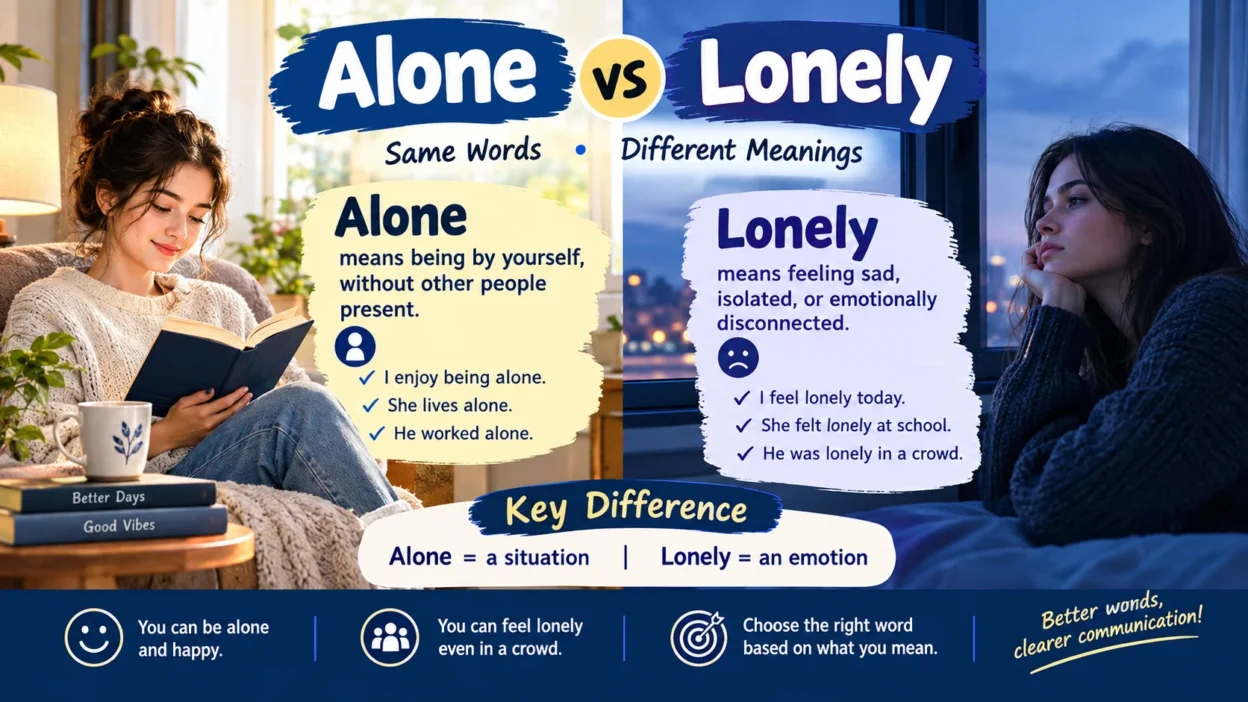
Alone means being by yourself, without other people present. Lonely means feeling sad, isolated, or emotionally disconnected because you lack the companionship you want. Being alone is a situation, but being lonely is an emotional experience. You can be alone and happy, or surrounded by people and still feel lonely.
Why Do People Confuse Alone and Lonely?
People often confuse these words because both relate to separation from other people. However, the difference lies in whether you are describing a situation or an emotion.
- Alone: Focuses on who is physically present.
- Lonely: Focuses on how someone feels emotionally.
For example, a student studying alone in a library may feel peaceful and focused. Another student sitting in a crowded classroom may feel lonely because they have no close friends.
The key is to remember that being by yourself does not automatically mean you feel sad or isolated.
What Does Alone Mean?
Alone means being without other people or doing something by yourself. It usually describes a physical or social situation rather than an emotional state.
You can use alone when talking about spending time by yourself, working independently, or having no one else present.
Examples of Alone
- I live alone in a small apartment.
- She likes to walk alone in the morning.
- He was alone at home when the phone rang.
- I want to be alone for a while.
- The child was left alone in the room.
How to Use Alone in a Sentence
Alone commonly appears after a verb or at the end of a sentence.
Examples:
- She prefers to travel alone.
- I was alone last night.
- He completed the project alone.
It can also emphasize that someone has no help or support.
Example: She alone solved the difficult problem.
In this sentence, alone means that she solved it without anyone else’s help.
What Does Lonely Mean?
Lonely describes the feeling of sadness or emotional isolation that can occur when someone lacks the companionship or connection they want.
A person can feel lonely because they miss family, have difficulty making friends, or feel disconnected from people around them. Loneliness does not necessarily depend on whether someone is physically alone.
Examples of Lonely
- I feel lonely when my family is away.
- She became lonely after moving to a new city.
- He felt lonely even though he was surrounded by friends.
- The unless man was lonely because he rarely received visitors.
- Sometimes, people feel lonely during the holidays.
How to Use Lonely in a Sentence
Lonely is an adjective that describes a person’s emotional state or something that creates a feeling of isolation.
Examples:
- I am lonely today.
- She felt lonely at school.
- It was a lonely evening.
- He looked lonely sitting by the window.
The word can also describe a place that seems empty, isolated, or unwelcoming.
Example: They walked along a lonely road.
Here, lonely describes the road’s isolated atmosphere rather than necessarily describing someone’s feelings.
Alone vs Lonely: Comparison Table
| Feature | Alone | Lonely |
|---|---|---|
| Main meaning | By yourself | Feeling isolated or sad |
| Focus | Situation | Emotion or atmosphere |
| Part of speech | Usually an adverb or adjective | Adjective |
| Positive use | Often describes peaceful independence | Usually describes an unwanted lack of connection |
| Negative use | Can describe unwanted isolation | Commonly expresses emotional distress |
| Example | I enjoy being alone. | I feel lonely without my friends. |
| Can happen in a crowd? | Usually refers to being without others physically | Yes, even in a crowd |
| Opposite idea | Together or accompanied | Connected or emotionally fulfilled |
When Should You Use Alone or Lonely?
Choose the word that best describes what you want to communicate.
Use Alone When You Mean “By Yourself”
Use alone when you want to explain that someone is physically by themselves or doing something without help.
Examples:
- I prefer to work alone.
- She stayed alone in the house.
- He traveled alone across the country.
In these sentences, the focus is on the person’s situation or independence.
Use Lonely When You Mean “Feeling Isolated”
Use lonely when someone feels sad, disconnected, or in need of companionship.
Examples:
- I feel lonely when nobody talks to me.
- She was lonely after leaving her hometown.
- He felt lonely despite having many acquaintances.
In these examples, the focus is on emotional connection rather than physical presence.
Can You Be Alone Without Being Lonely?
Yes. You can enjoy your own company, relax, or focus on personal interests while being alone.
Example: I love spending a quiet Sunday alone because it helps me recharge.
Can You Be Lonely Without Being Alone?
Yes. You can feel lonely while spending time with family, classmates, or coworkers if you do not feel understood or connected.
Example: Although he attended the party, he felt lonely because he did not know anyone well.
12 Examples of Alone vs Lonely in Sentences
These examples show how the two words work in everyday English.
- Alone: I stayed alone at home while my parents went shopping.
- Lonely: I felt lonely because my best friend moved away.
- Alone: She enjoys eating alone at her favorite restaurant.
- Lonely: He became lonely after retiring from his job.
- Alone: The student worked alone on the science project.
- Lonely: The new student felt lonely during the first week of school.
- Alone: I need to be alone to think about my future.
- Lonely: She felt lonely even when her relatives visited.
- Alone: They left me alone to finish the assignment.
- Lonely: He was lonely because he missed his family.
- Alone: We walked alone along the beach at sunrise.
- Lonely: She sometimes feels lonely despite having hundreds of online followers.
Notice that alone tells you about the situation, while lonely tells you about an emotional experience.
Common Mistakes When Using Alone and Lonely
Mistake 1: Using Lonely When You Mean Alone
Incorrect: I like to be lonely when I study.
Better: I like to be alone when I study.
Why? The intended meaning is that you prefer to study without other people around, not that you enjoy feeling sad or isolated.
Mistake 2: Using Alone When You Mean Lonely
Incorrect: I feel alone because nobody understands me.
This sentence is not necessarily grammatically wrong, but it may not communicate the intended emotional meaning as clearly as lonely.
Clearer: I feel lonely because nobody understands me.
Note that feel alone can also express emotional isolation, so the original sentence can be correct in the right context.
Mistake 3: Assuming Everyone Who Is Alone Is Lonely
Incorrect assumption: She lives alone, so she must be lonely.
Better: She lives alone, but she enjoys her independence and has a strong social circle.
Living alone does not automatically mean someone feels lonely.
Mistake 4: Forgetting That Lonely Can Describe a Place
Incorrect: It was an alone road.
Correct: It was a lonely road.
In this context, lonely describes a road that feels isolated or deserted. Alone generally does not work as a direct adjective before road in this meaning.
Mistake 5: Confusing Alone With Lonely in Emotional Writing
If you are describing an actual feeling of sadness or disconnection, lonely may be more precise. If you are describing being without other people, alone is usually the better choice.
Memory Trick: How to Remember Alone vs Lonely
Use this simple memory trick:
- Alone = All by yourself.
- Lonely = Longing for connection.
Think of alone as a description of your surroundings and lonely as a description of your feelings.
For example, if you are sitting alone in your room and enjoying the quiet, you are alone but not lonely. If you are at a party and wish someone would talk to you, you may feel lonely without being alone.
Remember: Alone describes being by yourself; lonely describes feeling disconnected.
Alone vs Lonely in American and British English
There is no significant difference in the core meanings of alone and lonely between American and British English. Both varieties use these words in essentially the same way.
| Expression | American English | British English |
|---|---|---|
| I live alone. | Correct | Correct |
| I feel lonely. | Correct | Correct |
| She likes to travel alone. | Correct | Correct |
| He felt lonely at school. | Correct | Correct |
Both American and British speakers use alone to describe being by oneself and lonely to describe feelings of isolation.
The choice between these words depends on the intended meaning, not the variety of English.
Similar Words: Alone, Lonely, Solitary, Isolated, and Lonesome
Several English words are related to alone and lonely, but they have slightly different meanings.
1. Solitary
Solitary means being alone or separated from others. It often sounds more formal than alone.
Example: He enjoys solitary walks in the countryside.
2. Isolated
Isolated means separated from others, physically or socially. It can describe people, places, or situations.
Example: The village is isolated from the nearest town.
3. Lonesome
Lonesome means lonely. It is often associated with informal, emotional, or literary language.
Example: She felt lonesome after her children moved away.
4. Independent
Independent means able to do things without relying on others. It does not necessarily mean being alone.
Example: He is independent and enjoys making his own decisions.
5. Secluded
Secluded describes a place that is quiet and away from other people. It often has a neutral or positive meaning.
Example: They rented a secluded cabin in the mountains.
6. Isolated Emotionally
This phrase describes feeling disconnected from other people, even when they are physically nearby.
Example: She felt emotionally isolated because nobody listened to her concerns.
Understanding these related words helps you express different types of separation, independence, and emotional experience more accurately.
Final Verdict: Which Word Is Correct?
Both alone and lonely are correct English words, but they serve different purposes.
Use alone when you mean that someone is by themselves or doing something without other people.
Use lonely when you mean that someone feels sad, disconnected, or lacking the companionship they want.
Compare these two sentences:
- I am alone tonight. — This describes your situation.
- I am lonely tonight. — This describes how you feel.
The context determines which word is appropriate. Being alone can be enjoyable, while loneliness usually suggests an unwanted lack of connection.
Frequently Asked Questions
1. What is the main difference between alone and lonely?
Alone means being by yourself, while lonely means feeling sad or emotionally disconnected because you lack the companionship you want. You can be alone without feeling lonely, and you can feel lonely even when other people are around.
2. Can you be alone but not lonely?
Yes. Many people enjoy spending time alone because it gives them peace, privacy, and an opportunity to recharge. For example, someone reading a book alone at home may feel perfectly happy.
3. Can you feel lonely when surrounded by people?
Yes. Loneliness is an emotional experience, not simply the absence of people. Someone may feel lonely in a crowded room if they lack meaningful relationships or feel that nobody understands them.
4. Is alone a negative word?
No. Alone is generally neutral. It can describe a positive experience, such as enjoying quiet time, or a negative situation, such as being left without help. Its meaning depends on the context.
5. Is lonely an adjective?
Yes. Lonely is an adjective that describes a person’s feelings or the atmosphere of a place. For example, “I feel lonely” describes an emotion, while “a lonely road” describes an isolated setting.
6. Is it correct to say “I feel alone”?
Yes. “I feel alone” is grammatically correct and can describe either being by yourself or feeling emotionally unsupported. “I feel lonely” more directly emphasizes sadness or a lack of emotional connection.
7. What is the opposite of lonely?
Possible opposites include connected, companioned, and fulfilled, depending on the context. For a simple everyday contrast, not lonely or feeling connected is often more natural. The word happy is not always an exact opposite because someone can be happy while alone.
8. What is the opposite of alone?
Common opposites include together, accompanied, and with others. For example, “She was alone” can be contrasted with “She was with her friends.”
Remember This
- Alone = being by yourself.
- Lonely = feeling sad or disconnected.
- You can be alone and happy.
- You can be lonely in a crowd.
- Choose the word based on whether you are describing a situation or an emotion.
Conclusion
Understanding the difference between alone and lonely makes your English more accurate and expressive. Although both words relate to being apart from others, alone describes a situation, while lonely usually describes an emotional experience. Knowing this distinction helps you communicate clearly in everyday conversations, school assignments, and personal writing.
The easiest way to remember the difference is to ask yourself what you want to describe. If you mean that someone is by themselves, choose alone. If you mean that someone feels a lack of companionship or emotional connection, choose lonely. With practice, you will be able to use both words naturally and confidently.

David Henry is a language enthusiast and content writer specializing in synonyms, vocabulary, and word meanings. He creates clear, engaging resources that help readers improve their writing, communication, and English skills.