
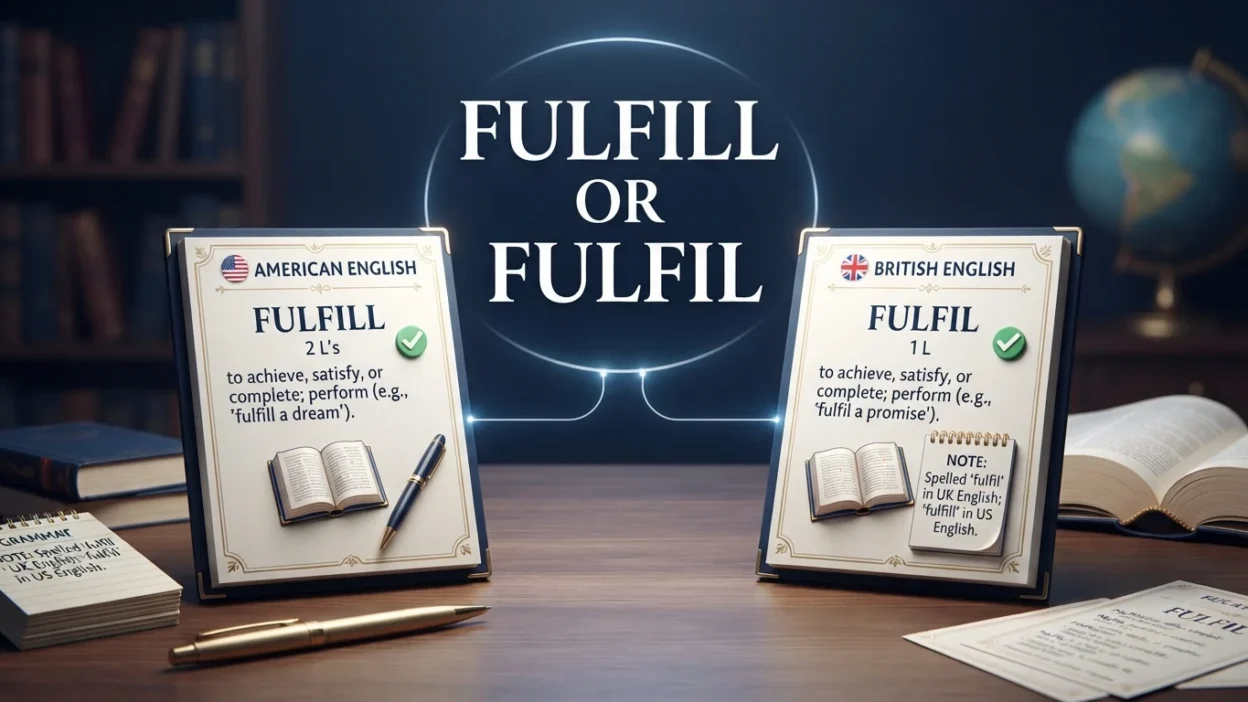
If you are unsure if to write “fulfill” or “fulfil,” both spellings are correct. The main difference is regional spelling. Fulfill is the standard spelling in American English, while fulfil is commonly used in British English and other varieties that follow British spelling conventions.
Both words have the same meaning: to complete something, satisfy a requirement, or achieve what is expected. For example, you can say, “She fulfilled her promise” in American English or “She fulfilled her promise” in British English as well. The difference becomes more noticeable in forms such as fulfilled and fulfilling, where both varieties use the double l.
Understanding this spelling difference can help students, ESL learners, writers, and professionals choose the form that matches their audience and style guide.
Quick Answer
Fulfill and fulfil are both correct spellings. Fulfill is preferred in American English, while fulfil is preferred in British English. They have the same meaning and pronunciation. Choose the spelling that matches the variety of English you are writing.
Why Do People Confuse “Fulfill” and “Fulfil”?
The confusion comes from differences between American and British spelling.
Many English words have different spellings depending on the variety of English being used. Words ending in -ll in American English sometimes use only -l in British English.
For example:
- American English: fulfill
- British English: fulfil
The meaning does not change.
You may see either spelling in international writing, online publications, books, and professional documents.
Fulfill: Meaning and Usage
Fulfill is the standard American English spelling.
It can mean:
- To complete or carry out something
- The company fulfilled the contract.
- To satisfy a requirement
- You must fulfill all the requirements before applying.
- To keep a promise or obligation
- He fulfilled his promise to help her.
- To achieve a wish, goal, or expectation
- She fulfilled her dream of becoming a teacher.
Examples with “Fulfill”
- We need to fulfill the requirements.
- She fulfilled her promise.
- The order was fulfilled on time.
- He hopes to fulfill his ambition.
- The program helps fulfill an important need.
Fulfil: Meaning and Usage
Fulfil is the standard British English spelling.
It has exactly the same meanings as fulfill. The difference is spelling, not definition.
Examples with “Fulfil”
- You must fulfil the requirements.
- She fulfilled her promise.
- The company fulfilled the order.
- He wants to fulfil his ambition.
- The policy aims to fulfil its purpose.
Notice that fulfilled is spelled with -ll in both varieties.
Fulfill vs Fulfil: Comparison Table
| Feature | Fulfill | Fulfil |
|---|---|---|
| Main variety | American English | British English |
| Meaning | Complete, satisfy, achieve | Complete, satisfy, achieve |
| Pronunciation | Same | Same |
| Present/base form | fulfill | fulfil |
| Past tense | fulfilled | fulfilled |
| -ing form | fulfilling | fulfilling |
| Correct spelling? | Yes | Yes |
| Best choice for US writing | Yes | Usually no |
| Best choice for UK writing | Usually no | Yes |
When Should You Use Each Spelling?
Use “Fulfill” in American English
Choose fulfill when writing for an American audience or following American English conventions.
Examples:
- We must fulfill the legal requirements.
- The company will fulfill your order.
- She fulfilled her lifelong dream.
Use “Fulfil” in British English
Choose fulfil when writing for a British audience or following British spelling conventions.
Examples:
- Applicants must fulfil the necessary requirements.
- The company will fulfil your order.
- He finally fulfilled his ambition.
What About International English?
For international communication, neither spelling is inherently wrong. The important thing is consistency.
If your document uses British spellings such as colour, organise, centre, and favour, then fulfil will usually fit better.
If it uses American spellings such as color, organize, center, and favor, then fulfill is the natural choice.
10+ Examples of Fulfill and Fulfil
- American: The student must fulfill all the course requirements.British: The student must fulfil all the course requirements.
- American: She fulfilled her promise.British: She fulfilled her promise.
- American: The company fulfilled the customer’s order.British: The company fulfilled the customer’s order.
- American: He wants to fulfill his potential.British: He wants to fulfil his potential.
- American: This position fulfills an important need.British: This position fulfils an important need.
- American: They worked hard to fulfill their responsibilities.British: They worked hard to fulfil their responsibilities.
- American: The product fulfills the necessary safety standards.British: The product fulfils the necessary safety standards.
- American: She hopes to fulfill her childhood dream.British: She hopes to fulfil her childhood dream.
- American: The agreement was fulfilled successfully.British: The agreement was fulfilled successfully.
- American: We are working to fulfill your request.British: We are working to fulfil your request.
- American: He fulfilled his duty.British: He fulfilled his duty.
- American: The scholarship helped fulfill her educational goals.British: The scholarship helped fulfil her educational goals.
Common Mistakes
Mistake 1: Treating One Spelling as Incorrect
❌ Fulfil is always wrong.
That is incorrect. Fulfil is a standard British spelling.
❌ Fulfill is always wrong.
That is also incorrect. Fulfill is a standard American spelling.
Mistake 2: Mixing Spelling Styles
A document can become inconsistent if it uses both American and British spelling without a reason.
For example:
- The company will fulfil the order.
- The company will organize the event.
- The center is nearby.
If you are following American English, fulfill, organize, and center would normally be expected.
Mistake 3: Changing the Past-Tense Spelling
The past tense is generally fulfilled in both varieties.
Correct:
- fulfilled
- fulfilling
Not:
- ❌ fulfiled
- ❌ fulfiling
Memory Trick
Think of the regional spelling like this:
US English → fulfill → two Ls at the end
UK English → fulfil → one L at the end
A simple reminder is:
America fills with two Ls: fulfill.
Remember that the past and -ing forms use double l in both varieties:
- fulfill → fulfilled → fulfilling
- fulfil → fulfilled → fulfilling
American vs British English
The main distinction is regional.
American English generally uses fulfill.
British English generally uses fulfil.
Other English-speaking regions may follow British or American conventions, or have their own established preferences. Australian and New Zealand English, for example, commonly follow British spelling conventions in many contexts.
The safest approach is to follow the spelling system required by your school, employer, publisher, client, or style guide.
Similar Words
Several words are related to fulfill/fulfil, but they are not always interchangeable.
Satisfy
Means to meet a need, condition, or expectation.
- The answer satisfied the teacher.
Complete
Means to finish something.
- She completed the assignment.
Accomplish
Means to successfully achieve a task or goal.
- They accomplished their objective.
Achieve
Means to successfully reach a goal or desired result.
- He achieved his goal.
Carry out
Means to perform or complete a task, plan, or instruction.
- The team carried out the plan.
Keep
Can mean to honor a promise or agreement.
- She kept her promise.
Final Verdict
Fulfill and fulfil are both correct. The difference is primarily regional spelling.
- Fulfill → American English
- Fulfil → British English
- Fulfilled → commonly spelled this way in both varieties
- Fulfilling → commonly spelled this way in both varieties
Choose the form that matches the English variety you are using, and keep your spelling consistent throughout your writing.
FAQs
Is “fulfill” or “fulfil” correct?
Both are correct. Fulfill is the standard American English spelling, while fulfil is the standard British English spelling.
Is “fulfil” British or American?
Fulfil is primarily the British English spelling. It is also used in other varieties that generally follow British spelling conventions.
Is “fulfill” American English?
Yes. Fulfill is the standard spelling in American English.
Do “fulfill” and “fulfil” have the same meaning?
Yes. They have the same meaning and pronunciation. The difference is mainly spelling based on regional English conventions.
Is “fulfilled” spelled with one L or two?
Fulfilled is spelled with two Ls after the prefix in standard usage: fulfilled. This spelling is used in both American and British English.
Is “fulfilling” spelled with one L or two?
The standard spelling is fulfilling, with a double l before -ing.
Which spelling should I use in academic writing?
Use the spelling required by your institution or style guide. If you are writing in American English, use fulfill; for British English, use fulfil.
Can I use both “fulfill” and “fulfil” in the same document?
It is better to choose one regional spelling and use it consistently unless you are deliberately quoting a source that uses the other form.
Remember This
Fulfill = American English
Fulfil = British English
Both mean to complete, satisfy, carry out, or achieve something. The meaning does not change when the spelling changes.
Conclusion
The choice between fulfill and fulfil depends mainly on the variety of English you are using. American English normally uses fulfill, while British English normally uses fulfil. Neither spelling is universally “more correct”; each fits a different spelling convention.
If you are writing for an American audience, choose fulfill. If you are writing for a British audience, choose fulfil. Most importantly, keep your spelling consistent throughout your document so your writing looks clear and polished.

Daniel Jack is a language enthusiast and content writer who specializes in synonyms, vocabulary, and word meanings. He creates clear, engaging resources that help readers improve communication and expand their English skills.