
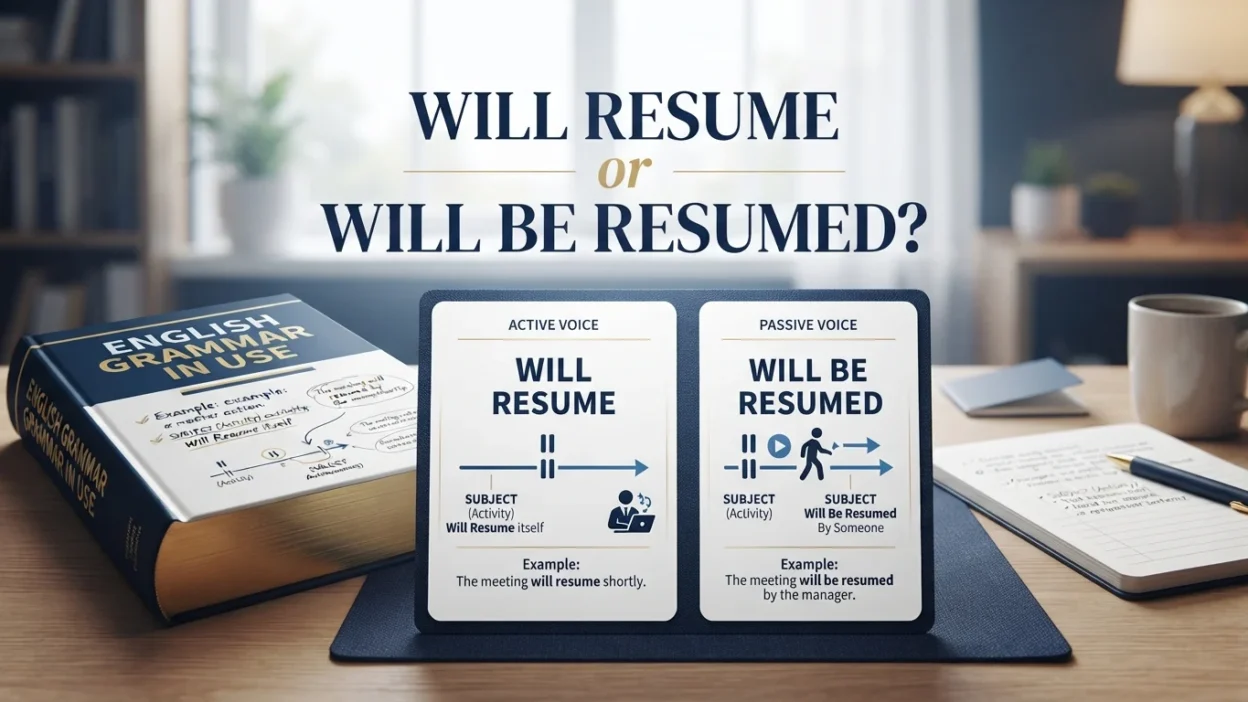
When you are unsure if to write “will resume” or “will be resumed,” the key difference is whether the subject performs the action or receives the action. “Will resume” is active and usually means something will start again or continue after a pause. “Will be resumed” is passive and emphasizes that someone or something will cause the activity to start again.
For example, “The meeting will resume at 3 p.m.” means the meeting will start again at 3 p.m. In contrast, “The meeting will be resumed by the chairperson” emphasizes that the chairperson will restart the meeting. Both forms can be grammatically correct, but they are used in different situations. Understanding this distinction helps you choose the natural expression for emails, announcements, reports, academic writing, and everyday English.
Quick Answer
“Will resume” is generally used when an activity, event, process, or situation will start again or continue after a pause. “Will be resumed” is the passive form and is used when the focus is on the activity being restarted by someone or something. In many everyday sentences, “will resume” sounds more natural and direct.
Why People Confuse It
The confusion happens because resume can be used in different grammatical patterns.
The verb resume can mean:
- To begin again after stopping
- The class will resume after lunch.
- To continue something that was interrupted
- She resumed her work after the phone call.
When we use the active form, the subject performs the action:
When we use the passive form, the subject receives the action:
The difference is therefore not simply about correctness. It is mainly about voice, focus, and meaning.
First Word: “Will Resume”
What Does “Will Resume” Mean?
“Will resume” is the future form of the active verb resume.
It means that something will start again, continue, or return to an earlier activity after an interruption.
Examples
- The meeting will resume at 2 p.m.
- Classes will resume next Monday.
- The game will resume after the rain stops.
- The discussion will resume later.
- Normal service will resume shortly.
In these sentences, the subject is the activity or event that continues.
Why It Sounds Natural
English often uses resume actively when talking about meetings, classes, games, services, discussions, negotiations, and other ongoing activities.
For example:
The conference will resume at 10 a.m.
This is short, clear, and natural.
You do not need to say who will restart the conference because the important information is when it will continue.
Second Word: “Will Be Resumed”
What Does “Will Be Resumed” Mean?
“Will be resumed” is the passive form of will resume.
It means that something will be started or continued again by someone or something, with the focus placed on what receives the action.
The basic structure is:
Subject + will be + past participle
For example:
The investigation will be resumed next week.
Here, the investigation receives the action of being resumed.
Examples
- The investigation will be resumed next month.
- The negotiations will be resumed when both sides agree.
- The project will be resumed after funding is approved.
- The examination will be resumed after the technical problem is fixed.
- The construction work will be resumed once the weather improves.
The passive form is especially useful when the person responsible for restarting something is unknown, unimportant, or deliberately left unstated.
“Will Resume” vs. “Will Be Resumed”: Comparison Table
| Expression | Voice | Main Focus | Example | Common Use |
|---|---|---|---|---|
| Will resume | Active | The activity continues | The meeting will resume at 3. | Meetings, classes, games, services |
| Will be resumed | Passive | The activity is restarted | The meeting will be resumed by the chair. | Formal or process-focused writing |
| Will resume shortly | Active | Activity starts again soon | Service will resume shortly. | Announcements |
| Will be resumed later | Passive | Something will be restarted | The investigation will be resumed later. | Reports and formal contexts |
When to Use Each
Use “Will Resume” When the Activity Is the Focus
Choose will resume when you simply want to say that something will continue or start again.
Examples:
- The lecture will resume after the break.
- The train service will resume soon.
- The meeting will resume at noon.
- The match will resume tomorrow.
- Talks will resume next week.
This is usually the better choice for clear, concise communication.
Use “Will Be Resumed” When the Passive Meaning Matters
Use will be resumed when you want to emphasize that something is being restarted.
Examples:
- The investigation will be resumed by the authorities.
- The negotiations will be resumed after further discussions.
- The construction project will be resumed once approval is granted.
The passive construction is particularly useful when the person or organization responsible for the action is secondary.
An Easy Test
Ask:
“Do I want to focus on the activity continuing, or on someone restarting it?”
If the activity continuing is the main idea:
The meeting will resume at 4 p.m.
If the restarting action is the main idea:
The meeting will be resumed by the committee.
10+ Examples of “Will Resume” and “Will Be Resumed”
Examples of “Will Resume”
- The meeting will resume at 3 p.m.
- Classes will resume after the holiday.
- The game will resume when the rain stops.
- The discussion will resume tomorrow.
- Normal operations will resume soon.
- The train service will resume this evening.
- The conference will resume after lunch.
- The negotiations will resume next week.
- The program will resume after a short break.
- The examination will resume once the technical issue is resolved.
Examples of “Will Be Resumed”
- The investigation will be resumed next week.
- The project will be resumed after funding is secured.
- The negotiations will be resumed by both parties.
- Construction will be resumed when conditions become safe.
- The trial will be resumed after the interruption.
- The search will be resumed tomorrow morning.
Notice that the active examples often sound more direct, while the passive examples place greater attention on the process being restarted.
Common Mistakes
Mistake 1: Assuming “Will Be Resumed” Is Always More Formal
Passive voice can sound formal, but that does not automatically make it better.
For example:
The meeting will be resumed at 2 p.m.
This is grammatically possible, but:
The meeting will resume at 2 p.m.
is often more natural when there is no need to identify who will restart it.
Mistake 2: Using “Will Resume” When a Person Is the Object
Consider:
The manager will resume the meeting.
This means the manager will restart or continue the meeting.
That is different from:
The meeting will resume.
Here, the meeting itself is the grammatical subject.
And:
The meeting will be resumed by the manager.
uses the passive voice.
Mistake 3: Confusing “Resume” With “Return”
Resume usually means start again after an interruption.
Return can mean come back or go back.
Compare:
The meeting will resume at 3 p.m.
with:
The manager will return at 3 p.m.
The meanings are different.
Mistake 4: Forgetting the “Be” in the Passive
Incorrect:
The project will resumed next month.
Correct:
The project will be resumed next month.
The passive future construction requires:
will + be + past participle
So:
- will be resumed
- will be completed
- will be continued
- will be reviewed
Memory Trick
Remember this simple rule:
Active = the activity resumes.
The class will resume.
Passive = the activity is resumed.
The class will be resumed by the teacher.
A useful shortcut is:
“Will resume” = starts again.
“Will be resumed” = is started again by someone/something.
If you are not emphasizing the person responsible for restarting an activity, “will resume” is often the simpler choice.
American vs. British English
There is no major American-versus-British grammar difference that makes one form correct and the other incorrect.
Both American English and British English use:
- will resume
- will be resumed
The choice depends primarily on the intended meaning, grammatical voice, and writing style.
For example, speakers in both varieties can naturally say:
The meeting will resume at 2 p.m.
Formal British or American writing may also use:
The investigation will be resumed following further evidence.
The context matters more than the variety of English.
Similar Words
Several words are related to resume, but they are not always interchangeable.
Continue
Continue means to keep doing something without necessarily suggesting a specific interruption.
She will continue working.
Restart
Restart means to start something again, often after it has stopped.
The computer will restart automatically.
Recommence
Recommence means to begin again and is more formal or literary.
The proceedings will recommence after the break.
Reopen
Reopen means to open something again, such as a business, case, facility, or discussion.
The store will reopen next Monday.
Return
Return means to come or go back, rather than necessarily continue an interrupted activity.
He will return tomorrow.
Start Again
Start again is a simple, conversational alternative to resume.
The lesson will start again after lunch.
Final Verdict
Both “will resume” and “will be resumed” are grammatically correct, but they serve different purposes.
Use “will resume” when the subject is the activity that will start again or continue:
The meeting will resume at 3 p.m.
Use “will be resumed” when you want a passive construction that emphasizes the activity being restarted, especially when the person or organization responsible is mentioned or understood:
The meeting will be resumed by the chairperson.
For most straightforward announcements, “will resume” is usually the clearer and more natural choice.
FAQs
Is “will resume” grammatically correct?
Yes. “Will resume” is grammatically correct and is commonly used to say that an activity, event, or process will start again after an interruption.
Is “will be resumed” grammatically correct?
Yes. “Will be resumed” is the passive form of “will resume.” It emphasizes that something will be restarted or continued by someone or something.
Which is more natural: “will resume” or “will be resumed”?
In many everyday situations, “will resume” sounds more natural because it is direct and concise. “Will be resumed” is useful when the passive voice is appropriate.
Should I say “the meeting will resume” or “the meeting will be resumed”?
Usually, say “The meeting will resume” if you simply mean that the meeting will start again. Use “will be resumed” when you want to emphasize the action of restarting the meeting.
Can “resume” be used as a transitive verb?
Yes. Resume can be transitive:
The chairperson will resume the meeting.
It can also be used without a direct object:
The meeting will resume.
Is “will resume” active voice?
Yes. “Will resume” is an active construction when the subject performs the action of resuming.
What is the passive form of “will resume”?
The passive form is “will be resumed.”
Active:
The committee will resume the discussion.
Passive:
The discussion will be resumed by the committee.
Does “resume” mean “continue”?
Often, yes. Resume commonly means to continue something after it has been stopped or interrupted. However, continue is broader and does not always imply an interruption.
Remember This
- Will resume = something will start again or continue.
- Will be resumed = something will be started or continued again in the passive voice.
- Use will resume for simple, direct announcements.
- Use will be resumed when the passive focus is important.
- Both forms are grammatically correct.
- The best choice depends on what you want to emphasize.
Conclusion
The difference between “will resume” and “will be resumed” is mainly a difference in grammatical voice and focus. “Will resume” presents the activity as continuing or starting again, while “will be resumed” presents the activity as receiving that action. Neither expression is universally better; the surrounding sentence determines which one fits best.
When writing everyday English, announcements, emails, or schedules, “will resume” is often the clearest option because it communicates the idea directly. Choose “will be resumed” when you specifically need the passive construction or want to focus on the action of restarting something. Once you understand this active-versus-passive distinction, choosing between the two becomes much easier.

David Henry is a language enthusiast and content writer specializing in synonyms, vocabulary, and word meanings. He creates clear, engaging resources that help readers improve their writing, communication, and English skills.