
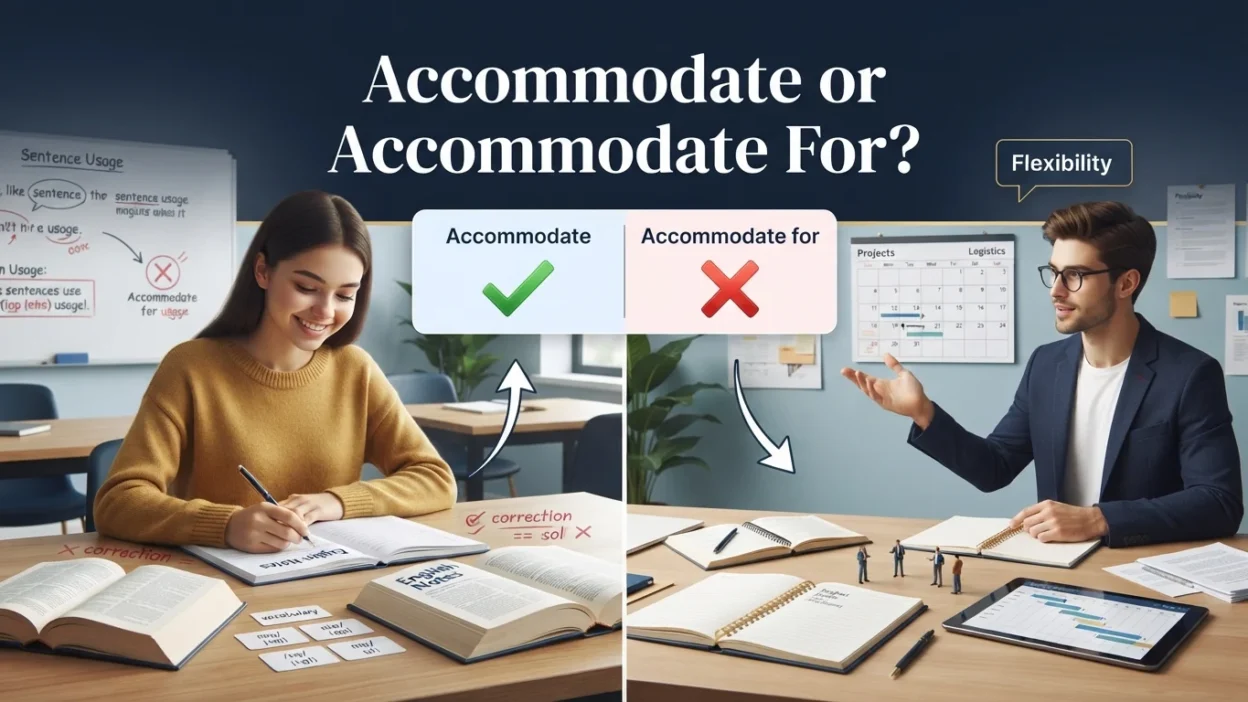
If you are wondering whether to say “accommodate” or “accommodate for,” the safer standard choice is usually “accommodate” without “for.” For example, say “The hotel can accommodate 200 guests” rather than “The hotel can accommodate for 200 guests.” When you mean “make provision for” or “take something into consideration,” however, expressions such as “allow for,” “account for,” or “make provision for” are often better choices.
The confusion happens because accommodate and phrases such as “allow for” have related meanings. In everyday English, writers and speakers may sometimes add for after accommodate because the intended meaning involves making room or adjusting to something. Understanding the grammatical patterns will help you choose the natural expression in academic writing, professional communication, and everyday conversation.
Quick Answer
Use “accommodate” when you mean to provide space, meet a need, or adjust to someone’s requirements. In standard English, “accommodate for” is generally not the preferred construction. If you mean “make allowance for” or “take into account,” use “allow for,” “account for,” or “make provision for” instead.
Why People Confuse It
The confusion comes from the meanings of accommodate and allow for being quite close in some situations.
Accommodate can mean:
- To provide enough space for someone or something
- To meet someone’s needs or requirements
- To adjust to a situation
- To adapt something to suit a particular purpose
For example:
The conference room can accommodate 100 people.
Here, accommodate means “have enough space for.”
On the other hand, allow for means to consider or make provision for something that may happen.
We need to allow for delays during the journey.
Because both expressions can involve adjusting plans or making room for circumstances, people sometimes combine them and produce “accommodate for.”
First Word: Accommodate
Accommodate is a standard English verb with several useful meanings.
1. To provide space
The apartment can accommodate four people.
This means the apartment has enough space for four people.
2. To meet a need
The school accommodated the student’s special requirements.
Here, the school adjusted its arrangements to meet the student’s needs.
3. To adapt to something
The schedule was changed to accommodate the new timetable.
In this sentence, accommodate means “adjust to make something possible.”
Common patterns with “accommodate”
The most useful structure is:
accommodate + person/thing
Examples:
- accommodate guests
- accommodate customers
- accommodate students
- accommodate a request
- accommodate different needs
- accommodate changes
- accommodate a larger group
You generally do not need for between the verb and its object.
Second Word: Accommodate For
“Accommodate for” is generally not the preferred standard construction when you mean “provide space for,” “meet the needs of,” or “adjust to.”
Instead of:
The hotel can accommodate for 100 guests.
Use:
The hotel can accommodate 100 guests.
Instead of:
The plan should accommodate for possible delays.
A more natural standard choice is:
The plan should allow for possible delays.
or:
The plan should account for possible delays.
The key is to identify what you actually mean. If you mean make room for or adjust to, use accommodate. If you mean consider something when making a plan, allow for or account for may be the better expression.
Comparison Table
| Expression | Meaning | Example | Best Use |
|---|---|---|---|
| Accommodate | Provide space or meet a need | The hotel can accommodate 300 guests. | Space, needs, requests, adjustments |
| Allow for | Make provision for or consider | Allow for extra travel time. | Plans and possible circumstances |
| Account for | Consider or include something | The budget accounts for rising costs. | Calculations, plans, explanations |
| Make provision for | Prepare for something | The policy makes provision for emergencies. | Formal writing |
| Accommodate for | Generally not preferred in standard usage | Avoid this construction when a clearer alternative exists. | Usually replace with “accommodate,” “allow for,” or “account for” |
When to Use Each
Use “accommodate” for space
When something has enough physical or practical capacity, use accommodate.
The bus can accommodate 50 passengers.
This room can accommodate a large meeting.
Use “accommodate” for needs
When someone changes something to meet another person’s requirements, use accommodate.
The restaurant can accommodate dietary restrictions.
The teacher accommodated the student’s learning needs.
Use “accommodate” for requests
When someone agrees to or adjusts something because of a request, accommodate works naturally.
We will try to accommodate your request.
Use “allow for” for possibilities
When you need to consider something that might happen, use allow for.
We should allow for heavy traffic.
Use “account for” when considering something in a calculation or plan
The estimate accounts for additional expenses.
Use “make provision for” in formal contexts
The agreement makes provision for unexpected circumstances.
10+ Examples of Accommodate and Better Alternatives
Examples with “accommodate”
1. The hotel can accommodate up to 250 guests.
2. The classroom was redesigned to accommodate more students.
3. The restaurant can accommodate large groups.
4. We will do our best to accommodate your request.
5. The schedule was adjusted to accommodate the new meeting time.
6. The company changed its policy to accommodate remote workers.
7. The building was designed to accommodate people with different mobility needs.
8. The teacher adjusted the lesson to accommodate different learning styles.
Examples where “allow for” is better
9. We should allow for extra time because of traffic.
10. The budget should allow for unexpected expenses.
11. When planning the trip, allow for possible weather changes.
12. The schedule needs to allow for short breaks.
Examples where “account for” is better
13. The report should account for seasonal changes.
14. The final calculation must account for additional costs.
These examples show why simply adding for after accommodate can create an unnatural sentence. The correct expression depends on the meaning you want.
Common Mistakes
Mistake 1: Adding “for” before a direct object
Incorrect or less standard:
The hotel can accommodate for 100 guests.
Better:
The hotel can accommodate 100 guests.
Mistake 2: Using “accommodate for” when you mean “allow for”
Less natural:
The schedule should accommodate for delays.
Better:
The schedule should allow for delays.
Mistake 3: Confusing “accommodate” with “account for”
These verbs are related in some contexts, but they are not interchangeable.
The room can accommodate 30 people.
Here, accommodate refers to capacity.
The calculation accounts for 30 additional people.
Here, account for refers to considering something in a calculation or plan.
Mistake 4: Assuming every verb needs a preposition
English verbs have different grammatical patterns. Because phrases such as “allow for” and “account for” are common, it can be tempting to add for to other verbs.
Learn the complete pattern instead:
accommodate someone/something
not:
accommodate for someone/something
Memory Trick
Remember:
ACCOMMODATE = make room
ALLOW FOR = make allowance
Think of a hotel:
The hotel accommodates 100 guests.
Think of a journey:
We allow for traffic delays.
So, if you are talking about space, needs, requests, or adjustments, think accommodate.
If you are talking about possible problems, extra time, or things you need to consider, think allow for.
American vs. British English
The basic distinction is broadly the same in American and British English.
In both varieties, accommodate is normally used directly with its object:
The venue can accommodate 500 people.
The system can accommodate different requirements.
For the meaning “take something into consideration,” both American and British English commonly use expressions such as:
allow for
account for
make provision for
You may encounter “accommodate for” in informal or nonstandard usage, but it is best avoided when you want clear, conventional English, especially in academic, professional, or formal writing.
Similar Words
Several expressions can replace accommodate depending on the intended meaning.
Adapt
Means to change something so that it works in a new situation.
We adapted the lesson for younger students.
Adjust
Means to make a small change to improve suitability.
We adjusted the schedule to accommodate everyone.
Fit
Means to have enough physical space.
The room can fit 20 people.
House
Often means to provide a place for people or things.
The building houses several offices.
Meet
Can mean to satisfy a need or requirement.
The service meets the needs of its customers.
Allow for
Means to consider something when planning.
The estimate allows for additional costs.
Account for
Means to consider or include something in a calculation, explanation, or plan.
The report accounts for changes in demand.
Final Verdict
If you are choosing between “accommodate” and “accommodate for,” the best general rule is simple: use “accommodate” without “for” when it has a direct object.
Correct: The hotel can accommodate 200 guests.
Better: The plan should allow for unexpected delays.
If your intended meaning is “make room for,” “meet the needs of,” or “adjust to,” choose accommodate. If your intended meaning is “consider,” “make allowance for,” or “prepare for,” choose allow for or account for.
Frequently Asked Questions
1. Is “accommodate for” grammatically correct?
It is generally not the preferred standard construction when accommodate means provide space, meet a need, or adjust to something. Use accommodate directly with the object instead.
2. Is it “accommodate” or “accommodate for”?
Usually, use accommodate without for.
The room can accommodate 50 people.
If you mean “make allowance for,” use allow for.
3. Should I say “accommodate for my needs”?
A more standard choice is:
The service can accommodate my needs.
You do not normally need for after accommodate in this construction.
4. What is the difference between “accommodate” and “allow for”?
Accommodate means to provide for, fit, meet a need, or adjust to something. Allow for means to consider something when planning or making an estimate.
5. Can “accommodate” mean “consider”?
Sometimes accommodate can convey the idea of adjusting to someone’s needs or circumstances, but account for or allow for is often clearer when the meaning is specifically “take into consideration.”
6. Is “accommodate for” common in English?
You may encounter it, especially in informal usage, but it is not the safest choice for standard formal English. When possible, replace it with accommodate, allow for, or account for, depending on the intended meaning.
7. What is the noun form of accommodate?
Common noun forms include accommodation and, depending on the meaning, accommodating as a related adjective or participle.
The hotel provides comfortable accommodation.
8. What preposition follows “accommodate”?
When accommodate takes an object, it commonly does so directly:
The venue accommodates 500 people.
It does not normally require for before the object.
Remember This
Accommodate = make room, meet a need, or adjust.
The hotel can accommodate 100 guests.
Allow for = consider something that may affect a plan.
We should allow for traffic.
Account for = include or consider something in a calculation or explanation.
The budget accounts for unexpected costs.
When in doubt, do not automatically add for after accommodate. First decide what you mean, then choose the expression that matches that meaning.
Conclusion
The difference between “accommodate” and “accommodate for” becomes much easier once you focus on meaning and sentence structure. In standard English, accommodate is normally used directly with its object when you mean to provide space, meet a need, accept a request, or adjust to circumstances. For example, “The venue can accommodate 300 guests” is the natural construction.
When your meaning is instead “consider something when planning,” expressions such as allow for and account for are usually the right choices. Learning these patterns will make your writing clearer and help you avoid unnecessary prepositions. The simple rule to remember is: accommodate someone or something; allow for something; account for something.

Daniel Jack is a language enthusiast and content writer who specializes in synonyms, vocabulary, and word meanings. He creates clear, engaging resources that help readers improve communication and expand their English skills.