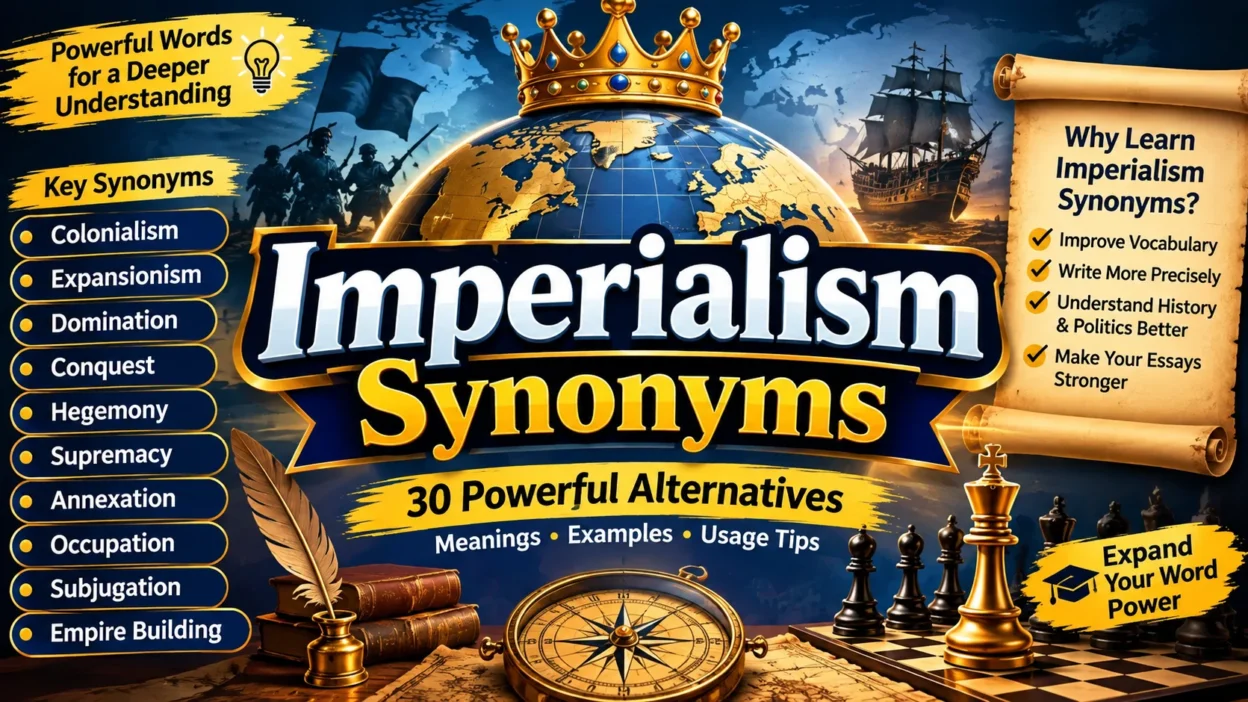
Understanding imperialism synonyms can help students, ESL learners, writers, and content creators express ideas about political power, territorial expansion, domination, and historical control more precisely. The word imperialism describes a policy or practice in which a powerful country extends its influence or control over other countries, territories, or peoples.
Depending on the context, you may need a word that emphasizes colonial rule, political domination, territorial expansion, or economic control. While many related words overlap with imperialism, they do not all carry exactly the same meaning or emotional tone.
This guide explains 30 useful synonyms and closely related terms for imperialism in simple English. Each word includes an easy definition, an example sentence, and guidance on when it works best.
Important note: Not every word below is a perfect dictionary synonym for imperialism. Some are closely related concepts that are useful substitutes depending on the sentence and context.
What Does Imperialism Mean?
Imperialism is the policy or practice of extending a country’s power and influence over other nations, territories, or peoples.
It can involve political control, military force, economic influence, settlement, or cultural pressure.
Example:
European imperialism changed the political and economic structure of many regions around the world.
Tone and Usage of “Imperialism”
The word imperialism is usually used in historical, political, academic, and social discussions. It often has a critical or negative tone, especially when describing exploitation, domination, or unequal relationships between powerful and weaker nations.
For example:
- Academic: “The study examines the effects of imperialism on local economies.”
- Historical: “Imperialism shaped international relations during the nineteenth century.”
- Critical: “The policy was criticized as a form of economic imperialism.”
30 Imperialism Synonyms and Related Words
1. Colonialism
Meaning: The practice of controlling another country or territory and often settling people there.
Example:
Colonialism had lasting effects on the language and institutions of many nations.
Best usage: Historical discussions involving colonies and colonial rule.
2. Expansionism
Meaning: A policy of expanding a country’s territory, power, or influence.
Example:
The government’s expansionism increased tensions with neighboring countries.
Best usage: Political and historical writing about territorial growth.
3. Colonial Expansion
Meaning: The process of increasing control over foreign territories through colonies.
Example:
Colonial expansion transformed the political map of several continents.
Best usage: Formal historical writing.
4. Domination
Meaning: Strong control or power over another person, group, or country.
Example:
The empire maintained domination over several neighboring regions.
Best usage: Situations emphasizing control and unequal power.
5. Conquest
Meaning: The act of taking control of a place or people through military force.
Example:
The conquest of the region changed its political system.
Best usage: Military and historical contexts.
6. Subjugation
Meaning: The act of bringing someone or a group under complete control, often by force.
Example:
The population resisted years of subjugation by the occupying power.
Best usage: Strongly negative descriptions of forced control.
7. Hegemony
Meaning: Dominance or leadership by one country, group, or power over others.
Example:
The country sought regional hegemony through trade and military alliances.
Best usage: Academic, political, and international-relations writing.
8. Supremacy
Meaning: The position of having greater power or authority than others.
Example:
The empire competed for military supremacy in the region.
Best usage: Discussions of military, political, or economic superiority.
9. Territorial Expansion
Meaning: The process of increasing the amount of land controlled by a country.
Example:
Territorial expansion was a major goal of the growing empire.
Best usage: Geography and history.
10. Aggression
Meaning: Hostile or forceful behavior toward another country or group.
Example:
The invasion was viewed as an act of military aggression.
Best usage: Military and political contexts.
11. Annexation
Meaning: The formal addition of another territory to a country’s own territory.
Example:
The annexation of the territory was condemned by neighboring governments.
Best usage: Legal and political discussions of territorial control.
12. Occupation
Meaning: Control of a place by a foreign military force.
Example:
The city remained under foreign occupation for several years.
Best usage: Military and wartime contexts.
13. Exploitation
Meaning: The unfair use of people, resources, or opportunities for one’s own benefit.
Example:
The exploitation of natural resources became a major source of conflict.
Best usage: Economic and social criticism.
14. Militarism
Meaning: A strong emphasis on military power and military interests.
Example:
Growing militarism encouraged the government to increase its armed forces.
Best usage: Political and historical discussions where military power is central.
15. Interventionism
Meaning: A policy of becoming involved in the affairs of another country.
Example:
The government’s interventionism influenced political developments abroad.
Best usage: Foreign-policy discussions.
16. Foreign Domination
Meaning: Control or influence imposed by an outside country.
Example:
The movement demanded independence from foreign domination.
Best usage: Independence movements and political history.
17. Empire Building
Meaning: The process of creating or expanding a powerful empire.
Example:
Empire building became a major objective of the ruling dynasty.
Best usage: Historical and accessible writing.
18. Power Expansion
Meaning: The process of increasing political, military, or economic influence.
Example:
The nation’s power expansion worried its neighboring states.
Best usage: General political analysis.
19. Political Dominance
Meaning: A position in which one country or group has greater political power over others.
Example:
The country established political dominance throughout the region.
Best usage: Politics and international relations.
20. Economic Dominance
Meaning: Strong economic control or influence over another country or region.
Example:
Economic dominance allowed the larger nation to influence local policies.
Best usage: Trade, economics, and globalization discussions.
21. Territorialism
Meaning: A strong concern with controlling or expanding territory.
Example:
Territorialism contributed to disputes between the neighboring states.
Best usage: Academic and political contexts.
22. Power Politics
Meaning: Political behavior focused strongly on gaining and maintaining power.
Example:
Power politics influenced the alliances formed during the conflict.
Best usage: International relations and political analysis.
23. Coercion
Meaning: The use of force or threats to make someone act in a particular way.
Example:
The smaller state accused the larger country of economic coercion.
Best usage: Situations involving pressure, threats, or forced decisions.
24. Oppression
Meaning: Cruel or unfair treatment and control of a group.
Example:
The population organized a movement against political oppression.
Best usage: Human-rights and social discussions.
25. Subordination
Meaning: The condition of being placed under the authority or control of another.
Example:
The policy created a relationship of political subordination.
Best usage: Formal academic and political writing.
26. Colonization
Meaning: The process of establishing control over a territory and often settling it with people from another country.
Example:
Colonization profoundly affected the region’s political institutions.
Best usage: Historical and academic contexts.
27. Imperial Expansion
Meaning: The growth of an empire’s territory, influence, or power.
Example:
Imperial expansion continued throughout the century.
Best usage: Historical writing about empires.
28. Cultural Domination
Meaning: The process of one culture becoming dominant over another.
Example:
Critics argued that cultural domination threatened local traditions.
Best usage: Cultural studies, sociology, and social commentary.
29. Economic Imperialism
Meaning: The use of economic power to influence or control another country.
Example:
Some scholars describe the unequal trade relationship as economic imperialism.
Best usage: Economics, development studies, and political analysis.
30. Neo-imperialism
Meaning: Modern forms of influence or control that resemble imperialism without traditional direct colonial rule.
Example:
The writer examined whether foreign investment could contribute to neo-imperialism.
Best usage: Modern political, economic, and academic discussions.
Quick Comparison of Imperialism Synonyms
| Word | Main Idea | Tone | Best Context |
|---|---|---|---|
| Colonialism | Control through colonies | Negative/neutral | History |
| Expansionism | Expanding territory or influence | Neutral/critical | Politics |
| Domination | Strong control | Negative | General/political |
| Conquest | Taking territory by force | Negative | Military/history |
| Subjugation | Forced control | Strongly negative | Human rights/history |
| Hegemony | Dominant influence | Academic | International relations |
| Supremacy | Being more powerful | Neutral/negative | Military/politics |
| Annexation | Formally adding territory | Neutral/critical | Law/politics |
| Occupation | Foreign military control | Negative | War/history |
| Exploitation | Unfair use for benefit | Negative | Economics/social issues |
| Interventionism | Involvement in another country | Neutral/critical | Foreign policy |
| Empire Building | Creating or expanding an empire | Neutral/critical | History |
| Oppression | Cruel or unfair control | Strongly negative | Social issues |
| Economic Imperialism | Economic control | Critical | Economics |
| Cultural Domination | Cultural influence/control | Critical | Culture/social studies |
How to Choose the Right Imperialism Synonym
Choosing the best synonym depends on what aspect of imperialism you want to emphasize.
For Historical Writing
Use:
- Colonialism
- Colonization
- Colonial expansion
- Conquest
- Imperial expansion
- Empire building
These terms work well when discussing historical empires, colonies, and territorial growth.
For Political Writing
Use:
- Hegemony
- Domination
- Expansionism
- Political dominance
- Interventionism
- Power politics
These words are useful when discussing international relations and political influence.
For Military Contexts
Use:
- Conquest
- Occupation
- Aggression
- Militarism
- Supremacy
- Subjugation
These terms emphasize force, military control, or conflict.
For Economic Contexts
Use:
- Economic dominance
- Economic imperialism
- Exploitation
- Coercion
These are better when the focus is trade, resources, investment, or financial influence.
For Strongly Critical Writing
Use:
- Oppression
- Subjugation
- Exploitation
- Foreign domination
- Cultural domination
These terms emphasize the harmful effects of unequal power.
Imperialism vs. Colonialism
Imperialism and colonialism are closely related, but they are not always interchangeable.
Imperialism is the broader concept of extending power or influence over another country or region. It can happen through political, military, economic, or cultural means.
Colonialism generally refers more specifically to establishing control over a territory, often involving settlement and formal colonial administration.
Example:
Imperialism can involve economic influence, while colonialism traditionally involves direct territorial control.
Imperialism vs. Expansionism
Expansionism focuses on the desire or policy of expanding a country’s territory or influence.
Imperialism can involve expansion, but it also includes broader forms of political, economic, and cultural domination.
For example:
- The nation followed a policy of territorial expansionism.
- The empire’s imperialism affected the region’s economy and culture.
Imperialism vs. Hegemony
Hegemony refers to dominance or leadership, especially when one country has significant influence over others.
Unlike traditional imperialism, hegemony does not necessarily require direct political control or colonization.
Example:
The country maintained regional hegemony through economic strength and diplomacy.
Why Understanding Imperialism Synonyms Matters
Learning different words related to imperialism is valuable because each term highlights a slightly different idea.
For students, these distinctions can improve essays, research papers, and exam answers. ESL learners can also use them to understand historical and political texts more accurately.
For writers and content creators, choosing the right term makes an argument clearer and avoids repeating the same word throughout an article.
Instead of writing “imperialism” repeatedly, you might use colonialism when discussing colonies, hegemony when discussing influence, or subjugation when emphasizing forced control.
Example Sentences Using Imperialism Synonyms
Here are several examples showing how these words can work naturally:
- Colonialism: Colonialism influenced the language, education, and political systems of many societies.
- Expansionism: The government’s expansionism created tension with neighboring states.
- Hegemony: Economic strength helped the country establish regional hegemony.
- Conquest: The conquest changed the leadership structure of the kingdom.
- Exploitation: The exploitation of local resources benefited foreign companies.
- Subjugation: The people resisted political subjugation.
- Occupation: The territory remained under military occupation.
- Annexation: The annexation of the disputed territory caused international criticism.
- Economic imperialism: The researcher examined the effects of economic imperialism on developing economies.
- Cultural domination: The community feared cultural domination and the loss of local traditions.
Frequently Asked Questions About Imperialism Synonyms
What is the closest synonym for imperialism?
Colonialism is often one of the closest related terms, especially when imperialism involves direct control of foreign territories. However, imperialism is broader and can include economic, political, military, or cultural influence.
What is another word for imperialism in simple English?
In simple English, you can describe imperialism as the control or influence of one powerful country over another country or territory. Depending on context, domination, expansionism, or colonialism may work.
Is colonialism the same as imperialism?
No. Colonialism is closely connected to imperialism but is more specifically associated with establishing and maintaining colonies. Imperialism is a broader concept.
What is a negative synonym for imperialism?
Words such as subjugation, oppression, exploitation, domination, and foreign domination can express strongly negative aspects of imperialism.
What is a synonym for imperial expansion?
Useful alternatives include territorial expansion, colonial expansion, expansionism, and empire building.
What is the opposite of imperialism?
Depending on the context, possible opposites include independence, self-determination, sovereignty, non-intervention, and decolonization.
Final Takeaways
The best imperialism synonyms depend on the specific meaning you want to communicate. Colonialism and colonization are useful for discussions of colonies, while expansionism emphasizes territorial or political growth. Hegemony focuses on dominance and influence, whereas conquest and occupation emphasize military control.
For strongly critical contexts, terms such as subjugation, oppression, exploitation, and domination may be more appropriate. Understanding these differences allows you to write with greater accuracy, variety, and clarity.
Whether you are a student writing a history essay, an ESL learner building vocabulary, or a writer looking for a more precise expression, knowing these related terms can help you communicate the complex ideas surrounding imperialism more effectively.

Alexander Eric is the Administrator of SynonymLot, dedicated to providing accurate synonyms, vocabulary resources, and language tools. He enjoys helping readers improve writing, communication, and English word knowledge daily.