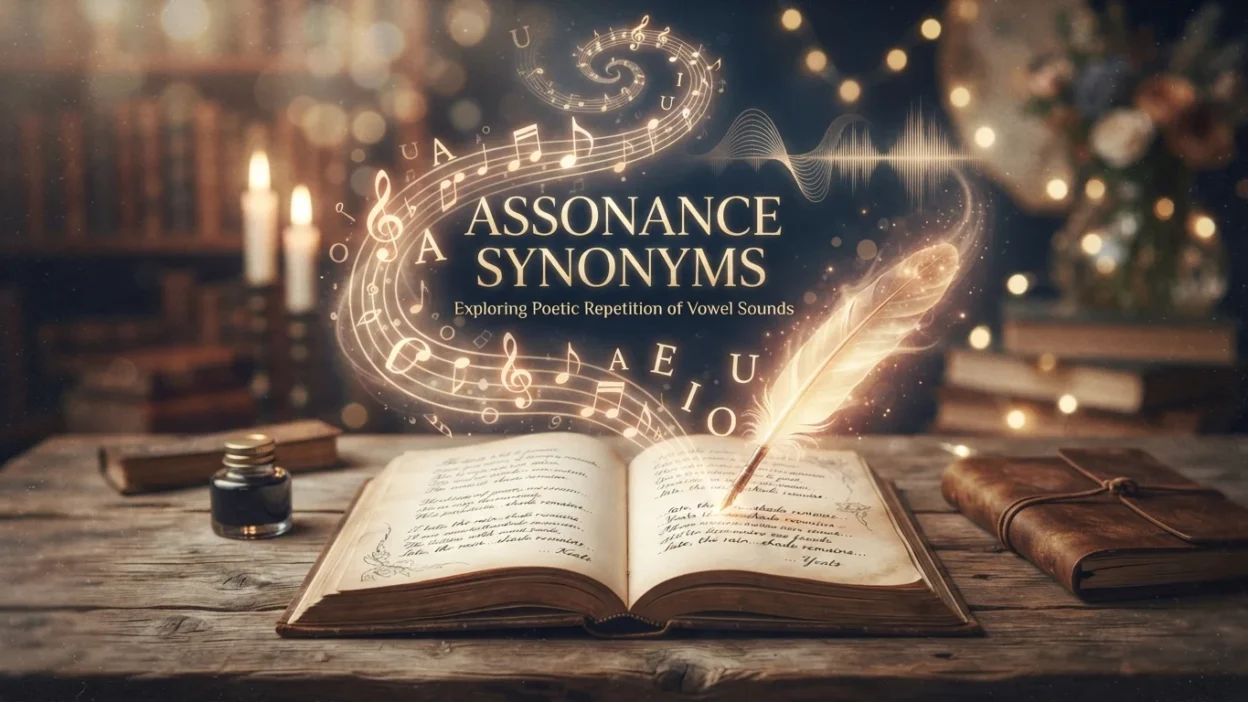
Have you ever read a poem or a sentence that just seemed to flow beautifully? Chances are, the writer used a technique called assonance. But what exactly does it mean, and why should you care?
Put simply, assonance is the repetition of vowel sounds in words that are close to each other. It’s the “long O” sound in “Go slow on the road.” This technique is a powerful tool in poetry and prose, used to create rhythm, mood, and musicality.
But when you’re talking about this concept, what are the assonance synonyms you can use? Whether you’re a student trying to understand poetic devices, an ESL learner expanding your vocabulary, or a writer looking for the perfect word, this guide is for you. We will explore the meaning of assonance, provide a long list of related words, and help you understand the nuances between them.
What Does “Demure” Mean? (A Quick Guide)
Before we jump into the list of synonyms for assonance, let’s take a quick detour. You might be here because you heard the word “demure” in a social media trend and wondered what it means. While it isn’t a direct synonym for assonance, understanding word meanings is part of building vocabulary.
Demure is an adjective used to describe someone who is quiet, modest, and reserved. It often suggests a shy or serious manner . Imagine a person who speaks softly, wears simple and modest clothing, and generally avoids being the center of attention. That person could be described as demure. It’s the opposite of being bold, loud, or brash . For example, you might say, “She gave a demure smile and looked down at her feet.”
30 Synonyms of Assonance (and Related Terms)
The word “assonance” is quite specific. Many of its assonance synonyms describe similar sound devices or general sound qualities. Here is a list of 30 synonyms and related terms, explained in simple English.
1. Alliteration
- Meaning: The repetition of the same beginning consonant sound in nearby words (e.g., “Peter Piper picked”).
- Example: “Seven sisters slept soundly.”
- Best usage context: When discussing the repetition of initial consonant sounds, often used in poetry and tongue twisters.
2. Consonance
- Meaning: The repetition of consonant sounds anywhere within words (e.g., “pitter-patter”).
- Example: “Mike likes his new bike.”
- Best usage context: When focusing on the repeated “k” sound rather than the vowel sound.
3. Chime
- Meaning: A pleasing or harmonious combination of sounds.
- Example: “The chime of the children’s laughter filled the room.”
- Best usage context: Describing a pleasant, musical quality in sound.
4. Rhyme
- Meaning: A similarity of sound between words, especially at the ends of lines (e.g., “cat” and “hat”).
- Example: “The rhyme of ‘dream’ and ‘seem’ is perfect.”
- Best usage context: When words have identical sounds at the end, a very common term in poetry.
5. Jingle
- Meaning: A light, ringing sound, often used to refer to catchy, simple rhymes in advertisements.
- Example: “I can’t get that annoying advertising jingle out of my head.”
- Best usage context: When referring to a catchy, repetitive sound or phrase.
6. Clink
- Meaning: A short, sharp, metallic sound.
- Example: “The clink of glasses was a happy sound.”
- Best usage context: Describing a sharp, resonant sound.
7. Dingdong
- Meaning: The sound of a bell, or a monotonous rhythm.
- Example: “The dingdong of the doorbell echoed through the house.”
- Best usage context: Describing a repetitive and simple sound pattern.
8. Monotone
- Meaning: A single, unchanging tone or pitch in the voice.
- Example: “He gave a boring speech in a flat monotone.”
- Best usage context: Describing a lack of vocal variety, which is the opposite of assonance’s musicality.
9. Drone
- Meaning: A low, continuous, humming sound.
- Example: “The drone of the engine made me sleepy.”
- Best usage context: Describing a dull, continuous, low-pitched sound.
10. Gong
- Meaning: A large, loud, resonant sound, like that of a metal disc.
- Example: “The gong of the clock signaled the start of the new year.”
- Best usage context: When describing a deep, resonant, and powerful sound.
11. Harmonium
- Meaning: A musical sound or quality.
- Example: “The harmonium of the voices in the choir was beautiful.”
- Best usage context: When discussing the pleasant musicality of language.
12. Paronomasia
- Meaning: A fancy word for a pun or a play on words.
- Example: “The comedian’s paronomasia had the audience laughing.”
- Best usage context: When you want a technical term for wordplay involving similar sounds.
13. Crambo
- Meaning: A game in which one player gives a word and others find a rhyme.
- Example: “The children played crambo to pass the time.”
- Best usage context: In a historical or playful context for rhyming games.
14. Harping
- Meaning: Talking or writing about something repeatedly and at length.
- Example: “He kept harping on about the same point.”
- Best usage context: Describing a repetitive and annoying sound or topic.
15. Pitter-patter
- Meaning: A light, repeated, pattering sound.
- Example: “The pitter-patter of rain on the roof is so relaxing.”
- Best usage context: Describing a gentle, repeated sound, often of rain or footsteps.
16. Repetition
- Meaning: The action of repeating something.
- Example: “The repetition of the chorus makes the song catchy.”
- Best usage context: The general term for saying or doing something more than once.
17. Vowel Rhyme
- Meaning: Another term for assonance, specifically focusing on vowels.
- Example: “The poet used vowel rhyme to create a flow in the verse.”
- Best usage context: When you want to be specific that you are talking about vowel sounds.
18. Head Rhyme
- Meaning: Another term for alliteration (repetition of initial consonant sounds).
- Example: “The head rhyme in ‘wild and woolly’ gives the phrase a punch.”
- Best usage context: When discussing the repetition of the beginning sounds of words.
19. Beginning Rhyme
- Meaning: Same as head rhyme and alliteration.
- Example: “Beginning rhyme is often used in children’s poetry.”
- Best usage context: A simpler way to say alliteration for beginner learners.
20. Double Rhyme
- Meaning: A rhyme involving two syllables (e.g., “clever” and “never”).
- Example: “The double rhyme is common in limericks.”
- Best usage context: When analyzing rhyme schemes with more than one syllable.
21. Eye Rhyme
- Meaning: Words that look like they should rhyme based on spelling but don’t sound like it (e.g., “love” and “move”).
- Example: “The poet used an eye rhyme for visual effect.”
- Best usage context: When discussing the difference between spelling and pronunciation in poetry.
22. Near Rhyme
- Meaning: Words that have a partial but not perfect rhyme (e.g., “time” and “mine”).
- Example: “Using near rhyme can add a subtle dissonance to a song.”
- Best usage context: When the sounds are close but not exact.
23. Blank Verse
- Meaning: Poetry written in unrhymed iambic pentameter.
- Example: “Shakespeare often used blank verse in his plays.”
- Best usage context: Describing a specific poetic form.
24. Doggerel
- Meaning: Badly written or comic verse, often with forced rhymes.
- Example: “His first attempt at poetry was just doggerel.”
- Best usage context: When criticizing or referring to low-quality poetry.
25. Humdrum
- Meaning: Lacking variety; monotonous or boring.
- Example: “He lived a humdrum life with no excitement.”
- Best usage context: Describing a lack of variety in sound or life.
26. Monotony
- Meaning: The state of being boring or having no variety.
- Example: “The monotony of the sound put him to sleep.”
- Best usage context: Similar to humdrum, focusing on a lack of variety.
27. Singsong
- Meaning: A repetitive, rhythmic, and often tedious way of speaking.
- Example: “The children recited the poem in a singsong voice.”
- Best usage context: Describing a childlike, repetitive vocal rhythm.
28. Tone
- Meaning: The general character or attitude of a piece of writing or sound.
- Example: “The tone of the story was dark and mysterious.”
- Best usage context: A broad term for the overall quality of sound or writing.
29. Accent
- Meaning: A distinctive way of pronouncing a language.
- Example: “Her French accent was charming.”
- Best usage context: When discussing pronunciation, which is related to sound.
30. Rhythm
- Meaning: The pattern of beats or stress in a language.
- Example: “The rhythm of the poem was like a gentle dance.”
- Best usage context: When discussing the flow and pattern of sounds in speech.
Comparison Table: When to Use Different Synonyms
Sometimes the best way to understand is to compare. Here is a quick guide to help you choose the right synonym.
| Synonym | Best Used For |
|---|---|
| Assonance | Talking specifically about the repetition of vowel sounds (e.g., “lake” and “fate”). |
| Alliteration | Talking specifically about the repetition of beginning consonant sounds (e.g., “big blue ball”). |
| Consonance | Talking about the repetition of consonant sounds at any point in the word (e.g., “pitter-patter”). |
| Rhyme | When words have identical sounds, usually at the end of lines (e.g., “day” and “say”). |
| Chime / Jingle / Dingdong | Describing a light, pleasant, and often catchy sound that is musical. |
How to Choose the Right Synonym
Using the right synonym depends on what you want to say.
When you want to be precise:
- If you’re talking about vowel sounds, use assonance.
- If you’re talking about beginning consonant sounds, use alliteration.
- If you’re talking about any consonant sounds, use consonance.
When you want to be general:
- Use rhyme or sound repetition. These words are safe and commonly understood.
When you want to be descriptive:
- Use words like chime, jingle, or singsong to describe a pleasant or rhythmic sound.
- Use words like monotone, drone, or humdrum to describe a boring or flat sound.
Conclusion
Understanding the nuances of sound devices is a superpower for any writer or student. The word assonance might be specific, but there are many assonance synonyms and related terms that can help you describe the musicality of language perfectly.
From the precise technicality of consonance to the catchiness of a jingle, each word we’ve explored offers a unique shade of meaning. By using this guide, you can improve your vocabulary, appreciate the art of writing, and even add more sonic depth to your own work. So next time you hear a phrase that sounds beautiful, you will have the perfect word to describe it.

Amber Amy is a passionate writer at SynonymLot, dedicated to helping readers discover better words, expand their vocabulary, and improve their writing through clear, accurate, and easy-to-understand synonym guides.