The word “me” is one of the most common pronouns in English. It refers to the speaker or writer when that person is receiving an action or is the object of a verb or preposition. For example, “She called me” and “This gift is for me.”
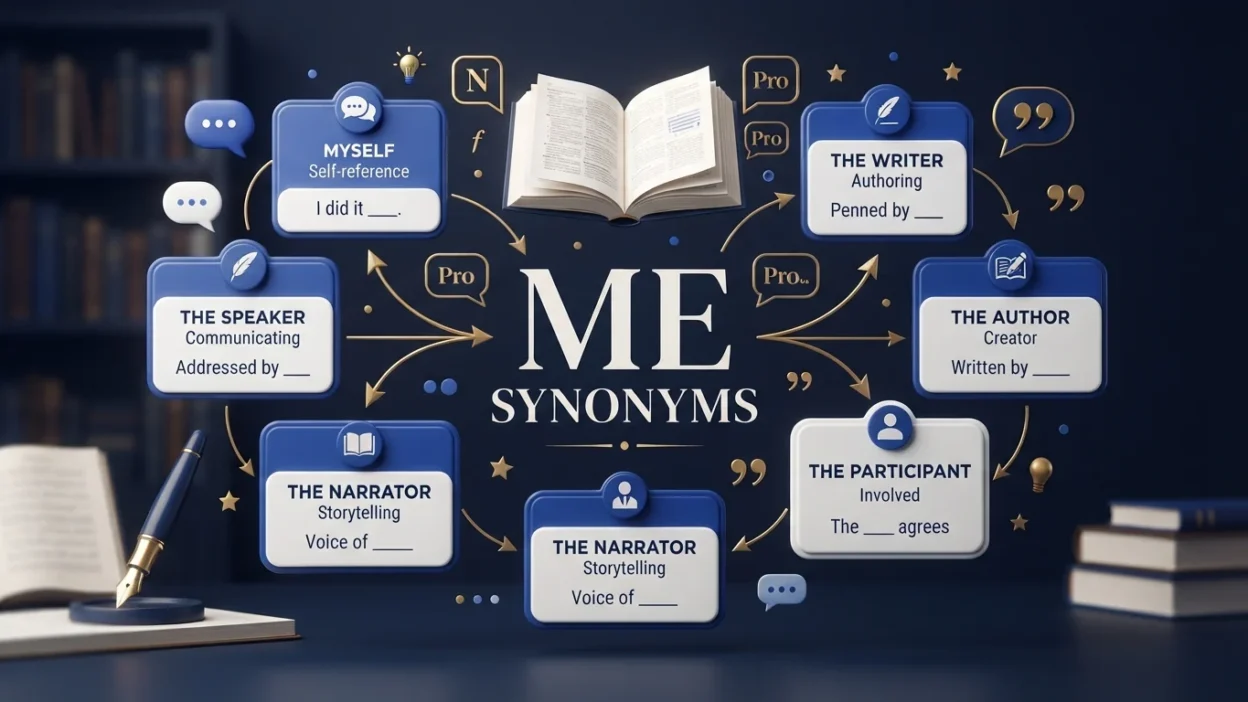
Finding exact me synonyms can be challenging because “me” is a grammatical pronoun rather than a word with many direct substitutes. Depending on the sentence, however, you can sometimes replace it with phrases such as myself, my person, the speaker, this person, or the individual concerned. The best choice depends on grammar, context, tone, and whether you are writing formally or informally.
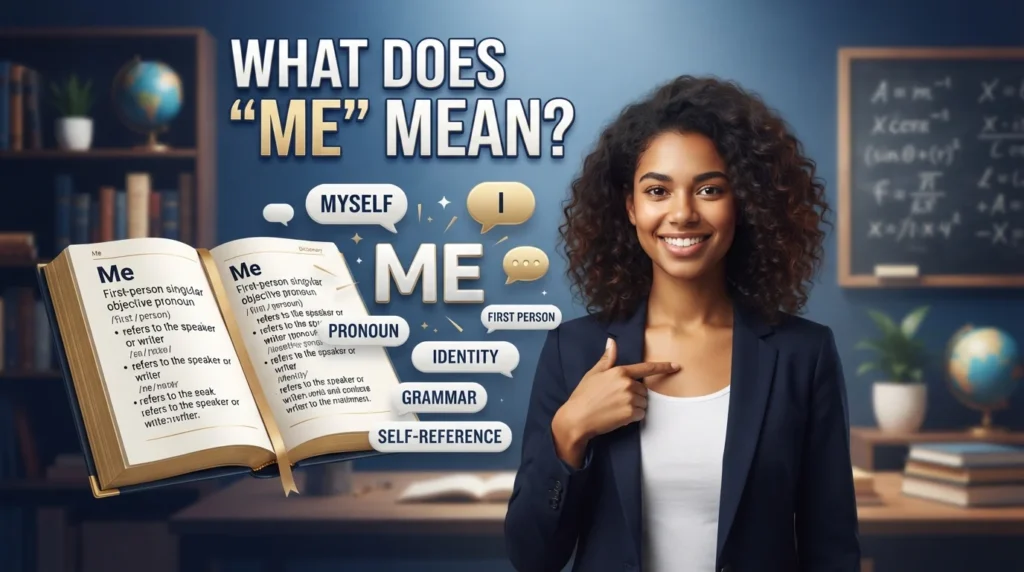
What Does “Me” Mean?
Me is the objective form of the first-person singular pronoun “I.” It is used when the speaker or writer is the person receiving an action or following a preposition.
Examples
- She helped me with my homework.
- Please give me the book.
- They invited me to dinner.
- This message is for me.
In everyday English, “me” is usually the most natural and direct choice. Its alternatives are often phrases that change the emphasis or grammatical structure rather than perfect one-word synonyms.
30 Synonyms and Alternatives for “Me”
Below are useful alternatives and related expressions. Remember that they are context-dependent, so not every option can replace “me” in every sentence.
| # | Word / Alternative | Simple Meaning | Example | Best Usage |
|---|---|---|---|---|
| 1 | Myself | Refers back to the speaker | I did it myself. | Emphasis or reflexive use |
| 2 | I | First-person form of “me” | I completed the task. | When “me” is the subject |
| 3 | My person | A formal or playful way to refer to oneself | Please direct the question to my person. | Formal, humorous, or stylized writing |
| 4 | The speaker | The person who is speaking | The speaker described the experience. | Formal or academic writing |
| 5 | The writer | The person who wrote something | The writer explains the idea clearly. | Articles and academic contexts |
| 6 | The author | The person who created written work | The author presents a personal view. | Books and formal writing |
| 7 | This person | Refers to the person being discussed | This person would like to help. | Third-person style |
| 8 | This individual | A formal expression for a person | This individual believes the plan will work. | Formal writing |
| 9 | The individual | A particular person | The individual contacted the office. | Academic or professional writing |
| 10 | The person concerned | The person involved in an issue | The person concerned should respond. | Formal situations |
| 11 | The one speaking | The person currently talking | The one speaking is responsible for the statement. | Explanatory contexts |
| 12 | The writer of this | The person who wrote the current text | The writer of this piece believes in lifelong learning. | Articles or essays |
| 13 | The narrator | The person telling a story | The narrator describes his journey. | Fiction and storytelling |
| 14 | The character | A person represented in a story | The character struggles with the decision. | Fiction |
| 15 | The protagonist | Main character in a story | The protagonist faces a difficult choice. | Literature |
| 16 | The subject | The person being discussed or studied | The subject described the event. | Research and academic writing |
| 17 | The participant | Someone taking part in something | The participant shared an opinion. | Surveys and studies |
| 18 | The respondent | Someone answering questions | The respondent selected the first option. | Surveys and research |
| 19 | The applicant | A person applying for something | The applicant submitted the form. | Jobs and applications |
| 20 | The customer | A person buying something | The customer requested assistance. | Business contexts |
| 21 | The client | A person receiving professional services | The client asked for an update. | Business and professional writing |
| 22 | The user | A person using a product or service | The user can change the settings. | Technology and instructions |
| 23 | The reader | A person reading something | The reader can find more information below. | Blogs and publications |
| 24 | The learner | A person who is learning | The learner should practice regularly. | Education |
| 25 | The student | A person studying | The student completed the assignment. | School and education |
| 26 | The employee | A person working for an organization | The employee reported the issue. | Workplace writing |
| 27 | The speaker/writer | The person communicating the message | The speaker/writer expresses a personal opinion. | Formal explanations |
| 28 | My own person | A strong way to emphasize oneself | I want to make the decision as my own person. | Personal or expressive writing |
| 29 | Yours truly | A traditional expression referring to oneself | Yours truly appreciates your support. | Letters and playful/formal writing |
| 30 | Your humble servant | An old-fashioned expression for oneself | Your humble servant remains grateful. | Historical or humorous writing |
“Me” vs. “Myself”
One of the most important distinctions is between me and myself.
Me is normally used as an object:
She invited me.
Myself is generally used reflexively:
I hurt myself.
It can also provide emphasis:
I made the cake myself.
Therefore, “myself” is not a universal synonym for “me.” Replacing “me” with “myself” can make a sentence grammatically incorrect.
Comparison Guide: Which Alternative Should You Use?
| Alternative | Tone | Best For |
|---|---|---|
| Me | Natural | Everyday English |
| Myself | Personal/emphatic | Reflexive or emphatic sentences |
| I | Standard | Subject position |
| The speaker | Formal | Speeches and analysis |
| The writer | Formal | Articles and essays |
| The author | Formal | Books and publications |
| The narrator | Literary | Stories |
| The protagonist | Literary | Main characters |
| The participant | Academic | Research |
| The respondent | Academic | Surveys |
| The applicant | Professional | Applications |
| The customer | Business | Commerce |
| The client | Professional | Services |
| The user | Technical | Software and products |
| The reader | Informative | Articles and guides |
| The learner | Educational | Language learning |
| Yours truly | Old-fashioned | Letters or humor |
How to Choose the Right Synonym for “Me”
Choosing an alternative to “me” depends heavily on your sentence.
1. For Everyday Conversation
Use me.
It is short, natural, and understood by everyone.
Can you help me?
There is usually no reason to replace it.
2. For Emphasis
Use myself when the sentence requires a reflexive pronoun or when you want to emphasize that you personally performed an action.
I prepared the presentation myself.
3. For Academic Writing
Instead of repeatedly saying “me,” writers may restructure the sentence or use terms such as the researcher, the participant, the respondent, or the author, depending on the actual role.
The participant reported feeling confident.
This is often clearer than repeatedly using first-person language.
4. For Stories
Use terms such as the narrator, the protagonist, or the character when discussing someone within a story.
The narrator explains why the journey was important.
5. For Professional Writing
Words such as the applicant, the employee, the customer, and the client can be more precise than “me” when describing a person’s professional role.
6. For Formal or Historical Writing
Expressions such as yours truly or your humble servant may work when the writing intentionally has an old-fashioned, ceremonial, or humorous tone.
Why There Are Few Exact Synonyms for “Me”
Unlike adjectives such as happy, which can have alternatives like joyful, cheerful, and pleased, “me” is a grammatical pronoun.
Its meaning is closely tied to the speaker.
For example:
John helped me.
The word me specifically identifies the speaker as the person receiving John’s help.
Changing it to:
John helped the writer.
changes the perspective and meaning. It no longer directly addresses the speaker through first-person grammar.
This is why many so-called me synonyms are actually contextual alternatives or sentence substitutions, rather than exact synonyms.
Me Synonyms for Different Writing Situations
Casual Writing
- me
- myself
- I
Academic Writing
- the researcher
- the participant
- the respondent
- the subject
- the author
Professional Writing
- the applicant
- the employee
- the client
- the customer
- the individual
Technology Writing
- the user
- the individual
- the customer
- the account holder
Literary Writing
- the narrator
- the protagonist
- the character
- the speaker
Formal or Traditional Writing
- yours truly
- your humble servant
- my person
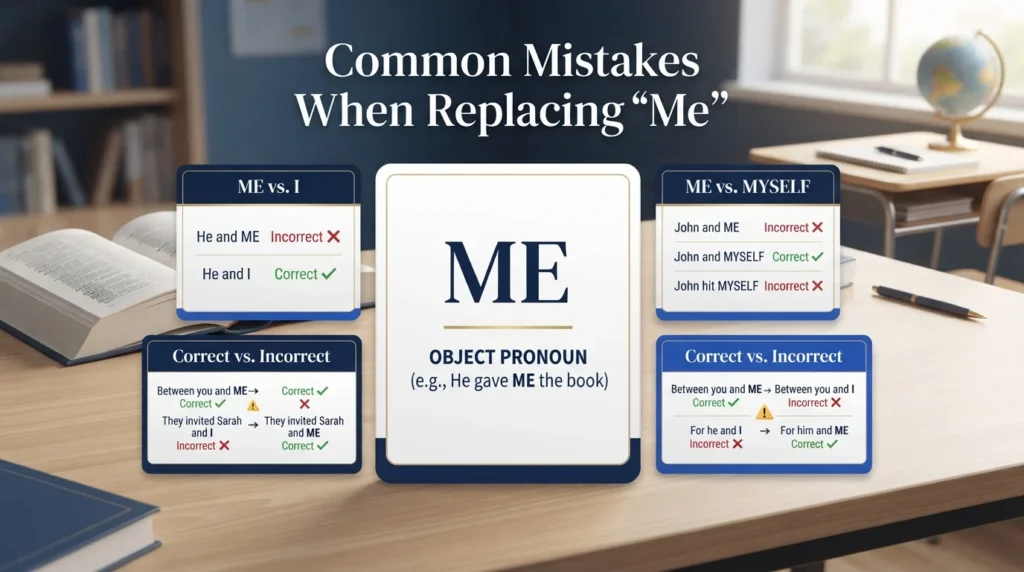
Common Mistakes When Replacing “Me”
Mistake 1: Using “Myself” Everywhere
Incorrect:
Please send the information to myself.
Better:
Please send the information to me.
“Yourself,” “myself,” and similar forms should not automatically replace objective pronouns.
Mistake 2: Confusing “I” and “Me”
Incorrect:
Sarah and me went shopping.
Correct:
Sarah and I went shopping.
But:
Sarah invited me.
The basic rule is that I is generally used as a subject, while me is used as an object.
Mistake 3: Forcing Formal Alternatives
Replacing every instance of “me” with a formal expression can make writing sound unnatural.
For example:
Please give the document to my person.
sounds unnecessarily formal in normal conversation.
Simply saying:
Please give the document to me.
is clearer and more natural.
Frequently Asked Questions About “Me Synonyms”
What is the closest synonym for “me”?
There is no perfect universal synonym for me. Myself is related but is not interchangeable in every sentence. The best alternative depends on grammatical function and context.
Can “I” be a synonym for “me”?
I and me are forms of the same first-person singular pronoun, but they have different grammatical roles. I is normally used as a subject, while me is normally used as an object.
Is “myself” a synonym for “me”?
Not exactly. Myself is a reflexive pronoun and can also add emphasis. It should only replace “me” when the grammar and meaning are appropriate.
What can I use instead of “me” in formal writing?
Depending on the context, you might use the author, the researcher, the participant, the respondent, the applicant, or the individual. However, changing the pronoun can also change the meaning or perspective.
What is the best alternative to “me” in academic writing?
There is no single best replacement. Use a precise role-based term such as the researcher or the participant when that description is accurate. Otherwise, first-person writing may be clearer.
Final Thoughts on “Me Synonyms”
The word “me” is simple but grammatically important. Because it is a first-person objective pronoun, it does not have dozens of exact synonyms in the same way that descriptive words do.
Instead, writers can use myself, the speaker, the writer, the author, the narrator, the participant, the respondent, the individual, the client, or other context-specific expressions when appropriate. The key is to choose an alternative that preserves both the intended meaning and the correct grammatical structure.
For everyday English, “me” is usually the clearest choice. For formal, academic, professional, or literary writing, a more specific description may sometimes provide greater precision.

David Henry is a language enthusiast and content writer specializing in synonyms, vocabulary, and word meanings. He creates clear, engaging resources that help readers improve their writing, communication, and English skills.