
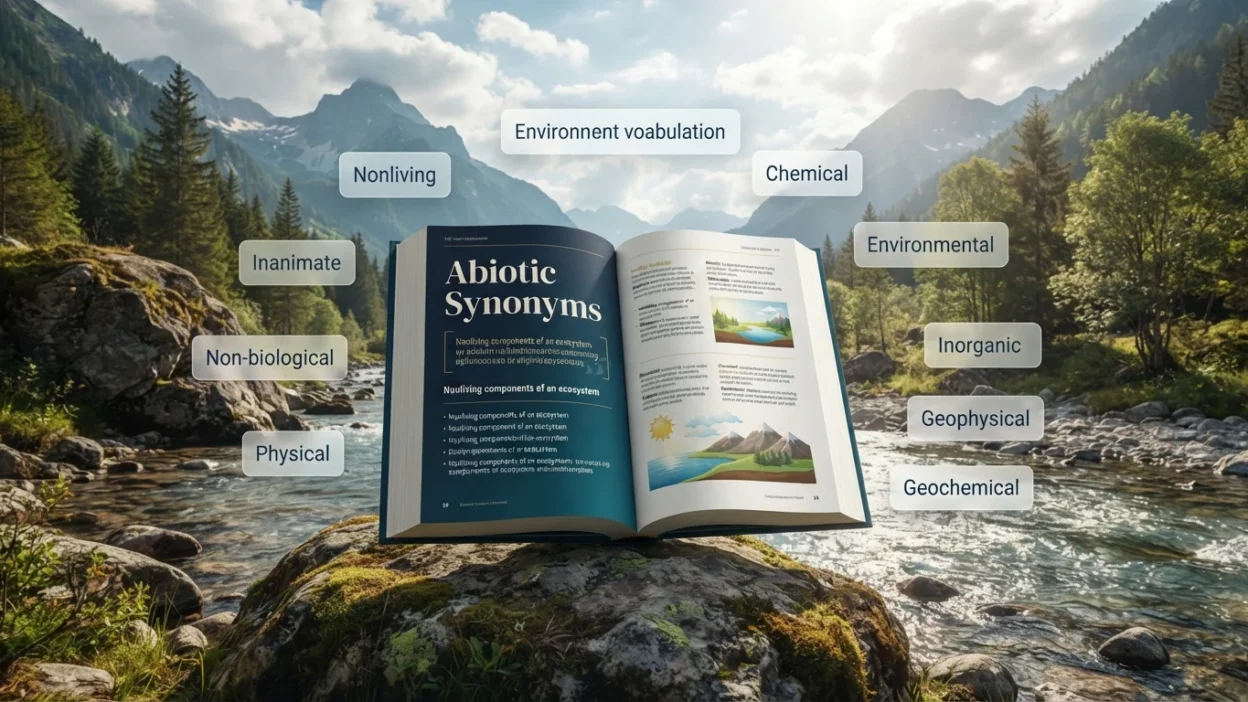
When studying biology, ecology, environmental science, or natural systems, you may often encounter the word abiotic. Understanding its meaning and related words can make scientific writing easier and help you describe the nonliving parts of an environment more accurately.
The word abiotic generally refers to something that is not living or is not produced by living organisms. In an ecosystem, abiotic factors include sunlight, temperature, water, air, soil, minerals, and climate. These factors can strongly affect living organisms and the way ecosystems function.
Finding the right abiotic synonyms can also be useful for students, ESL learners, writers, researchers, and content creators. However, not every related word has exactly the same scientific meaning. Some alternatives are general, while others are better suited to ecology, biology, or environmental writing.
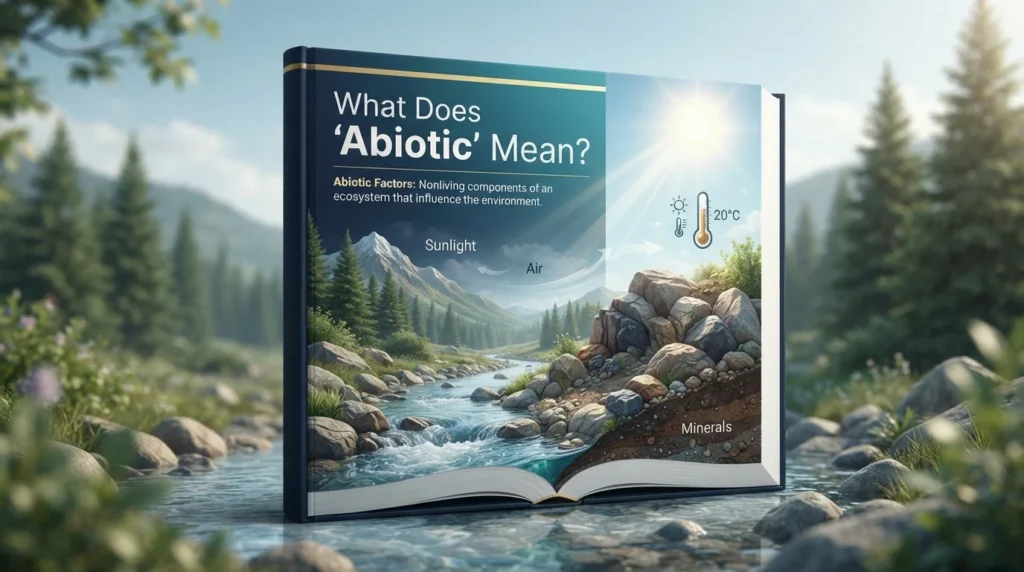
What Does “Abiotic” Mean?
Abiotic means related to nonliving things or physical and chemical parts of the environment.
In simple English, if something is abiotic, it is not alive.
Examples
- Sunlight is an abiotic factor in an ecosystem.
- Temperature is an important abiotic condition for plants.
- Water quality can influence organisms through an ecosystem’s abiotic environment.
- Soil contains many abiotic components, including minerals and water.
The word abiotic is especially common in scientific and academic writing.
Abiotic vs. Biotic
The easiest way to understand the word is to compare it with biotic.
| Term | Simple Meaning | Examples |
|---|---|---|
| Abiotic | Nonliving | Sunlight, water, rocks, temperature |
| Biotic | Living or related to living organisms | Plants, animals, fungi, bacteria |
For example, a forest contains both biotic factors, such as trees and insects, and abiotic factors, such as sunlight, rainfall, soil, and temperature.
30 Abiotic Synonyms and Related Words
Below are 30 useful synonyms or closely related expressions for abiotic. Because abiotic is a specialized scientific term, some alternatives are broader rather than exact one-word synonyms.
1. Nonliving
Meaning: Something that is not alive.
Example: Water, rocks, and sunlight are nonliving components of an ecosystem.
Best usage context: General science and educational writing.
2. Inanimate
Meaning: Not alive and without the characteristics of living organisms.
Example: The researcher examined both living organisms and inanimate objects in the environment.
Best usage context: Formal, scientific, and general descriptive writing.
3. Lifeless
Meaning: Having no life.
Example: The barren landscape contained several lifeless rocks and dry surfaces.
Best usage context: General or descriptive writing.
4. Non-biological
Meaning: Not related to living organisms or biological processes.
Example: Temperature is a major non-biological influence on many aquatic organisms.
Best usage context: Biology, ecology, and academic writing.
5. Physical
Meaning: Related to the material or measurable conditions of the environment rather than living organisms.
Example: Physical conditions such as temperature and light can affect plant growth.
Best usage context: Environmental science and ecology.
6. Chemical
Meaning: Related to chemical substances or chemical conditions rather than living organisms.
Example: Chemical conditions in the water can determine which species survive.
Best usage context: Environmental chemistry and ecology.
7. Environmental
Meaning: Related to the surroundings or conditions in which organisms exist.
Example: Environmental conditions can influence the distribution of animals.
Best usage context: Ecology and environmental science.
8. Extrabiological
Meaning: Existing outside biological or living processes.
Example: The study examined extrabiological influences on the ecosystem.
Best usage context: Specialized academic writing.
9. Nonorganic
Meaning: Not originating from living organisms; in some contexts, referring to inorganic matter.
Example: Nonorganic components such as minerals contribute to soil structure.
Best usage context: General scientific writing, although context matters.
10. Inorganic
Meaning: Relating to matter that is generally not classified as organic.
Example: Inorganic minerals are important components of many natural environments.
Best usage context: Chemistry, biology, geology, and environmental science.
11. Material
Meaning: Relating to physical matter or substances.
Example: Material components of the habitat included rocks, sand, and mineral deposits.
Best usage context: General scientific descriptions.
12. Physical-chemical
Meaning: Involving both physical and chemical conditions.
Example: Physical-chemical factors influence the quality of freshwater habitats.
Best usage context: Technical ecology and environmental research.
13. Geophysical
Meaning: Related to the physical properties and processes of Earth.
Example: Geophysical conditions can influence the development of different habitats.
Best usage context: Earth science, environmental science, and geography.
14. Geochemical
Meaning: Related to the chemical composition and processes of Earth.
Example: Geochemical conditions affect the availability of minerals in soil.
Best usage context: Geology, ecology, and environmental research.
15. Nonorganic Matter
Meaning: Physical matter that is not classified as organic material.
Example: Nonorganic matter such as sand and minerals can affect soil characteristics.
Best usage context: Educational and environmental explanations.
16. Nonliving Component
Meaning: A part of an environment that is not alive.
Example: Temperature is a nonliving component that affects organisms in the habitat.
Best usage context: Biology and ecology lessons.
17. Nonliving Factor
Meaning: An environmental condition that does not consist of living organisms.
Example: Rainfall is a major nonliving factor affecting plant communities.
Best usage context: Ecosystem discussions and biology education.
18. Physical Factor
Meaning: A measurable physical condition that affects an ecosystem or organism.
Example: Light intensity is an important physical factor in aquatic ecosystems.
Best usage context: Ecology and environmental science.
19. Chemical Factor
Meaning: A chemical condition that influences organisms or ecosystems.
Example: Soil pH is an important chemical factor affecting plant growth.
Best usage context: Biology, agriculture, and environmental science.
20. Environmental Factor
Meaning: A condition in the surroundings that influences organisms.
Example: Temperature is an environmental factor that affects the activity of many animals.
Best usage context: General science and ecology.
21. Ecological Factor
Meaning: A condition or influence that affects an ecosystem or its organisms.
Example: Water availability is an important ecological factor in desert environments.
Best usage context: Ecology and environmental writing.
22. Physical Component
Meaning: A nonliving physical part of an environment.
Example: Rocks are physical components of the mountain ecosystem.
Best usage context: Educational and scientific writing.
23. Chemical Component
Meaning: A chemical substance or condition forming part of an environment.
Example: Dissolved oxygen is an important chemical component of aquatic habitats.
Best usage context: Environmental science and biology.
24. Nonliving Element
Meaning: A nonliving part of an environment or system.
Example: Sunlight is a nonliving element that supports photosynthesis indirectly.
Best usage context: Beginner-friendly educational writing.
25. Physical Condition
Meaning: A measurable environmental state such as temperature, light, pressure, or moisture.
Example: The species survives only under particular physical conditions.
Best usage context: Ecology and scientific research.
26. Environmental Condition
Meaning: A surrounding condition that can influence organisms.
Example: Changes in environmental conditions can alter the composition of an ecosystem.
Best usage context: Environmental science and academic writing.
27. Non-biotic
Meaning: Not associated with living organisms.
Example: Researchers measured several non-biotic characteristics of the lake.
Best usage context: Technical and scientific writing.
28. Nonliving Influence
Meaning: An effect caused by a nonliving part of the environment.
Example: Temperature is a powerful nonliving influence on seasonal animal activity.
Best usage context: Ecology explanations.
29. Abiological
Meaning: Not involving living organisms or biological processes.
Example: The researchers investigated abiological processes affecting the formation of the landscape.
Best usage context: Specialized scientific writing.
30. Physical-Environmental
Meaning: Relating to the physical conditions of an environment.
Example: Physical-environmental conditions can determine which organisms thrive in a region.
Best usage context: Environmental and ecological discussions.
Abiotic Synonyms Comparison Table
Choosing an appropriate alternative depends on the context.
| Word or Phrase | Meaning | Best Context |
|---|---|---|
| Nonliving | Not alive | General science |
| Inanimate | Without life | Formal/general writing |
| Lifeless | Having no life | Descriptive writing |
| Non-biological | Not related to living systems | Biology |
| Physical | Relating to physical conditions | Ecology |
| Chemical | Relating to chemical conditions | Environmental science |
| Environmental | Relating to surroundings | General ecology |
| Inorganic | Not generally organic | Chemistry/geology |
| Geophysical | Physical Earth processes | Earth science |
| Geochemical | Chemical Earth processes | Geology |
| Nonliving factor | A nonliving environmental influence | Ecology |
| Physical factor | Physical environmental influence | Biology |
| Chemical factor | Chemical environmental influence | Ecology |
| Ecological factor | Influence within an ecosystem | Ecology |
| Abiological | Not involving biological processes | Technical writing |
Abiotic vs. Nonliving: Are They the Same?
The words abiotic and nonliving are closely related, but they are not always interchangeable in every sentence.
Nonliving is a broad and easy-to-understand word. It simply means something does not have life.
Abiotic is more specialized. In ecology, it usually describes the nonliving physical and chemical components of an ecosystem.
For example:
The forest contains many nonliving objects.
This is grammatically correct, but broad.
A more scientific statement would be:
Temperature, sunlight, and soil moisture are important abiotic factors in the forest.
The second sentence gives a more precise ecological meaning.
How to Choose the Right Abiotic Synonym
The best synonym depends on what you want to communicate.
For Simple English
Choose:
- Nonliving
- Nonliving element
- Nonliving factor
- Inanimate
These are useful when explaining science to beginners or ESL learners.
Example
Instead of:
Abiotic components influence ecosystem stability.
You could write:
Nonliving components influence ecosystem stability.
For Academic Writing
Choose:
- Non-biological
- Physical
- Chemical
- Environmental
- Abiological
These terms work well in research papers and formal scientific explanations.
Example
Non-biological factors influence the growth of aquatic plants.
For Ecology
Choose:
- Abiotic factor
- Nonliving factor
- Physical factor
- Chemical factor
- Environmental factor
- Ecological factor
These expressions are particularly useful when discussing ecosystems.
Example
Temperature is an important abiotic factor affecting species distribution.
For Chemistry and Environmental Science
Choose:
- Chemical
- Inorganic
- Geochemical
- Physical-chemical
- Chemical component
These words are useful when discussing substances, minerals, pH, dissolved materials, or chemical conditions.
For Earth Science
Choose:
- Geophysical
- Geochemical
- Physical
- Inorganic
- Environmental
These terms are useful when describing Earth systems and their physical or chemical processes.
Why Understanding Abiotic Synonyms Matters
Learning synonyms is more than memorizing replacement words. It helps you understand the small differences between terms.
For example, nonliving is very broad, while chemical identifies a particular type of abiotic condition. Likewise, geochemical is much more specialized than environmental.
Using the right word can make your writing clearer and more professional.
Students can use these terms in biology assignments, while researchers may need more precise vocabulary in scientific papers. Writers and content creators can also use alternatives to avoid repetitive language.
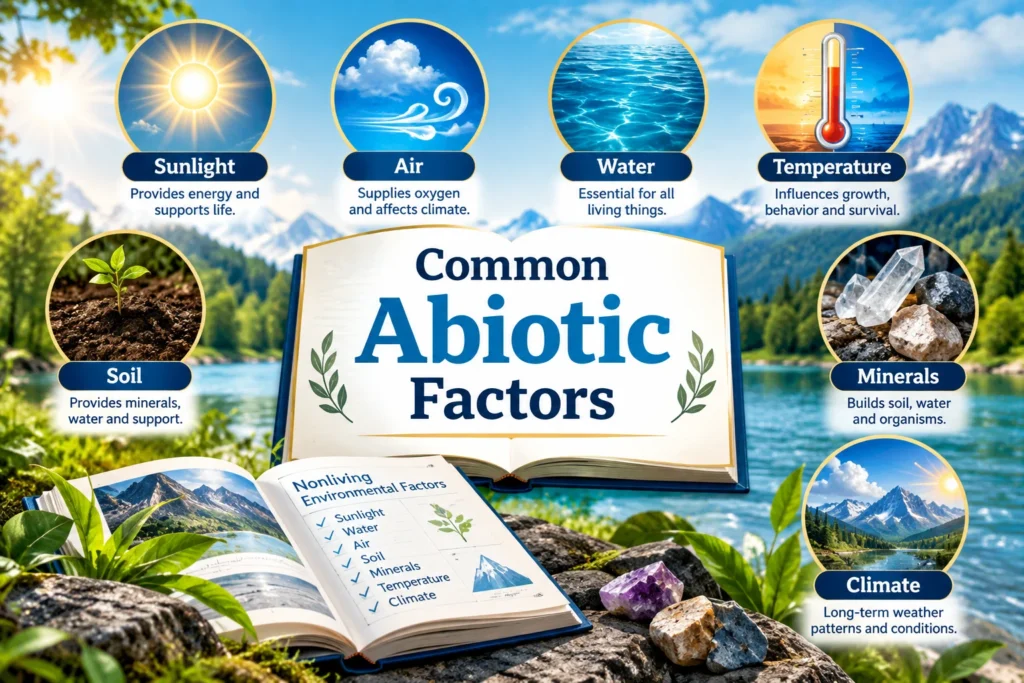
Common Abiotic Factors
To understand the word more clearly, it helps to know some common examples of abiotic factors.
Sunlight
Sunlight provides energy for photosynthesis and influences temperature and daily biological activity.
Temperature
Temperature affects metabolism, reproduction, growth, and survival.
Water
Water availability is especially important for plants, animals, and microorganisms.
Soil
Soil provides minerals, water, and physical support for many organisms.
Air
The composition and movement of air can affect living organisms and environmental conditions.
Minerals
Minerals contribute to soil and water chemistry and can influence biological processes.
pH
The acidity or alkalinity of soil and water can determine which organisms can survive.
Climate
Long-term patterns of temperature, rainfall, and other atmospheric conditions influence ecosystems.
Frequently Asked Questions About Abiotic Synonyms
What is the simplest synonym for abiotic?
The simplest synonym for abiotic is nonliving. It is easy for beginners and ESL learners to understand.
What is another word for abiotic factors?
Depending on the context, you can use nonliving factors, physical factors, chemical factors, or environmental factors.
Is “nonliving” the same as “abiotic”?
They are closely related. However, abiotic is a more specialized scientific term commonly used for nonliving physical and chemical components of ecosystems.
What is the opposite of abiotic?
The usual opposite is biotic, which refers to living organisms or biological components.
Is “inanimate” a synonym for abiotic?
Inanimate can be a close general synonym because it means not alive. However, abiotic has a more specific scientific meaning and is preferred in ecological contexts.
Can I use “inorganic” instead of “abiotic”?
Not always. Inorganic describes a category of substances, especially in chemistry, while abiotic describes nonliving components or influences in an ecological context. The two terms can overlap but should not automatically be treated as exact synonyms.
Quick Guide to Abiotic Synonyms
If you need a quick replacement, use this guide:
- Easy and general: nonliving
- Formal: inanimate
- Scientific: non-biological
- Ecological: abiotic factor
- Physical: physical factor
- Chemical: chemical factor
- Environmental: environmental factor
- Chemistry: inorganic
- Earth science: geophysical
- Earth chemistry: geochemical
- Technical: abiological
Final Thoughts on Abiotic Synonyms
Understanding abiotic synonyms can improve both your vocabulary and your scientific writing. The word abiotic specifically describes nonliving physical and chemical aspects of an environment, especially in ecology and biology.
The most useful general alternative is nonliving, while terms such as physical, chemical, environmental, non-biological, geophysical, and geochemical provide more specific meanings.
The key is to choose a synonym based on context. A simple word may be best for students and ESL learners, while a specialized term may be more appropriate for academic or scientific writing.
By learning these related words and understanding their differences, you can write more clearly, avoid repetition, and describe environmental systems with greater precision.

Daniel Jack is a language enthusiast and content writer who specializes in synonyms, vocabulary, and word meanings. He creates clear, engaging resources that help readers improve communication and expand their English skills.