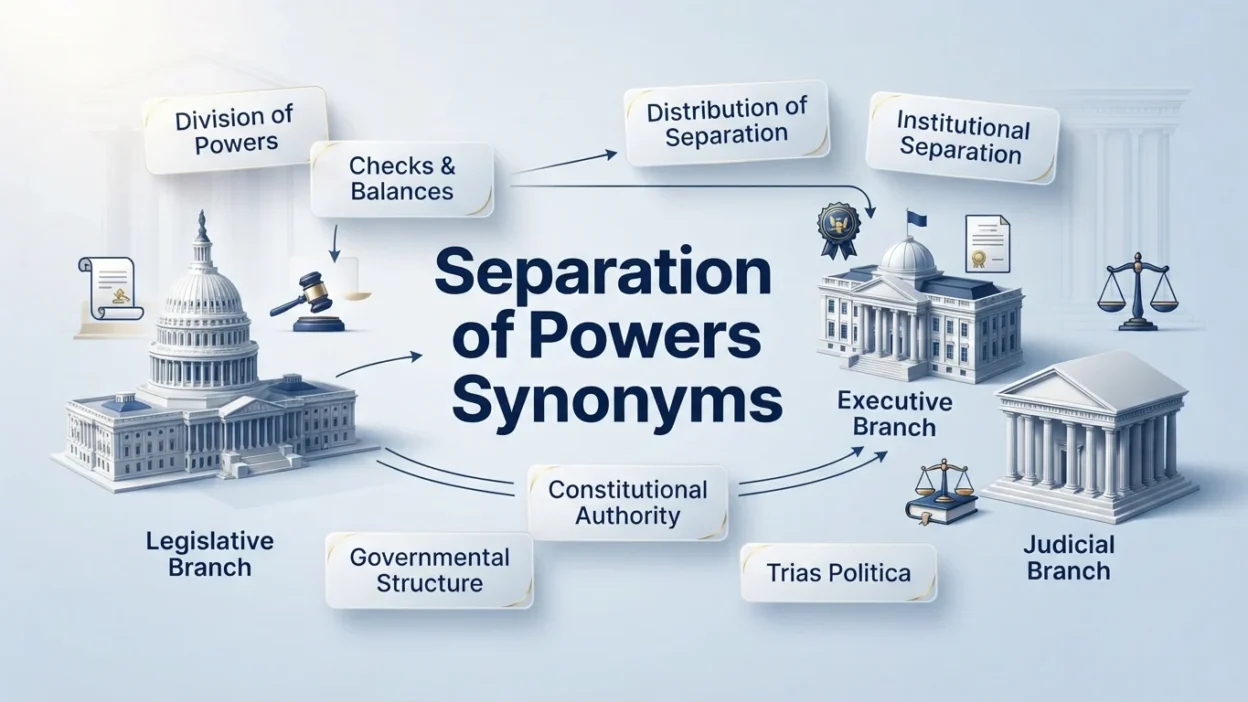
The phrase “separation of powers” describes a political system in which government authority is divided among different branches or institutions. Its purpose is to prevent too much power from being concentrated in one place.
For students, ESL learners, writers, and content creators, understanding separation of powers synonyms can make essays, reports, history assignments, and educational content more varied and precise. However, there is an important distinction: most alternatives are related expressions rather than perfect synonyms, because “separation of powers” is a specific constitutional concept.
In this guide, we will explore useful alternative terms and closely related expressions, explain how they differ, and show you when each one works best.
Note: Your prompt also asks for the meaning and 30 synonyms of “demure.” Since demure is unrelated to separation of powers, that vocabulary section is provided separately at the end so the main article remains accurate and focused.
What Does “Separation of Powers” Mean?
Separation of powers means dividing government responsibilities among different branches so that no single branch controls all governmental authority.
In many democratic systems, these branches are commonly described as:
- Legislative branch — makes laws
- Executive branch — carries out and enforces laws
- Judicial branch — interprets laws and resolves legal disputes
The exact structure differs between countries, but the basic idea is to distribute authority and create safeguards against abuse of power.
Simple Definition
Separation of powers = dividing government power among different branches or institutions.
Example
The country’s constitution uses separation of powers to prevent one branch of government from becoming too powerful.
Are There True Synonyms for “Separation of Powers”?
Not all alternative phrases have exactly the same meaning.
Separation of powers is a specific constitutional and political principle. Terms such as division of governmental authority, distribution of power, and institutional separation can describe similar ideas, but they may not be interchangeable in every sentence.
This distinction is especially important for academic writing.
For example:
The constitution establishes a separation of powers among three branches.
You could write:
The constitution establishes a division of governmental authority among three branches.
The second sentence has a similar meaning, but it is broader and less technically precise.
30 Separation of Powers Synonyms and Related Terms
Below are 30 useful alternatives and closely related expressions.
| # | Term | Simple Meaning | Best Usage |
|---|---|---|---|
| 1 | Division of powers | Government authority is divided | General explanation |
| 2 | Division of governmental authority | State powers are distributed among institutions | Academic writing |
| 3 | Distribution of power | Power is shared among different bodies | General political discussion |
| 4 | Separation of government powers | Government authority is separated | Educational writing |
| 5 | Division of state powers | State authority is divided | Constitutional contexts |
| 6 | Institutional separation | Different institutions have separate responsibilities | Formal writing |
| 7 | Divided government authority | Authority is not held by one institution | Explanatory writing |
| 8 | Power sharing | Different groups or institutions share authority | Broad political contexts |
| 9 | Dispersal of power | Power is spread across several institutions | Political analysis |
| 10 | Distribution of authority | Authority is allocated among different bodies | Formal writing |
| 11 | Checks and balances | Institutions limit and monitor one another | Constitutional systems |
| 12 | Constitutional division of powers | A constitution divides governmental authority | Legal writing |
| 13 | Branch separation | Government branches have distinct roles | Educational contexts |
| 14 | Branch division | Responsibilities are divided between branches | Simple explanations |
| 15 | Institutional division of power | Power is divided among institutions | Academic writing |
| 16 | Governmental decentralization | Authority is moved away from a central authority | Broader governance contexts |
| 17 | Decentralization of authority | Decision-making is distributed | Government studies |
| 18 | Dispersed authority | Authority is spread among multiple bodies | Political analysis |
| 19 | Shared governmental power | Multiple institutions exercise government power | General discussion |
| 20 | Constitutional checks | Constitutional mechanisms limit governmental power | Legal contexts |
| 21 | System of checks and balances | Branches restrict one another’s powers | Civics education |
| 22 | Separation of governmental functions | Different institutions perform different functions | Formal academic writing |
| 23 | Functional separation | Different government functions are kept distinct | Constitutional analysis |
| 24 | Institutional checks | Institutions monitor or constrain each other | Political science |
| 25 | Division of constitutional powers | Constitutional authority is divided | Legal/academic writing |
| 26 | Balanced governmental authority | Government authority is structured to prevent excessive control | Explanatory contexts |
| 27 | Power allocation | Authority is assigned to different institutions | Academic discussion |
| 28 | Authority-sharing system | Different bodies possess designated authority | General explanation |
| 29 | Distributed governance | Governance responsibilities are spread across institutions | Political analysis |
| 30 | Constitutional power distribution | Constitutional authority is allocated among different bodies | Formal writing |
1. Division of Powers
Meaning: Government authority is divided between different branches or institutions.
Example:
The constitution establishes a clear division of powers between government branches.
Best usage: General academic and educational writing.
2. Division of Governmental Authority
Meaning: Government authority is allocated among separate institutions.
Example:
The division of governmental authority helps prevent excessive control by one institution.
Best usage: Formal essays and political science writing.
3. Distribution of Power
Meaning: Power is spread among different people, institutions, or branches.
Example:
The distribution of power is an important feature of democratic government.
Best usage: General political discussions.
4. Separation of Government Powers
Meaning: Government powers are kept separate among different branches.
Example:
Separation of government powers can protect citizens from concentrated authority.
Best usage: Educational and explanatory writing.
5. Division of State Powers
Meaning: Powers belonging to the state are divided among institutions.
Example:
The division of state powers creates different responsibilities for different branches.
Best usage: Constitutional discussions.
6. Institutional Separation
Meaning: Different institutions have distinct responsibilities and authority.
Example:
Institutional separation can reduce the possibility of centralized control.
Best usage: Formal political or academic writing.
7. Divided Government Authority
Meaning: Government authority is not controlled by one institution.
Example:
Divided government authority gives several institutions important responsibilities.
Best usage: Simple explanatory writing.
8. Power Sharing
Meaning: Authority is shared between different groups or institutions.
Example:
Power sharing can help different institutions participate in governance.
Best usage: Broad political contexts.
9. Dispersal of Power
Meaning: Power is spread across multiple institutions rather than concentrated in one.
Example:
The dispersal of power limits the ability of a single institution to dominate government.
Best usage: Political analysis.
10. Distribution of Authority
Meaning: Authority is assigned to different institutions.
Example:
The distribution of authority creates separate responsibilities within government.
Best usage: Formal and academic writing.
11. Checks and Balances
Meaning: Different branches of government can limit and monitor each other.
Example:
Checks and balances prevent any single branch from exercising unlimited authority.
Best usage: Civics, constitutional studies, and political science.
Important: This is related to separation of powers, but it is not an exact synonym.
12. Constitutional Division of Powers
Meaning: A constitution divides governmental authority among different branches or institutions.
Example:
The constitutional division of powers defines the responsibilities of each branch.
Best usage: Constitutional law and academic writing.
13. Branch Separation
Meaning: Different government branches have separate roles.
Example:
Branch separation gives the legislature, executive, and judiciary different responsibilities.
Best usage: Beginner-friendly explanations.
14. Branch Division
Meaning: Government responsibilities are divided among separate branches.
Example:
Branch division is designed to prevent all government power from being concentrated in one place.
Best usage: Educational writing.
15. Institutional Division of Power
Meaning: Government power is divided among separate institutions.
Example:
Institutional division of power provides safeguards against excessive authority.
Best usage: Political science and academic essays.
16. Governmental Decentralization
Meaning: Some authority is moved away from a central government or institution.
Example:
Governmental decentralization can give local institutions greater decision-making authority.
Best usage: Governance and public administration.
Note: Decentralization is broader than separation of powers and should not always be used as a direct substitute.
17. Decentralization of Authority
Meaning: Decision-making authority is distributed rather than concentrated.
Example:
The decentralization of authority allows regional institutions to make certain decisions.
Best usage: Government and administrative contexts.
18. Dispersed Authority
Meaning: Authority is spread among multiple institutions.
Example:
Dispersed authority makes it more difficult for one institution to control the entire government.
Best usage: Political analysis.
19. Shared Governmental Power
Meaning: Different institutions have responsibility for exercising government power.
Example:
Shared governmental power can provide institutional safeguards.
Best usage: General educational writing.
20. Constitutional Checks
Meaning: Constitutional rules limit or control the exercise of governmental power.
Example:
Constitutional checks help prevent government institutions from exceeding their authority.
Best usage: Legal and constitutional writing.
21. System of Checks and Balances
Meaning: A political structure in which branches monitor and restrict one another.
Example:
The system of checks and balances helps prevent the abuse of governmental authority.
Best usage: Civics and government education.
22. Separation of Governmental Functions
Meaning: Different government institutions perform different functions.
Example:
The separation of governmental functions creates distinct responsibilities for each branch.
Best usage: Formal academic writing.
23. Functional Separation
Meaning: Different government functions are kept distinct.
Example:
Functional separation helps distinguish lawmaking from law enforcement and judicial interpretation.
Best usage: Constitutional and political analysis.
24. Institutional Checks
Meaning: Government institutions monitor and restrict each other’s authority.
Example:
Institutional checks can help protect the political system from excessive concentration of power.
Best usage: Political science writing.
25. Division of Constitutional Powers
Meaning: Constitutional authority is divided among different governmental bodies.
Example:
The division of constitutional powers establishes limits on government institutions.
Best usage: Constitutional law.
26. Balanced Governmental Authority
Meaning: Government authority is structured so that no institution has unlimited control.
Example:
Balanced governmental authority can support political stability and accountability.
Best usage: General political writing.
27. Power Allocation
Meaning: Power is assigned to particular institutions or branches.
Example:
The constitution determines the power allocation among different branches.
Best usage: Academic and analytical writing.
28. Authority-Sharing System
Meaning: Multiple institutions possess defined areas of authority.
Example:
An authority-sharing system can prevent one institution from controlling every government function.
Best usage: Explanatory writing.
29. Distributed Governance
Meaning: Governance responsibilities are spread among different institutions or levels.
Example:
Distributed governance can create several points of decision-making.
Best usage: Political and public-policy discussions.
30. Constitutional Power Distribution
Meaning: A constitution assigns governmental powers to different institutions.
Example:
Constitutional power distribution establishes boundaries between major government branches.
Best usage: Constitutional studies and formal essays.
Separation of Powers vs. Checks and Balances
These concepts are closely connected but should not be treated as identical.
| Concept | Main Idea | Example |
|---|---|---|
| Separation of powers | Divides government functions among branches | Legislature makes laws |
| Checks and balances | Allows branches to limit each other | One branch checks another |
| Decentralization | Moves authority away from a central institution | Local governments receive powers |
| Power sharing | Authority is shared among multiple groups | Several groups participate in governance |
| Institutional separation | Institutions have distinct roles | Courts remain separate from lawmakers |
| Power distribution | Authority is spread among different bodies | Different institutions receive different powers |
Easy Way to Remember
Think of it this way:
Separation of powers = Who has which responsibility?
Checks and balances = Who can limit whom?
This distinction is useful when writing political science essays or explaining constitutional systems.
How to Choose the Right Separation of Powers Synonym
The best alternative depends on what you are trying to emphasize.
For Academic Writing
Choose:
- Division of powers
- Division of governmental authority
- Institutional separation
- Distribution of authority
- Functional separation
- Constitutional power distribution
These sound precise and formal.
For Simple Explanations
Choose:
- Branch separation
- Branch division
- Shared governmental power
- Distribution of power
- Division of state powers
These are easier for beginners and ESL learners.
For Constitutional Discussions
Choose:
- Constitutional division of powers
- Division of constitutional powers
- Constitutional checks
- Constitutional power distribution
- Separation of government powers
When Discussing Limits on Government
Choose:
- Checks and balances
- Institutional checks
- System of checks and balances
- Constitutional checks
These emphasize control and accountability, rather than simply dividing responsibilities.
When Discussing Decentralization
Choose:
- Governmental decentralization
- Decentralization of authority
- Dispersed authority
- Distributed governance
These are appropriate when discussing the movement of authority across levels or institutions.
Why Understanding Separation of Powers Synonyms Matters
Using alternative expressions can make your writing clearer and less repetitive.
For example, instead of repeatedly writing:
Separation of powers is important. Separation of powers prevents abuse. Separation of powers protects democracy.
You can write:
The separation of powers is an important constitutional principle. This division of governmental authority can reduce the concentration of power and create institutional checks that support accountability.
The second version provides more vocabulary while preserving the central idea.
However, writers should avoid replacing technical terms simply to make writing appear more sophisticated. Precision is more important than variety.
Common Mistakes When Using These Terms
Mistake 1: Treating Every Related Term as a Perfect Synonym
“Checks and balances” and “separation of powers” are closely connected, but they describe different aspects of government structure.
Mistake 2: Confusing Separation With Decentralization
Decentralization generally refers to distributing authority across levels or locations of government. Separation of powers usually concerns distinct governmental branches or functions.
Mistake 3: Using Informal Expressions in Legal Writing
Terms such as “power sharing” may be understandable but can be too broad for a constitutional-law essay.
Mistake 4: Ignoring Context
The best alternative depends on your sentence, audience, and subject.
For a school assignment, division of powers may be ideal.
For constitutional analysis, constitutional division of powers may be more precise.
Separate Vocabulary Note: What Does “Demure” Mean?
The word demure is unrelated to separation of powers. It describes a person who behaves in a quiet, modest, reserved, or somewhat shy way.
Simple Definition of Demure
Demure = quiet, modest, and reserved in behavior or appearance.
Example
She gave a demure smile when the teacher praised her work.
The word often describes a person’s manner, appearance, expression, or behavior.
Tone of “Demure”
Demure usually has a polite, gentle, traditional, or modest tone. Depending on context, it can sound complimentary, literary, or slightly old-fashioned.
30 Synonyms of Demure
| # | Synonym | Simple Meaning | Example Sentence | Best Usage |
|---|---|---|---|---|
| 1 | Modest | Not showing off | She wore a modest dress. | General use |
| 2 | Reserved | Quiet and not very expressive | He was reserved around strangers. | Personality |
| 3 | Shy | Nervous or quiet around others | The shy student avoided attention. | Social behavior |
| 4 | Bashful | Easily embarrassed or shy | She gave a bashful smile. | Gentle/social |
| 5 | Retiring | Avoiding attention | He had a retiring personality. | Formal/literary |
| 6 | Unassuming | Not trying to impress others | She was friendly and unassuming. | Personality |
| 7 | Quiet | Not loud or attention-seeking | She was quiet during the meeting. | General |
| 8 | Gentle | Calm and mild | He had a gentle manner. | Personality |
| 9 | Subdued | Quiet and restrained | Her expression was subdued. | Mood/behavior |
| 10 | Meek | Very gentle and not forceful | The meek child rarely argued. | Character |
| 11 | Mild | Gentle rather than strong | She has a mild personality. | General |
| 12 | Unobtrusive | Not attracting attention | He preferred an unobtrusive style. | Formal |
| 13 | Discreet | Careful and not drawing attention | She was discreet about the matter. | Behavior |
| 14 | Proper | Behaving according to social expectations | Her behavior was proper and respectful. | Formal/social |
| 15 | Ladylike | Traditionally graceful and modest | Her manner was considered ladylike. | Traditional |
| 16 | Refined | Polished and well-mannered | She had a refined manner. | Sophisticated |
| 17 | Modest-looking | Simple and not attention-seeking | She chose a modest-looking outfit. | Appearance |
| 18 | Timid | Lacking confidence in social situations | The timid student spoke softly. | Personality |
| 19 | Coy | Shy or pretending to be shy | She gave a coy smile. | Social/flirtatious |
| 20 | Demure-looking | Having a modest appearance | Her demure-looking style suited the occasion. | Appearance |
| 21 | Composed | Calm and controlled | She remained composed throughout the interview. | Behavior |
| 22 | Restrained | Controlled and not excessive | His response was restrained. | Formal |
| 23 | Dignified | Calm and worthy of respect | She maintained a dignified manner. | Formal |
| 24 | Unpretentious | Not trying to appear important | His unpretentious attitude made him approachable. | Personality |
| 25 | Innocent | Lacking sophistication or experience | Her innocent expression seemed sincere. | Character |
| 26 | Sweet-natured | Kind and gentle | She was sweet-natured and quiet. | Personality |
| 27 | Soft-spoken | Speaking quietly and gently | The soft-spoken teacher was easy to approach. | Speech |
| 28 | Unassertive | Not strongly expressing opinions or demands | He was polite but unassertive. | Personality |
| 29 | Mild-mannered | Calm and gentle in behavior | The mild-mannered employee rarely complained. | Character |
| 30 | Reserved-looking | Appearing quiet or restrained | Her reserved-looking expression made her seem serious. | Appearance |
Demure Synonyms: Quick Comparison Guide
| Word | Main Idea | Tone |
|---|---|---|
| Modest | Not showing off | Neutral/positive |
| Reserved | Not openly expressive | Neutral |
| Shy | Socially nervous | Neutral |
| Bashful | Sweetly shy | Gentle |
| Coy | Playfully shy | Sometimes flirtatious |
| Timid | Lacking confidence | Neutral/negative |
| Refined | Polished and sophisticated | Positive |
| Dignified | Calm and respectable | Positive |
| Unassuming | Humble and simple | Positive |
| Soft-spoken | Quiet manner of speaking | Positive |
How to Choose the Right Demure Synonym
If You Mean “Not Showing Off”
Use:
- Modest
- Unassuming
- Unpretentious
If You Mean “Quiet Around People”
Use:
- Reserved
- Shy
- Timid
- Retiring
If You Mean “Sweetly Shy”
Use:
- Bashful
- Coy
- Gentle
If You Mean “Elegant and Proper”
Use:
- Refined
- Dignified
- Ladylike
- Proper
If You Mean “Quiet Speech”
Use:
- Soft-spoken
- Mild-mannered
- Subdued
Final Thoughts on Separation of Powers Synonyms
Understanding separation of powers synonyms is useful for students, writers, and ESL learners who want to discuss government more clearly and avoid unnecessary repetition.
The most useful alternatives include division of powers, distribution of power, institutional separation, division of governmental authority, functional separation, and constitutional power distribution. Related concepts such as checks and balances and decentralization can also be useful, but they should not automatically be treated as exact synonyms.
For precise academic writing, always choose the term that matches your intended meaning. A technically accurate phrase is more valuable than a complicated word that only sounds similar.

Amber Amy is a passionate writer at SynonymLot, dedicated to helping readers discover better words, expand their vocabulary, and improve their writing through clear, accurate, and easy-to-understand synonym guides.