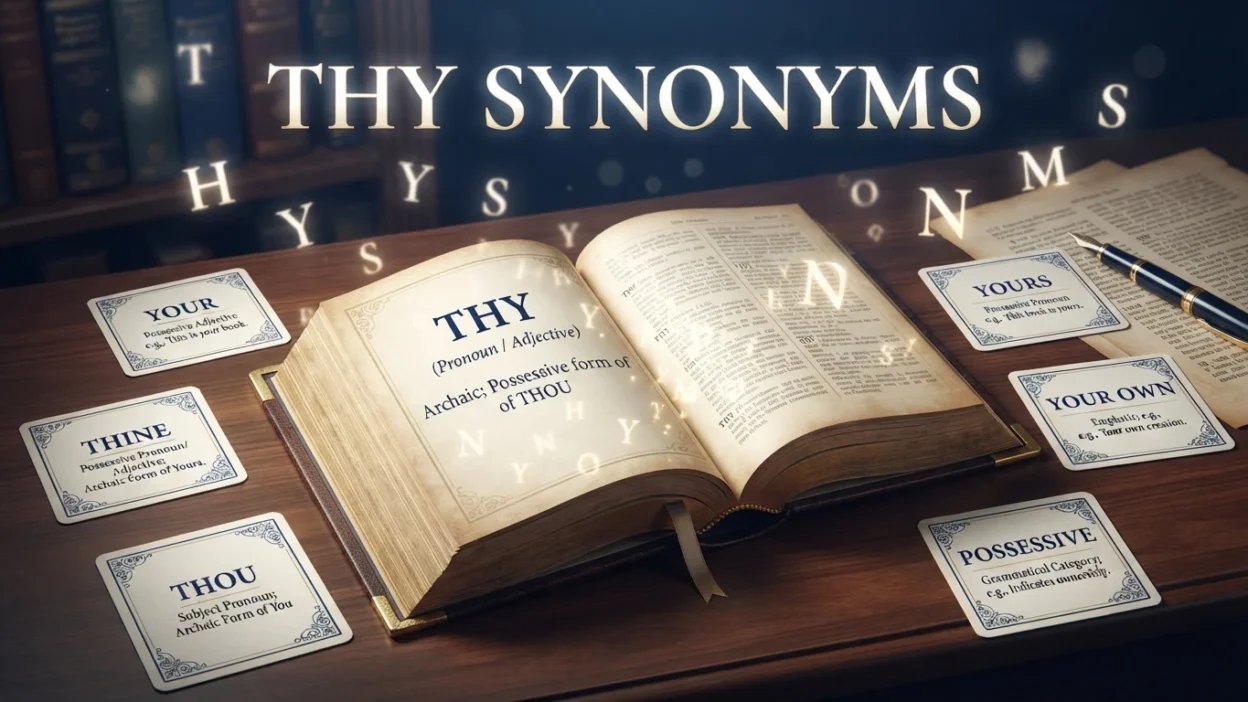
If you have ever read an old poem, classic novel, religious text, or historical speech, you have probably seen the word “thy.” Although it is uncommon in everyday modern English, thy still appears frequently in literature, songs, poetry, and traditional writing.
The word thy means “your.” It is an old fashioned or literary possessive form used before a noun. Understanding thy synonyms can help students, ESL learners, writers, and readers understand older English and recognize equivalent expressions in modern language.
In this guide, we will explain what thy means, explore its modern alternatives, look at examples, and then provide a separate vocabulary section covering demure and 30 words with similar meanings.
What Does “Thy” Mean?
Thy is an archaic or literary form of “your.”
It is normally used before a singular noun.
Examples
- Thy name is beautiful.
→ Your name is beautiful. - Guard thy heart.
→ Guard your heart. - Know thyself.
→ Know yourself.
The word thy is strongly associated with older forms of English, especially poetry, religious writing, historical literature, and dramatic dialogue.
Thy vs. Thee vs. Thou
These three words are often confused.
| Old English Form | Modern Equivalent | Main Function |
|---|---|---|
| Thou | You | Subject |
| Thee | You | Object |
| Thy | Your | Possessive |
| Thine | Yours / Your | Possessive |
For example:
- Thou art wise. → You are wise.
- I speak to thee. → I speak to you.
- Thy wisdom is great. → Your wisdom is great.
- The victory is thine. → The victory is yours.
Thy Synonyms and Modern Alternatives
Because thy means your, its closest modern equivalent is simply your.
However, depending on the sentence and writing style, several expressions can replace or convey the same possessive idea.
1. Your
Meaning: Belonging to or associated with you.
Example: Your book is on the table.
Best usage: Modern everyday English.
2. Yours
Meaning: Something belonging to you.
Example: This book is yours.
Best usage: Used independently rather than directly before a noun.
3. Belonging to You
Meaning: Something that belongs to you.
Example: The decision is something belonging to you.
Best usage: Formal explanations or emphasis.
4. Of You
Meaning: Connected with or associated with you.
Example: I remember the kindness of you.
Best usage: Literary or unusual constructions; not normally a direct replacement for thy.
5. Your Own
Meaning: Belonging specifically to you.
Example: Follow your own path.
Best usage: Emphasizing personal ownership or independence.
6. Yours Truly
Meaning: Belonging to you or sincerely associated with you.
Example: Yours truly, James.
Best usage: Traditional letter endings and informal literary writing.
7. Your Possession
Meaning: Something that belongs to you.
Example: The necklace is now your possession.
Best usage: Formal or legal contexts.
8. Your Property
Meaning: Something owned by you.
Example: The house is your property.
Best usage: Legal, business, or formal contexts.
9. Your Belonging
Meaning: Something that belongs to you.
Example: Please collect your belongings.
Best usage: Everyday language, especially in the plural form.
10. Your Own Property
Meaning: Something specifically owned by you.
Example: This land is your own property.
Best usage: Strong emphasis on ownership.
Thy Synonyms in Different Contexts
Not every alternative works in every sentence. Since thy is an older possessive word, the best modern replacement is usually your.
| Thy Expression | Modern Version | Style |
|---|---|---|
| Thy name | Your name | Modern |
| Thy heart | Your heart | Modern |
| Thy home | Your home | Modern |
| Thy words | Your words | Modern |
| Thy kingdom | Your kingdom | Formal/literary |
| Thy choice | Your choice | Modern |
| Thy duty | Your duty | Formal |
| Thy beloved | Your beloved | Literary |
| Thy possession | Your possession | Formal |
| Thy own path | Your own path | Modern |
How to Choose the Right Thy Synonym
Choosing the right replacement depends mainly on grammar, context, and tone.
For Everyday English
Use:
- Your
- Your own
Example:
Thy phone is ringing.
Modern version:
Your phone is ringing.
For Formal Writing
Use:
- Your
- Your property
- Your possession
- Belonging to you
Example:
Thy property must be protected.
Modern formal version:
Your property must be protected.
For Poetry and Literature
Sometimes it is better to keep thy rather than replace it.
For example:
Thy voice echoes through the night.
Using your makes the sentence modern, but thy gives it an older, poetic atmosphere.
For Historical or Religious Writing
Thy may be intentionally retained because it reflects the language and style of the original text.
Why Do Writers Still Use “Thy”?
Although thy is no longer common in ordinary conversation, it remains useful for stylistic purposes.
Writers may use it to create:
- A historical atmosphere
- A poetic tone
- A traditional feeling
- A dramatic voice
- A religious tone
- A sense of antiquity
For example:
“Know thyself.”
The use of thy gives the expression a traditional and memorable quality.
A modern version would be:
“Know yourself.”
Both communicate the same basic idea, but the first has a distinctly classical style.
What Does “Demure” Mean?
Demure is a completely different word from thy.
The adjective demure describes someone who behaves in a quiet, modest, reserved, or shy way, often in a graceful manner.
For example:
She gave a demure smile during the ceremony.
The word can suggest modesty and self-control, but its exact feeling depends on context. It is often used to describe someone’s appearance, behavior, expression, or manner.
Demure is especially common in descriptive writing, fashion discussions, literature, and situations where someone appears quiet and modest.
30 Synonyms of Demure
1. Modest
Meaning: Not showing off; behaving in a restrained way.
Example: She wore a modest dress to the formal event.
Best usage: Clothing, behavior, and appearance.
2. Shy
Meaning: Nervous or uncomfortable around other people.
Example: The shy student rarely spoke in large groups.
Best usage: Personality and social situations.
3. Reserved
Meaning: Quiet and not openly expressing feelings.
Example: He was reserved when meeting new people.
Best usage: Personality and behavior.
4. Bashful
Meaning: Easily embarrassed or shy.
Example: She became bashful when everyone praised her.
Best usage: Friendly or gentle descriptions.
5. Coy
Meaning: Shy or pretending to be shy in a playful way.
Example: She gave him a coy smile.
Best usage: Playful or flirtatious situations.
6. Unassuming
Meaning: Not trying to attract attention or appear important.
Example: Despite her success, she remained unassuming.
Best usage: Personality and character.
7. Quiet
Meaning: Not loud, talkative, or attention-seeking.
Example: He has a quiet and thoughtful personality.
Best usage: General descriptions.
8. Retiring
Meaning: Avoiding attention and preferring privacy.
Example: The retiring artist rarely appeared in public.
Best usage: Formal or literary writing.
9. Meek
Meaning: Gentle and unlikely to argue or demand attention.
Example: She had a meek and gentle manner.
Best usage: Personality descriptions.
10. Gentle
Meaning: Kind, calm, and not aggressive.
Example: His gentle manner made everyone comfortable.
Best usage: Personality and behavior.
11. Mild
Meaning: Gentle and not extreme.
Example: She responded with a mild expression.
Best usage: Behavior, personality, and reactions.
12. Subdued
Meaning: Quiet, restrained, or less noticeable.
Example: She wore a subdued expression throughout the meeting.
Best usage: Appearance, emotions, and atmosphere.
13. Restrained
Meaning: Controlled and not excessive.
Example: His restrained response showed considerable self-control.
Best usage: Formal writing and emotional behavior.
14. Composed
Meaning: Calm and in control of one’s emotions.
Example: She remained composed during the difficult conversation.
Best usage: Professional and formal contexts.
15. Dignified
Meaning: Calm, respectable, and serious.
Example: She maintained a dignified manner throughout the ceremony.
Best usage: Formal occasions and character descriptions.
16. Proper
Meaning: Behaving in a socially acceptable and respectable way.
Example: Her proper behavior impressed the guests.
Best usage: Formal or traditional contexts.
17. Prim
Meaning: Very proper, careful, and somewhat formal in behavior.
Example: She had a prim and carefully organized appearance.
Best usage: Describing mannerisms or appearance.
18. Modest-Mannered
Meaning: Behaving quietly without seeking attention.
Example: The modest-mannered student accepted the award gracefully.
Best usage: Character descriptions.
19. Demure-Looking
Meaning: Appearing quiet, modest, or reserved.
Example: She had a demure-looking style.
Best usage: Appearance and fashion descriptions.
20. Unobtrusive
Meaning: Not attracting unnecessary attention.
Example: The unobtrusive design fit perfectly into the room.
Best usage: Objects, style, behavior, and design.
21. Self-Effacing
Meaning: Not wanting to receive too much praise or attention.
Example: He was self-effacing despite his impressive achievements.
Best usage: Personality and professional writing.
22. Humble
Meaning: Not believing you are better or more important than others.
Example: She remained humble after winning the competition.
Best usage: Character and achievements.
23. Soft-Spoken
Meaning: Speaking quietly and gently.
Example: The soft-spoken teacher explained the lesson patiently.
Best usage: Speech and personality.
24. Reserved-Mannered
Meaning: Behaving in a quiet and controlled way.
Example: His reserved manner made him difficult to read.
Best usage: Formal character descriptions.
25. Discreet
Meaning: Careful not to attract attention or reveal too much.
Example: She gave a discreet smile before leaving.
Best usage: Social behavior and formal contexts.
26. Demure
Meaning: Quiet, modest, and reserved in manner or appearance.
Example: She gave a demure smile.
Best usage: Directly describing modest behavior or appearance.
27. Ladylike
Meaning: Traditionally associated with graceful, polite, and refined behavior.
Example: Her ladylike manner was noticeable at the formal dinner.
Best usage: Traditional or descriptive contexts.
28. Refined
Meaning: Elegant, polished, and socially graceful.
Example: She had a refined and understated style.
Best usage: Fashion, manners, and personality.
29. Unpretentious
Meaning: Simple and not designed to impress others.
Example: He has an unpretentious personality despite his fame.
Best usage: Personality, lifestyle, and writing.
30. Innocent-Looking
Meaning: Appearing harmless, gentle, or inexperienced.
Example: She had an innocent-looking smile.
Best usage: Appearance and descriptive writing.
Demure Synonyms: Quick Comparison Guide
| Synonym | Main Meaning | Tone |
|---|---|---|
| Modest | Not showing off | Neutral |
| Shy | Uncomfortable with attention | Friendly |
| Reserved | Emotionally quiet | Neutral |
| Bashful | Easily embarrassed | Warm |
| Coy | Playfully shy | Playful |
| Unassuming | Not seeking attention | Positive |
| Retiring | Avoiding attention | Literary |
| Meek | Gentle and submissive | Neutral/negative |
| Subdued | Restrained or quiet | Neutral |
| Composed | Calm and controlled | Positive |
| Dignified | Respectable and graceful | Formal |
| Prim | Very proper | Traditional |
| Refined | Polished and elegant | Positive |
| Humble | Not self-important | Positive |
| Soft-spoken | Speaking gently | Positive |
How to Choose the Right Demure Synonym
Different synonyms communicate slightly different ideas.
If You Mean “Quiet and Shy”
Choose:
- Shy
- Bashful
- Reserved
- Retiring
These words focus mainly on someone’s social behavior.
If You Mean “Modest”
Choose:
- Modest
- Unassuming
- Humble
- Unpretentious
These emphasize a lack of showiness or self-importance.
If You Mean “Elegant and Refined”
Choose:
- Refined
- Dignified
- Ladylike
- Composed
These are useful when describing graceful or polished behavior.
If You Mean “Playfully Shy”
Choose:
- Coy
- Bashful
- Demure
These can work especially well in descriptive or romantic writing, depending on context.
If You Mean “Quietly Controlled”
Choose:
- Restrained
- Subdued
- Composed
- Discreet
These words emphasize emotional or behavioral control rather than simple shyness.
Thy vs. Your: The Simplest Way to Remember
The easiest rule is:
Thy = Your
For modern English, replace thy with your in most sentences.
Examples
Thy book is here.
→ Your book is here.
Protect thy family.
→ Protect your family.
Follow thy dreams.
→ Follow your dreams.
Thy words are powerful.
→ Your words are powerful.
However, keep thy when you intentionally want an old-fashioned, poetic, historical, or traditional style.
Common Mistakes With “Thy”
Mistake 1: Treating Thy as a Synonym of Thee
This is incorrect.
Thy means your, while thee means you when used as an object.
Incorrect:
I gave thy the book.
Correct:
I gave thee the book.
Mistake 2: Using Thy in Normal Modern Conversation
Although grammatically understandable, thy sounds archaic in ordinary conversation.
Instead of:
Thy car is outside.
Modern English normally uses:
Your car is outside.
Mistake 3: Confusing Thy and Thine
Both relate to possession, but they are used differently.
Thy usually comes before a noun:
Thy heart
Thine can stand alone:
The victory is thine.
It can also appear before certain vowel-initial nouns in older English:
Thine eyes
Why Understanding Thy Synonyms Matters
Learning thy synonyms is useful because it connects modern English with historical English.
Students can better understand classic literature. ESL learners can recognize older grammatical forms. Writers can choose whether they want their language to sound modern, traditional, poetic, or dramatic.
Understanding the difference between thy, thou, thee, and thine also makes reading older texts much easier.
At the same time, knowing synonyms such as modest, reserved, shy, coy, refined, and composed helps writers express subtle differences in personality and behavior.
Final Thoughts on Thy Synonyms
The most important thing to remember is simple: thy means “your.” It is an old-fashioned or literary possessive form that remains familiar because of its use in poetry, historical writing, religious texts, and classic literature.
For everyday modern English, your is almost always the natural choice. Other expressions such as your own, your property, or belonging to you may work depending on the sentence and intended meaning.
Also remember that demure is a separate vocabulary word. Its closest synonyms include modest, shy, reserved, bashful, coy, unassuming, composed, dignified, refined, and subdued. Choosing among these words depends on whether you want to emphasize shyness, modesty, elegance, restraint, or a playful manner.
By understanding both the literal meaning and the tone of related words, you can make your English more accurate, expressive, and natural.

Daniel Jack is a language enthusiast and content writer who specializes in synonyms, vocabulary, and word meanings. He creates clear, engaging resources that help readers improve communication and expand their English skills.