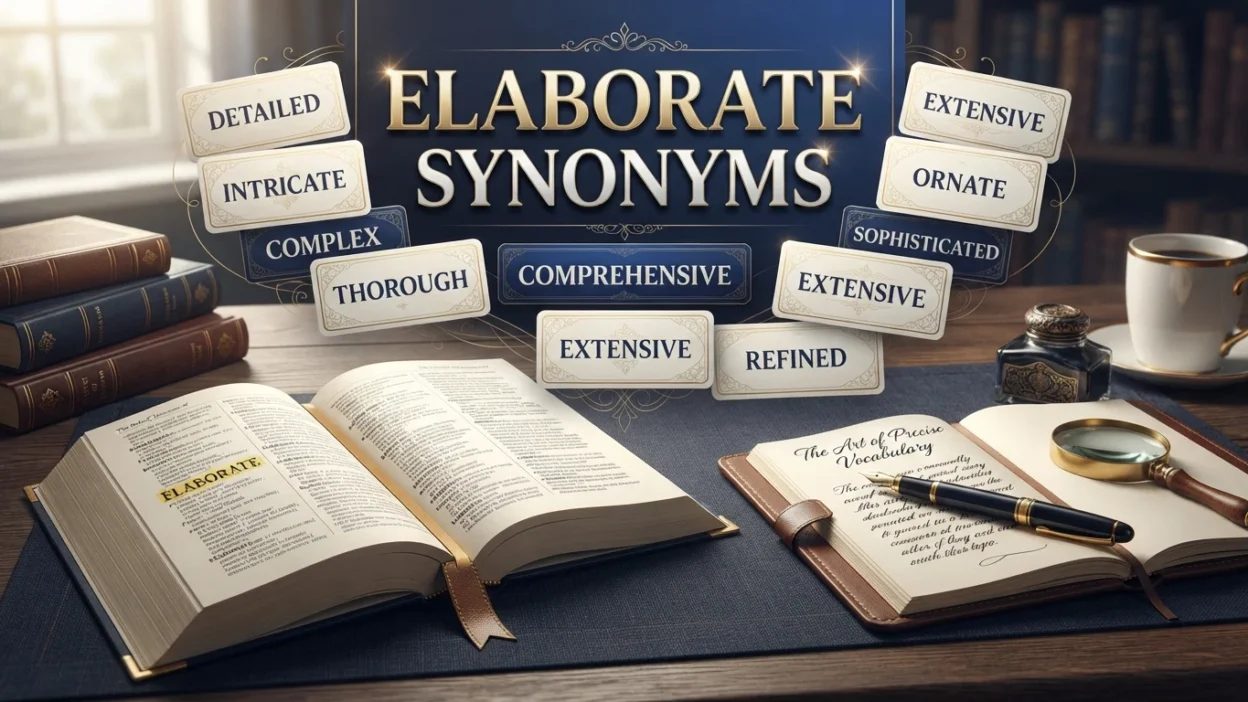
Finding the right synonym can make your writing clearer, more precise, and more interesting. if you are a student, ESL learner, writer, or content creator, understanding similar words helps you express ideas with greater confidence. Learning elaborate synonyms and understanding how words differ in tone can also improve vocabulary and communication skills.
The word elaborate can describe something detailed, carefully developed, or complicated. However, choosing an appropriate synonym depends on the meaning you want to communicate. A word that works well in academic writing may sound unnatural in casual conversation.
This guide also explores the meaning of demure in simple English and provides 30 useful synonyms. Each word includes a simple definition, example sentence, and the situation where it works best. This makes the article useful as both a dictionary-style reference and an ESL-friendly vocabulary guide.
What Does “Elaborate” Mean?
Elaborate has several meanings depending on how it is used.
As an adjective, elaborate means something that contains many details or has been carefully designed.
Example:
“She wore an elaborate dress covered with delicate embroidery.”
Here, elaborate means detailed and carefully made.
As a verb, elaborate means to explain something in more detail.
Example:
“Could you elaborate on your main argument?”
In this sentence, elaborate means to give more information or explanation.
Because the word has different meanings, the best synonym depends on the context.
What Does “Demure” Mean?
Demure is an adjective used to describe someone who behaves in a quiet, modest, reserved, or somewhat shy way.
A demure person usually does not try to attract attention. The word can describe someone’s behavior, appearance, expression, or manner.
Example:
“She gave a demure smile when everyone praised her.”
The tone of demure is usually gentle, polite, modest, and somewhat formal. It is often used in descriptions of personality, clothing, manners, or appearance.
Although demure can suggest shyness, it does not always mean that someone is nervous or lacking confidence. It can simply describe a calm and modest manner.
30 Synonyms of Demure
Below are 30 useful words that can express meanings similar to demure. Some are close synonyms, while others match only a particular aspect of the word.
1. Modest
Meaning: Not showing too much pride, attention, or boldness.
Example:
“She was modest about her impressive achievement.”
Best usage context: Everyday writing, personal qualities, and behavior.
2. Reserved
Meaning: Quiet and not likely to openly express feelings or opinions.
Example:
“He was reserved when meeting new people.”
Best usage context: Personality and social behavior.
3. Shy
Meaning: Nervous or uncomfortable around other people.
Example:
“The shy student smiled quietly at her classmates.”
Best usage context: Casual descriptions of personality.
4. Reticent
Meaning: Unwilling to speak freely about thoughts or feelings.
Example:
“She was reticent about discussing her personal life.”
Best usage context: Formal or academic writing.
5. Unassuming
Meaning: Not trying to appear important, impressive, or special.
Example:
“Despite his success, he remained unassuming.”
Best usage context: Describing humble personalities.
6. Mild
Meaning: Gentle, calm, and not aggressive or extreme.
Example:
“She had a mild and pleasant manner.”
Best usage context: Personality and behavior.
7. Quiet
Meaning: Making little noise or not speaking much.
Example:
“The quiet girl preferred reading to large social gatherings.”
Best usage context: Simple everyday English.
8. Subdued
Meaning: Calm, restrained, or less energetic than usual.
Example:
“Her subdued expression showed that she was thinking carefully.”
Best usage context: Describing expressions, emotions, or behavior.
9. Gentle
Meaning: Kind, calm, and soft in manner.
Example:
“He spoke in a gentle voice.”
Best usage context: Personality, voice, and behavior.
10. Meek
Meaning: Very quiet, gentle, and unlikely to challenge others.
Example:
“The meek child rarely interrupted anyone.”
Best usage context: Literary or descriptive writing.
11. Unobtrusive
Meaning: Not attracting attention or disturbing others.
Example:
“She chose an unobtrusive outfit for the formal event.”
Best usage context: Appearance, design, behavior, and formal writing.
12. Coy
Meaning: Pretending to be shy or hesitant, sometimes in a playful or flirtatious way.
Example:
“She gave him a coy smile.”
Best usage context: Social or romantic situations.
13. Demurely
Meaning: In a modest, reserved, or shy manner.
Example:
“She demurely lowered her eyes.”
Best usage context: Literary descriptions and narrative writing.
14. Dignified
Meaning: Calm, serious, and worthy of respect.
Example:
“She maintained a dignified attitude during the difficult discussion.”
Best usage context: Formal situations and professional writing.
15. Proper
Meaning: Behaving according to accepted social standards.
Example:
“She was careful to remain proper during the formal ceremony.”
Best usage context: Traditional or formal descriptions.
16. Discreet
Meaning: Careful not to attract unnecessary attention or reveal private information.
Example:
“He gave her a discreet signal across the room.”
Best usage context: Formal communication and social situations.
17. Introverted
Meaning: More comfortable with quiet environments and limited social interaction.
Example:
“She was introverted and enjoyed spending time alone.”
Best usage context: Personality discussions.
Note: Introverted does not necessarily mean shy or demure.
18. Bashful
Meaning: Easily embarrassed or shy.
Example:
“The bashful child hid behind her mother.”
Best usage context: Informal and friendly descriptions.
19. Timid
Meaning: Lacking confidence or being easily frightened by unfamiliar situations.
Example:
“The timid puppy stayed close to its owner.”
Best usage context: People, animals, and informal descriptions.
20. Soft-spoken
Meaning: Speaking quietly and gently.
Example:
“She was soft-spoken but very confident.”
Best usage context: Describing someone’s voice or communication style.
21. Unpretentious
Meaning: Simple and not designed to impress others.
Example:
“His unpretentious personality made him easy to talk to.”
Best usage context: Personality and lifestyle descriptions.
22. Humble
Meaning: Not believing that you are more important or better than others.
Example:
“The humble winner thanked everyone who supported her.”
Best usage context: Achievements, character, and professional writing.
23. Self-effacing
Meaning: Avoiding praise or attention for yourself.
Example:
“She was self-effacing and rarely talked about her accomplishments.”
Best usage context: Formal writing and personality descriptions.
24. Unpretending
Meaning: Natural and not trying to impress or deceive others.
Example:
“His unpretending manner made the conversation comfortable.”
Best usage context: Literary and descriptive writing.
25. Docile
Meaning: Quiet and willing to follow instructions.
Example:
“The docile horse was easy for the young rider to handle.”
Best usage context: Animals, behavior, and certain formal contexts.
26. Innocent
Meaning: Free from harmful intentions or sophisticated wrongdoing.
Example:
“She gave an innocent smile when asked about the surprise.”
Best usage context: Character descriptions and storytelling.
27. Unpretentious
Meaning: Simple, natural, and without an attempt to seem impressive.
Example:
“Her unpretentious style made her approachable.”
Best usage context: Fashion, personality, and lifestyle writing.
28. Composed
Meaning: Calm and in control of your emotions.
Example:
“She remained composed throughout the interview.”
Best usage context: Professional and formal situations.
29. Restrained
Meaning: Controlled and not overly emotional, expressive, or dramatic.
Example:
“His restrained response surprised everyone.”
Best usage context: Formal writing, emotions, and behavior.
30. Sophisticated
Meaning: Polished, refined, or showing good taste.
Example:
“She wore a sophisticated outfit to the evening event.”
Best usage context: Fashion, style, and polished descriptions.
Demure Synonyms Comparison Table
| Synonym | Main Meaning | Tone | Best Used For |
|---|---|---|---|
| Modest | Not showing off | Neutral | Personality |
| Reserved | Not openly expressive | Neutral/Formal | Behavior |
| Shy | Uncomfortable socially | Casual | Personality |
| Reticent | Unwilling to speak | Formal | Communication |
| Unassuming | Not seeking attention | Positive | Character |
| Gentle | Calm and kind | Warm | Personality |
| Coy | Playfully shy | Playful | Social/romantic |
| Bashful | Easily embarrassed | Friendly | Casual descriptions |
| Timid | Lacking confidence | Neutral | Personality |
| Composed | Calm and controlled | Positive/Formal | Professional settings |
| Restrained | Emotionally controlled | Formal | Writing and behavior |
| Humble | Not boastful | Positive | Character |
| Dignified | Calm and respectable | Formal | Serious situations |
| Soft-spoken | Speaks quietly | Positive | Voice/personality |
| Unobtrusive | Avoiding attention | Neutral | Appearance/behavior |
Elaborate Synonyms: Common Alternatives
When you are actually looking for alternatives to elaborate, the right synonym depends on the meaning.
When “Elaborate” Means Detailed
Use:
- Detailed
- Comprehensive
- Thorough
- Extensive
- In-depth
- Specific
- Intricate
- Full
- Exhaustive
- Precise
Example:
“The researcher provided an elaborate explanation.”
Possible alternatives include:
“The researcher provided a detailed explanation.”
“The researcher provided a comprehensive explanation.”
“The researcher provided an in-depth explanation.”
These alternatives are especially useful in academic and professional writing.
When “Elaborate” Means Complicated or Carefully Designed
Use:
- Intricate
- Complex
- Complicated
- Sophisticated
- Ornate
- Decorative
- Elaborately designed
- Detailed
- Refined
- Advanced
Example:
“The building had an elaborate interior.”
You could write:
“The building had an intricate interior.”
Or:
“The building had an ornate interior.”
The best choice depends on whether you want to emphasize complexity, decoration, or careful design.
When “Elaborate” Means “Explain in More Detail”
Use:
- Explain
- Clarify
- Expand
- Develop
- Describe
- Detail
- Discuss
- Illustrate
- Specify
- Amplify
Example:
“Could you elaborate on your idea?”
Natural alternatives include:
“Could you explain your idea in more detail?”
“Could you expand on your idea?”
“Could you clarify your idea?”
How to Choose the Right Synonym
Choosing a synonym is not simply about finding a word with a similar dictionary definition. You should also consider tone, context, audience, and exact meaning.
For Casual Writing
Choose simple words such as:
- Shy
- Quiet
- Modest
- Gentle
- Bashful
These are easy for everyday conversations and beginner-level English.
For Academic Writing
Choose more precise words such as:
- Reticent
- Reserved
- Restrained
- Composed
- Comprehensive
- Detailed
- Thorough
These words can make academic writing more precise without becoming unnecessarily complicated.
For Professional Writing
Consider:
- Dignified
- Composed
- Discreet
- Reserved
- Sophisticated
- Unassuming
These words work well when describing professional behavior, communication, or presentation.
For Creative Writing
Creative writers have more freedom to use expressive vocabulary, including:
- Coy
- Bashful
- Demure
- Subdued
- Meek
- Soft-spoken
- Timid
These words can help create a stronger picture of a character.
For Romantic or Playful Contexts
Some words have special emotional meanings.
Coy can suggest playful or flirtatious shyness.
Bashful can suggest sweet embarrassment.
Demure can suggest modest and reserved behavior.
Be careful with these words because they are not always interchangeable.
Demure vs. Shy: Are They the Same?
Demure and shy are related, but they are not identical.
Shy usually means uncomfortable, nervous, or lacking confidence in social situations.
Demure focuses more on modest, quiet, restrained, or reserved behavior.
For example:
“The shy student avoided speaking in class.”
This suggests social nervousness.
“She wore a demure dress to the ceremony.”
This suggests modesty and restrained style.
Therefore, demure can describe appearance and manner, while shy more strongly describes social confidence.
Demure vs. Reserved
Reserved means someone does not openly express their feelings or thoughts.
Demure can suggest reserved behavior, but it often has a softer association with modesty and appearance.
Reserved:
“He was reserved during the meeting.”
Demure:
“She gave a demure smile.”
The first sentence emphasizes personality and communication. The second emphasizes manner and expression.
Demure vs. Coy
These words are especially easy to confuse.
Demure usually suggests genuine modesty, quietness, or restraint.
Coy can suggest deliberately acting shy, especially in a playful or romantic situation.
Example:
“She had a demure personality.”
“She gave him a coy smile.”
The second sentence may suggest playful flirtation, while the first simply describes a reserved manner.
Why Synonyms Matter in Writing
Using synonyms effectively can make your writing more accurate and engaging.
However, replacing every repeated word with a synonym is not always a good strategy. A synonym should match the exact meaning and tone of the original word.
For example, replacing demure with timid can change the meaning. Likewise, replacing elaborate with complicated may make a description sound more negative.
Good writers therefore choose synonyms based on meaning rather than simply avoiding repetition.
Quick Vocabulary Guide
If you want to describe someone as quiet and modest, try:
- Demure
- Reserved
- Modest
- Quiet
If you want to describe someone as socially nervous, try:
- Shy
- Timid
- Bashful
If you want to describe someone as calm and controlled, try:
- Composed
- Restrained
- Dignified
If you want to describe someone as not seeking attention, try:
- Unassuming
- Unobtrusive
- Humble
- Self-effacing
If you want to describe something as highly detailed, try:
- Elaborate
- Detailed
- Comprehensive
- Thorough
- Extensive
If you want to describe something as complex and carefully designed, try:
- Intricate
- Sophisticated
- Ornate
- Complex
Frequently Asked Questions
What is the best synonym for elaborate?
The best synonym depends on the meaning. Detailed, comprehensive, and thorough work well when elaborate means highly detailed. Intricate or ornate may work when describing something complex or decorative.
What is a simple synonym for elaborate?
Simple alternatives include detailed, complex, thorough, and explain further, depending on how the word is being used.
What does demure mean in simple English?
Demure means quiet, modest, reserved, or shy in manner or appearance.
Is shy a synonym for demure?
Shy can sometimes be used as a close alternative, but the meanings are not exactly the same. Shy focuses more on nervousness or lack of confidence, while demure emphasizes modest and restrained behavior.
Is modest a synonym for demure?
Yes. Modest is one of the closest alternatives to demure, especially when describing someone’s appearance, behavior, or manner.
Is coy the same as demure?
Not exactly. Coy often suggests playful or deliberate shyness, while demure generally suggests modesty and restraint.
Can demure describe clothing?
Yes. Demure can describe clothing that is modest, conservative, elegant, or not designed to attract excessive attention.
Conclusion
Understanding elaborate synonyms is about more than memorizing lists of similar words. The strongest vocabulary choices come from understanding the exact meaning, tone, and context of each word.
The word demure, for example, generally describes a quiet, modest, and reserved manner. Words such as modest, reserved, unassuming, shy, bashful, composed, dignified, and soft-spoken can express related ideas, but each has its own nuance.
For students, ESL learners, writers, and content creators, learning these differences can make communication more natural and precise. Instead of choosing the first synonym you find, consider what you really want the reader to understand. The right word can make a sentence clearer, more accurate, and much more effective.

David Henry is a language enthusiast and content writer specializing in synonyms, vocabulary, and word meanings. He creates clear, engaging resources that help readers improve their writing, communication, and English skills.