
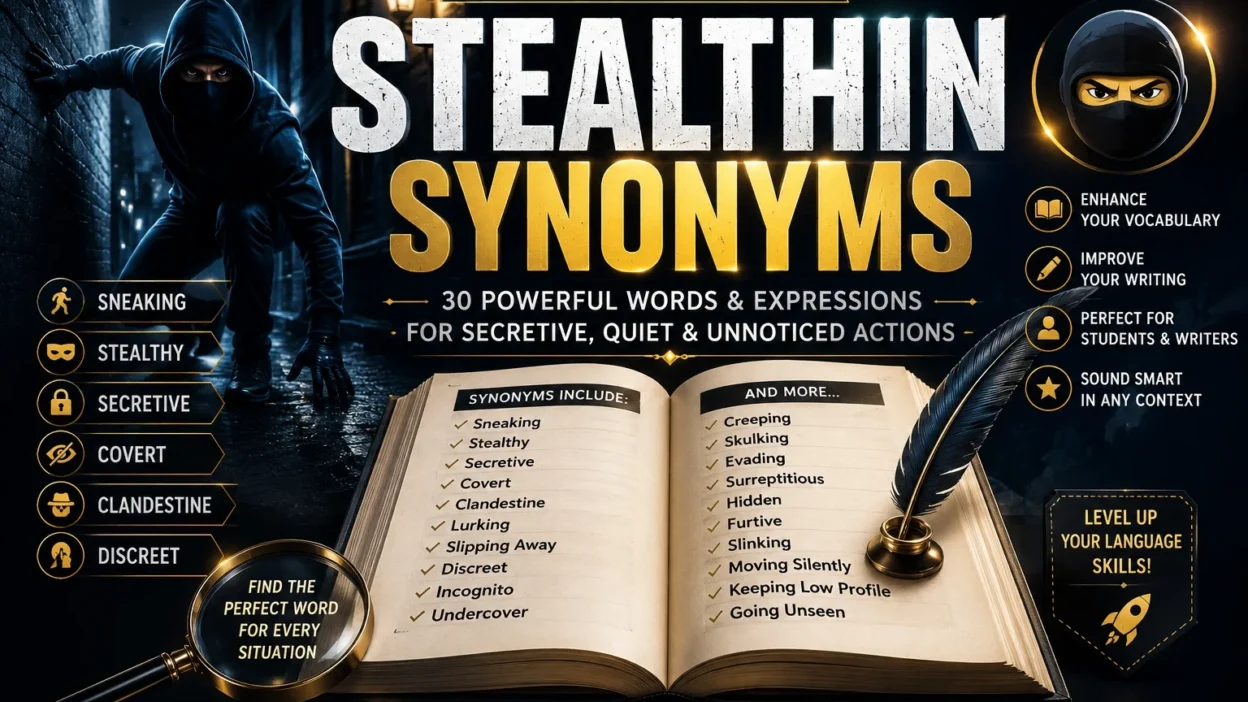
If you are searching for stealthin synonyms, you may be looking for words that describe moving quietly, acting secretly, staying unnoticed, or avoiding attention. “Stealthin” is an informal or playful form related to stealthing or behaving with stealth, depending on the context in which it appears.
Because “stealthin” is not a standard formal dictionary word in most contexts, the best synonym depends on what you want to express. You might mean sneaking, hiding, lurking, slipping away, or simply doing something quietly and unnoticed.
Understanding related words can help students, ESL learners, writers, and content creators choose language that sounds natural and accurately communicates the intended meaning. This guide provides 30 useful alternatives, with simple meanings, examples, and usage notes.
What Does “Stealthin” Mean?
“Stealthin” is an informal spelling or shortened form associated with stealthy behavior. In everyday language, it can suggest doing something quietly, secretly, or without attracting attention.
For example:
“He was stealthin through the house so nobody would notice.”
In this sentence, “stealthin” suggests moving quietly and carefully to remain unnoticed.
The exact meaning can change according to context. It may describe physical movement, secretly entering or leaving a place, quietly observing someone, or carrying out an action without drawing attention.
30 Stealthin Synonyms
1. Sneaking
Meaning: Moving or acting quietly so that other people do not notice.
Example: She was sneaking into the kitchen for a late-night snack.
Best usage context: Everyday conversation and informal writing.
2. Sneaking Around
Meaning: Moving or behaving secretly to avoid being seen or discovered.
Example: The children were sneaking around the house after bedtime.
Best usage context: Informal situations involving secret behavior.
3. Stealthy
Meaning: Quiet, careful, and difficult to notice.
Example: The cat made a stealthy approach toward the bird.
Best usage context: General writing, descriptions, and storytelling.
4. Secretive
Meaning: Trying to keep actions, information, or intentions hidden.
Example: He became secretive when we asked about his plans.
Best usage context: People, behavior, information, and personal actions.
5. Quietly
Meaning: Without making much noise or attracting attention.
Example: She quietly left the room.
Best usage context: Simple everyday descriptions.
6. Unnoticed
Meaning: Not seen, heard, or recognized by others.
Example: He slipped away unnoticed during the busy event.
Best usage context: Actions that happen without attention.
7. Clandestine
Meaning: Kept secret, especially because something is not supposed to be known.
Example: They held a clandestine meeting after work.
Best usage context: Formal writing, journalism, and serious situations.
8. Covert
Meaning: Hidden or secret, especially when an action is deliberately concealed.
Example: The organization carried out a covert operation.
Best usage context: Formal, professional, military, or strategic contexts.
9. Hidden
Meaning: Kept out of sight or concealed from others.
Example: The note was hidden beneath the book.
Best usage context: Objects, information, intentions, and actions.
10. Concealed
Meaning: Deliberately kept from view or knowledge.
Example: The entrance was concealed behind a wall.
Best usage context: Formal and descriptive writing.
11. Lurking
Meaning: Staying somewhere secretly or quietly, often while waiting or watching.
Example: A stranger was lurking near the entrance.
Best usage context: Suspenseful, cautious, or negative situations.
12. Slipping Away
Meaning: Leaving quietly or gradually without being noticed.
Example: She slipped away before the meeting ended.
Best usage context: Casual conversation and storytelling.
13. Creeping
Meaning: Moving slowly and quietly, often to avoid detection.
Example: The fox was creeping toward the fence.
Best usage context: Physical movement and descriptive writing.
14. Tiptoeing
Meaning: Walking quietly on the tips of your toes.
Example: He was tiptoeing past the sleeping baby.
Best usage context: Literal movement where silence is important.
15. Skulking
Meaning: Moving or staying somewhere in a secretive way, often because you do not want to be noticed.
Example: The dog was skulking around the garden.
Best usage context: Informal or slightly negative descriptions.
16. Slinking
Meaning: Moving quietly and secretly, often because of embarrassment or a desire to avoid attention.
Example: He came slinking into the room after being late.
Best usage context: Informal writing with a negative or humorous tone.
17. Slithering
Meaning: Moving smoothly and quietly, usually like a snake.
Example: The snake was slithering silently through the grass.
Best usage context: Animals and vivid descriptive writing.
18. Evading
Meaning: Avoiding someone or something, especially deliberately.
Example: The suspect kept evading the reporters.
Best usage context: Avoidance, pursuit, and formal writing.
19. Avoiding
Meaning: Staying away from someone or something intentionally.
Example: She was avoiding attention at the crowded party.
Best usage context: Everyday English and general writing.
20. Discreet
Meaning: Careful not to attract attention or reveal private information.
Example: The assistant made a discreet exit.
Best usage context: Professional, polite, and socially appropriate situations.
21. Incognito
Meaning: With your identity hidden or disguised.
Example: The celebrity traveled incognito to avoid attention.
Best usage context: Travel, entertainment, storytelling, and identity-related situations.
22. Undercover
Meaning: Secretly working or acting while hiding your real identity or purpose.
Example: The officer was working undercover.
Best usage context: Police, investigations, journalism, and fiction.
23. Surreptitious
Meaning: Done secretly to avoid being noticed.
Example: He took a surreptitious glance at the clock.
Best usage context: Formal or advanced writing.
24. Furtive
Meaning: Secretive and nervous because you do not want to be noticed.
Example: She gave him a furtive look across the room.
Best usage context: Formal descriptions of suspicious or nervous behavior.
25. Stealing Away
Meaning: Leaving quietly and secretly.
Example: They were stealing away before anyone could say goodbye.
Best usage context: Storytelling and literary writing.
26. Ghosting
Meaning: Suddenly ending communication with someone without explanation.
Example: After several messages, he started ghosting his friends.
Best usage context: Modern informal and social-media language.
Note: “Ghosting” is not a direct synonym for physical stealth. It applies specifically to communication and relationships.
27. Keeping a Low Profile
Meaning: Avoiding attention and not making yourself noticeable.
Example: After the controversy, the actor kept a low profile.
Best usage context: People who intentionally avoid public attention.
28. Going Unseen
Meaning: Remaining out of sight or avoiding detection.
Example: The animal moved quickly while going unseen through the forest.
Best usage context: Descriptive and creative writing.
29. Moving Silently
Meaning: Traveling or changing position without making noise.
Example: The guard was moving silently through the hallway.
Best usage context: Physical movement and action scenes.
30. Acting in Secret
Meaning: Doing something without informing other people.
Example: They were acting in secret to organize the surprise party.
Best usage context: General explanations and informal writing.
Quick Comparison of Stealthin Synonyms
| Synonym | Main Idea | Tone | Best Context |
|---|---|---|---|
| Sneaking | Moving secretly | Informal | Everyday situations |
| Stealthy | Difficult to notice | Neutral | General writing |
| Secretive | Hiding information or intentions | Neutral | People and behavior |
| Clandestine | Deliberately hidden | Formal | Secret activities |
| Covert | Hidden purpose or operation | Formal | Strategic situations |
| Lurking | Secretly waiting or watching | Negative | Suspicious situations |
| Tiptoeing | Walking quietly | Neutral | Literal movement |
| Slinking | Moving secretly or shamefully | Negative | Informal descriptions |
| Discreet | Avoiding unwanted attention | Positive/neutral | Professional settings |
| Furtive | Secretive and nervous | Negative | Suspicious behavior |
| Incognito | Hiding identity | Neutral | Public appearances |
| Undercover | Hiding identity or purpose | Formal | Investigations |
| Ghosting | Cutting off communication | Informal | Social media |
| Low profile | Avoiding public attention | Neutral | Public figures |
Stealthin vs. Sneaking
Stealthin and sneaking can be very close in casual usage.
“Stealthin” has a playful, informal quality and emphasizes the idea of using stealth. “Sneaking” is a standard English word and is much more widely understood.
For example:
- “He was stealthin through the hallway.” — playful and informal.
- “He was sneaking through the hallway.” — natural standard English.
For academic or professional writing, sneaking, moving quietly, or acting secretly will usually be clearer.
Stealthin vs. Stealthy
The adjective stealthy is one of the closest standard English alternatives.
“Stealthy” describes something that is done quietly and without attracting attention.
Example:
The mouse made a stealthy movement across the floor.
If you are replacing “stealthin” in formal writing, “stealthy” may be a better choice when you need an adjective.
Stealthin vs. Secretive
These words overlap, but they are not identical.
Stealthin generally focuses on quietly doing or moving through something. Secretive focuses more on hiding information, plans, feelings, or intentions.
For example:
He was stealthin through the building.
Meanwhile:
She is very secretive about her plans.
describes a person’s unwillingness to reveal information.
Stealthin vs. Sneaking Around
“Sneaking around” is a very natural informal expression when someone moves or behaves secretly.
It can sometimes suggest suspicious behavior.
Example:
Why are you sneaking around the house?
This sounds natural in everyday conversation and is often a better choice than the informal “stealthin.”
How to Choose the Right Stealthin Synonym
Choosing the best synonym depends on your intended meaning and tone.
For Simple Everyday English
Use:
- Sneaking
- Sneaking around
- Quietly
- Slipping away
- Moving silently
These are easy for ESL learners and work well in ordinary conversations.
For Formal Writing
Use:
- Clandestine
- Covert
- Surreptitious
- Concealed
- Discreet
These words are more suitable for essays, reports, journalism, and professional writing.
For Suspicious Behavior
Use:
- Lurking
- Furtive
- Skulking
- Slinking
- Evading
These choices can suggest that someone’s behavior is questionable or suspicious.
For Physical Movement
Use:
- Creeping
- Tiptoeing
- Sneaking
- Moving silently
- Slithering
These are especially useful when describing how someone or something physically moves.
For Hiding Identity
Use:
- Incognito
- Undercover
- Covert
- Concealed
These words work well when someone’s identity or purpose is intentionally hidden.
For Avoiding Attention
Use:
- Discreet
- Unnoticed
- Keeping a low profile
- Going unseen
- Quietly
These options are useful when the main idea is avoiding attention rather than doing something suspicious.
Stealthin Synonyms for Students and ESL Learners
If you are learning English, you do not need to memorize all 30 words at once.
Start with these five:
- Sneaking — moving secretly.
- Stealthy — difficult to notice.
- Secretive — keeping things hidden.
- Quietly — without much noise or attention.
- Unnoticed — without being seen or recognized.
These words cover many everyday situations and are easier to use correctly.
Once you are comfortable with them, you can learn more advanced vocabulary such as clandestine, covert, surreptitious, and furtive.
Stealthin Synonyms in Different Sentences
Here are a few examples showing how different words can change the tone:
Casual:
He was sneaking around the house.
Neutral:
He was moving quietly through the house.
Descriptive:
He made a stealthy movement through the hallway.
Formal:
They conducted a clandestine meeting.
Suspicious:
Someone was lurking near the entrance.
Professional:
The team used a covert approach.
Each sentence communicates a similar general idea of secrecy or reduced visibility, but the specific word changes the meaning and tone.
Why Synonyms Matter
Learning synonyms is more than memorizing lists of alternative words. Good vocabulary helps you communicate precise ideas.
For writers, synonyms prevent repetitive sentences and make descriptions more interesting. For students, they improve vocabulary and reading comprehension. For ESL learners, they show how small differences in tone can change a sentence.
For example, discreet usually sounds more positive and socially appropriate than secretive, while furtive can make a person seem suspicious.
That difference is important when choosing the right word.
Final Thoughts on Stealthin Synonyms
The best stealthin synonyms depend on what you mean. If you are describing quiet movement, words such as sneaking, tiptoeing, creeping, and moving silently work well. If you mean hidden or secret activity, covert, clandestine, surreptitious, and concealed may be more appropriate.
For everyday English, simple choices such as sneaking, quietly, unnoticed, and slipping away are usually the most natural. More advanced words such as furtive and surreptitious are useful when you want a formal or precise style.
Remember that “stealthin” is informal, so the best replacement should match both the intended meaning and the audience. Choosing the right synonym makes your writing clearer, more natural, and more expressive.

Daniel Jack is a language enthusiast and content writer who specializes in synonyms, vocabulary, and word meanings. He creates clear, engaging resources that help readers improve communication and expand their English skills.