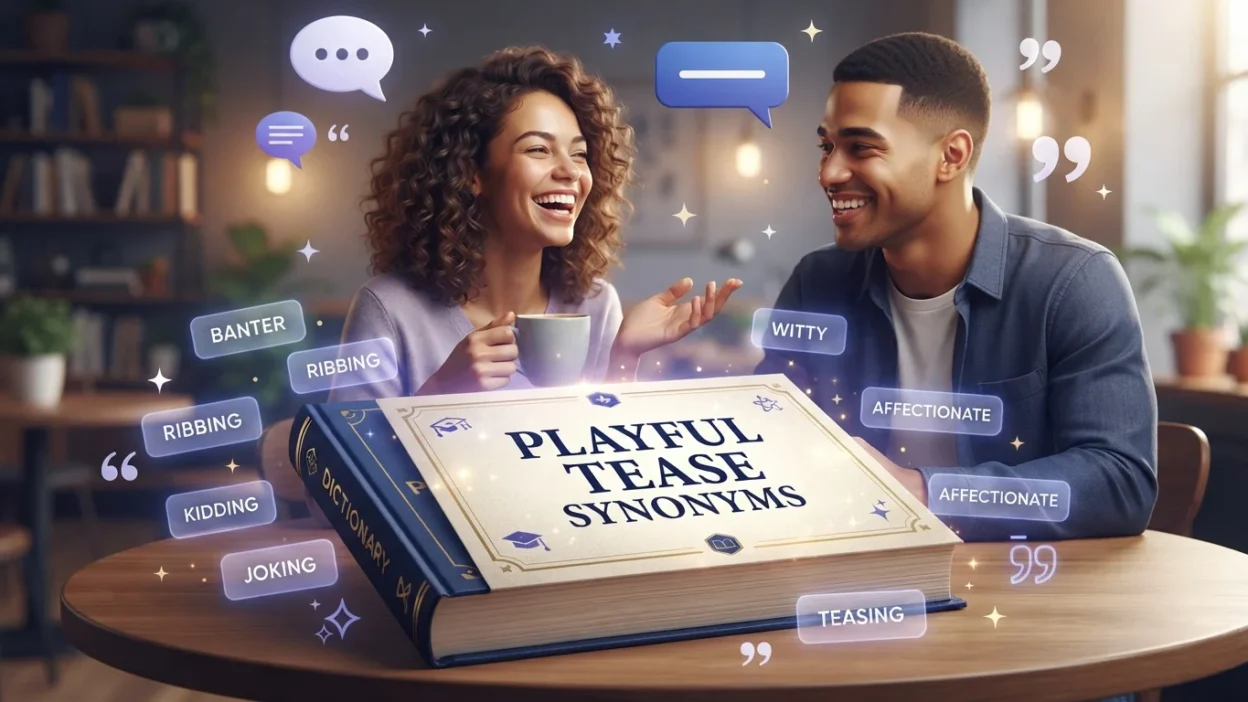
Finding the right words for a playful tease can make conversations more natural, humorous, and expressive. A playful tease is usually a light joke or gentle comment meant to make someone laugh rather than hurt their feelings. It often appears between friends, family members, romantic partners, or people who know each other well.
Learning playful tease synonyms is useful because not every teasing expression has the same tone. Words such as banter, ribbing, and kidding can sound friendly, while mocking or taunting may suggest something more negative. Understanding these differences helps students, ESL learners, writers, and content creators choose language that matches the situation.
What Does “Playful Tease” Mean?
A playful tease is a lighthearted remark, joke, or action intended to gently make fun of someone without seriously insulting them. The goal is usually amusement, affection, or friendly interaction.
For example, if your friend arrives late and you say, “Nice of you to finally join us!” with a smile, you may be playfully teasing them. The words sound critical, but the friendly context shows that you are joking.
Playful teasing can show familiarity, affection, humor, or confidence between people. However, context matters. A joke that makes one person laugh could make another person uncomfortable. Good teasing should respect boundaries and stop when the other person does not enjoy it.

30 Playful Tease Synonyms and Related Expressions
Some expressions below are close synonyms, while others describe specific forms of playful teasing. The exact meaning can change depending on context.
1. Banter
Meaning: Friendly conversation involving jokes, teasing, and quick humorous comments.
Example Sentence:
“Emma and Jake exchanged playful banter throughout dinner.”
Best Usage Context: Friendly conversations, relationships, workplaces, and casual dialogue.
2. Ribbing
Meaning: Friendly teasing, especially between people who know each other well.
Example Sentence:
“The team gave Mark some good-natured ribbing after he missed the easy goal.”
Best Usage Context: Informal conversations, sports, friendships, and group settings.
3. Kidding
Meaning: Saying something as a joke rather than seriously.
Example Sentence:
“I’m only kidding—you did a great job!”
Best Usage Context: Everyday spoken English and casual conversations.
4. Joking
Meaning: Saying something humorous rather than making a serious statement.
Example Sentence:
“I was just joking when I said you needed a map to find the kitchen.”
Best Usage Context: Almost any informal situation where the humorous intention is clear.
5. Teasing
Meaning: Making fun of someone in a playful or sometimes critical way.
Example Sentence:
“Her brother was teasing her about her enormous collection of shoes.”
Best Usage Context: Everyday conversations. Tone determines whether it feels friendly or hurtful.
6. Poking Fun
Meaning: Making a light joke about someone or something.
Example Sentence:
“We were just poking fun at Tom’s obsession with organizing everything.”
Best Usage Context: Friendly and informal situations.
7. Playful Mockery
Meaning: Imitating or making fun of someone in a humorous, non-serious way.
Example Sentence:
“His playful mockery of her dramatic storytelling made everyone laugh.”
Best Usage Context: Close friendships, comedy, and creative writing.
8. Jesting
Meaning: Speaking humorously or making a joke, often in a slightly formal style.
Example Sentence:
“I’m only jesting; your presentation was excellent.”
Best Usage Context: Writing, storytelling, and slightly more formal language.
9. Chaffing
Meaning: Lightly teasing or joking with someone in a friendly manner.
Example Sentence:
“The old friends spent the afternoon chaffing each other.”
Best Usage Context: Informal English, especially in British and Australian usage.
10. Taunting Lightly
Meaning: Making provocative remarks in a joking way.
Example Sentence:
“She was lightly taunting her brother about his losing streak.”
Best Usage Context: Competitive games and close friendships. Use carefully because taunting can also be hostile.
11. Teasing Remark
Meaning: A comment made mainly to joke with or gently provoke someone.
Example Sentence:
“‘You finally remembered my birthday!’ was a teasing remark.”
Best Usage Context: Everyday conversation and informal writing.
12. Wisecracking
Meaning: Making clever, humorous, or slightly cheeky comments.
Example Sentence:
“He kept wisecracking during the road trip.”
Best Usage Context: Casual conversation, comedy, and character dialogue.
13. Cracking Jokes
Meaning: Making jokes, often repeatedly or casually.
Example Sentence:
“Everyone was cracking jokes while they waited for dinner.”
Best Usage Context: Informal conversation and social situations.
14. Kidding Around
Meaning: Behaving playfully and joking without being serious.
Example Sentence:
“We were just kidding around during the lunch break.”
Best Usage Context: Very casual speech, especially among friends.
15. Joking Around
Meaning: Spending time being playful, silly, or humorous.
Example Sentence:
“The students were joking around before class began.”
Best Usage Context: Casual spoken English.
16. Good-Natured Teasing
Meaning: Friendly teasing that is not intended to cause harm.
Example Sentence:
“His good-natured teasing made everyone smile.”
Best Usage Context: When you specifically want to emphasize that the teasing is friendly.
17. Friendly Ribbing
Meaning: Light teasing between people who share a comfortable relationship.
Example Sentence:
“The players exchanged friendly ribbing after practice.”
Best Usage Context: Sports, friendships, teams, and informal groups.
18. Playful Poking
Meaning: Gently teasing someone to get a humorous reaction.
Example Sentence:
“She was playfully poking at her friend for being overly organized.”
Best Usage Context: Casual conversations and informal writing.
19. Cheeky Teasing
Meaning: Playful teasing that is slightly bold, mischievous, or impudent.
Example Sentence:
“His cheeky teasing made her laugh.”
Best Usage Context: Informal conversations and playful relationships.
20. Lighthearted Teasing
Meaning: Teasing that is cheerful, relaxed, and not meant seriously.
Example Sentence:
“The conversation was full of lighthearted teasing.”
Best Usage Context: Friendly social situations and general writing.
21. Affectionate Teasing
Meaning: Teasing that expresses warmth, closeness, or affection.
Example Sentence:
“Her affectionate teasing showed how comfortable the two friends were together.”
Best Usage Context: Close friendships, family relationships, and romantic relationships.
22. Good-Natured Joking
Meaning: Friendly jokes made without serious criticism or hostility.
Example Sentence:
“There was plenty of good-natured joking during the family gathering.”
Best Usage Context: Families, friends, teams, and social gatherings.
23. Playful Jabbing
Meaning: Making a pointed but humorous comment toward someone.
Example Sentence:
“His playful jabbing about her coffee habit made her laugh.”
Best Usage Context: Informal conversations between people who understand each other well.
24. Witty Teasing
Meaning: Teasing through clever, amusing, or intelligent remarks.
Example Sentence:
“Her witty teasing kept the conversation entertaining.”
Best Usage Context: Clever conversations, writing, dialogue, and social situations.
25. Mischievous Teasing
Meaning: Teasing in a playful way that suggests a little harmless troublemaking.
Example Sentence:
“He gave her a mischievous grin before starting his teasing.”
Best Usage Context: Friendly relationships, stories, and playful interactions.
26. Playful Needling
Meaning: Repeatedly teasing someone about a particular subject, usually in a light way.
Example Sentence:
“His friends kept playfully needling him about his favorite football team.”
Best Usage Context: Close friendships and informal speech. It can become irritating if overused.
27. Good-Natured Mocking
Meaning: Pretending to imitate or criticize someone for humorous effect without serious hostility.
Example Sentence:
“Her good-natured mocking of his dramatic expressions made everyone laugh.”
Best Usage Context: Close relationships and humorous writing.
28. Lighthearted Poking Fun
Meaning: Gently making jokes about someone or something.
Example Sentence:
“They spent the evening lightheartedly poking fun at their old school photos.”
Best Usage Context: Friends, family, social media, and casual writing.
29. Playful Provocation
Meaning: Deliberately saying or doing something to get a humorous reaction.
Example Sentence:
“His playful provocation was clearly intended to make his sister laugh.”
Best Usage Context: Close relationships, creative writing, and playful conversations.
30. Playful Flirting
Meaning: Light teasing combined with romantic or attractive interest.
Example Sentence:
“Their playful flirting made it obvious that they enjoyed each other’s company.”
Best Usage Context: Romantic or potentially romantic situations where both people are comfortable with that tone.

Playful Tease Synonyms Comparison Table
| Synonym/Phrase | Tone | Meaning | Best Usage |
|---|---|---|---|
| Banter | Friendly | Humorous back-and-forth | Friends and casual conversation |
| Ribbing | Friendly | Good-natured teasing | Friends and teams |
| Kidding | Casual | Not being serious | Everyday speech |
| Joking | Humorous | Saying something for fun | General conversation |
| Poking fun | Light | Gently making fun | Informal situations |
| Wisecracking | Cheeky | Making clever remarks | Comedy and casual talk |
| Jesting | Light/Formal | Speaking humorously | Writing and storytelling |
| Chaffing | Friendly | Light teasing | British/Australian English |
| Affectionate teasing | Warm | Teasing that shows closeness | Friends, family, partners |
| Witty teasing | Clever | Teasing with smart humor | Conversation and writing |
| Cheeky teasing | Mischievous | Bold, playful teasing | Informal relationships |
| Playful flirting | Romantic | Teasing with romantic interest | Dating and relationships |
How to Choose the Right Playful Tease Synonym
The best synonym depends on what you want to communicate. A word that sounds funny among close friends may sound rude in a professional setting.
For Friendly Teasing
Choose banter, ribbing, kidding, joking, or good-natured teasing.
These expressions work well when people already have a comfortable relationship.
Example:
“We spent the afternoon exchanging friendly banter.”
For Humorous Teasing
Choose joking, poking fun, wisecracking, or cracking jokes.
These words focus more on humor than affection.
Example:
“She was just poking fun at his terrible singing.”
For Affectionate Teasing
Choose affectionate teasing or good-natured joking when the goal is to show warmth and familiarity.
Example:
“His affectionate teasing made her smile.”
For Cheeky or Mischievous Teasing
Use cheeky teasing, mischievous teasing, playful jabbing, or playful needling.
These expressions can suggest a little boldness or mischief.
Example:
“His cheeky teasing made the conversation more exciting.”
For Witty Teasing
Use witty teasing or wisecracking when the humor depends on clever language.
Example:
“Her witty teasing gave the dialogue plenty of personality.”
For Sarcastic Teasing
Use sarcasm carefully. Sarcasm can be funny among people who understand each other’s humor, but it can also sound insulting.
Example:
“‘Brilliant idea,’ he said sarcastically after the plan failed.”
Sarcasm is therefore related to playful teasing but is not always friendly.
For Playful Flirting
Playful flirting works when teasing is connected to romantic interest.
Example:
“She responded to his playful flirting with a smile.”
This expression should be used only when the context and relationship make the intention appropriate.
For Casual Conversation
The safest everyday choices are usually kidding, joking, banter, ribbing, and teasing.
These are common and easy for ESL learners to recognize.
For Creative Writing
Writers can use expressions such as banter, witty teasing, playful mockery, wisecracking, affectionate teasing, and playful jabbing to give characters distinctive voices.
Playful Tease vs. Similar Words
Understanding related expressions is important because they do not all have the same emotional effect.
Playful Tease vs. Banter
Playful tease can be one humorous remark directed at someone.
Banter usually involves a back-and-forth exchange of jokes or teasing comments.
Example:
One friend says, “You are always late.” That is teasing.
Both friends repeatedly joke about each other’s habits. That is banter.
Playful Tease vs. Ribbing
Ribbing is usually friendly teasing, especially between people who know each other well.
It is very close to the idea of playful teasing.
Playful Tease vs. Joking
Joking is broader. A joke does not necessarily involve teasing another person.
For example, telling a funny story is joking, but it is not necessarily teasing.
Playful Tease vs. Mocking
Mocking means making fun of someone, often by copying their behavior, voice, or mannerisms.
It can be playful, but it can also be insulting.
Playful Tease vs. Taunting
Taunting usually has a stronger and more provocative meaning. It may be intended to annoy, challenge, or upset someone.
Therefore, it is not normally the safest synonym for friendly teasing.
Playful Tease vs. Sarcasm
Sarcasm involves saying something that often means the opposite of the literal words, usually for humor or criticism.
It can be playful, but it can also be harsh.
Playful Tease vs. Kidding
Kidding is a casual way to say that you are not being serious.
For example:
“Don’t worry, I’m just kidding.”
It is one of the easiest playful-teasing expressions for everyday English.
Examples of Playful Teasing in Context
Everyday Conversation
A: “You made coffee again?”
B: “Of course. Someone has to keep you awake.”
A: “Very funny!”
This is playful teasing because the comment is humorous rather than genuinely critical.
Friend-to-Friend Communication
“Look who finally decided to show up! We were about to send a search party.”
The exaggeration makes the teasing feel lighthearted.
Text Message
“Wow, you replied in only three hours. New personal record 😂”
The emoji can help communicate that the comment is intended humorously.
Social Media
“Another picture of your breakfast? At this point, I think your toast deserves its own account.”
This is a playful comment that gently jokes about someone’s repeated posts.
Creative Writing
“‘You’re calling that a plan?’ Maya laughed. ‘I’ve seen better strategies from a sleepy cat.’”
The teasing helps make the character’s personality more lively.
Character Dialogue
“You’re really wearing that?”
“Jealous?”
“Absolutely not. I’m just impressed by your confidence.”
The exchange uses playful teasing to show familiarity between the characters.
ESL Tips for Using Playful Teasing Words
If English is your second language, remember that teasing can be difficult because tone is often more important than the literal words.
1. Start With Safe Expressions
Words such as joking, kidding, banter, and friendly teasing are generally easier to understand.
2. Be Careful With Mocking
Mocking can sound negative. Use it when the context clearly shows that the imitation or joke is friendly.
3. Use “Just Kidding” When Appropriate
The phrase “I’m just kidding” can clarify that you did not intend a statement seriously.
However, it should not be used to excuse genuinely hurtful comments.
4. Understand “Banter”
In everyday English, banter often describes playful back-and-forth conversation. It is especially common in informal settings.
5. Watch Your Relationship With the Person
A joke between close friends may not work with a stranger, teacher, manager, or new colleague.
6. Pay Attention to Reactions
If someone looks uncomfortable, stops laughing, or asks you to stop, respect that response. Playful teasing should be enjoyable for everyone involved.
7. Remember That Culture Matters
Humor and teasing vary between cultures. An expression that sounds normal in one English-speaking community may feel stronger or stranger in another.
Frequently Asked Questions About Playful Tease Synonyms
What is another word for playful tease?
Common alternatives include banter, ribbing, kidding, joking, teasing, poking fun, and good-natured teasing. The best choice depends on the context.
What is a synonym for friendly teasing?
Ribbing, banter, good-natured teasing, affectionate teasing, and kidding can describe friendly teasing.
Is “banter” the same as teasing?
Not exactly. Banter usually describes playful back-and-forth conversation, while teasing can involve a single comment directed at another person.
What is a playful way to say someone is teasing you?
You might say, “You’re just kidding,” “You’re teasing me,” “Stop messing with me,” or “You’re just giving me a hard time.”
Is teasing always negative?
No. Teasing can be friendly, affectionate, humorous, or flirtatious. However, it becomes negative when it is intended to hurt, embarrass, intimidate, or repeatedly upset someone.
What is the difference between teasing and mocking?
Teasing can be gentle and friendly. Mocking usually involves imitating or making fun of someone and can carry a more negative tone.
Can playful teasing be flirtatious?
Yes. Playful flirting can include teasing, jokes, compliments, and light challenges. The context and mutual comfort of both people are important.
What is a formal synonym for teasing?
Jesting can sometimes work in more formal or literary writing, although it is less common in everyday conversation.
Conclusion
A playful tease is a lighthearted way of joking with someone, often to create laughter, show familiarity, or make a conversation more enjoyable. The best playful tease synonyms include banter, ribbing, kidding, joking, poking fun, affectionate teasing, and wisecracking, but each expression carries its own shade of meaning.
The most important thing is to consider tone, context, relationship, and intention. Friendly teasing should feel light rather than hurtful. When you understand these differences, you can choose words that make conversations, stories, social posts, and creative writing sound more natural and expressive.
if you are an ESL learner expanding your vocabulary or a writer looking for better dialogue, understanding playful teasing expressions gives you more precise control over tone and meaning.

David Henry is a language enthusiast and content writer specializing in synonyms, vocabulary, and word meanings. He creates clear, engaging resources that help readers improve their writing, communication, and English skills.