Can and could are two of the most common modal verbs in English. They often appear in questions, requests, sentences about ability, and situations involving possibility. Because both words can sometimes express similar ideas, English learners frequently wonder when to use can vs could.
The main difference is that can usually refers to present ability, permission, or possibility, while could can describe past ability, a more tentative possibility, or a polite request. However, the choice depends on context. For example, “I can swim” talks about an ability someone has now, while “I could swim when I was five” describes an ability in the past. Understanding these small differences will help you sound clearer and more natural in everyday English, writing, and conversation.
Quick Answer
Can is mainly used for present ability, permission, and possibility. Could is commonly used for past ability, polite requests, suggestions, and less certain possibilities. Compare: “I can help you now” with “I could help you tomorrow.” The correct choice depends on time, certainty, and context.
Why Do People Confuse Can and Could?
People confuse can and could because both words are modal verbs and can express ability or possibility.
For example:
- I can help you. → I am able or willing to help now.
- I could help you. → I am suggesting a possible option or future action.
- She can drive. → She has the ability now.
- She could drive when she was eighteen. → This describes past ability.
The important point is that could is not simply the past form of can in every situation. Although it often refers to past ability, it has several other uses.
Can
What Does “Can” Mean?
Can is a modal verb used mainly to talk about ability, permission, possibility, and willingness.
1. Present Ability
Use can when someone has the ability to do something now.
- I can speak three languages.
- She can play the piano.
- We can finish the work today.
2. Permission
Use can to ask for or give permission, especially in everyday conversation.
- Can I use your phone?
- You can leave early today.
- Can we sit here?
3. Possibility
Can can describe something that is generally possible.
- Too much sunlight can damage your skin.
- Winters can be very cold here.
- Mistakes can happen to anyone.
4. Offering Help
Can is also common when offering to do something.
- I can help you with your homework.
- We can carry those bags for you.
Could
What Does “Could” Mean?
Could is a modal verb used for past ability, polite requests, possibility, suggestions, and hypothetical situations.
1. Past Ability
Use could to describe a general ability someone had in the past.
- I could read when I was four.
- She could swim at the age of six.
- When we were young, we could run for hours.
For a specific successful action in the past, was/were able to is often more natural:
- I was able to fix the computer yesterday.
2. Polite Requests
Could can make a request sound more polite or less direct.
- Could you open the window?
- Could I borrow your pen?
- Could you explain this question?
This does not necessarily mean the action is in the past.
3. Possibility
Could can describe something that is possible but uncertain.
- It could rain tonight.
- This could be the answer.
- We could miss the train.
The speaker presents the situation as a possibility rather than a certainty.
4. Suggestions
Could can introduce an idea or possible solution.
- We could go to the library.
- You could try restarting your computer.
- She could ask her teacher for help.
Can vs Could: Comparison Table
| Use | Can | Could |
|---|---|---|
| Present ability | I can drive. | — |
| General past ability | — | I could drive at 17. |
| Present permission | Can I leave? | Could I leave? |
| Polite request | Can you help me? | Could you help me? |
| General possibility | It can happen. | It could happen. |
| Uncertain possibility | Less typical | It could happen. |
| Suggestion | We can go. | We could go. |
| Hypothetical situation | — | I could help if I had time. |
When Should You Use Can or Could?
Choose can when you are talking about:
- Present ability
- Everyday permission
- General possibility
- An offer or willingness to help
- Something that is realistically available now
Choose could when you are talking about:
- General ability in the past
- A polite request
- An uncertain possibility
- A suggestion
- A hypothetical or conditional situation
Compare these sentences:
Can you help me?
This is a normal, direct request.
Could you help me?
This is generally more polite and less direct.
Both are grammatically correct. The difference is mainly in tone.
Can vs Could: 10+ Examples
Example 1: Present Ability
I can drive a car.
This means the person has the ability to drive now.
Example 2: Past Ability
I could ride a bicycle when I was five.
This describes a general ability in the past.
Example 3: Asking Permission
Can I borrow your notebook?
This is a common, natural request for permission.
Example 4: Polite Permission
Could I use your laptop for a few minutes?
This sounds more polite or formal than “Can I use your laptop?”
Example 5: Direct Request
Can you help me with this exercise?
The speaker is making a normal request.
Example 6: Polite Request
Could you help me with this exercise?
The meaning is similar, but the request is softer.
Example 7: General Possibility
Driving too fast can cause accidents.
This means that speeding has the potential to cause accidents generally.
Example 8: Uncertain Possibility
The package could arrive tomorrow.
The speaker believes tomorrow is possible but is not certain.
Example 9: Suggestion
We could take the bus instead.
The speaker is presenting an option.
Example 10: Hypothetical Situation
I could buy a new phone if I saved enough money.
The action depends on a condition.
Example 11: Past Ability
My grandfather could speak several languages.
This describes a general ability he had in the past.
Example 12: Present Ability
My sister can speak Spanish fluently.
This describes an ability she has now.
Common Mistakes With Can and Could
Mistake 1: Using “Can” for Every Past Ability
Incorrect:
- When I was young, I can swim.
Correct:
- When I was young, I could swim.
Mistake 2: Thinking “Could” Always Means Past
Could does not always refer to the past.
For example:
- Could you help me?
This is a present request, not a request about the past.
Mistake 3: Confusing Permission and Ability
Compare:
- I can swim. → ability
- I can swim here. → permission may be implied by context
The surrounding situation determines the exact meaning.
Mistake 4: Assuming “Could” Always Means More Polite
Could is often more polite in requests, but its meaning also depends on context.
- Can you send the file?
- Could you send the file?
Both are requests. The second usually sounds softer.
Mistake 5: Using “Could” When You Mean Certain Ability
If you are talking about a clear present ability, can is usually the natural choice.
- I can solve this problem.
Not:
- I could solve this problem.
The second sentence may instead suggest a conditional or hypothetical meaning depending on context.
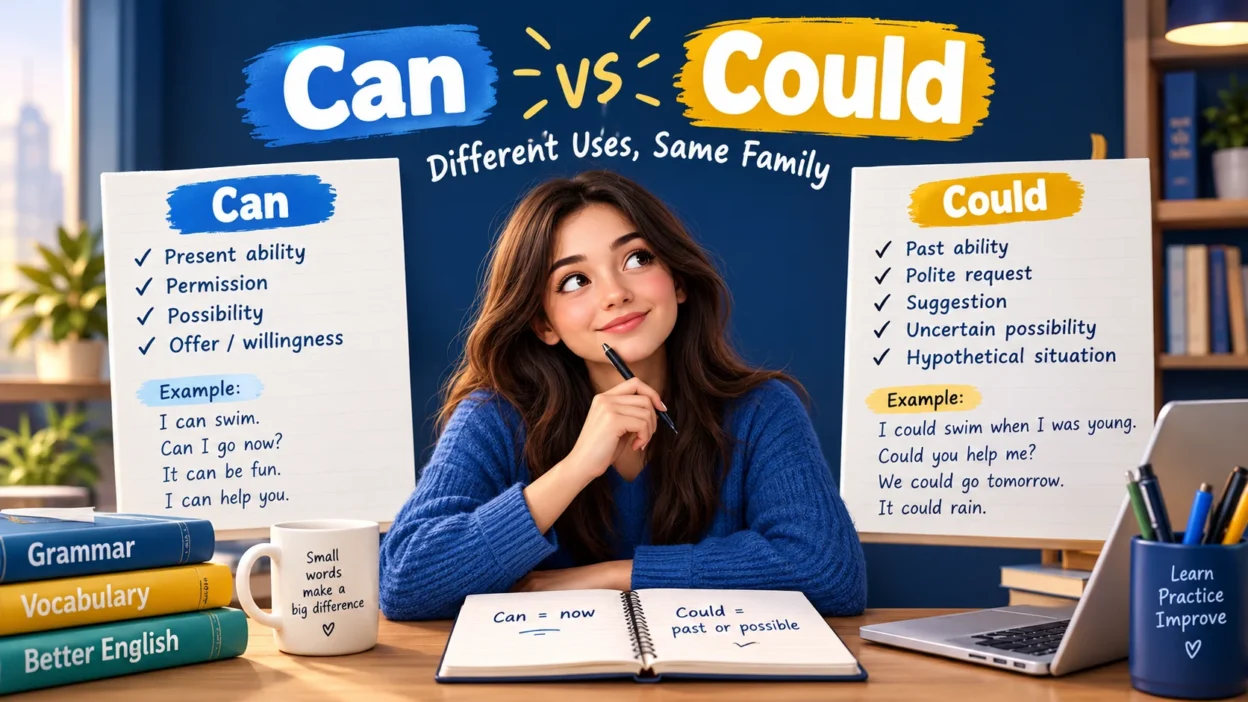
Memory Trick: Can = Now, Could = Past or Possible
A simple way to remember the difference is:
CAN = ability or possibility now
COULD = past ability, polite request, or possible option
Think of could as giving you more distance from the situation. That distance can refer to past time, uncertainty, politeness, or a hypothetical idea.
Can vs Could in American and British English
Both can and could are standard in American and British English. Their basic meanings and grammatical uses are the same.
One noticeable difference is that British English may use could quite naturally for polite requests, while American English also commonly uses can in everyday conversation.
For example:
- Can you pass the salt?
- Could you pass the salt?
Both are understood in both varieties of English.
The choice often depends more on formality, politeness, certainty, and context than on whether the speaker uses American or British English.
Similar Words to Can and Could
Several other expressions can overlap with can and could.
Be Able To
Be able to expresses ability and can be useful when a different tense is needed.
- I can swim.
- I was able to swim across the pool.
May
May can express possibility or permission.
- It may rain tonight.
- May I come in?
It is often more formal than can when asking for permission.
Might
Might expresses possibility, often with less certainty.
- It might rain later.
Would
Would is frequently used for polite requests and hypothetical situations.
- Would you help me?
- I would travel more if I had more free time.
Final Verdict: Can vs Could
The easiest distinction is this: can commonly describes present ability, permission, or general possibility, while could commonly describes past ability, polite requests, suggestions, uncertain possibilities, and hypothetical situations.
Remember that could does not always mean past tense. In “Could you help me?”, it is a polite present request. In “It could rain,” it expresses possibility. In “I could swim when I was six,” it refers to past ability.
Frequently Asked Questions
Is “could” the past tense of “can”?
Could is often used as the past form of can when describing general past ability. However, it also has other uses, including polite requests, suggestions, possibilities, and hypothetical situations.
Which is more polite: “Can you” or “Could you”?
Could you is generally more polite or less direct than can you when making a request. For example, “Could you help me?” sounds softer than “Can you help me?”
Can I use “could” for present situations?
Yes. Could can describe present or future possibilities and can also make a present request more polite.
Example: Could you help me with this problem?
Is “Can I” grammatically correct for asking permission?
Yes. Can I is common and natural in everyday English when asking permission.
Example: Can I leave early today?
What is the difference between “I can” and “I could”?
I can usually expresses present ability or possibility. I could can express past ability, a possible option, a hypothetical situation, or a more tentative idea.
Which is correct: “It can rain” or “It could rain”?
Both can be correct, but the meaning differs. It can rain can describe a general possibility or tendency. It could rain usually means rain is a possibility in a particular situation.
Can “could” be used for suggestions?
Yes. Could is commonly used to suggest an option.
Example: We could meet at the library tomorrow.
Is “Could I” more polite than “Can I”?
Usually, yes. Could I generally sounds more polite or formal than Can I, although both are widely used and grammatically acceptable.
Remember This
Can → present ability, permission, general possibility
Could → past ability, polite requests, suggestions, uncertain possibilities, hypothetical situations
If you are talking about what someone can do now, choose can. If you are talking about what someone could do in the past, or presenting a polite request or possible option, could is often the better choice.
Conclusion
Understanding can vs could becomes much easier when you focus on time, certainty, and tone. Use can for present abilities, everyday permission, and general possibilities. Use could for general past abilities, polite requests, suggestions, uncertain possibilities, and hypothetical situations.
The two words are closely related, but they are not interchangeable in every sentence. Pay attention to what you want to communicate: Can often sounds direct and immediate, while could can create distance through past time, politeness, uncertainty, or imagination. With regular practice and attention to context, choosing between them will become natural.

Daniel Jack is a language enthusiast and content writer who specializes in synonyms, vocabulary, and word meanings. He creates clear, engaging resources that help readers improve communication and expand their English skills.