
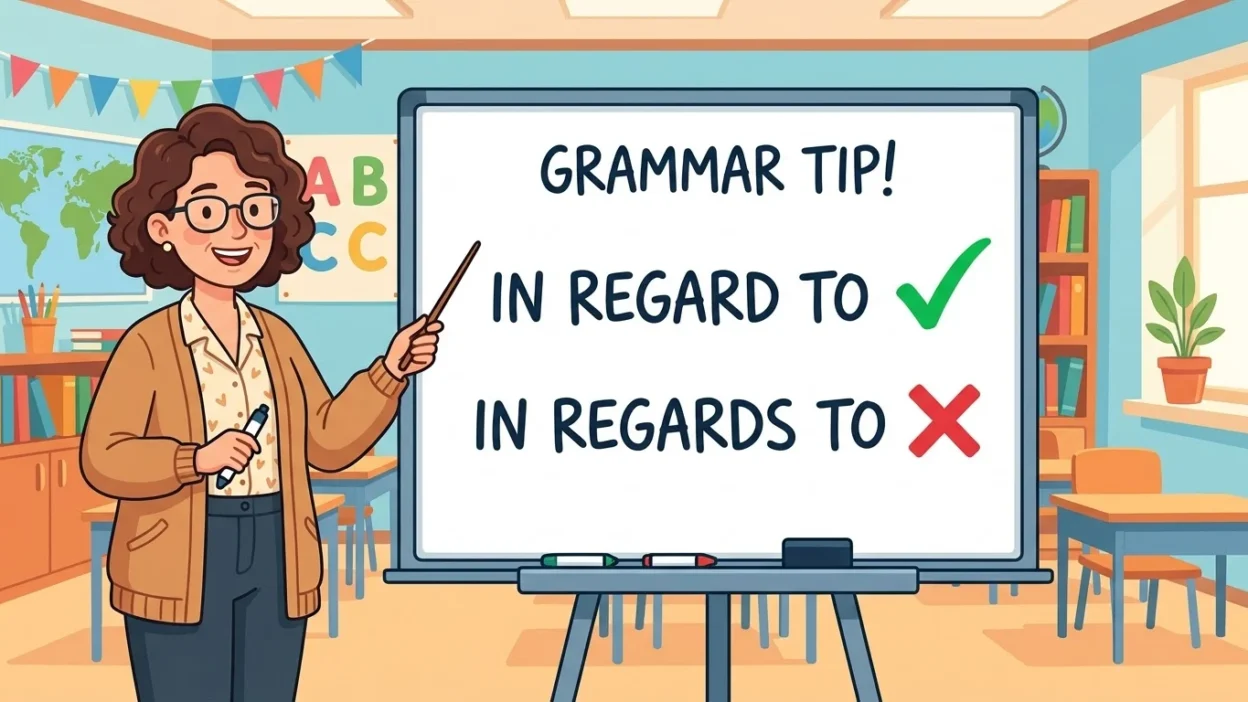
In regard to is the correct phrase. In regards to is a common mistake. If you have ever wondered which one to use in an email or a formal letter, you are not alone. Many native English speakers get this wrong too. The confusion happens because both phrases sound almost identical when spoken, and the word “regards” does exist in English—but it means something completely different.
This article explains the difference in simple terms. You will learn why one is standard and the other is not, see clear examples, and discover an easy memory trick. Whether you are writing a business email, a school assignment, or a message to a colleague, this guide will help you choose the right phrase every time. By the end, you will know exactly when to write “in regard to” and when to avoid “in regards to” altogether.
Quick Answer
In regard to is correct. In regards to is nonstandard. Use “in regard to” to mean “about” or “concerning.” The word “regards” means “greetings” or “best wishes,” so “in regards to” sounds like you are sending greetings, not discussing a topic.
Why People Confuse “In Regard To” and “In Regards to”
The confusion comes from two places.
First, the phrases sound nearly identical when spoken quickly. The “s” at the end of “regards” is easy to miss or add by accident.
Second, the word “regards” is real and common—but it means something else. “Regards” means “greetings” or “best wishes,” as in “Give my regards to your family.” When people write “in regards to,” they are mixing up a formal phrase with a word that has a completely different meaning.
This mistake has become so widespread that some grammar experts believe “in regards to” may eventually become accepted standard English. For now, however, careful writers still avoid it.
What Does “Regard” Mean?
“Regard” is a noun that means “attention,” “consideration,” or “relation.” In the phrase “in regard to,” it works like a formal way to say “about” or “concerning.”
The phrase has been used in English since the late 1400s. It appears mostly in formal writing, such as business letters, legal documents, and academic papers.
Examples:
- I am writing in regard to your recent application.
- In regard to your question, I will respond by Friday.
What Does “Regards” Mean?
“Regards” is a plural noun that means “greetings” or “best wishes.” It is the word you use at the end of a friendly letter or when you ask someone to say hello to another person.
Examples:
- Please give my regards to your parents.
- She sent her regards to everyone at the office.
“Regards” can also be a verb. When you “regard” someone, you look at them or think about them in a certain way. But in the phrase “in regards to,” the word “regards” is being used incorrectly as a noun with an added “s.”
There is one correct phrase that uses “regards” with an “s”: as regards. Here, “regards” is a verb, not a noun. It means “as concerns” or “regarding”.
Example:
- As regards your first question, let me refer you to a good book.
Comparison Table
| Phrase | Status | Meaning | Example |
|---|---|---|---|
| In regard to | Correct (formal) | About, concerning | In regard to your email, I agree. |
| In regards to | Incorrect | — | (Avoid this phrase.) |
| With regard to | Correct (formal) | About, concerning | With regard to the meeting, it is canceled. |
| As regards | Correct | Regarding, concerning | As regards the budget, we need to talk. |
| Regards | Correct | Greetings, best wishes | Give my regards to your brother. |
When to Use Each Phrase
Use “in regard to” when you want a formal way to say “about.” It works well in business emails, cover letters, reports, and official correspondence.
Use “with regard to” in the same situations. It is equally correct and slightly more common in some styles of writing.
Use “as regards” when you want a formal phrase that means “concerning.” Be aware that this phrase sounds old-fashioned to some American ears, though it remains correct in British English.
Use “regards” only when you mean “greetings” or “best wishes.” Never use it to introduce a topic.
Avoid “in regards to” entirely. It is nonstandard, and many readers will notice the error.
In everyday conversation and casual writing, you can simply use about, regarding, or concerning instead of any of these formal phrases. They are shorter, clearer, and sound more natural.
10+ Examples of “In Regard To” in Sentences
Here are examples that show how to use “in regard to” correctly in different contexts.
- Business email: I am writing in regard to your invoice dated March 15.
- Customer service: The store called in regard to the missing order.
- Formal letter: In regard to your request, we are pleased to approve it.
- Report: The data is limited in regard to long-term effects.
- Meeting: We need to make a decision in regard to the new policy.
- Academic writing: Several questions remain in regard to the study’s methodology.
- Legal document: The clause is unclear in regard to liability.
- News article: The senator made a statement in regard to the proposed law.
- Workplace: I have some concerns in regard to the project timeline.
- Everyday formal: In regard to dinner, it has been moved to 8:00.
- Letter opening: In regard to your letter of June 24, I am happy to respond.
- Simple alternative: Instead of “in regard to,” just say “about.” Example: I have a question about your last statement.
Common Mistakes to Avoid
Mistake 1: Writing “in regards to.”
This is the most common error. Remember: no “s” after “regard” in this phrase.
Mistake 2: Using “regards” to introduce a topic.
“Regards” means greetings. Do not write “In regards to your email” because it sounds like you are sending greetings to the email.
Mistake 3: Adding “s” to “with regard to.”
“With regards to” is also incorrect for the same reason. The correct form is “with regard to”.
Mistake 4: Being too wordy.
“In regard to” is formal but wordy. If “about” or “regarding” works, use it instead. Your writing will be clearer and more direct.
Memory Trick
Here is a simple way to remember the correct phrase.
“In regard to” has no “s” because it has no greetings.
If you are not sending greetings, do not use “regards.” You are writing about a topic, so use the singular “regard.”
Another trick: think of the phrase “with regard to.” Both “in regard to” and “with regard to” use the singular form. If you remember one, you remember both.
American vs British English
Both American and British English prefer “in regard to” and “with regard to” over “in regards to”.
“As regards” is more common in British English than in American English. American speakers often find it stiff or old-fashioned, while British speakers use it more naturally.
There is no difference between American and British English regarding the core rule: “in regards to” is nonstandard in both.
Similar Words and Phrases
Several phrases have similar meanings to “in regard to.” Here are the most useful ones.
- Regarding: A simple, common alternative. Example: Regarding your question, I will respond soon.
- Concerning: Formal and clear. Example: I have a question concerning the schedule.
- About: The simplest option. Example: We need to talk about the budget.
- With respect to: Very formal. Example: With respect to your request, we need more time.
- In reference to: Formal, often used in letters. Example: In reference to your inquiry, please see below.
Final Verdict
In regard to is correct. In regards to is wrong. Use “in regard to” or “with regard to” in formal writing. Use “regards” only when you mean “greetings.” When in doubt, choose a simpler word like “about” or “regarding.” Your reader will thank you for the clarity.
FAQs
Is “in regards to” ever correct?
No. “In regards to” is considered nonstandard in both American and British English. The correct phrase is always “in regard to.” However, because the mistake is so widespread, some language experts believe it may become accepted in the future. For now, careful writers should avoid it.
What does “in regard to” mean?
It means “about” or “concerning.” It is a formal way to introduce the topic of a sentence. Example: “In regard to your email, I will reply tomorrow.”
Is “with regard to” or “with regards to” correct?
“With regard to” is correct. “With regards to” is incorrect for the same reason as “in regards to”—the “s” turns “regard” into “regards,” which means greetings.
When should I use “regards”?
Use “regards” when you mean “greetings” or “best wishes.” For example, at the end of a letter or when asking someone to say hello to another person. Example: “Please give my regards to your family.”
What is a simpler alternative to “in regard to”?
You can use about, regarding, concerning, or as for. These words are shorter and sound more natural in everyday writing. Example: Instead of “In regard to your question,” write “About your question.”
Is “as regards” correct?
Yes. “As regards” is correct, but it sounds formal and slightly old-fashioned to some speakers. It is more common in British English than American English. Example: “As regards your proposal, we will discuss it tomorrow.”
Why do people say “in regards to” if it is wrong?
People say it because it sounds almost identical to “in regard to,” and because “regards” is a real word they hear often. The mistake spreads through habit and imitation. It is one of the most common grammar errors in professional writing.
Can I use “in regard to” in casual conversation?
You can, but it sounds formal. In casual conversation, “about” or “regarding” is more natural. Save “in regard to” for emails, letters, and formal documents.
Remember This
In regard to = correct. In regards to = incorrect. Regards = greetings. If you are not sending greetings, do not add the “s.” When you want a simpler option, use “about” or “regarding.”
Conclusion
The difference between “in regard to” and “in regards to” comes down to one letter. That letter changes the meaning completely. “In regard to” means “about.” “In regards to” sounds like you are sending greetings to a topic, which makes no sense. The correct phrase has been standard for centuries, and the incorrect one remains a common error despite its popularity.
If you remember nothing else, remember this: no “s” unless you mean “greetings.” For formal writing, “in regard to” and “with regard to” are safe choices. For everything else, “about” and “regarding” work perfectly. Clear writing is not about using fancy phrases—it is about communicating your meaning without confusion.

David Henry is a language enthusiast and content writer specializing in synonyms, vocabulary, and word meanings. He creates clear, engaging resources that help readers improve their writing, communication, and English skills.


