
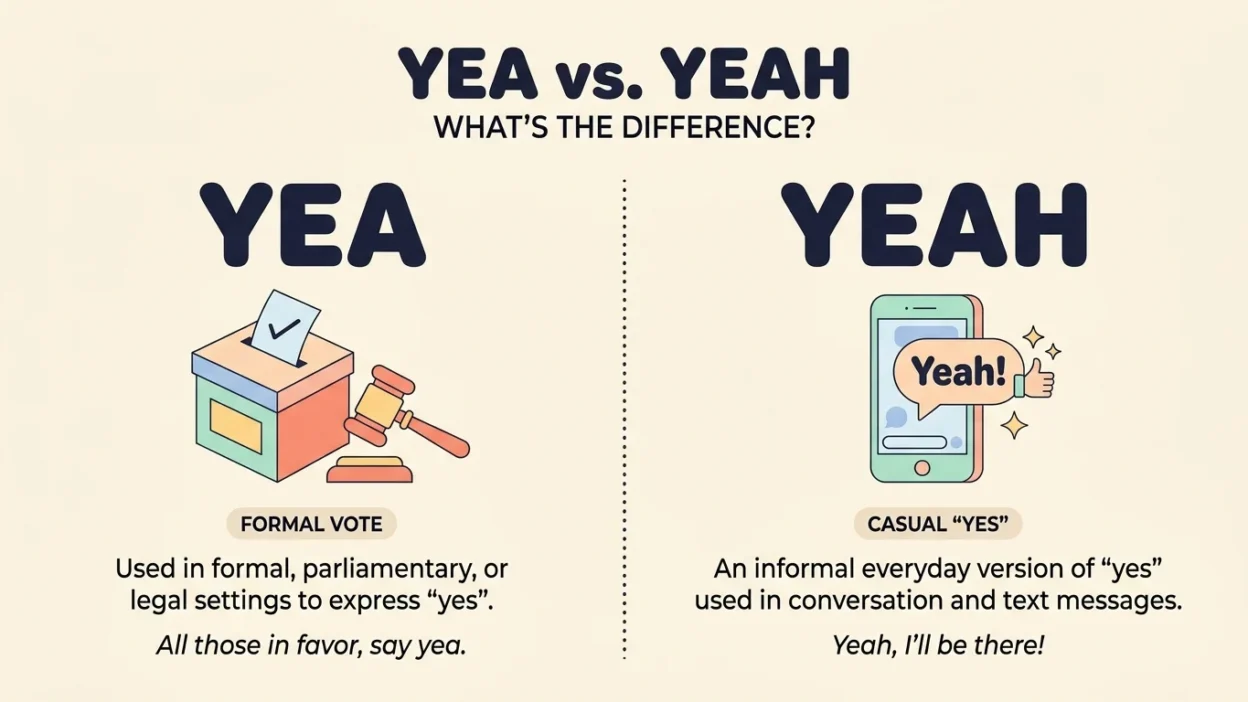
If you have ever typed “yea” in a text and wondered if you meant “yeah,” you are not alone. These two small words look almost identical, sound almost identical, and yet they are not interchangeable. Mixing them up can make your writing look careless, especially in formal situations like emails, essays, or job applications.
The good news is that the difference is simple once you see it clearly. In this guide, you will learn exactly what “yea” and “yeah” mean, when to use each one, and how to remember the difference for good. By the end, you will never second-guess yourself again.
Quick Answer
“Yea” is a formal, old-fashioned word that means “yes,” and it also means “yes” in voting. “Yeah” is the casual, everyday way to say “yes” in speech and informal writing. Use “yeah” in texts and friendly messages. Use “yea” only in voting contexts or very formal, traditional writing.
Why People Confuse “Yea” and “Yeah”
The confusion makes perfect sense. Both words mean “yes.” Both are pronounced almost the same way in fast, casual speech. And they differ by only one letter, so a typo can easily turn one into the other.
There is one more reason. In everyday conversation, people say “yeah” constantly. When they try to write that sound down, some spell it “yea” because it looks simpler. That spelling is wrong for casual writing, but it happens all the time.
The result is that “yea” has become one of the most commonly misspelled words in casual English. Understanding the history and grammar behind each word clears up the confusion completely.
What Does “Yea” Mean?
“Yea” is an old word with two main jobs in modern English.
First, it is a formal or literary way to say “yes.” You will find it in old books, religious texts, and poetry. For example, “Yea, though I walk through the valley” uses “yea” to mean “yes, even.”
Second, and more importantly today, “yea” is the official word for a “yes” vote. In government, meetings, and official decisions, people vote “yea” or “nay.” A “yea” vote means you support the proposal.
Key facts about “yea”:
- It is formal, traditional, or official
- It rhymes with “say” and “day”
- It is a noun or adverb in voting and old writing
- It almost never appears in casual conversation
- The plural is “yeas,” as in “the yeas have it”
The phrase “yea or nay” is still used today to mean “yes or no,” especially in voting and formal decisions.
What Does “Yeah” Mean?
“Yeah” is the casual, spoken form of “yes.” It is what you say when a friend asks, “Want to grab lunch?” You answer, “Yeah, sure.”
It is informal by nature. You use it with friends, family, and people you know well. It belongs in texts, chats, social media, and casual speech. It does not belong in formal essays, business reports, or academic writing.
Key facts about “yeah”:
- It is informal and conversational
- It rhymes with “yeah,” which sounds like “yeh” or “yah”
- It works as an adverb or a short answer
- It is extremely common in spoken English worldwide
- It is not used in formal writing
“Yeah” is not a “wrong” word. It is simply a casual one. Knowing where it fits is the key skill.
Yea vs Yeah: Comparison Table
| Feature | Yea | Yeah |
|---|---|---|
| Meaning | Yes; a yes vote | Yes (casual) |
| Formality | Formal, official, or literary | Informal, conversational |
| Pronunciation | Rhymes with “say” | Sounds like “yeh” |
| Main use | Voting, old texts, formal writing | Speech, texts, casual chats |
| Example | “The yeas have it.” | “Yeah, I agree.” |
| Register | Official or traditional | Friendly and relaxed |
| Common in speech? | Rarely | Constantly |
When Should You Use Each Word?
Choosing the right word comes down to one question: how formal is the situation?
Use “yea” when:
- You are writing about a vote or official decision
- You are quoting old or traditional texts
- You want a formal, literary tone for effect
- You are using the phrase “yea or nay”
- You are referring to a “yea” vote in a meeting
Use “yeah” when:
- You are texting or chatting with friends
- You are writing dialogue in a story
- You are speaking casually
- You want to agree informally
- You are posting on social media
A simple rule helps here. If you would not wear a suit to the situation, use “yeah.” If you are writing something official, reach for “yea.”
10+ Examples of “Yea” and “Yeah” in Sentences
Seeing the words in real context makes the difference stick. Here are clear examples of each.
Examples of “yea”:
- “All in favor, say yea.”
- “The yeas have it, and the motion passes.”
- “Yea, though I walk through the valley, I will fear no evil.”
- “The vote was 40 yeas and 12 nays.”
- “She cast her yea vote on the new law.”
- “Yea or nay, we must decide today.”
Examples of “yeah”:
- “Yeah, I will be there at six.”
- “Yeah, that movie was amazing.”
- “Are you coming? Yeah, of course.”
- “Yeah, I know what you mean.”
- “He said yeah, but he looked unsure.”
- “Yeah, let us meet after class.”
- “Yeah, that makes total sense.”
- “Oh yeah, I forgot about that.”
Notice how “yeah” always sounds relaxed and personal. “Yea” always sounds official or old-fashioned. That contrast is the heart of the difference.
Common Mistakes to Avoid
Even careful writers slip up here. Watch out for these common errors.
- Using “yea” in casual texts. “Yea, I will come” looks wrong to many readers. Use “yeah” instead.
- Using “yeah” in formal writing. “The committee voted yeah” is incorrect. Use “yea” for votes.
- Assuming they are always interchangeable. They are not. One is formal, one is casual.
- Confusing “yea” with “yay.” “Yay” shows excitement, as in “Yay, we won!” It is a third, separate word.
- Confusing “yea” with “yep” or “yup.” Those are casual like “yeah,” not formal like “yea.”
- Misspelling “yeah” as “yah” or “yea.” “Yah” is a different, less standard spelling.
Keeping these three words straight, “yea,” “yeah,” and “yay,” solves most of the problem.
A Simple Memory Trick
Here is an easy way to remember the difference for life.
Think of the letter “a” in “yea.” The “a” stands for “assembly” or “official.” An assembly votes with yeas and nays.
Think of the “h” in “yeah.” The “h” stands for “hello” and “hanging out.” It is the friendly, casual word you use with people you know.
So: “yea” for the assembly, “yeah” for your friends. That one image keeps them separate forever.
American vs British English
Good news: this difference is the same on both sides of the Atlantic.
In both American and British English, “yeah” is the informal spoken “yes,” and “yea” is the formal or voting word. Spelling does not change. Pronunciation of “yeah” shifts slightly by region, but the meaning and usage stay the same.
You will hear “yeah” constantly in British and American conversation alike. You will see “yea” mainly in voting records, formal minutes, and older literature in both varieties.
Similar Words Worth Knowing
English has several words that mean “yes” or show agreement. Knowing them helps you pick the right tone.
- Yeah: casual yes
- Yea: formal or voting yes
- Yay: shows excitement or joy
- Yep: casual yes, slightly more upbeat than yeah
- Yup: same as yep, very informal
- Yes: the standard, neutral answer
- Aye: a yes vote, common in Scottish and nautical use
- Nay: the formal “no,” the opposite of yea
Each word carries its own flavor. “Yes” is safe anywhere. “Yeah” and “yep” are relaxed. “Yea” and “aye” belong to formal voting. “Yay” is pure emotion.
Final Verdict
So, which one should you use? It depends entirely on your situation.
Choose “yeah” for everyday speech, texts, chats, stories, and informal writing. It is natural, friendly, and correct in casual settings.
Choose “yea” for voting, official records, formal decisions, and traditional or literary writing. It signals seriousness and formality.
Never treat them as identical. One letter changes the tone completely. When in doubt, ask yourself: “Am I being casual or official?” Your answer tells you which word to use.
Frequently Asked Questions
Is “yea” the same as “yeah”?
No. “Yea” is formal and means “yes,” especially in voting. “Yeah” is the casual, everyday way to say “yes.” They have different tones and different uses, even though they look similar.
Can I use “yea” in a text message?
You can, but most readers will find it odd. In casual messages, “yeah” is the expected and correct spelling. Save “yea” for formal or voting contexts.
What does “yea” mean in voting?
In voting, “yea” means a vote in favor of a proposal. It is the opposite of “nay.” When a majority votes “yea,” the motion passes. You often hear the phrase “all in favor, say yea.”
Is “yeah” a real word?
Yes, “yeah” is a real, accepted word. It appears in major dictionaries as the informal spelling of “yes.” It is standard in casual speech and informal writing.
What is the difference between “yea,” “yeah,” and “yay”?
“Yea” means a formal or voting yes. “Yeah” means a casual yes. “Yay” shows excitement or celebration, as in “Yay, we did it!” All three are different words with different meanings.
Which is more formal, “yea” or “yeah”?
“Yea” is far more formal. It belongs in voting, official records, and traditional writing. “Yeah” is informal and fits friendly, everyday conversation.
How do you pronounce “yea” and “yeah”?
“Yea” rhymes with “say” and “day.” “Yeah” sounds like “yeh” or “yah,” shorter and more relaxed. The difference is small but noticeable in careful speech.
Is “yea” old-fashioned?
Yes, outside of voting, “yea” sounds old-fashioned or literary. It appears in classic books, religious texts, and formal speeches. In daily conversation, people say “yeah” or “yes” instead.
Remember This
“Yea” is for votes and formal writing. “Yeah” is for friends and casual talk. One letter, one tone, one clear rule.
If you remember the assembly for “yea” and your friends for “yeah,” you will always choose correctly.
Conclusion
The difference between “yea” and “yeah” is small in spelling but big in tone. “Yea” carries formality and official weight, showing up in votes, meetings, and old literature. “Yeah” carries warmth and ease, filling everyday conversation, texts, and friendly writing.
Once you know which tone you need, the correct word follows naturally. Use “yea” when you mean business or cast a vote. Use “yeah” when you are chatting, agreeing, or keeping things relaxed. Master this tiny distinction, and your English will sound more accurate, more natural, and more confident in every situation.

David Henry is a language enthusiast and content writer specializing in synonyms, vocabulary, and word meanings. He creates clear, engaging resources that help readers improve their writing, communication, and English skills.


