If you’ve ever paused while typing to wonder if it should be “emphasise” or “emphasize,” you’re not alone. This is one of the most common spelling questions in English, and the answer depends entirely on where you are and who you’re writing for.
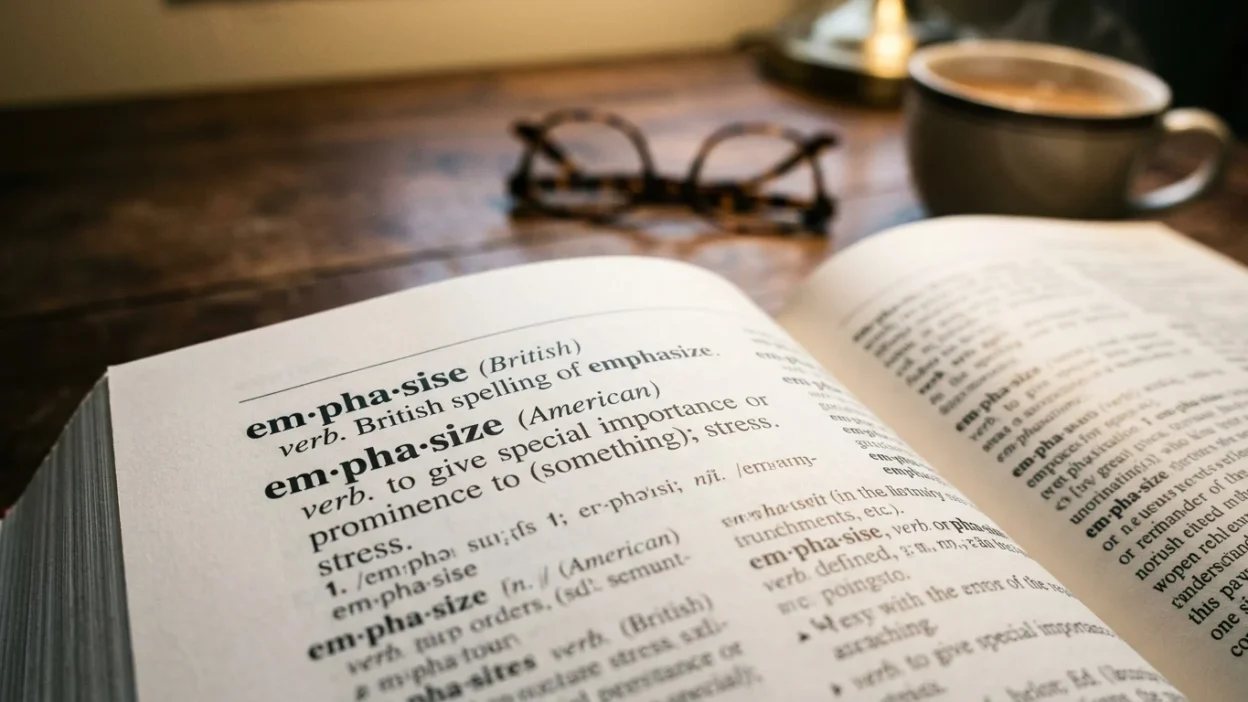
The good news is that both spellings are correct. They mean exactly the same thing: to give special importance or attention to something. The only real difference is the variety of English you’re using. British English prefers “emphasise,” while American English prefers “emphasize.” Neither version is wrong, and neither is better than the other. It simply comes down to your audience and the style guide you follow.
In this article, we’ll break down the difference clearly, show you when to use each spelling, share plenty of examples, and give you a simple memory trick so you never second-guess yourself again.
Quick Answer
Both “emphasise” and “emphasize” are correct. Use “emphasize” in American English and “emphasise” in British English. The meaning is identical: to give special importance to something. Choose based on your audience, not on which one looks more familiar.
Why People Confuse “Emphasise” and “Emphasize”
The confusion comes from a simple fact: English is spoken and written differently around the world. British and American English share most of their vocabulary, but a small group of words ending in “-ise” and “-ize” split the two traditions.
Words like “organise/organize,” “realise/realize,” and “apologise/apologize” follow the same pattern as “emphasise/emphasize.” Because both forms appear constantly online, in books, and in media, learners often see both and assume one must be a mistake. It isn’t. Both are accepted, and the choice usually reflects regional style rather than a rule about correctness.
What Does “Emphasise” Mean?
“Emphasise” is the British English spelling of the verb meaning to stress, highlight, or draw attention to something. It’s used in the United Kingdom, Ireland, Australia, New Zealand, South Africa, and many other regions that follow British spelling conventions.
Examples of British usage:
- The teacher emphasised the importance of reading every day.
- The report emphasises the need for cleaner energy.
- She emphasised that the deadline would not change.
You’ll commonly see “emphasise” in British newspapers, academic writing, government documents, and school textbooks across the Commonwealth.
What Does “Emphasize” Mean?
“Emphasize” is the American English spelling of the same verb. It carries the exact same meaning and is used in the United States and in many international contexts where American English is the standard.
Examples of American usage:
- The coach emphasized teamwork above everything else.
- Our manager emphasized the importance of arriving on time.
- The study emphasizes the link between sleep and memory.
In American publishing, “emphasize” is the standard form. Most US style guides, including those used by major newspapers and publishers, treat “-ize” as the correct ending for this group of words.
Comparison Table
| Feature | Emphasise | Emphasize |
|---|---|---|
| Region | British English | American English |
| Meaning | To stress or highlight | To stress or highlight |
| Part of speech | Verb | Verb |
| Common in | UK, Australia, Ireland, Canada (mixed) | United States |
| Noun form | Emphasis | Emphasis |
| Adjective form | Emphatic | Emphatic |
| Correctness | Fully correct | Fully correct |
Notice that the noun “emphasis” and the adjective “emphatic” stay the same in both versions. Only the verb changes.
When Should You Use Each Spelling?
The choice is about consistency and audience, not grammar. Here’s a simple way to decide:
- Use “emphasize” if you’re writing for an American audience, a US-based company, or a publication that follows American style.
- Use “emphasise” if you’re writing for a British, Australian, Irish, or other Commonwealth audience.
- If your school, workplace, or client has a style guide, follow it. Consistency matters more than the specific choice.
- In academic writing, check your institution’s preferred style. Many journals state whether they use British or American spelling.
- In international contexts with mixed audiences, either form is fine as long as you stay consistent throughout the document.
The one thing you should avoid is mixing both spellings in the same piece of writing. That looks careless, even though both forms are technically correct.
10+ Examples of “Emphasise” and “Emphasize” in Sentences
- British: The doctor emphasised the importance of regular exercise.
- American: The doctor emphasized the importance of regular exercise.
- British: Our teacher emphasises clear handwriting.
- American: Our teacher emphasizes clear handwriting.
- British: The campaign emphasises safety above speed.
- American: The campaign emphasizes safety above speed.
- British: He emphasised his point by raising his voice.
- American: He emphasized his point by raising his voice.
- British: The guide emphasises that visitors must not feed the animals.
- American: The guide emphasizes that visitors must not feed the animals.
- British: She emphasised the word “never” in her speech.
- American: She emphasized the word “never” in her speech.
- British: The report emphasises three main risks.
- American: The report emphasizes three main risks.
In every pair, the meaning is identical. Only the spelling changes.
Common Mistakes to Avoid
Even though both spellings are valid, writers still make a few predictable errors:
- Mixing spellings in one document. Choose one and stick with it.
- Assuming “emphasise” is wrong. It’s standard in British English.
- Assuming “emphasize” is only American. It’s also widely accepted internationally.
- Changing the noun. “Emphasis” never becomes “emphasise” as a noun. The noun is always “emphasis.”
- Forgetting the adjective. The adjective is “emphatic” in both versions, not “emphasized” when describing a tone.
- Using “emphasize on.” The correct structure is “emphasize something,” not “emphasize on something.” For example, say “She emphasized the rules,” not “She emphasized on the rules.”
A Simple Memory Trick
Here’s an easy way to remember which spelling belongs where:
The letter “z” sounds American because “zee” is the American pronunciation of the letter Z. So “emphasize” with a Z goes with American English.
The letter “s” sounds British because “zed” is the British pronunciation. So “emphasise” with an S goes with British English.
Say it once: Z for America, S for Britain. That single sentence solves the puzzle for this word and for dozens of others like it.
American vs British English: The Bigger Pattern
“Emphasise” and “emphasize” are part of a larger family of words that follow the same rule. Understanding the pattern helps you handle similar words without checking a dictionary every time.
| American (-ize) | British (-ise) |
|---|---|
| organize | organise |
| realize | realise |
| recognize | recognise |
| apologize | apologise |
| criticize | criticise |
| summarize | summarise |
| emphasize | emphasise |
A few notes on this pattern:
- Some British publishers also accept “-ize” endings, especially in academic and scientific writing. Oxford style, for example, often prefers “-ize.”
- A small group of words always use “-ise” in both varieties, such as “advertise,” “surprise,” and “exercise.” These are not part of the pattern.
- Canadian English often mixes both systems, leaning toward American “-ize” but British “-our” in words like “colour.”
The key takeaway: the “-ise” and “-ize” split is a regional preference, not a rule about right and wrong.
Similar Words That Follow the Same Pattern
If you understand “emphasise” and “emphasize,” you can apply the same logic to many other words:
- Realise / realize
- Organise / organize
- Recognise / recognize
- Apologise / apologize
- Analyse / analyze (note: British uses “analyse” with an S, American uses “analyze” with a Z)
- Criticise / criticize
- Memorise / memorize
Each pair means the same thing. The only difference is the spelling convention tied to a region.
Final Verdict
There is no single correct answer to “emphasise or emphasize.” Both are correct. Both mean the same thing. The choice depends on your audience and your style guide. If you’re writing for an American reader, use “emphasize.” If you’re writing for a British or Commonwealth reader, use “emphasise.” If you’re unsure, pick one and stay consistent throughout your document. Consistency is what makes your writing look polished and professional.
Frequently Asked Questions
Is “emphasise” or “emphasize” correct?
Both are correct. “Emphasize” is standard in American English, and “emphasise” is standard in British English. They mean exactly the same thing.
Which spelling should I use in the United States?
Use “emphasize” with a Z in the United States. It’s the standard form in American publishing, schools, and media.
Which spelling should I use in the UK?
Use “emphasise” with an S in the United Kingdom. It’s the standard form in British newspapers, schools, and official documents.
Is “emphasise” wrong in America?
It isn’t grammatically wrong, but it looks unusual to American readers. Most US style guides prefer “emphasize.”
Can I use both spellings in the same document?
You can, but you shouldn’t. Mixing them looks inconsistent. Choose one spelling and use it throughout.
What is the noun form of “emphasise” and “emphasize”?
The noun is “emphasis” in both British and American English. It never changes.
What is the adjective form?
The adjective is “emphatic” in both varieties. For example, “She gave an emphatic answer.”
Does “emphasize” need “on” after it?
No. Say “emphasize the point,” not “emphasize on the point.” The verb takes a direct object.
Remember This
Both spellings are correct. Use “emphasize” with a Z for American English and “emphasise” with an S for British English. When in doubt, match your audience and stay consistent. Z for America, S for Britain.
Conclusion
The debate between “emphasise” and “emphasize” isn’t really a debate at all. Both words are correct, both are widely used, and both mean the same thing. The difference is regional style, not grammar. American English favors “emphasize,” while British English favors “emphasise.” Once you know which audience you’re writing for, the choice becomes simple.
The next time you’re unsure, remember the pattern: this is just one example of the larger “-ise” versus “-ize” split that separates British and American spelling. Learn the rule once, and you’ll apply it confidently to dozens of words. Pick the spelling that fits your reader, use it consistently, and move on with your writing.

David Henry is a language enthusiast and content writer specializing in synonyms, vocabulary, and word meanings. He creates clear, engaging resources that help readers improve their writing, communication, and English skills.