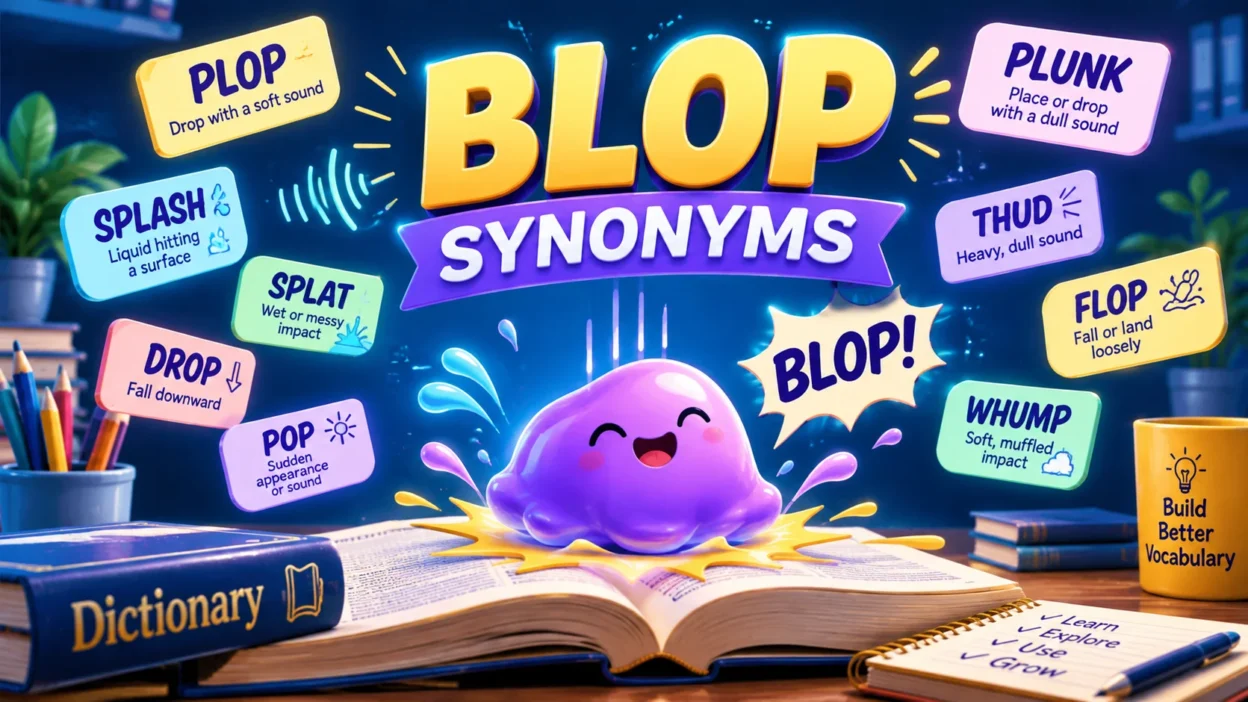
The phrase “blop synonyms” is an unusual vocabulary search because blop is not a common standard-English word with one fixed dictionary definition. It is often used as an informal, playful, or sound-based expression. Depending on context, blop can suggest something dropping softly, landing with a dull little sound, appearing suddenly, or being placed somewhere casually.
Because blop is flexible and informal, choosing the right alternative depends heavily on what you mean. A writer may want a word that describes a soft sound, while a casual social-media post may need something humorous or expressive. Understanding related words can therefore help students, ESL learners, writers, and content creators communicate more precisely.
This guide explores blop synonyms and related expressions, with simple meanings, examples, and usage notes. Since blop does not have a fixed set of traditional synonyms, the list focuses on words that can replace it in different contexts.
What Does “Blop” Mean?
Blop is an informal, playful word that can imitate a small, soft, or dull sound. It may describe something dropping, falling, landing, or being placed with a short sound.
For example:
- “The berry fell into the bowl with a little blop.”
- “He dropped the toy on the sofa—blop!”
- “The character suddenly blopped onto the screen.”
The exact meaning depends on the sentence. Unlike words such as drop or fall, blop often adds a humorous, cartoon-like, or casual feeling.
Tone and Usage
Blop is generally:
- Informal
- Playful
- Casual
- Sound-based
- Sometimes humorous
- Commonly suited to creative writing, comics, chats, and internet language
It is usually not the best choice for formal academic or professional writing.
30 Blop Synonyms and Related Words
Because blop is an expressive informal word, these alternatives are grouped according to the meaning you want to communicate.
1. Plop
Meaning: To fall or sit down with a soft, heavy sound.
Example:
“The book fell with a quiet plop.”
Best usage context:
Excellent when blop describes something landing or dropping.
2. Drop
Meaning: To fall downward or let something fall.
Example:
“She accidentally dropped the spoon.”
Best usage context:
Use in everyday and standard English.
3. Drip
Meaning: To fall in small drops of liquid.
Example:
“Water began to drip from the tap.”
Best usage context:
Best when blop refers to liquid rather than a solid object.
4. Splash
Meaning: To scatter liquid when something enters or hits it.
Example:
“The stone landed in the puddle with a loud splash.”
Best usage context:
Use when water or another liquid is involved.
5. Plunk
Meaning: To drop or place something with a short, noticeable sound.
Example:
“He plunked the bag onto the table.”
Best usage context:
Useful for casual descriptions of objects being placed or dropped.
6. Thump
Meaning: A dull, heavy sound caused by impact.
Example:
“The box hit the floor with a thump.”
Best usage context:
Use when the impact is heavier than a typical blop.
7. Bump
Meaning: To hit something lightly or make a short impact.
Example:
“The ball bumped against the wall.”
Best usage context:
Good for small, ordinary impacts.
8. Blob
Meaning: A soft, shapeless mass or spot.
Example:
“A blue blob of paint appeared on the page.”
Best usage context:
Useful when blop refers more to shape or appearance than sound.
9. Pop
Meaning: To appear, move, or burst suddenly with a short sound.
Example:
“A message popped onto the screen.”
Best usage context:
Great for sudden appearances or quick sounds.
10. Flop
Meaning: To fall or move heavily and loosely.
Example:
“The tired puppy flopped onto the rug.”
Best usage context:
Use for soft, loose, or awkward movement.
11. Plop Down
Meaning: To sit or place something down suddenly and casually.
Example:
“She plopped down on the chair.”
Best usage context:
Perfect for informal descriptions of sitting or placing something.
12. Land
Meaning: To come down onto a surface.
Example:
“The ball landed beside the box.”
Best usage context:
Use when emphasizing where something ends up.
13. Fall
Meaning: To move downward because of gravity.
Example:
“The apple fell from the tree.”
Best usage context:
A simple, neutral replacement for many uses of blop.
14. Tumble
Meaning: To fall or roll repeatedly.
Example:
“The little ball tumbled down the stairs.”
Best usage context:
Best for movement involving rolling or repeated falling.
15. Squish
Meaning: To press something soft until it becomes flatter or changes shape.
Example:
“The toy made a funny sound when I squished it.”
Best usage context:
Useful for playful descriptions involving soft objects.
16. Splat
Meaning: A sound or action involving something wet or soft hitting a surface.
Example:
“The mud hit the wall with a splat.”
Best usage context:
Use for messy, wet, or dramatic impacts.
17. Smack
Meaning: A sharp sound caused by hitting something.
Example:
“The ball hit the board with a smack.”
Best usage context:
Use when the impact is sharper or stronger.
18. Plunking
Meaning: Dropping or placing something with a dull, casual sound.
Example:
“He was plunking coins onto the counter.”
Best usage context:
Useful for continuous or repeated actions.
19. Bob
Meaning: To move gently up and down.
Example:
“The toy began to bob on the water.”
Best usage context:
Use when the movement is gentle rather than a sudden drop.
20. Bounce
Meaning: To move back after hitting a surface.
Example:
“The rubber ball bounced across the floor.”
Best usage context:
Best when an object hits a surface and rebounds.
21. Sink
Meaning: To move downward gradually.
Example:
“The stone began to sink into the mud.”
Best usage context:
Use when something slowly moves downward.
22. Squish Down
Meaning: To press or settle something into a softer or flatter position.
Example:
“He squished down the pillow.”
Best usage context:
Good for playful and physical descriptions.
23. Thud
Meaning: A low, dull sound caused by a heavy object hitting something.
Example:
“We heard a thud from upstairs.”
Best usage context:
Use for a heavier impact than blop.
24. Plop Plop
Meaning: A playful repetition describing several soft drops or impacts.
Example:
“Rain went plop plop against the window.”
Best usage context:
Useful in children’s writing, comics, captions, and playful content.
25. Dribble
Meaning: To flow or fall in small amounts.
Example:
“Juice began to dribble down the side of the glass.”
Best usage context:
Best for liquids moving slowly or irregularly.
26. Squirt
Meaning: To send out a small, quick stream of liquid.
Example:
“The bottle squirted water onto the table.”
Best usage context:
Use for quick liquid movement.
27. Clunk
Meaning: A dull, heavy sound made when hard objects hit.
Example:
“The machine made a strange clunk.”
Best usage context:
Good for mechanical or hard-object impacts.
28. Whump
Meaning: A deep, soft, or muffled impact sound.
Example:
“The cushion hit the floor with a soft whump.”
Best usage context:
Useful in fiction, comics, and sound-effect writing.
29. Splosh
Meaning: A wet, liquid sound caused by movement through water or another fluid.
Example:
“His boots went splosh through the puddle.”
Best usage context:
Best for playful descriptions involving water.
30. Plop Onto
Meaning: To fall, sit, or settle onto something in a relaxed or slightly heavy way.
Example:
“She plopped onto the couch after work.”
Best usage context:
Ideal when describing a casual movement or landing.
Blop Synonyms Comparison Table
| Word | Main Meaning | Tone | Best Context |
|---|---|---|---|
| Plop | Soft, dull landing | Casual | Objects landing |
| Drop | Move downward | Neutral | Everyday English |
| Drip | Small liquid drops | Neutral | Water/liquids |
| Splash | Liquid impact | Expressive | Water |
| Plunk | Casual heavy placement | Informal | Objects |
| Thump | Heavy dull impact | Strong | Heavy objects |
| Bump | Light impact | Neutral | Small collisions |
| Blob | Soft shapeless mass | Informal | Shapes |
| Pop | Sudden appearance/sound | Casual | Sudden events |
| Flop | Loose heavy movement | Informal | People/animals |
| Splat | Messy impact | Playful | Mud/paint/food |
| Thud | Heavy dull sound | Neutral | Strong impacts |
| Bounce | Hit and rebound | Neutral | Balls/objects |
| Dribble | Small liquid flow | Neutral | Liquids |
| Clunk | Hard dull sound | Informal | Machines/objects |
| Whump | Muffled impact | Expressive | Fiction |
| Splosh | Wet movement sound | Playful | Water |
Blop vs. Plop: What Is the Difference?
Blop and plop can sound similar because both are playful sound words.
However, plop is much more established in standard English. It commonly describes something falling, sitting, or landing with a soft, heavy sound.
Blop is more unusual and flexible. It can be used creatively as a sound effect or invented expression.
Example
Plop:
“The stone fell into the mud with a plop.”
Blop:
“The little creature went blop into the puddle.”
If you are writing formal English, plop is generally the safer choice.
Blop vs. Drop
The words also differ in tone.
Drop is neutral and standard:
“The phone dropped onto the bed.”
Blop is playful and sound-focused:
“The phone went blop onto the cushion.”
Choose drop for academic, professional, or ordinary writing. Choose blop when you intentionally want a humorous or cartoon-like effect.
Blop Synonyms for Different Writing Situations
For formal writing
Use:
- Drop
- Fall
- Land
- Sink
- Drip
These words are clear and widely understood.
For casual writing
Use:
- Plop
- Plunk
- Flop
- Pop
- Bump
These words sound natural in conversations and informal writing.
For creative writing
Use:
- Blop
- Whump
- Splosh
- Splat
- Plop
These expressions can make scenes more vivid and entertaining.
For comic or playful writing
Use:
- Blop
- Plop
- Pop
- Splat
- Squish
- Whump
Sound words can make fictional scenes feel more energetic.
How to Choose the Right Blop Synonym
The best synonym depends on what happens, how it sounds, and the tone of your writing.
1. Choose by Movement
If something simply moves downward, choose:
- Drop
- Fall
- Sink
If something rolls or moves repeatedly, choose:
- Tumble
- Bounce
If something settles heavily, choose:
- Plop
- Flop
2. Choose by Sound
For a soft impact:
- Plop
- Blop
- Whump
For a heavier impact:
- Thud
- Thump
- Clunk
For a wet impact:
- Splat
- Splosh
- Splash
3. Choose by Tone
For neutral English:
- Drop
- Fall
- Land
- Drip
For casual English:
- Plop
- Plunk
- Flop
- Pop
For humorous or creative writing:
- Blop
- Whump
- Splat
- Splosh
4. Choose by Object
For people:
- Flop
- Plop down
- Sit down
For solid objects:
- Drop
- Plop
- Plunk
- Thud
For liquids:
- Drip
- Dribble
- Splash
- Splosh
For paint, mud, or other messy substances:
- Splat
- Splash
- Squish
Are “Blop” and “Plop” True Synonyms?
Not always.
A true synonym normally has almost the same meaning and can replace another word in many situations. Blop is different because it is an informal, sound-based expression whose meaning depends on context.
Therefore, many words listed as blop synonyms are better described as related expressions or contextual alternatives.
This distinction matters for ESL learners. Replacing blop with any word from the list without checking the sentence can change the meaning.
For example:
“Water dripped from the roof.”
cannot normally become:
“Water thumped from the roof.”
The second sentence changes the type of action and sound.
Examples of Blop in Sentences
Here are some creative examples showing how blop might work:
- “The jelly landed on the plate with a tiny blop.”
- “The cartoon character disappeared with a funny blop.”
- “A raindrop made a soft blop in the puddle.”
- “The blob of paint went blop onto the paper.”
- “The toy fell into the box with a quiet blop.”
These examples show why context is important. Blop can function more like a playful sound effect than a conventional dictionary synonym.
Frequently Asked Questions About Blop Synonyms
What is the closest synonym for blop?
Plop is often the closest standard-English alternative when blop describes a soft object landing or dropping.
Is blop a real English word?
Blop is an informal and playful expression rather than a common standard-English vocabulary word. Its meaning depends on context.
What is another word for a soft dropping sound?
Words such as plop, plunk, whump, and sometimes blop can describe soft or dull dropping sounds.
Is blop formal English?
No. Blop is generally informal and playful. It works better in creative writing, comics, captions, chats, and humorous content than in academic writing.
What is the difference between blop and plop?
Plop is a recognized English word commonly describing a soft, dull landing or falling sound. Blop is more unusual and creative.
Can I use blop in creative writing?
Yes. Creative writers can use blop as a sound effect to make a scene feel playful, unusual, or cartoon-like.
Final Thoughts on Blop Synonyms
The keyword “blop synonyms” is best understood through context rather than through a traditional synonym list. Blop is an informal, playful expression that can imitate a small sound or describe a soft, sudden action.
If you need a standard replacement, plop, drop, fall, land, or drip may work depending on the sentence. For creative writing, words such as splat, splosh, whump, plunk, and flop can provide stronger personality and sound.
The key lesson is simple: do not choose a synonym only because it sounds similar. Choose the word that matches the action, sound, object, and tone you want to communicate.
Whether you are an ESL learner, student, writer, or content creator, understanding these subtle differences can make your vocabulary more accurate, natural, and expressive.

Daniel Jack is a language enthusiast and content writer who specializes in synonyms, vocabulary, and word meanings. He creates clear, engaging resources that help readers improve communication and expand their English skills.