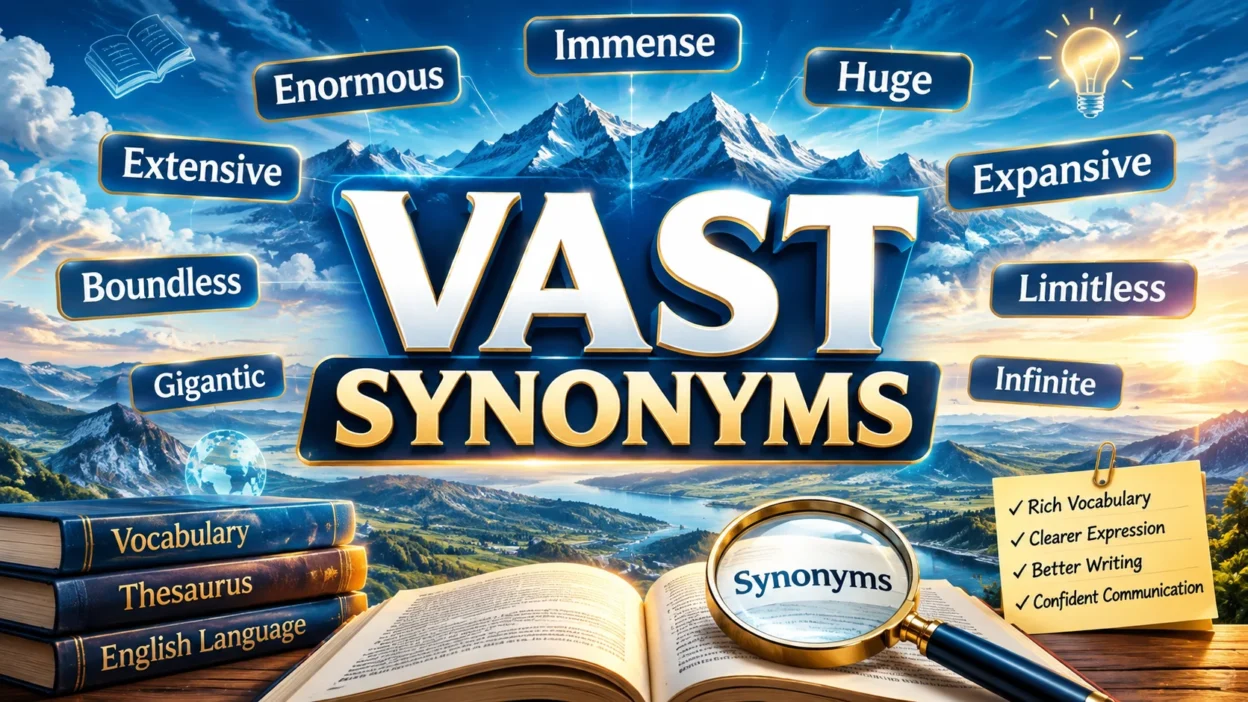
When something is vast, it is extremely large, wide, or extensive. We often use “vast” to describe spaces, areas, amounts, collections, knowledge, or possibilities. For example, we can talk about a vast ocean, a vast desert, or a vast amount of information.
Learning vast synonyms can make your English more precise and interesting. Different alternatives carry slightly different meanings: enormous emphasizes size, extensive often describes range or coverage, while boundless suggests that something seems to have no limits.
For students, ESL learners, writers, and content creators, understanding these differences is useful because choosing the right synonym can make writing clearer, more natural, and more expressive.
What Does “Vast” Mean?
Vast is an adjective meaning extremely large in size, area, amount, degree, or range.
Simple definition
Vast = very large, extensive, or seemingly limitless.
Examples
- We crossed a vast desert.
- The internet contains a vast amount of information.
- She has a vast knowledge of history.
- A vast ocean stretched beyond the horizon.
Tone and usage
“Vast” is neutral to slightly formal. It is common in academic writing, journalism, descriptive writing, and everyday English.
It can describe both physical and abstract things:
- Physical: a vast landscape, vast ocean, vast forest
- Abstract: vast knowledge, vast experience, vast opportunities
- Quantities: a vast amount, vast resources, vast numbers
30 Vast Synonyms
Below are 30 useful alternatives to vast, with simple meanings, examples, and usage guidance.
1. Enormous
Meaning: Extremely large in size or amount.
Example: The company built an enormous warehouse outside the city.
Best usage: Use it when strongly emphasizing size or quantity.
2. Huge
Meaning: Very large.
Example: They live in a huge house near the lake.
Best usage: Common and informal; excellent for everyday English.
3. Immense
Meaning: Extremely large or great.
Example: The project required an immense amount of effort.
Best usage: Good for formal, academic, and descriptive writing.
4. Gigantic
Meaning: Extremely large, often surprisingly so.
Example: A gigantic ship entered the harbor.
Best usage: Best when emphasizing extraordinary physical size.
5. Tremendous
Meaning: Very great in size, amount, strength, or degree.
Example: The team made tremendous progress this year.
Best usage: Useful for both physical and abstract ideas.
6. Colossal
Meaning: Extremely large or powerful.
Example: The construction project was a colossal undertaking.
Best usage: Use when you want dramatic emphasis.
7. Mammoth
Meaning: Extremely large, especially in scale or difficulty.
Example: Organizing the international event was a mammoth task.
Best usage: Often used figuratively for difficult or large-scale tasks.
8. Monumental
Meaning: Very large, important, or significant.
Example: The scientists made a monumental discovery.
Best usage: Particularly useful for important achievements, challenges, or events.
9. Extensive
Meaning: Covering a large area, range, or amount.
Example: The researcher conducted extensive studies on the subject.
Best usage: Excellent for academic and professional writing.
10. Expansive
Meaning: Covering a large area or having a broad range.
Example: The hotel has an expansive view of the countryside.
Best usage: Good for landscapes, ideas, systems, and opportunities.
11. Boundless
Meaning: Having no apparent limits or boundaries.
Example: The children showed boundless enthusiasm.
Best usage: Best for abstract qualities, possibilities, or emotions.
12. Limitless
Meaning: Without a limit or apparent end.
Example: Technology offers almost limitless opportunities for communication.
Best usage: Useful for possibilities, potential, resources, and opportunities.
13. Infinite
Meaning: Having no end or limit.
Example: The universe appears to contain infinite possibilities.
Best usage: Best when something is theoretically or conceptually without limits.
14. Broad
Meaning: Covering a wide range or area.
Example: She has a broad understanding of environmental issues.
Best usage: Excellent for knowledge, subjects, interests, and categories.
15. Wide
Meaning: Extending over a large distance or range.
Example: The river is wide at this point.
Best usage: Common everyday English, especially for physical dimensions.
16. Widespread
Meaning: Existing or occurring across a large area or among many people.
Example: The new technology has become widespread.
Best usage: Best for trends, conditions, practices, and events distributed across areas or populations.
17. Sweeping
Meaning: Covering a large area, range, or subject.
Example: The report proposes sweeping changes to the education system.
Best usage: Strong choice for major changes, statements, reforms, or reviews.
18. Far-reaching
Meaning: Having a wide or significant effect.
Example: The new law could have far-reaching consequences.
Best usage: Ideal for effects, consequences, decisions, and policies.
19. Spacious
Meaning: Having plenty of room.
Example: Their new apartment is bright and spacious.
Best usage: Best for rooms, houses, offices, vehicles, and other physical spaces.
20. Sizable
Meaning: Fairly large or substantial.
Example: The organization received a sizable donation.
Best usage: Useful for amounts, groups, objects, and donations.
21. Substantial
Meaning: Large in amount, size, importance, or value.
Example: The company made a substantial investment in research.
Best usage: Common in business, academic, and formal writing.
22. Astronomical
Meaning: Extremely large, especially in number, cost, or amount.
Example: The project faced astronomical costs.
Best usage: Often used figuratively to emphasize an exceptionally high figure.
23. Stupendous
Meaning: Extremely impressive or large.
Example: The athlete achieved a stupendous result.
Best usage: Use for dramatic emphasis, especially in expressive writing.
24. Monumental
Meaning: Extremely significant, large, or important.
Example: Completing the bridge was a monumental achievement.
Best usage: Best for achievements, tasks, events, and historical importance.
25. Grand
Meaning: Large, impressive, or ambitious.
Example: They developed a grand plan for the future.
Best usage: Useful for plans, designs, buildings, ambitions, and events.
26. Great
Meaning: Large in size, degree, amount, or importance.
Example: The project required a great deal of patience.
Best usage: Very common and flexible, though less precise than “vast.”
27. Oceanic
Meaning: Extremely large or resembling the enormous scale of an ocean.
Example: The company has oceanic reserves of data.
Best usage: More literary or figurative; use when emphasizing enormous scale.
28. Comprehensive
Meaning: Including a large amount or wide range of information or subjects.
Example: The guide provides a comprehensive overview of the topic.
Best usage: Best for reports, guides, studies, plans, and explanations.
29. Panoramic
Meaning: Offering a wide and complete view of an area.
Example: The hotel offers panoramic views of the mountains.
Best usage: Particularly useful for views, landscapes, and photography.
30. Limitless
Meaning: Having no apparent boundaries or restrictions.
Example: Her creativity seemed limitless.
Best usage: Excellent for creativity, potential, imagination, and opportunities.
Vast Synonyms Comparison Table
| Synonym | Main Idea | Best Used For | Tone |
|---|---|---|---|
| Vast | Extremely large or extensive | Areas, amounts, knowledge | Neutral/Formal |
| Enormous | Extremely large | Objects, amounts | Neutral |
| Huge | Very large | Everyday situations | Informal/Neutral |
| Immense | Extremely large or great | Size, effort, importance | Formal |
| Gigantic | Exceptionally large | Physical objects | Expressive |
| Extensive | Large in range or coverage | Research, knowledge, systems | Formal |
| Expansive | Broad and large | Views, areas, ideas | Neutral/Formal |
| Boundless | Without apparent limits | Energy, enthusiasm, potential | Literary |
| Limitless | Without restrictions | Potential, opportunities | Neutral |
| Infinite | Without an end | Time, space, possibilities | Formal/Conceptual |
| Broad | Covering many areas | Knowledge, subjects | Neutral |
| Widespread | Distributed widely | Trends, conditions | Formal |
| Far-reaching | Having wide effects | Policies, decisions | Formal |
| Spacious | Having plenty of room | Buildings, rooms | Neutral |
| Substantial | Large or significant | Amounts, investments | Formal |
| Comprehensive | Covering a wide range | Reports, studies | Formal |
| Panoramic | Showing a wide view | Scenery, photography | Descriptive |
How to Choose the Right Vast Synonym
Choosing the best synonym depends on what you are describing and the tone you want.
For physical size
Use:
- Enormous
- Huge
- Gigantic
- Immense
- Colossal
- Mammoth
Example:
“The museum contains a huge collection of artifacts.”
For areas and landscapes
Use:
- Expansive
- Vast
- Wide
- Panoramic
- Spacious
Example:
“We enjoyed an expansive view of the valley.”
For knowledge and information
Use:
- Extensive
- Broad
- Comprehensive
- Immense
Example:
“She has extensive knowledge of linguistics.”
For opportunities and possibilities
Use:
- Limitless
- Boundless
- Infinite
- Far-reaching
Example:
“The internet provides limitless opportunities for learning.”
For formal or academic writing
Use:
- Extensive
- Substantial
- Comprehensive
- Far-reaching
- Immense
Example:
“The study provides an extensive analysis of language development.”
For dramatic writing
Use:
- Colossal
- Gigantic
- Stupendous
- Mammoth
- Astronomical
Example:
“The expedition faced a colossal challenge.”
Vast vs. Enormous
Both words describe something very large, but their typical usage differs.
Vast often suggests a large area, range, or quantity.
The explorers crossed a vast desert.
Enormous focuses more directly on size or magnitude.
The building has an enormous entrance.
Vast vs. Huge
Huge is more common in casual conversation, while vast often sounds more descriptive or formal.
- Huge: “That dog is huge.”
- Vast: “A vast mountain range surrounded the village.”
For academic and professional writing, vast can often sound more polished.
Vast vs. Extensive
These words overlap, but they are not always interchangeable.
Vast emphasizes extraordinary size or scale.
The country has vast natural resources.
Extensive emphasizes broad coverage, range, or thoroughness.
The researchers conducted extensive testing.
Therefore, “extensive research” sounds natural, while “vast research” usually does not.
Common Collocations With Vast
Learning common word combinations can help ESL learners use vast naturally.
Vast + Physical Things
- vast ocean
- vast desert
- vast landscape
- vast area
- vast region
- vast territory
- vast wilderness
Vast + Abstract Ideas
- vast knowledge
- vast experience
- vast potential
- vast opportunities
- vast resources
- vast amount of information
- vast range
Example Sentences
- The country contains vast natural resources.
- She has a vast amount of experience.
- Students now have access to a vast range of online resources.
- The explorers entered a vast wilderness.
Common Mistakes When Using Vast
Mistake 1: Using “vast” for every type of large thing
Not every large object needs the word “vast.”
For example:
The elephant is vast. ❌
“Enormous” or “huge” sounds more natural:
The elephant is enormous. ✅
“Vast” works particularly well with areas, quantities, ranges, and abstract concepts.
Mistake 2: Assuming all synonyms are interchangeable
Although synonyms share a basic meaning, their natural contexts differ.
For example:
Extensive knowledge ✅
Broad knowledge ✅
Huge knowledge ❌
The first two are much more natural.
Mistake 3: Confusing “vast” with “infinite”
“Vast” means extremely large, but it does not necessarily mean endless.
The ocean is vast. ✅
The ocean is infinite. ⚠️
“Infinite” means literally without an end or limit, so it should be used more carefully.
Why Learn Vast Synonyms?
Knowing synonyms helps you avoid repetitive writing and express ideas more accurately.
Instead of repeatedly writing:
“The area was vast.”
You might write:
- “The area was expansive.”
- “The landscape was immense.”
- “The territory was extensive.”
- “The wilderness seemed boundless.”
Each word creates a slightly different impression.
For ESL learners, studying these distinctions is especially useful because English vocabulary often contains words with similar dictionary definitions but different natural contexts.
Quick Vocabulary Guide
If you mean very large, try enormous.
If you mean very large in an everyday way, try huge.
If you mean extremely large or impressive, try immense.
If you mean large in range or coverage, try extensive.
If you mean broad and open, try expansive.
If you mean without apparent limits, try boundless or limitless.
If you mean without an actual end, use infinite.
If you mean covering many subjects or details, use comprehensive.
If you mean having a wide effect, use far-reaching.
Final Thoughts on Vast Synonyms
The word vast is a powerful way to describe something extremely large, extensive, or broad. However, using the right alternative can make your writing more precise and natural.
Words such as enormous, immense, huge, extensive, expansive, boundless, limitless, substantial, comprehensive, and far-reaching all share some connection with “vast,” but each has its own best context.
For students and ESL learners, the key is not simply memorizing a long list of synonyms. Instead, pay attention to meaning, context, tone, and common word combinations. Writers and content creators can use this approach to make their vocabulary richer without making their writing complicated.
The best synonym is always the one that communicates your exact idea clearly.

Alexander Eric is the Administrator of SynonymLot, dedicated to providing accurate synonyms, vocabulary resources, and language tools. He enjoys helping readers improve writing, communication, and English word knowledge daily.