When should you say “for me” and when should you use “for myself”? These phrases look similar, but they do not always perform the same grammatical job. Choosing the wrong one can make an otherwise natural English sentence sound awkward or incorrect.
The key is to understand the difference between an object pronoun and a reflexive pronoun. In most ordinary sentences, “for me” is the natural choice when something is intended for you, done on your behalf, or beneficial to you. “For myself” is generally used when myself refers back to the subject “I,” especially when the speaker emphasizes their own involvement or action. Once you understand this pattern, the choice becomes much easier.
Quick Answer
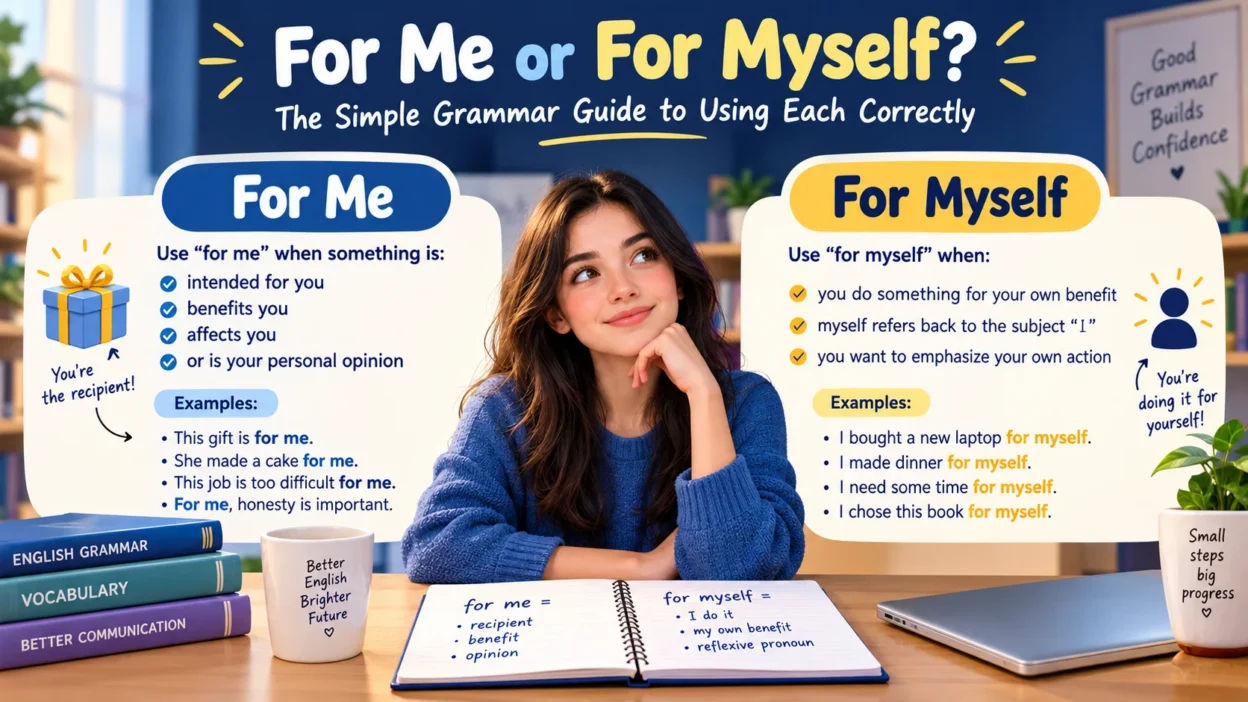
“For me” is usually correct when you mean “intended for me,” “beneficial to me,” or “in my opinion.” Use “for myself” when myself refers back to the subject I or emphasizes the person doing the action. For example: “This gift is for me” but “I bought it for myself.”
Why Do People Confuse “For Me” and “For Myself”?
The confusion happens because me and myself both refer to the speaker.
However, they have different grammatical functions:
- Me is the object form of I.
- Myself is a reflexive pronoun.
- For me is common when something is directed toward or intended for the speaker.
- For myself is normally used when the speaker is also the person affected by their own action.
Compare:
This present is for me.
I bought this present for myself.
In the first sentence, me simply identifies the recipient. In the second, myself refers back to the subject I.
First Word: “For Me”
What does “for me” mean?
For me is the normal phrase when something is intended for, belongs to, benefits, or concerns the speaker.
Examples:
- She made a cake for me.
- This chair is for me.
- Can you save a seat for me?
- That job would be difficult for me.
- This decision is important for me.
Here, me is an object pronoun.
“For me” can also express an opinion
For me can mean “in my opinion” or “from my personal point of view.”
For example:
For me, honesty is more important than money.
This means:
In my opinion, honesty is more important than money.
Second Word: “For Myself”
What does “for myself” mean?
For myself is generally used when myself refers back to the subject “I.”
For example:
I bought a new laptop for myself.
The subject is I, and the person who receives the laptop is also I. Therefore, the reflexive pronoun myself is appropriate.
Other examples include:
- I made dinner for myself.
- I kept some cake for myself.
- I need some time for myself.
- I chose this book for myself.
- I prepared a cup of coffee for myself.
Why not simply use “for me”?
Sometimes for me is also grammatically possible, but the meaning or emphasis can change.
Compare:
She bought a book for me.
Someone else bought it for the speaker.
I bought a book for myself.
The speaker bought the book for their own use.
The reflexive form makes the relationship between the subject and object clear.
For Me vs For Myself: Comparison Table
| Phrase | Main use | Example |
|---|---|---|
| for me | Something is intended for or benefits the speaker | She bought this for me. |
| for myself | The speaker does something for their own benefit | I bought this for myself. |
| for me | Personal opinion | For me, this is the best option. |
| for myself | Emphasis on the speaker’s own action or benefit | I made it for myself. |
| for me | Recipient of an action | He saved a seat for me. |
| for myself | Reflexive relationship with “I” | I saved a seat for myself. |
When Should You Use “For Me”?
Use for me when the phrase simply identifies the person who receives something, experiences something, or is affected by something.
Use “for me” when someone else does something for you
My sister cooked dinner for me.
Use “for me” when something is intended for you
There is a package for me.
Use “for me” to express your personal viewpoint
For me, this explanation is easier to understand.
Use “for me” after certain adjectives
This task is difficult for me.
That schedule is convenient for me.
The movie was interesting for me.
When Should You Use “For Myself”?
Use for myself when the speaker’s action and the person benefiting from it are the same.
Use “for myself” when you do something for your own benefit
I cooked dinner for myself.
Use “for myself” when you purchase something for your own use
I bought a new phone for myself.
Use “for myself” to emphasize your own needs
I need some quiet time for myself.
Use “for myself” when contrasting yourself with others
I bought gifts for everyone and something for myself.
10+ Examples of “For Me” and “For Myself”
- This letter is for me.
The letter is intended for the speaker. - She made lunch for me.
Someone else prepared the lunch. - This job is too difficult for me.
The speaker finds the job difficult. - For me, the blue one looks better.
The speaker is giving a personal opinion. - Can you keep this seat for me?
The seat is being reserved for the speaker. - I made lunch for myself.
The speaker prepared lunch for their own use. - I bought this jacket for myself.
The speaker purchased the jacket for their own use. - I need some time for myself.
The speaker wants personal time. - I saved the last piece of cake for myself.
The speaker deliberately kept it for their own benefit. - I chose a quiet room for myself.
The speaker selected the room for their own use. - My friend prepared a gift for me.
The friend prepared it for the speaker. - I prepared a gift for myself.
The speaker prepared it for their own use or benefit.
Common Mistakes
Mistake 1: Using “myself” instead of “me” unnecessarily
❌ This gift is for myself.
✅ This gift is for me.
When you are simply identifying the recipient, me is usually the natural choice.
Mistake 2: Using “me” when a reflexive relationship is needed
❌ I bought this gift for me.
✅ I bought this gift for myself.
The first sentence can occur in some contexts, especially with contrast or emphasis, but myself is the standard choice when the speaker is buying something for their own benefit.
Mistake 3: Thinking “myself” sounds more formal
Some speakers use myself because they believe it sounds more sophisticated or formal.
That is not a reliable rule.
❌ Please send the document to myself.
✅ Please send the document to me.
The reflexive pronoun should not replace me simply to make a sentence sound formal.
Mistake 4: Confusing “for me” with “by myself”
These expressions have different meanings:
I cooked dinner for myself.
I cooked dinner for my own benefit.
I cooked dinner by myself.
I cooked dinner without anyone helping me.
Memory Trick
Remember this simple rule:
Me = recipient.
Myself = I doing something for I.
Think:
Someone does it for me.
I do it for myself.
For example:
She bought a coffee for me.
I bought a coffee for myself.
American vs British English
There is no major American-versus-British distinction that changes the basic rule between for me and for myself.
Both varieties commonly use:
- for me when identifying the recipient or expressing a viewpoint
- for myself when a reflexive pronoun is required or useful for emphasis
For example, both American and British English naturally use:
I bought it for myself.
and:
She bought it for me.
The main difference is therefore grammar and meaning, not national variety.
Similar Words and Expressions
Several related expressions can cause confusion.
For me vs for myself
This present is for me.
I bought this present for myself.
By myself
By myself usually means alone or without assistance.
I completed the project by myself.
To me
To me can identify the recipient of an action or introduce a personal opinion.
She gave the book to me.
To me, the explanation is clear.
Myself
Myself can also be used for emphasis.
I myself checked the report.
Here, myself emphasizes the subject rather than functioning as the object of for.
Final Verdict
The choice between “for me” and “for myself” depends on the grammatical relationship in the sentence.
Use for me when you are simply talking about something intended for you, affecting you, or expressing your personal perspective. Use for myself when myself refers back to the subject I, particularly when you do something for your own benefit.
The easiest comparison is:
She bought it for me.
I bought it for myself.
Frequently Asked Questions
Is “for me” grammatically correct?
Yes. For me is a standard and extremely common English phrase. It is used when something is intended for, affects, or benefits the speaker.
Is “for myself” grammatically correct?
Yes. For myself is correct when the reflexive pronoun refers back to I, such as in “I bought a gift for myself.”
Should I say “This is for me” or “This is for myself”?
Usually, say “This is for me.” You are simply identifying yourself as the recipient.
Should I say “I did it for me” or “I did it for myself”?
When you mean that you did something for your own benefit, “I did it for myself” is generally the natural choice.
Is “for myself” more formal than “for me”?
No. Myself should not be used simply to sound more formal. Choose the pronoun according to its grammatical function.
Can “for me” mean “in my opinion”?
Yes. For example:
For me, this is the easiest solution.
Here, for me means something like “from my point of view.”
What is the difference between “for myself” and “by myself”?
For myself describes who benefits from an action. By myself usually means that you did something alone or without help.
I cooked dinner for myself.
I cooked dinner by myself.
Remember This
For me = intended for me, affecting me, or from my point of view.
For myself = I am doing something for my own benefit, and myself refers back to I.
A useful pattern is:
Someone does something for me.
I do something for myself.
Conclusion
The difference between for me and for myself is mainly about grammatical function. Me is an object pronoun, while myself is a reflexive pronoun that normally connects back to the subject I. This is why “She bought it for me” and “I bought it for myself” are both natural but have different structures.
When in doubt, ask who is performing the action and who benefits from it. If you are simply the recipient, for me is usually right. If I am doing something for my own benefit, for myself is often the appropriate choice.

David Henry is a language enthusiast and content writer specializing in synonyms, vocabulary, and word meanings. He creates clear, engaging resources that help readers improve their writing, communication, and English skills.


