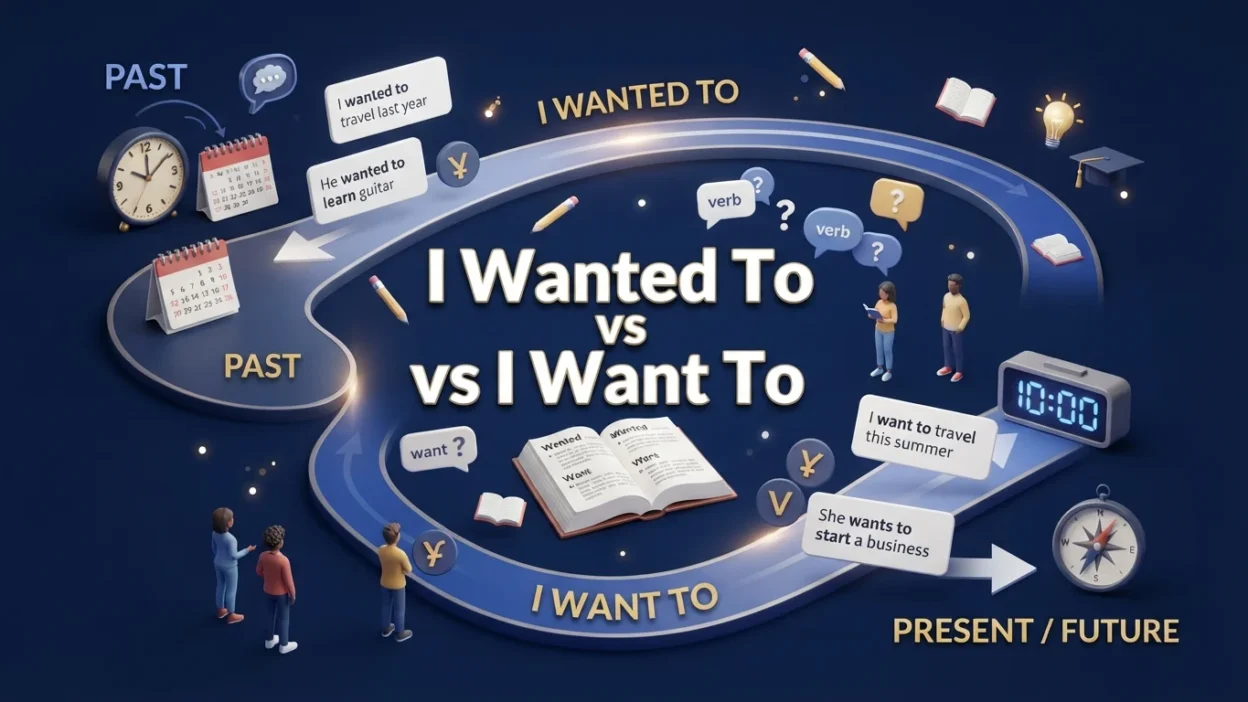
If you are unsure if to say “I wanted to” or “I want to,” the key difference is time and meaning. “I want to” describes a present desire, intention, or wish, while “I wanted to” usually describes a past desire or intention. However, “I wanted to” can also be used politely when making a request or introducing something you want to say.
For example, “I want to learn English” means learning English is your current goal. “I wanted to learn English” means that was your desire in the past, although the situation may have changed. Understanding this small difference helps you choose the right tense and communicate your meaning clearly. Both forms are common in everyday English, but they are not always interchangeable.
Quick Answer
“I want to” is used for something you desire or intend to do now or in the future. “I wanted to” normally refers to a past desire or intention. However, “I wanted to” can also sound softer and more polite when making a request or explaining why you are speaking.
Why Do People Confuse “I Wanted To” and “I Want To”?
People often confuse these expressions because they can describe similar actions.
Compare:
- I want to call her. → I currently have the desire or intention to call her.
- I wanted to call her. → I had that desire or intention in the past.
The important difference is usually the verb tense:
- want = present tense
- wanted = past tense
However, English speakers sometimes use the past form wanted for politeness, so context matters.
What Does “I Want To” Mean?
“I want to” expresses a present desire, wish, plan, or intention.
Examples
- I want to travel abroad.
- I want to improve my English.
- I want to talk to you.
- I want to buy a new phone.
- I want to become a teacher.
In these sentences, the speaker’s desire exists now.
“I want to” for future intentions
Although want is present tense, the action after it can happen in the future.
I want to visit London next year.
The wanting is happening now, while the visit is planned for the future.
What Does “I Wanted To” Mean?
“I wanted to” usually describes a desire, plan, or intention that existed in the past.
Examples
- I wanted to call you yesterday.
- I wanted to ask you something.
- I wanted to become a doctor when I was young.
- I wanted to buy that book, but it was too expensive.
- I wanted to go with you, but I was busy.
The speaker is talking about what they desired or intended at an earlier time.
“I wanted to” can also be polite
Sometimes “I wanted to” does not simply mean that the desire has ended.
For example:
I wanted to ask you a question.
This can be a polite way to introduce a question, especially in conversation or professional communication.
I Wanted To vs I Want To: Comparison Table
| Expression | Tense | Main Meaning | Example |
|---|---|---|---|
| I want to | Present | Current desire or intention | I want to learn Spanish. |
| I wanted to | Past | Past desire or intention | I wanted to learn Spanish. |
| I want to | Present | Current plan or wish | I want to see that movie. |
| I wanted to | Past | Previous plan or wish | I wanted to see that movie yesterday. |
| I wanted to | Past form used politely | Softer introduction/request | I wanted to ask you something. |
When Should You Use “I Want To”?
Use “I want to” when the desire or intention is current.
Use it for:
- Present wishes
- Current goals
- Future intentions
- Personal preferences
- Direct statements of desire
Examples
I want to study tonight.
I want to talk to my manager.
I want to learn how to drive.
I want to visit my family this weekend.
When Should You Use “I Wanted To”?
Use “I wanted to” when referring to a past desire or intention.
Use it for:
- Something you intended to do in the past
- A past plan that did not happen
- A past wish
- A polite introduction to a request or statement
Examples
I wanted to call you last night.
I wanted to buy the dress, but it was sold out.
I wanted to ask if you needed help.
12 Examples of “I Want To” and “I Wanted To”
1. Learning English
I want to improve my English.
→ This is my current goal.
I wanted to improve my English when I was in college.
→ This describes a past goal.
2. Calling someone
I want to call Sarah.
→ I intend to call her now or soon.
I wanted to call Sarah yesterday.
→ I had the intention yesterday.
3. Asking a question
I want to ask you something.
→ A direct statement.
I wanted to ask you something.
→ A softer or more polite introduction.
4. Buying something
I want to buy a new laptop.
→ I currently desire one.
I wanted to buy a new laptop last month.
→ The desire or plan belonged to the past.
5. Going somewhere
I want to go to the beach.
I wanted to go to the beach yesterday, but it rained.
6. Eating
I want to eat pizza tonight.
I wanted to eat pizza last night, but the restaurant was closed.
7. Studying
I want to study medicine.
I wanted to study medicine when I was younger.
8. Talking to someone
I want to talk to you about this.
I wanted to talk to you about this yesterday.
9. Making a request
I want to ask for your help.
I wanted to ask for your help.
The second sentence can sound less direct and more polite depending on the context.
10. Traveling
I want to travel to Japan.
I wanted to travel to Japan last year.
11. Changing a job
I want to change my job.
I wanted to change my job before I found a better position.
12. Meeting someone
I want to meet your brother.
I wanted to meet your brother when I visited you last summer.
Common Mistakes
Mistake 1: Using “wanted” for a current desire
❌ I wanted to learn English now.
If you mean that learning English is your current desire, say:
✅ I want to learn English now.
Mistake 2: Using “want” for a completed past intention
❌ Yesterday, I want to call you.
Better:
✅ Yesterday, I wanted to call you.
Mistake 3: Assuming “wanted” always means the desire disappeared
This is not always true.
I wanted to ask you a question.
Here, wanted can function as a polite way to introduce a question. It does not necessarily mean the speaker no longer wants to ask.
Mistake 4: Confusing “want to” with “wanted”
Remember that to is normally followed by a base-form verb:
✅ I want to go.
✅ I wanted to go.
❌ I want to went.
❌ I wanted to went.
Memory Trick
Think of the endings:
WANT = NOW
WANTED = BEFORE
So:
I want to → my desire now
I wanted to → my desire before
There is one important exception to remember: “I wanted to…” can be a polite conversational expression.
American vs British English
There is no major American-versus-British grammar difference between “I want to” and “I wanted to.”
Both forms are standard in American and British English.
For example, speakers in both varieties can say:
I want to speak with you.
and:
I wanted to speak with you.
The difference is primarily about tense, context, and politeness, not nationality.
Similar Words and Expressions
Several expressions are related to want but have slightly different meanings.
I would like to
“I would like to” is often more polite or formal than “I want to.”
I want to speak with the manager.
I would like to speak with the manager.
I plan to
This emphasizes an intention or plan rather than simply a desire.
I plan to start a course next month.
I intend to
This is more formal and strongly emphasizes intention.
I intend to finish the project this week.
I hoped to
This expresses a past hope or expectation.
I hoped to see you yesterday.
I was going to
This often describes a past intention, especially when the action did not happen.
I was going to call you, but I forgot.
Final Verdict
“I want to” and “I wanted to” are both correct. Choose “I want to” when you are talking about a present desire, wish, or intention. Choose “I wanted to” when discussing a past desire or intention.
Remember that “I wanted to…” can also be used as a polite conversational form, particularly before questions, requests, or explanations.
Frequently Asked Questions
Is “I wanted to” past tense?
Yes. Wanted is the past tense of want. It normally describes a desire or intention that existed in the past.
Is “I want to” present tense?
Yes. Want is the present-tense form used with I, so “I want to” normally describes a current desire or intention.
Is “I wanted to ask” correct?
Yes. “I wanted to ask…” is grammatically correct and very common. It can describe a past intention or work as a polite way to introduce a question.
Is “I want to ask” correct?
Yes. “I want to ask…” directly expresses your current intention to ask something.
Does “I wanted to” mean I no longer want to?
Not necessarily. In some contexts, “I wanted to…” simply refers to a past intention. In polite conversation, it may also introduce a request or question without suggesting that the desire has disappeared.
Which is more polite: “I want to” or “I wanted to”?
In many conversational contexts, “I wanted to…” can sound softer or less direct. However, politeness also depends on the situation, tone, and wording of the entire sentence.
Can I use “I wanted to” for something I still want?
Yes. For example:
I wanted to ask you about the meeting.
The speaker may still want to ask the question. Here, wanted can soften the statement rather than strictly indicating that the desire has ended.
Remember This
- I want to = a present desire or intention.
- I wanted to = usually a past desire or intention.
- I wanted to can also make a request or question sound softer.
- Both forms are correct.
- Context determines the exact meaning.
Understanding the difference between “I wanted to” and “I want to” mainly comes down to recognizing the time of the desire or intention. Want connects the idea to the present, while wanted normally connects it to the past.
Once you understand this basic tense difference, choosing the correct expression becomes much easier. Just remember “want = now” and “wanted = before,” while keeping in mind that the past form can also be used politely in everyday English.

Daniel Jack is a language enthusiast and content writer who specializes in synonyms, vocabulary, and word meanings. He creates clear, engaging resources that help readers improve communication and expand their English skills.