
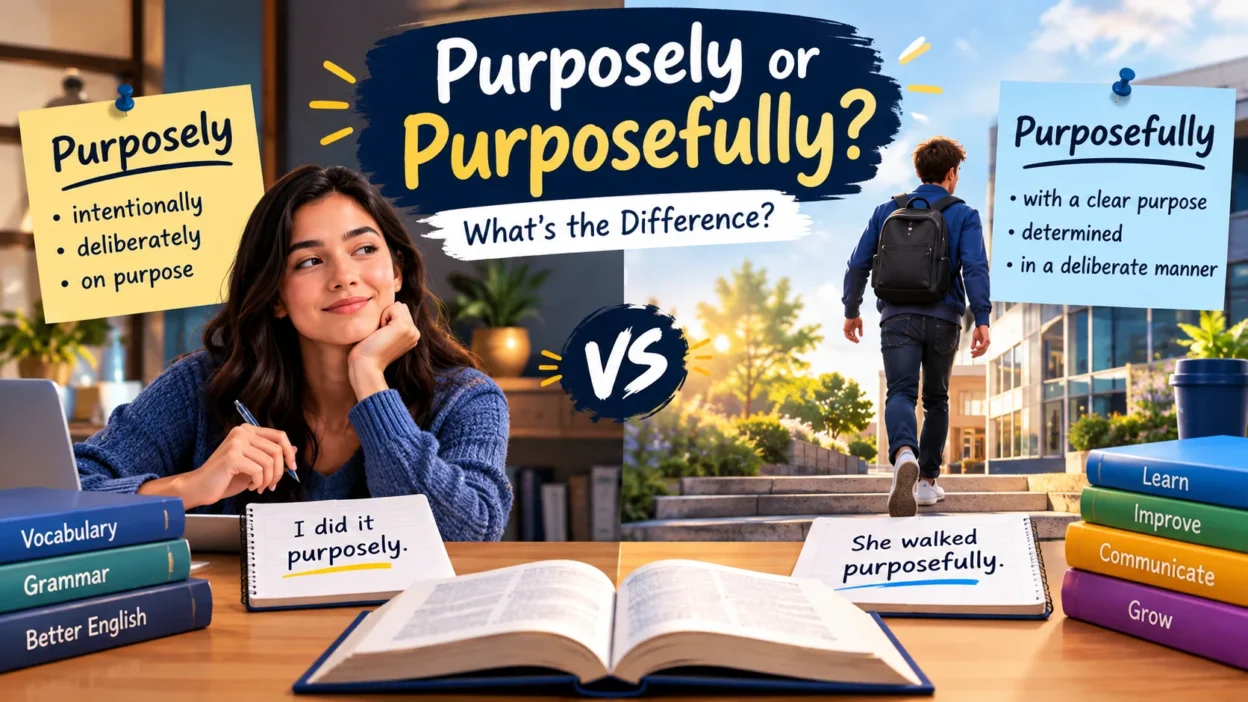
When you want to say that someone did something intentionally, purposely and purposefully can both seem correct. They are closely related, but they do not always emphasize exactly the same idea. Understanding the difference can help you choose the more natural word in everyday English and formal writing.
Purposely usually means intentionally or deliberately. Purposefully can also mean intentionally, but it often suggests that someone acts with a clear purpose, determination, or deliberate direction. In many sentences, either word may work, but the meaning or emphasis can change slightly.
Quick Answer: Purposely or Purposefully?
Purposely means doing something intentionally or deliberately. Purposefully can also mean intentionally, but it often emphasizes acting with a clear purpose or determination. For example, “She purposely ignored me” focuses on intention, while “She walked purposefully toward the door” emphasizes confident, deliberate movement.
Why Do People Confuse Purposely and Purposefully?
The confusion comes from their shared root, purpose, and their overlapping meanings.
Both words can describe an action that is not accidental:
- Purposely = intentionally; deliberately
- Purposefully = intentionally, with a clear purpose or determined manner
There is also an important usage point: purposefully has two closely connected senses. It can mean intentionally, but it can also describe the manner in which someone does something.
Compare:
He purposely broke the rule.
He walked purposefully across the room.
The first sentence focuses on intention. The second describes how he walked—in a deliberate, determined way.
What Does “Purposely” Mean?
Purposely is an adverb meaning intentionally, deliberately, or on purpose.
It is commonly used when someone chooses to do something rather than doing it accidentally.
Examples
- She purposely left early to avoid traffic.
- He purposely ignored the message.
- Did you purposely break the glass?
- I think she purposely changed the subject.
A useful synonym for purposely is deliberately.
Best use of “purposely”
Use purposely when your main idea is:
“This person intended to do this.”
What Does “Purposefully” Mean?
Purposefully can mean intentionally, but it often carries an additional sense of acting with a clear purpose, determination, or direction.
For example:
The manager spoke purposefully about the company’s future.
This suggests that the manager’s speech was deliberate and focused.
It can also describe physical movement:
She walked purposefully toward the office.
Here, purposefully means that her movement looked deliberate and determined.
Best use of “purposefully”
Use purposefully when you want to emphasize:
- a clear purpose
- determination
- deliberate action
- focused movement
- intentional behavior
Purposely vs Purposefully: Comparison Table
| Word | Main meaning | Main focus | Example |
|---|---|---|---|
| Purposely | Intentionally; deliberately | The intention behind an action | He purposely ignored the warning. |
| Purposefully | With purpose or intention | Purpose, determination, or manner | She walked purposefully toward the exit. |
| Purposely | Not accidentally | Choice or intention | They purposely arrived late. |
| Purposefully | In a deliberate, focused way | Manner or direction | He spoke purposefully to the audience. |
When Should You Use “Purposely”?
Choose purposely when you want to make clear that an action was intentional.
For example:
She purposely deleted the file.
The sentence tells us that deleting the file was intentional.
It is especially natural when contrasting intentional behavior with accidental behavior:
I didn’t break it accidentally. I purposely moved it.
You can often replace purposely with intentionally, deliberately, or on purpose.
When Should You Use “Purposefully”?
Choose purposefully when you want to emphasize that someone acts with a clear goal, determination, or deliberate manner.
For example:
The student purposefully reviewed each chapter before the exam.
This suggests focused and deliberate behavior.
It is also particularly natural with verbs describing movement, speech, or behavior:
- walked purposefully
- moved purposefully
- spoke purposefully
- acted purposefully
- worked purposefully
Purposely or Purposefully: 12 Examples
1. She purposely ignored my question.
She intentionally chose not to answer.
2. He purposely arrived early.
He deliberately chose to arrive early.
3. I didn’t do it purposely.
I didn’t do it intentionally.
4. They purposely changed the schedule.
They intentionally changed it.
5. She walked purposefully toward the building.
Her walking appeared deliberate and determined.
6. He spoke purposefully during the meeting.
His speech was focused and deliberate.
7. The team worked purposefully toward its goal.
The team worked with a clear objective.
8. She purposely left her phone at home.
She intentionally left it there.
9. The teacher purposefully designed the activity.
The activity was created with a particular goal in mind.
10. He purposefully avoided the topic.
He deliberately avoided discussing it.
11. The athlete moved purposefully across the field.
The athlete moved in a focused and determined way.
12. She purposefully included examples in her presentation.
She intentionally included them to serve a particular purpose.
Common Mistakes
Mistake 1: Thinking the words are always interchangeable
Although their meanings overlap, they are not always equally natural.
She purposely walked toward him.
This mainly means she intentionally walked toward him.
She walked purposefully toward him.
This emphasizes the deliberate and determined manner of her walking.
Mistake 2: Using “purposefully” when you simply mean “on purpose”
If your only meaning is intentional action, purposely is often the clearer choice.
He purposely deleted the email.
This directly communicates intention.
Mistake 3: Assuming “purposefully” always means “intentionally”
Purposefully can describe the manner of an action, especially movement or behavior.
She walked purposefully down the hallway.
Here, the word tells us how she walked, not merely that she intended to walk.
Mistake 4: Confusing both words with “purposefully” in every formal sentence
Neither word is automatically more correct because it sounds more formal. Choose based on the meaning you want.
Memory Trick
A simple way to remember the difference is:
Purposely = on purpose.
Purposefully = with purpose.
If you can replace the word with “intentionally”, purposely will often fit.
If you want to describe someone acting with focus, direction, or determination, purposefully may be more suitable.
American vs British English
Both purposely and purposefully are used in American and British English.
There is no major American-versus-British spelling difference between these two words.
The distinction is primarily about meaning and context, rather than regional grammar.
For example, both varieties of English can use:
She purposely avoided the question.
And:
He walked purposefully toward the door.
Similar Words
Several related expressions can help you express intention or deliberate action.
Intentionally
Means deliberately or not accidentally.
She intentionally changed the answer.
Deliberately
Means consciously and intentionally. It can sometimes suggest careful consideration.
He deliberately chose a different route.
On purpose
A common, natural phrase meaning intentionally.
Did you do that on purpose?
Purposeful
An adjective meaning having or showing a clear purpose.
She made a purposeful decision.
Intention
A noun referring to what someone plans or means to do.
His intention was to help.
Final Verdict
Purposely and purposefully are both correct words, and their meanings overlap.
Use purposely when you mainly mean intentionally or deliberately.
Use purposefully when you want to emphasize a clear purpose, focused action, determination, or deliberate manner.
A quick comparison is:
Purposely = intentionally
Purposefully = with purpose or in a deliberate, determined way
FAQs
Is “purposely” grammatically correct?
Yes. Purposely is a standard English adverb meaning intentionally or deliberately.
Is “purposefully” a real word?
Yes. Purposefully is a standard English adverb. It can mean intentionally and can also describe acting in a deliberate or determined manner.
Is purposely the same as intentionally?
In many contexts, yes. Purposely and intentionally both mean that someone did something deliberately rather than accidentally.
Is purposefully the same as purposely?
They can overlap when they mean “intentionally,” but purposefully can also emphasize acting with a clear purpose or in a determined manner.
Which is correct: “I did it purposely” or “I did it purposefully”?
If you mean “I did it on purpose,” purposely is the more direct choice:
I did it purposely.
You can also simply say:
I did it on purpose.
Can you say “walked purposely”?
Yes. Walked purposely can mean intentionally walked, although walked purposefully is often used when describing deliberate or determined movement.
What is the opposite of purposely?
Depending on context, the opposite can be accidentally, unintentionally, or inadvertently.
Remember This
- Purposely = intentionally or deliberately.
- Purposefully = with purpose, intention, focus, or determination.
- Use purposely when intention is the main idea.
- Use purposefully when the manner or purpose of an action matters.
- On purpose is a simple alternative to purposely.
Conclusion
The difference between purposely and purposefully is small but useful. Purposely most directly expresses the idea that something was done intentionally. It works especially well when you want to contrast deliberate action with an accident.
Purposefully can express intention too, but it often adds the idea of purpose, focus, or determination. When describing someone walking, speaking, working, or acting in a deliberate way, it can be especially natural. Remember “purposely = on purpose” and “purposefully = with purpose,” and you will usually make the right choice.

David Henry is a language enthusiast and content writer specializing in synonyms, vocabulary, and word meanings. He creates clear, engaging resources that help readers improve their writing, communication, and English skills.