
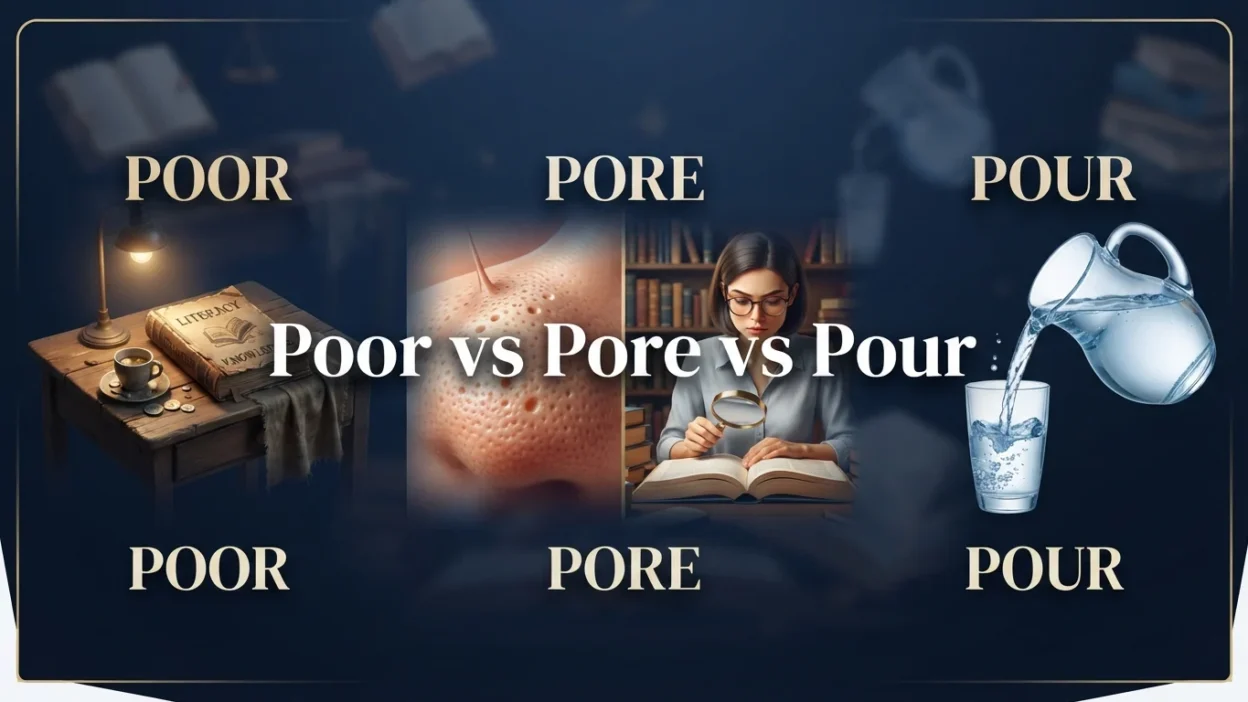
If you often confuse poor vs pore vs pour, you are not alone. These three words sound exactly the same in most varieties of English, but they have completely different meanings and spellings. Poor usually describes someone or something lacking money, quality, or ability. Pore can mean a tiny opening in the skin or the act of reading or examining something carefully. Pour means to make a liquid flow from one container or place to another.
Understanding the difference between these homophones can make your writing clearer and help you avoid common spelling mistakes. For students, ESL learners, and anyone improving their English vocabulary, learning each word with simple examples is much easier than memorizing definitions alone. This guide explains poor, pore, and pour, shows how they work in sentences, and gives you a simple memory trick to remember the correct spelling.
Quick Answer: Poor vs Pore vs Pour
Poor means lacking money, quality, or something needed. Pore means a tiny opening or to study something carefully. Pour means to make liquid flow. All three usually sound alike, but their meanings and spellings are different.
Why Do People Confuse Poor, Pore, and Pour?
Poor, pore, and pour are homophones in most standard varieties of English. Homophones are words that have the same or very similar pronunciation but different meanings and spellings.
For example:
- Poor: The family was poor.
- Pore: Sweat escaped through the pores of his skin.
- Pore: She will pore over the report tonight.
- Pour: Please pour some water into the glass.
The easiest way to choose the correct word is to look at its meaning and the words around it.
What Does “Poor” Mean?
Poor is an adjective with several related meanings.
It commonly describes someone who has little money or something that is below an expected standard.
Poor meaning “not wealthy”
- The poor family needed help.
- He grew up in a poor neighborhood.
Poor meaning “low quality”
- The report received a poor grade.
- The restaurant provided poor service.
Poor meaning “not good at something”
- I have a poor memory for names.
- She has poor communication skills.
Poor meaning “unfortunate”
Sometimes poor is used to show sympathy.
- The poor child was frightened by the storm.
- I felt sorry for the poor dog.
What Does “Pore” Mean?
Pore has two important meanings.
Pore as a noun
A pore is a very small opening in the skin or another surface.
- Your skin contains millions of pores.
- Dirt can collect in your pores.
- The cream is designed to clean blocked pores.
The word can also describe tiny openings in some materials.
Pore as a verb
To pore over something means to read, study, or examine it carefully and for a long time.
- She pored over the documents.
- He spent hours poring over the map.
- The students pored over their notes before the exam.
A useful phrase to remember is “pore over.”
What Does “Pour” Mean?
Pour is a verb meaning to make a liquid flow from one container, place, or person to another.
- Pour the milk into the bowl.
- She poured water into the glass.
- He poured coffee into my cup.
Pour can also describe rain falling heavily.
- Rain poured down all afternoon.
- Water poured through the broken window.
It can also be used figuratively:
- Fans poured into the stadium.
- People poured out of the building.
Poor vs Pore vs Pour: Comparison Table
| Word | Part of Speech | Main Meaning | Example |
|---|---|---|---|
| Poor | Adjective | Having little money, low quality, or limited ability | He comes from a poor family. |
| Pore | Noun | A tiny opening in the skin or a surface | This lotion helps clean the pores. |
| Pore | Verb | To study or examine carefully | She pored over the book. |
| Pour | Verb | To make liquid flow | Please pour me some water. |
When Should You Use Poor, Pore, or Pour?
Use “poor” when talking about money, quality, or ability
Choose poor when you mean:
- Not wealthy
- Low quality
- Below an expected standard
- Weak in a particular ability
- Unfortunate or deserving sympathy
Example:
The company provided poor customer service.
Use “pore” when talking about tiny openings
Use pore as a noun when discussing:
- Skin
- Small openings
- Surfaces
- Materials
Example:
Oil can build up inside the pores.
Use pore as a verb when you mean studying something carefully.
Example:
He pored over the instructions before starting.
Use “pour” for liquids or flowing things
Choose pour when something flows or is made to flow.
Example:
Pour the juice into the glass.
12 Examples of Poor, Pore, and Pour
- The family was too poor to afford a new car.
Here, poor means having little money. - The student received a poor grade.
Here, poor means below a satisfactory standard. - The company was criticized for its poor service.
Here, poor means low quality. - The doctor examined the pores on her skin.
Here, pores means tiny openings in the skin. - Sweat leaves the body through the pores.
Here, pores refers to small openings. - He pored over the map for several minutes.
Here, pored over means studied carefully. - She pored over the old photographs.
Here, pored over means examined closely. - Please pour the tea into my cup.
Here, pour means make a liquid flow. - He poured water into the bottle.
Here, poured describes transferring liquid. - Rain began to pour from the sky.
Here, pour describes heavy rainfall. - The fans poured into the stadium.
Here, poured describes people moving into a place in large numbers. - She poured herself a glass of orange juice.
Here, poured means transferred a drink into a glass.
Common Mistakes With Poor, Pore, and Pour
Mistake 1: Using “pour” when you mean “poor”
Incorrect:
He comes from a pour family.
Correct:
He comes from a poor family.
Mistake 2: Using “pore” for liquid
Incorrect:
Pore the milk into the cup.
Correct:
Pour the milk into the cup.
Mistake 3: Using “poor” when you mean “pore”
Incorrect:
The cream helps unclog your poor.
Correct:
The cream helps unclog your pores.
Mistake 4: Confusing “pore over” with “pour over”
When you mean study carefully, the standard expression is:
pore over
Example:
She pored over the exam notes.
When you mean making liquid flow over something, pour over is correct.
Example:
Pour the sauce over the pasta.
The difference depends entirely on the meaning.
Easy Memory Trick for Poor, Pore, and Pour
Try these simple associations:
- Poor = money or quality → Think “poor people” or “poor quality.”
- Pore = skin or study → Think skin pores or pore over a book.
- Pour = liquid flows → Think pour a drink.
A quick sentence can help:
Poor people may pore over their bills before they pour coffee.
The three words sound alike, but each spelling has its own job.
American vs British English
The spellings poor, pore, and pour are generally the same in both American and British English.
Their pronunciation can vary somewhat by speaker or regional accent, but they are commonly pronounced alike or very similarly.
The main differences between American and British English do not usually affect the spelling distinction among these three words.
For example:
- American English: Pour the water into the glass.
- British English: Pour the water into the glass.
The same spelling is used in both varieties.
Similar Words to Know
Learning related words can make these distinctions easier.
Words related to “poor”
- needy
- impoverished
- disadvantaged
- inadequate
- inferior
- weak
- unsuccessful
The best alternative depends on the context. For example, needy usually relates to financial need, while inadequate often describes something that does not meet a requirement.
Words related to “pore”
For the skin meaning:
- opening
- follicle
- tiny opening
For the verb meaning:
- study
- examine
- scrutinize
- inspect
- review carefully
Words related to “pour”
- spill
- flow
- stream
- discharge
- decant
These are not always exact synonyms. For example, spill often suggests an accidental release, while pour can be deliberate.
Final Verdict: Poor vs Pore vs Pour
The difference is simple once you connect each spelling with its meaning:
- Poor → lacking money, quality, or ability
- Pore → a tiny opening, or to study something carefully
- Pour → to make liquid flow
If you are writing about money or quality, choose poor. If you mean a tiny opening or careful study, choose pore. If you are talking about liquid flowing, choose pour.
Frequently Asked Questions
Is it “poor,” “pore,” or “pour” a drink?
The correct word is pour.
Example:
Please pour me a glass of water.
What is the difference between poor and pour?
Poor usually describes a lack of money, low quality, or limited ability. Pour means to make a liquid flow from one place or container to another.
What does “pore over” mean?
Pore over means to study, read, or examine something very carefully, usually for some time.
Example:
She pored over the documents before signing them.
Is “pore” a body part?
A pore is a tiny opening, especially one in the skin. It is not usually described as a separate body part.
Are poor, pore, and pour homophones?
Yes. In most standard varieties of English, poor, pore, and pour are pronounced the same or very similarly, although pronunciation can vary by regional accent.
Is “pour over” always wrong?
No. Pour over is correct when you literally mean making a liquid flow over something.
Example:
Pour the sauce over the vegetables.
When you mean study carefully, use pore over.
What is the easiest way to remember poor, pore, and pour?
Remember:
Poor = money/quality
Pore = skin/study
Pour = liquid
Remember This
Poor describes a lack or low standard.
Pore means a tiny opening or careful study.
Pour means making liquid flow.
If you can identify the meaning first, choosing the correct spelling becomes much easier.
Conclusion
The words poor, pore, and pour are easy to mix up because they sound alike, but their meanings are clearly different. Poor is mainly used for financial situations, quality, ability, or sympathy. Pore refers to a tiny opening and can also be a verb meaning to study something carefully. Pour describes the movement of liquid or, in some contexts, a large flow of people or things.
For quick recall, connect each word with one key idea: poor = lack or low quality, pore = opening or careful study, and pour = liquid flow. Once these associations become familiar, you can use all three confidently in everyday English and formal writing.

David Henry is a language enthusiast and content writer specializing in synonyms, vocabulary, and word meanings. He creates clear, engaging resources that help readers improve their writing, communication, and English skills.