
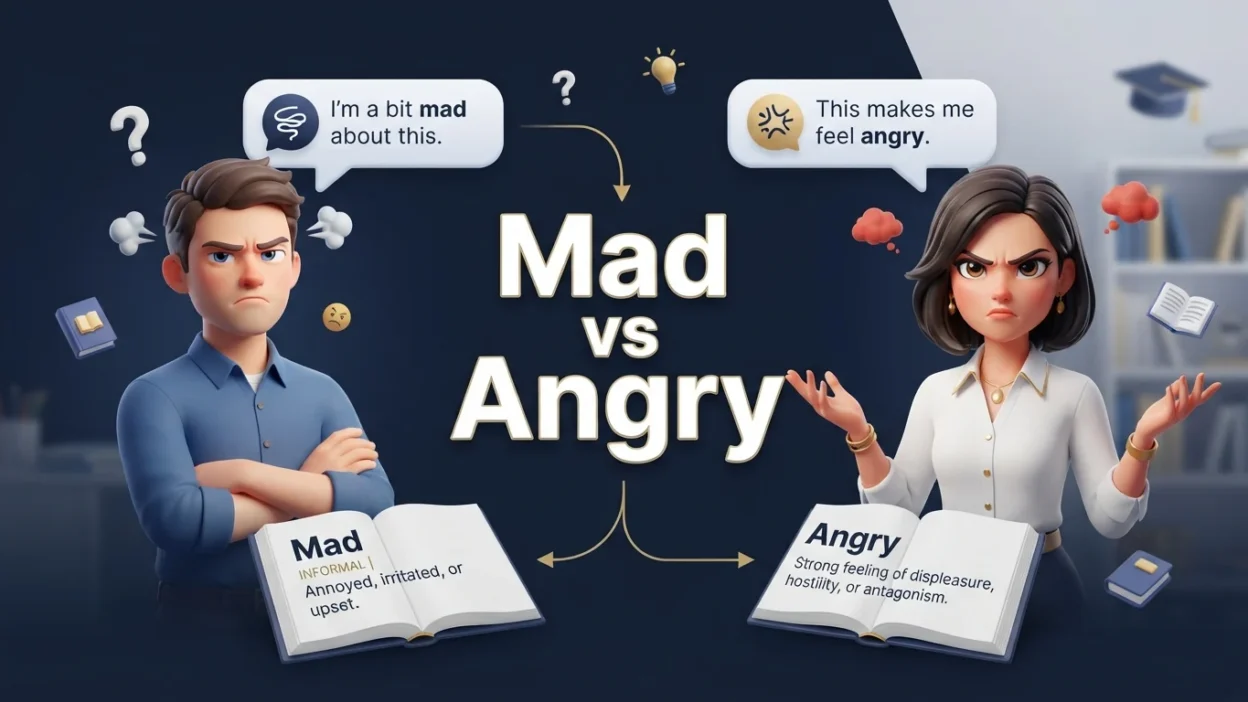
Mad and angry are two common English words used to describe a person who feels strong displeasure, irritation, or frustration. In many everyday sentences, they can mean almost the same thing. For example, “She is mad at me” and “She is angry with me” both tell us that she is upset because of something that happened.
The main difference is often usage and context rather than meaning. In American English, mad is very commonly used to mean “angry,” especially in casual conversation. Angry is more universal and can sound slightly more neutral or formal. In British English, mad traditionally means “crazy” or “insane,” although “mad” meaning angry is also understood and increasingly used. Understanding this small distinction can help students and ESL learners choose the right word naturally.
Quick Answer
Mad and angry can both mean feeling strong displeasure or irritation. In American English, mad commonly means angry in everyday speech. Angry works naturally in both casual and formal contexts. In British English, mad may also mean “crazy,” so context is important.
Why Do People Confuse “Mad” and “Angry”?
People confuse these words because they frequently describe the same emotional state.
Consider these examples:
- “I’m mad at him.”
- “I’m angry with him.”
Both sentences can mean that the speaker is upset with him.
The important difference is that mad has more than one major meaning. It can mean:
- Angry or annoyed.
- Crazy or mentally disturbed, especially in some varieties of English.
- Extremely enthusiastic or excited in informal expressions, such as “mad about football.”
Angry is much more focused on the emotion of anger.
What Does “Mad” Mean?
Mad can mean angry, annoyed, or upset.
In American English, this meaning is extremely common in everyday conversation.
Examples of “Mad”
- “I’m mad at my brother.”
- “She got mad when she heard the news.”
- “Why are you so mad?”
- “He was mad about the delay.”
In these examples, mad describes an emotional reaction.
However, mad can also mean crazy or mentally unstable in certain contexts, especially in British English or older usage.
For example:
“That sounds like a mad idea.”
Here, mad may mean “crazy” or “wild,” not necessarily angry.
What Does “Angry” Mean?
Angry is an adjective meaning feeling or showing strong displeasure, irritation, or resentment.
It is a direct and widely understood word for the emotion.
Examples of “Angry”
- “She was angry with her friend.”
- “He became angry after hearing the accusation.”
- “The customer was angry about the poor service.”
- “I’m not angry with you.”
Angry can be used in casual, academic, professional, and formal writing.
Mad vs Angry: Comparison Table
| Feature | Mad | Angry |
|---|---|---|
| Basic meaning | Angry, annoyed, or upset | Feeling strong displeasure |
| Common in American English | Very common | Very common |
| Common in British English | Can mean angry, but can also mean crazy | Standard word for anger |
| Formal writing | Less preferred when meaning angry | More suitable |
| Casual conversation | Very natural | Very natural |
| Other meanings | Yes | Fewer common meanings |
| Strength | Depends on context | Depends on context |
| Example | “I’m mad at him.” | “I’m angry with him.” |
When Should You Use “Mad” or “Angry”?
Use “Mad” in Casual American English
Mad sounds very natural in everyday American conversations.
“My sister is mad at me.”
“Don’t get mad.”
“He was really mad about what happened.”
Use “Angry” for Neutral or Formal Contexts
Angry is a safer choice when writing formally or when you want to describe the emotion clearly.
“The residents were angry about the proposed changes.”
“The employee became angry during the meeting.”
Use “Mad” Carefully in British English
Because mad can mean “crazy,” it can sometimes create ambiguity in British English.
If your meaning is specifically emotional anger, angry is often the clearest choice.
Mad vs Angry: 12 Examples
1. Everyday Conversation
Mad: “I’m mad at you.”
Angry: “I’m angry with you.”
Both mean that the speaker is upset.
2. After an Argument
“She was mad after the argument.”
“She was angry after the argument.”
Both are grammatically correct.
3. At Work
“The manager was angry about the mistake.”
Angry sounds more neutral in a professional setting.
4. With Friends
“Are you mad at me?”
This sounds very natural in casual American English.
5. Describing a Customer
“The customer was angry about the delay.”
This is a natural choice in a formal or professional context.
6. Strong Emotion
“He was extremely angry.”
“He was really mad.”
Both can describe strong anger.
7. Asking About Feelings
“Why are you mad?”
“Why are you angry?”
Both questions are correct.
8. After Being Disappointed
“She got mad when her plans changed.”
“She got angry when her plans changed.”
Both can work depending on the speaker and context.
9. Formal Writing
“The citizens were angry about the decision.”
Here, angry is generally more appropriate than the informal mad.
10. American English
“My dad will be mad if I’m late.”
This is completely natural in American English.
11. British English
“He was angry about the situation.”
This avoids the possible alternative meaning of mad.
12. Another Meaning of “Mad”
“That was a mad idea!”
Here, mad may mean crazy, wild, or unreasonable, rather than angry.
Common Mistakes
Mistake 1: Thinking “Mad” Always Means Angry
Mad has multiple meanings.
“She is mad at me.”
Here, mad means angry.
But:
“That person is completely mad.”
Depending on context, mad may mean crazy or mentally unstable.
Mistake 2: Assuming “Mad” Is Always Informal or Incorrect
In American English, mad meaning angry is completely standard.
“I’m mad at him.”
There is nothing grammatically wrong with this sentence.
Mistake 3: Using “Mad” When “Angry” Is Clearer
In formal writing, angry can make your meaning more precise.
Instead of:
“The officials were mad about the criticism.”
You could write:
“The officials were angry about the criticism.”
Mistake 4: Confusing “Mad About” With Anger
The expression mad about can have different meanings depending on context.
“She is mad about her new puppy.”
This can mean she is extremely enthusiastic about or fond of the puppy.
It does not necessarily mean she is angry about the puppy.
Memory Trick
Remember:
Mad = Angry in common American conversation.
Angry = The clear, standard word for the emotion.
A simple rule is:
Casual American English → mad or angry
Formal or universally clear English → angry
Also remember that mad can have other meanings, so context matters.
American vs British English
The word mad has an interesting difference between American and British usage.
American English
In American English, mad commonly means angry.
“Why are you mad at me?”
This is a normal everyday sentence.
British English
In British English, angry is the straightforward word for the emotion.
Mad can also be used to mean angry, particularly in informal speech, but it traditionally has the additional meaning crazy or insane.
For learners who want to avoid ambiguity, angry is usually the safer international choice.
Similar Words
Several words are related to mad and angry, but they are not always interchangeable.
| Word | Meaning | Example |
|---|---|---|
| Annoyed | Slightly angry or irritated | “I’m annoyed by the noise.” |
| Irritated | Bothered or mildly angry | “She was irritated by the interruption.” |
| Furious | Extremely angry | “He was furious about the decision.” |
| Enraged | Extremely angry | “The crowd was enraged.” |
| Frustrated | Upset because something is difficult or blocked | “I’m frustrated with this problem.” |
| Upset | Emotionally disturbed or unhappy | “She was upset by the news.” |
| Irritated | Experiencing annoyance | “He felt irritated after waiting.” |
| Infuriated | Made extremely angry | “The unfair treatment infuriated him.” |
The best word depends on how strong the emotion is and why the person feels it.
Final Verdict
Mad and angry often communicate the same basic idea: feeling strong displeasure or irritation.
The key distinction is usage. In American English, mad is a very common everyday alternative to angry. Angry is more universally clear and fits casual as well as formal contexts. Because mad has other meanings, including “crazy” in some contexts, angry can be the clearer choice when precision matters.
Frequently Asked Questions
Is “mad” the same as “angry”?
Usually, yes, when mad is being used to describe an emotional reaction. In American English, “I’m mad” commonly means “I’m angry.”
Is “mad” more informal than “angry”?
Generally, mad can sound more conversational when it means angry. Angry works comfortably in both everyday speech and formal writing.
Do British people say “mad” to mean angry?
Yes, mad can mean angry in British English, especially in informal contexts. However, mad also traditionally means crazy or insane, so angry can be clearer.
Which is stronger: mad or angry?
Neither word is inherently stronger. Intensity depends on modifiers and context. For example, “slightly angry” is mild, while “extremely mad” describes strong anger.
Can I use “mad” in formal writing?
You can, but angry is often clearer and more neutral when you are writing formally.
Is “mad at” or “angry at” correct?
Both can be correct. “Mad at” is especially common in American English. “Angry at” is also standard, while “angry with” is commonly used for people.
What is the difference between “mad” and “upset”?
Mad usually focuses on anger, while upset is broader and can describe sadness, disappointment, worry, or emotional distress.
What is the difference between “mad” and “furious”?
Furious means extremely angry. Mad can describe anything from mild irritation to strong anger, depending on context.
Remember This
- Mad can mean angry, especially in American English.
- Angry directly describes the emotion of anger.
- Angry is useful in both formal and informal contexts.
- Mad has other meanings, including “crazy” in some contexts.
- Mad at is very common in American English.
- Angry with and angry at are both used.
- When you want maximum clarity for an international audience, angry is often the safer choice.
Conclusion
The difference between mad vs angry is mostly about usage, context, and regional English rather than a completely different emotion. Both words can describe someone who feels displeasure or irritation, and both are common in everyday English. In American English, mad is especially natural in casual conversations.
For learners, the easiest rule is to use mad for casual American-style conversation and angry when you want a clear, neutral word that works well across different varieties of English. Once you notice the additional meanings of mad, choosing between the two becomes much easier.

Daniel Jack is a language enthusiast and content writer who specializes in synonyms, vocabulary, and word meanings. He creates clear, engaging resources that help readers improve communication and expand their English skills.