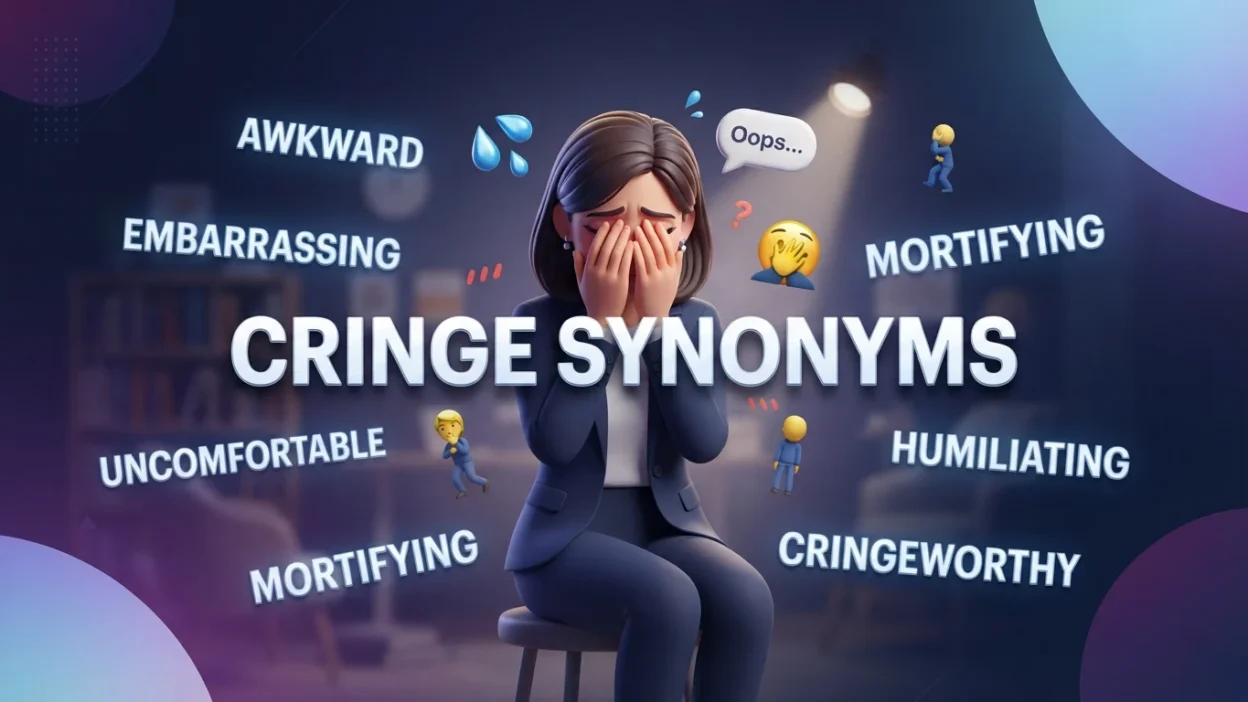
Have you ever watched someone do something so awkward that you wanted to look away? That feeling is often described with the word cringe. if it is an embarrassing social moment, an uncomfortable joke, or an awkward behavior, “cringe” is a common word in modern English.
However, using the same word repeatedly can make your writing sound boring. Learning cringe synonyms gives you more ways to describe embarrassment, awkwardness, discomfort, or secondhand embarrassment with greater accuracy.
This guide explains 30 useful alternatives to “cringe” in simple English. It is helpful for students, ESL learners, writers, bloggers, and content creators who want to choose the right word for different situations.
What Does “Cringe” Mean?
Cringe can mean to feel embarrassed, uncomfortable, or awkward because of something you see, hear, or experience.
It can also describe a physical reaction to something unpleasant, such as shrinking back or flinching.
Simple definition
Cringe: To feel embarrassed, uncomfortable, or awkward, especially because something seems embarrassing or unpleasant.
Examples
- I cringed when I remembered my old speech.
- That video was so awkward that I had to cringe.
- His overly dramatic message made everyone uncomfortable.
Tone and usage
“Cringe” is common in casual and informal English. It is especially popular online and in social media conversations.
For formal writing, alternatives such as embarrassing, awkward, uncomfortable, humiliating, or mortifying may be more suitable.
30 Cringe Synonyms
Below are 30 alternatives to “cringe,” with simple meanings, examples, and guidance on when to use each word.
1. Embarrassing
Meaning: Something that makes a person feel ashamed, awkward, or uncomfortable.
Example:
It was embarrassing when I forgot her name.
Best usage: Everyday conversations, school writing, and general descriptions.
2. Awkward
Meaning: Uncomfortable, strange, or difficult to handle socially.
Example:
There was an awkward silence after his joke.
Best usage: Social situations, conversations, and uncomfortable moments.
3. Uncomfortable
Meaning: Causing a person to feel uneasy or bothered.
Example:
The conversation became uncomfortable very quickly.
Best usage: General situations where “cringe” feels too informal.
4. Mortifying
Meaning: Extremely embarrassing or humiliating.
Example:
It was mortifying when she accidentally sent the message to the wrong person.
Best usage: Very strong embarrassment.
5. Humiliating
Meaning: Making someone feel ashamed or foolish in front of others.
Example:
Losing the competition in front of everyone was humiliating.
Best usage: Serious or intense embarrassment.
6. Embarrassed
Meaning: Feeling ashamed, awkward, or uncomfortable because of something that happened.
Example:
I felt embarrassed after making that mistake.
Best usage: Describing a person’s emotional reaction.
7. Ashamed
Meaning: Feeling bad or guilty about something you did.
Example:
He was ashamed of the rude comment he made.
Best usage: Situations involving guilt, regret, or wrongdoing.
8. Flinch
Meaning: To make a quick movement because something is unpleasant, painful, or shocking.
Example:
I flinched when I heard the terrible joke.
Best usage: Physical or instinctive reactions.
9. Winced
Meaning: Reacted with a sudden feeling of pain, discomfort, or embarrassment.
Example:
She winced when she heard her old recording.
Best usage: Strong reactions to something unpleasant.
10. Unpleasant
Meaning: Something that is not enjoyable and may cause discomfort.
Example:
The entire conversation was unpleasant.
Best usage: Neutral or more formal descriptions.
11. Distasteful
Meaning: Something considered offensive, inappropriate, or lacking good judgment.
Example:
His joke was distasteful and made everyone uncomfortable.
Best usage: Inappropriate jokes, comments, or behavior.
12. Unseemly
Meaning: Not suitable, proper, or socially acceptable.
Example:
His behavior at the formal event was unseemly.
Best usage: Formal writing and inappropriate behavior.
13. Shameful
Meaning: Deserving shame or strong disapproval.
Example:
The way he treated his colleague was shameful.
Best usage: Behavior that is morally or socially unacceptable.
14. Humbling
Meaning: Making someone feel less proud or confident, often because they realize a mistake or limitation.
Example:
The experience was humbling but taught me an important lesson.
Best usage: Situations involving self-awareness rather than simple embarrassment.
15. Ridiculous
Meaning: So silly or unreasonable that it may seem laughable.
Example:
His attempt to explain the mistake sounded ridiculous.
Best usage: Silly behavior or ideas.
16. Foolish
Meaning: Showing poor judgment or a lack of good sense.
Example:
I made a foolish decision without thinking about the consequences.
Best usage: Describing poor choices or behavior.
17. Silly
Meaning: Not serious, sensible, or intelligent.
Example:
That was a silly thing to say during the meeting.
Best usage: Mild situations where you want a softer word.
18. Absurd
Meaning: Completely unreasonable, illogical, or ridiculous.
Example:
His explanation was so absurd that nobody believed it.
Best usage: Extreme or illogical situations.
19. Mortifyingly Awkward
Meaning: Extremely uncomfortable and embarrassing.
Example:
The meeting became mortifyingly awkward when everyone realized the mistake.
Best usage: Informal writing when you want to emphasize both awkwardness and embarrassment.
20. Uncomfortable to Watch
Meaning: Something that makes viewers feel uneasy or embarrassed while watching it.
Example:
The video was uncomfortable to watch.
Best usage: Videos, movies, social media posts, and public behavior.
21. Secondhand Embarrassment
Meaning: Feeling embarrassed because of someone else’s embarrassing behavior.
Example:
I experienced serious secondhand embarrassment while watching his presentation.
Best usage: When another person’s actions make you feel embarrassed.
22. Shame-Inducing
Meaning: Something that causes feelings of shame or embarrassment.
Example:
The awkward performance was almost shame-inducing.
Best usage: Descriptive or analytical writing.
23. Icky
Meaning: Unpleasant, uncomfortable, or slightly disgusting.
Example:
The overly personal comments gave me an icky feeling.
Best usage: Casual conversations and informal online language.
24. Tacky
Meaning: Lacking good taste or style.
Example:
The excessive decorations looked tacky.
Best usage: Clothing, design, behavior, or choices that seem tasteless.
25. Cheesy
Meaning: Overly sentimental, dramatic, or predictable in an embarrassing way.
Example:
The romantic speech was sweet but a little cheesy.
Best usage: Romantic expressions, movies, advertisements, and jokes.
26. Corny
Meaning: Too predictable, old-fashioned, or sentimental in a way that can seem silly.
Example:
His pickup line was incredibly corny.
Best usage: Jokes, romantic lines, slogans, and entertainment.
27. Forced
Meaning: Not natural or genuine.
Example:
Their conversation felt forced and uncomfortable.
Best usage: Conversations, humor, emotions, and social interactions.
28. Pretentious
Meaning: Trying to appear more intelligent, important, or sophisticated than one really is.
Example:
His pretentious speech made the audience uncomfortable.
Best usage: Writing, speech, behavior, or style that feels unnecessarily superior.
29. Unnatural
Meaning: Not normal, genuine, or comfortable.
Example:
Her overly formal response sounded unnatural.
Best usage: Conversations, behavior, writing, or reactions that do not feel genuine.
30. Cringeworthy
Meaning: So embarrassing or awkward that it causes a strong uncomfortable reaction.
Example:
The old advertisement was completely cringeworthy.
Best usage: Informal English, online content, videos, posts, and entertainment.
Quick Comparison of Cringe Synonyms
| Synonym | Main Meaning | Strength | Best Context |
|---|---|---|---|
| Embarrassing | Causes embarrassment | Medium | General situations |
| Awkward | Socially uncomfortable | Medium | Conversations |
| Uncomfortable | Causes uneasiness | Medium | General/formal use |
| Mortifying | Extremely embarrassing | Very strong | Serious embarrassment |
| Humiliating | Causes shame before others | Strong | Public embarrassment |
| Distasteful | Offensive or inappropriate | Strong | Comments or behavior |
| Ridiculous | Very silly or unreasonable | Medium | Ideas or actions |
| Silly | Mildly foolish | Mild | Casual situations |
| Absurd | Extremely unreasonable | Strong | Illogical situations |
| Cheesy | Overly sentimental | Mild–medium | Romance and media |
| Corny | Predictably silly | Mild–medium | Jokes and phrases |
| Tacky | Lacking good taste | Medium | Style or behavior |
| Forced | Not natural | Medium | Conversations or emotions |
| Pretentious | Trying too hard to seem sophisticated | Medium–strong | Speech or behavior |
| Cringeworthy | Extremely awkward or embarrassing | Strong | Online content |
Cringe vs. Awkward: What’s the Difference?
Cringe and awkward are closely related, but they are not always interchangeable.
Awkward usually describes a situation that feels uncomfortable, strange, or socially difficult.
The conversation became awkward.
Cringe often describes a stronger emotional reaction to something embarrassing or uncomfortable.
I cringed when I heard the recording.
So, something can be awkward without being cringeworthy.
For example, a short silence between two strangers may be awkward, but it may not be embarrassing enough to make someone cringe.
Cringe vs. Embarrassing: What’s the Difference?
Embarrassing directly describes something that causes shame or self-consciousness.
Forgetting his name was embarrassing.
Cringe can describe your reaction to something embarrassing.
I cringed when I realized I had forgotten his name.
In simple terms:
Embarrassing = causes embarrassment
Cringe = react with discomfort or embarrassment
How to Choose the Right Cringe Synonym
The best synonym depends on exactly what you want to communicate.
For Mild Awkwardness
Use:
- Awkward
- Uncomfortable
- Silly
- Unnatural
These are useful when the situation is uncomfortable but not extremely embarrassing.
Example:
The conversation felt awkward.
For Strong Embarrassment
Use:
- Mortifying
- Humiliating
- Embarrassing
- Cringeworthy
These words work when the situation creates a powerful feeling of shame or discomfort.
Example:
It was a mortifying experience.
For Someone Else’s Embarrassing Behavior
Use:
- Secondhand embarrassment
- Cringeworthy
- Uncomfortable to watch
- Awkward
These are particularly useful when you are reacting to another person’s actions.
Example:
Watching him try to impress everyone gave me serious secondhand embarrassment.
For Poor Taste
Use:
- Tacky
- Distasteful
- Cheesy
- Corny
These words are useful when something feels embarrassing because it is overly sentimental, inappropriate, old-fashioned, or lacking style.
Example:
The commercial was cheesy but memorable.
For Foolish Behavior
Use:
- Foolish
- Silly
- Ridiculous
- Absurd
These words focus more on poor judgment or unreasonable behavior than embarrassment.
Example:
His ridiculous excuse made the situation even worse.
For Formal Writing
Instead of “cringe,” consider:
- Uncomfortable
- Embarrassing
- Humiliating
- Unseemly
- Distasteful
- Inappropriate
These options usually sound more professional and appropriate in academic or formal writing.
Cringe Synonyms for Different Situations
If someone tells a terrible joke:
Awkward, corny, cheesy, embarrassing
If someone behaves badly in public:
Unseemly, inappropriate, humiliating, embarrassing
If you watch an embarrassing video:
Cringeworthy, uncomfortable to watch, secondhand embarrassment
If someone makes an overly romantic statement:
Cheesy, corny, forced
If something looks cheap or tasteless:
Tacky, distasteful
If someone’s idea makes no sense:
Ridiculous, absurd, foolish
Why Use Synonyms for “Cringe”?
Using different words helps make your English more precise.
For example, saying:
That was cringe.
is simple and natural in casual speech.
But:
That was an incredibly awkward conversation.
gives the reader more information.
Likewise:
His speech was cringeworthy.
shows a different feeling from:
His speech was pretentious.
The first focuses on embarrassment. The second suggests that he was trying too hard to appear sophisticated.
Good vocabulary is not simply about knowing more words. It is about knowing which word fits the situation best.
Frequently Asked Questions About Cringe Synonyms
What is the best synonym for cringe?
Awkward is one of the closest general alternatives, but the best choice depends on context. Embarrassing, uncomfortable, mortifying, humiliating, and cringeworthy can all work in different situations.
What is a formal synonym for cringe?
For formal writing, use words such as embarrassing, uncomfortable, humiliating, unseemly, or distasteful, depending on the meaning.
What is a slang synonym for cringe?
In casual online language, words and phrases such as icky, awkward, cheesy, corny, and cringeworthy can work well.
What is the opposite of cringe?
Depending on the context, possible opposites include comfortable, natural, confident, enjoyable, appealing, or pleasant.
Is “cringeworthy” a synonym for cringe?
Yes. Cringeworthy describes something that is extremely awkward, embarrassing, or uncomfortable to experience or watch.
What is the difference between cringe and secondhand embarrassment?
Cringe describes a reaction of discomfort or embarrassment, while secondhand embarrassment specifically means feeling embarrassed because of another person’s behavior.
Final Thoughts on Cringe Synonyms
Learning cringe synonyms gives you more precise ways to describe uncomfortable, embarrassing, silly, or inappropriate situations. While “cringe” is extremely common in everyday and online English, it does not always express the exact feeling you want.
Use awkward for social discomfort, embarrassing for situations that cause shame, mortifying for extreme embarrassment, and cringeworthy for something that is painfully awkward to watch or experience.
For more specific situations, words such as cheesy, corny, tacky, distasteful, pretentious, ridiculous, and forced can communicate much more detail.
The key is to choose the synonym based on meaning, intensity, tone, and context. With the right word, your writing becomes clearer, more natural, and more expressive.

Amber Amy is a passionate writer at SynonymLot, dedicated to helping readers discover better words, expand their vocabulary, and improve their writing through clear, accurate, and easy-to-understand synonym guides.