
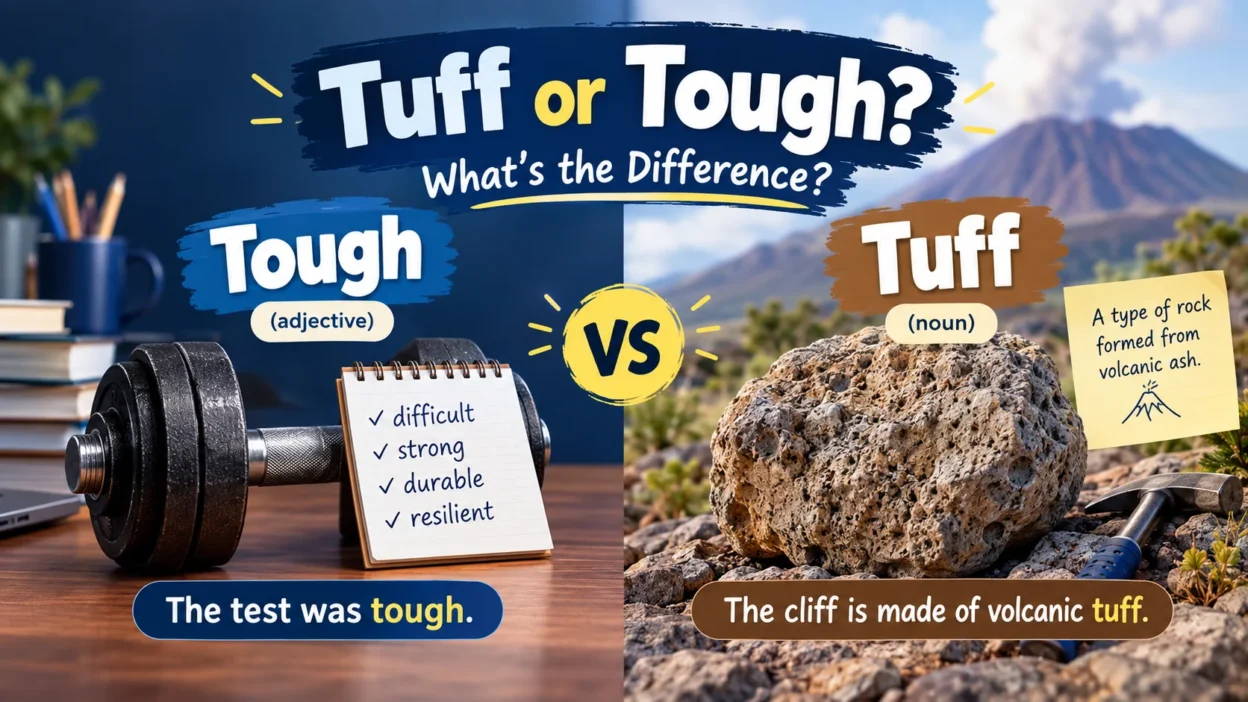
English has many words that sound similar but have very different meanings or uses. “Tuff” and “tough” are a good example. They are pronounced almost the same in some varieties of English, which can make them confusing for students, ESL learners, and anyone improving their spelling.
The key point is simple: “tough” is the standard English word used to describe something strong, difficult, hard, or resilient. “Tuff” is a different word, mainly used as a geological term for a type of rock made from volcanic ash. In informal contexts, “tuff” can also appear as slang or intentional alternative spelling, but it should not normally replace “tough” in standard writing.
Quick Answer
“Tough” is the correct word in most everyday situations. It can mean difficult, strong, durable, or emotionally resilient. “Tuff” is primarily a geological term for rock formed from compacted volcanic ash. If you mean “difficult” or “strong,” use tough.
Why Do People Confuse “Tuff” and “Tough”?
The confusion mainly comes from pronunciation and spelling.
Tough is pronounced /tʌf/, which sounds like “tuff.” English spelling is not always phonetic, so the letters -ough can represent different sounds in different words.
For example:
- tough → /tʌf/
- though → /ðoʊ/
- through → /θruː/
- thought → /θɔːt/
- cough → /kɔːf/
Because tough sounds like “tuff,” learners sometimes spell it as tuff. However, the standard spelling for the everyday adjective is tough.
What Does “Tough” Mean?
Tough is a common English adjective with several related meanings.
It can describe something that is:
- Difficult: “The exam was tough.”
- Strong or durable: “This material is tough.”
- Able to withstand hardship: “She is a tough person.”
- Hard to damage or break: “These boots are tough.”
- Emotionally resilient: “He stayed tough during the difficult period.”
Examples of “Tough”
- That was a tough decision.
- This meat is too tough to chew.
- She is tough enough to handle the pressure.
- The team faced a tough opponent.
- These shoes are made from tough leather.
What Does “Tuff” Mean?
Tuff is a real English word, but it has a much narrower meaning.
In geology, tuff is a type of rock formed from volcanic ash and other volcanic material that becomes compacted and cemented together.
For example:
The geologist identified the rock as volcanic tuff.
The word tuff can also appear in informal slang or stylized writing, especially online, where someone may deliberately write “tuff” instead of “tough.” However, this spelling is not appropriate as a general replacement for tough in formal or standard English.
Tuff vs Tough: Comparison Table
| Word | Meaning | Part of Speech | Common Use | Example |
|---|---|---|---|---|
| tough | Difficult, strong, durable, or resilient | Adjective | Everyday English | It was a tough test. |
| tuff | A rock made largely from volcanic ash | Noun | Geology | The cliff contains volcanic tuff. |
| tuff | Informal/stylized spelling of “tough” | Informal | Slang or online writing | That design looks tuff. |
When Should You Use “Tough”?
Use tough when you are talking about difficulty, strength, durability, or resilience.
Use “tough” for something difficult
- It was a tough question.
- We had a tough day.
- This is a tough problem to solve.
Use “tough” for something strong
- This fabric is very tough.
- The material is tough and durable.
Use “tough” for a resilient person
- She is a tough competitor.
- He is mentally tough.
Use “tough” for difficult circumstances
- They went through a tough period.
- The company is facing tough competition.
When Should You Use “Tuff”?
Use tuff when you are specifically referring to the geological material.
For example:
- The volcano produced layers of tuff.
- The building was constructed from volcanic tuff.
- Scientists examined a sample of tuff.
- The rock formation contains welded tuff.
If you are simply trying to say difficult, strong, or resilient, use tough, not tuff.
10+ Examples of “Tough” and “Tuff”
Examples with “Tough”
- The interview was tough, but I learned a lot.
- She made a tough choice.
- This phone case is surprisingly tough.
- He is a tough athlete.
- We had a tough match yesterday.
- That was a tough lesson.
- These plants are tough and can survive dry conditions.
- The coach gave us a tough workout.
- It can be tough to learn a new language.
- They faced some tough challenges.
Examples with “Tuff”
- The scientist found volcanic tuff near the crater.
- The wall was made from blocks of tuff.
- The geologist studied the composition of the tuff.
- The region contains several layers of volcanic tuff.
Common Mistakes
Mistake 1: Using “tuff” for “difficult”
❌ The exam was tuff.
✅ The exam was tough.
Mistake 2: Using “tuff” for “strong”
❌ This material is very tuff.
✅ This material is very tough.
Mistake 3: Assuming “tuff” is always an alternative spelling
“Tuff” is not the standard spelling of “tough.” It has its own established meaning in geology.
In casual internet language, people may use tuff intentionally as slang, but that does not make it the correct spelling for standard English.
Mistake 4: Using “tough” when discussing volcanic rock
❌ The geologist collected a sample of volcanic tough.
✅ The geologist collected a sample of volcanic tuff.
Memory Trick
Think:
Tough = hard
Tuff = volcanic rock
If you can replace the word with difficult, strong, or hard, you almost certainly need tough.
If you are talking about volcanic ash that has become rock, use tuff.
A simple memory sentence is:
A tough problem is hard; tuff is a type of rock.
American vs British English
There is no major American-versus-British spelling difference between these two words.
Both American and British English use:
- tough for the common adjective
- tuff for the geological noun
The main difference learners encounter is pronunciation, accent, or informal online usage rather than a different standard spelling.
Similar Words
Several words are related to tough, depending on the intended meaning:
- Difficult — not easy to do or understand
- Hard — requiring effort or difficult
- Strong — having physical or structural strength
- Durable — able to last without being damaged
- Resilient — able to recover from difficulty
- Rugged — strong and able to withstand rough conditions
- Robust — strong and unlikely to fail
- Challenging — requiring considerable effort or skill
For tuff, related geological terms include:
- volcanic ash
- volcanic rock
- igneous rock
- ash deposit
- welded tuff
- pyroclastic material
Final Verdict
If you’re wondering whether to write “tuff” or “tough” in an ordinary English sentence, the answer is almost always tough.
Use tough when you mean difficult, strong, durable, challenging, or resilient.
Use tuff when you are talking about the specific geological rock formed from volcanic ash. In informal online writing, “tuff” may also be used as slang or a stylized spelling, but it should not replace tough in formal or standard English.
FAQs
Is “tuff” a correct English word?
Yes. Tuff is a legitimate English word, especially in geology. It refers to a rock formed primarily from compacted or cemented volcanic ash.
Is “tuff” the same as “tough”?
No. They have different standard meanings. Tough commonly means difficult, strong, durable, or resilient, while tuff is a type of volcanic rock.
Is “tuff” a misspelling of “tough”?
It can be a misspelling when someone intends to write tough, but tuff is also a correctly spelled geological term and may appear as informal slang.
Should I write “tuff” or “tough” for difficult?
Write tough. For example: “This assignment is tough.”
What does “tough” mean?
Tough can mean difficult, strong, durable, or able to deal with difficult situations.
What is volcanic tuff?
Volcanic tuff is a type of rock formed when volcanic ash and other volcanic material become compacted or cemented together.
Is “tuff” formal English?
It depends on the context. Tuff is formal and correct when used as the geological term. As an informal spelling of “tough,” it is generally unsuitable for formal writing.
How do you remember the difference between tuff and tough?
Remember: tough means hard or difficult, while tuff is volcanic rock.
Remember This
Tough = difficult, strong, durable, or resilient.
Tuff = a type of volcanic rock.
When talking about an exam, person, material, challenge, or difficult situation, choose tough.
When talking about geology or volcanic rock, choose tuff.
Conclusion
The difference between tuff and tough is mainly one of meaning and standard usage. Although they can sound alike, they are not interchangeable in normal English. Tough is the everyday word used for things that are difficult, strong, durable, or resilient.
Tuff has a specialized meaning in geology, referring to rock formed from volcanic ash. It can also appear as an informal internet spelling of “tough,” but standard writing should use tough when that is the intended meaning.

David Henry is a language enthusiast and content writer specializing in synonyms, vocabulary, and word meanings. He creates clear, engaging resources that help readers improve their writing, communication, and English skills.