
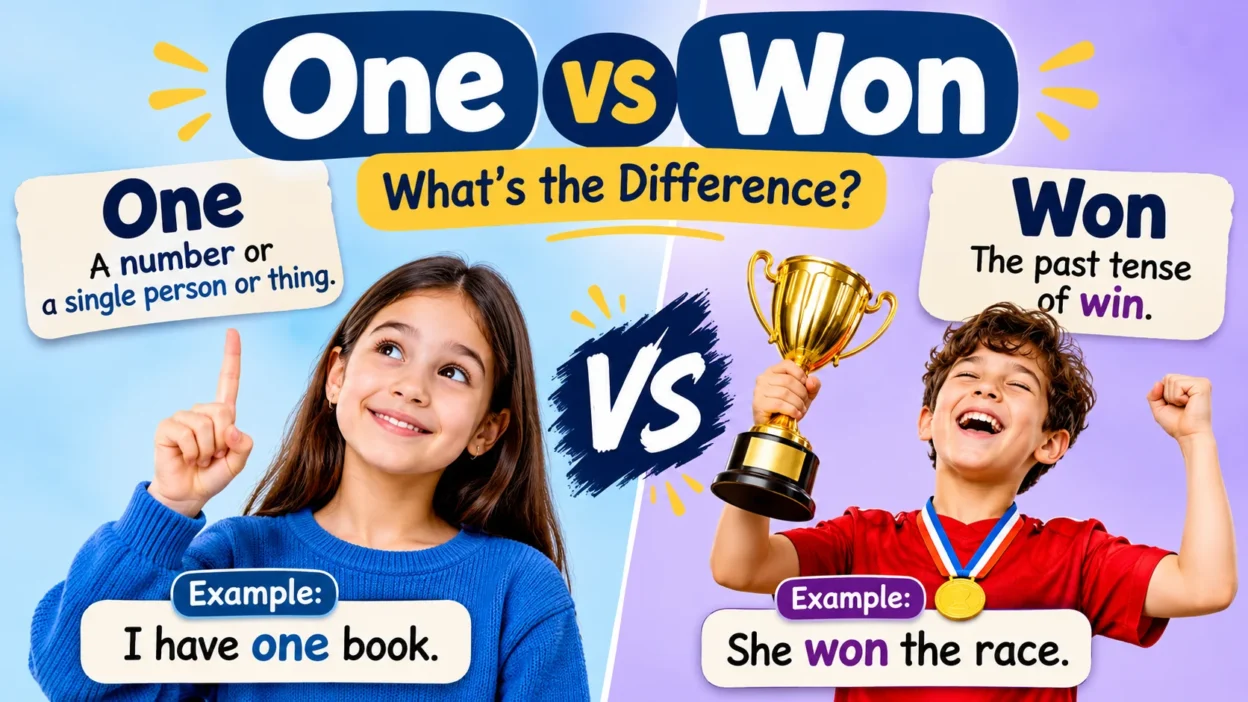
The English words one and won sound exactly the same, but they have different meanings, spellings, and grammatical uses. Understanding the difference between one vs won can help you avoid common spelling mistakes and make your writing clearer. Although these words are pronounced alike, you cannot use them interchangeably.
One is a number that represents 1. It can also function as a pronoun or determiner when referring to a single person or thing. Won, on the other hand, is the past tense and past participle of the verb win. It describes succeeding in a competition, contest, game, or difficult situation.
For example, you might say, “I have one brother” or “She won the competition.” Both sentences are correct, but changing these words would change the meaning completely. This guide explains their definitions, grammatical roles, differences, and practical examples so you can use them confidently.
Quick Answer: One vs Won
One means the number 1 or a single person or thing. Won is the past tense of the verb win, meaning to achieve victory or succeed. Both words sound identical, but their meanings and grammatical functions are different. Use one for quantity and won for victory.
Why Do People Confuse One and Won?
People often confuse one and won because they are homophones. Homophones are words that have the same pronunciation but different meanings and spellings.
Both words are pronounced /wʌn/, which sounds like “wun.”
Here is why the confusion happens:
- Identical pronunciation: Both words sound exactly alike in standard English.
- Different spellings: One begins with the letter O, while won begins with W.
- Different meanings: One refers to a number, while won describes achieving victory.
- Similar sentence positions: Both can appear in different parts of a sentence, depending on their grammatical roles.
The easiest way to avoid confusion is to consider what you want to express: a quantity or an achievement.
1. One: Meaning, Definition, and Usage
One is a number that represents a single unit, person, or thing. It is commonly used as a cardinal number, determiner, pronoun, and in certain expressions.
Different Uses of One
1. One as a Number
One represents the numerical value 1.
Examples:
- I have one sister.
- She bought one notebook.
- Only one student answered correctly.
2. One as a Determiner
One can identify a particular single person or thing.
Examples:
- One person is waiting outside.
- I need one more opportunity.
- He has one important question.
3. One as a Pronoun
One can replace a noun when referring to a person or thing.
Examples:
- This pen is broken; give me another one.
- I like the blue shirt, but the red one is cheaper.
- One should always respect others.
4. One in Expressions
One appears in common English expressions.
Examples:
- One day, I will travel around the world.
- She is one of my best friends.
- We arrived one after another.
2. Won: Meaning, Definition, and Usage
Won is the simple past tense and past participle of the verb win. It means to achieve victory, succeed in a competition, or receive something as a prize.
It is commonly used when discussing games, sports, awards, competitions, and achievements.
Different Uses of Won
1. Won as the Past Tense of Win
Use won when describing something that happened in the past.
Examples:
- Our team won the football match.
- She won the competition last year.
- I won the game yesterday.
2. Won as a Past Participle
Won is also used with helping verbs such as has, have, and had.
Examples:
- She has won several awards.
- They have won the championship.
- He had won the race before the rain started.
3. Won in Everyday Expressions
Won can describe success in different situations.
Examples:
- He won everyone’s respect.
- She won the scholarship.
- Our school won first place in the competition.
One vs Won: Comparison Table
| Feature | One | Won |
|---|---|---|
| Meaning | Number 1 | Achieved victory |
| Pronunciation | /wʌn/ | /wʌn/ |
| Word type | Number, determiner, pronoun | Verb form |
| Origin | Old English ān | Old English winnan |
| Verb form | Not a verb form | Past tense of win |
| Usage | Quantity or singular reference | Victory or success |
| Example | I have one book. | I won the prize. |
When to Use One vs Won
Choosing between these words becomes easy when you understand the context.
When Should You Use One?
Use one when:
- You are counting something.
- You want to describe a single person or object.
- You are replacing a previously mentioned noun.
- You are talking about a particular individual or item.
Examples:
- I ordered one pizza.
- She is one of my classmates.
- This is the one I wanted.
- One student received the award.
When Should You Use Won?
Use won when:
- Someone achieves victory in a game.
- A person succeeds in a competition.
- Someone receives an award or prize through winning.
- You are describing a past achievement.
Examples:
- He won the tennis match.
- Our team won the tournament.
- She won a gold medal.
- They won the first prize.
10+ Examples of One and Won in Sentences
The following examples show how these words work in everyday English.
Examples of One
- I have one brother and two sisters.
- She bought one dress from the store.
- Only one person knew the correct answer.
- I need one more chance to prove myself.
- This is one of my favorite books.
- He gave me one beautiful flower.
- One of my friends lives in London.
- I would like one cup of coffee.
- There is only one solution to this problem.
- She chose the blue one instead of the red one.
Examples of Won
- Our school won the basketball championship.
- She won a scholarship to study abroad.
- He won the race yesterday.
- My favorite team won the final match.
- They won first place in the competition.
- She has won several international awards.
- I won a prize at the school festival.
- The player won the game with his final shot.
- Their hard work won everyone’s respect.
- He had won three matches before the tournament ended.
Common Mistakes When Using One and Won
Even experienced English learners sometimes confuse these homophones. Here are common mistakes and their corrections.
| Incorrect Sentence | Correct Sentence |
|---|---|
| I won brother. | I have one brother. |
| She one the race. | She won the race. |
| I need won more chance. | I need one more chance. |
| They one the match. | They won the match. |
| He has won sister. | He has one sister. |
| We one the competition. | We won the competition. |
Remember: If you are talking about the number 1, write one. If you are talking about winning something, write won.
Memory Trick: How to Remember One vs Won
Here is a simple trick to remember the difference:
- ONE = ONE item: Think of one apple, one book, or one person.
- WON = WIN: Remember that won is the past form of win.
You can also remember these sentences:
- I have ONE goal.
- I WON the game.
The first sentence describes a quantity, while the second describes an achievement.
American vs British English: One and Won
There is no meaningful difference between American and British English when it comes to using one and won.
Both varieties follow the same spelling, meaning, and grammatical rules.
| Word | American English | British English |
|---|---|---|
| One | One | One |
| Won | Won | Won |
Both American and British speakers pronounce these words alike in standard pronunciation.
Examples:
- American English: She won the competition.
- British English: She won the competition.
- American English: I have one brother.
- British English: I have one brother.
The spelling and usage remain the same in both varieties.
Similar Words: Other Common English Homophones
Understanding other homophones can help you improve your spelling and vocabulary.
| Word Pair | Meaning |
|---|---|
| Won / One | Victory / Number 1 |
| Two / Too | Number 2 / Also or excessively |
| Their / There | Belonging to them / A place |
| Right / Write | Correct / To form words |
| Hear / Here | Perceive sound / This place |
| Buy / By | Purchase / Near or through |
| See / Sea | Observe / Large body of water |
| New / Knew | Recently made / Past tense of know |
| Son / Sun | Male child / The star in our solar system |
| Whole / Hole | Complete / An opening |
Learning these word pairs helps prevent spelling errors and improves everyday communication.
Final Verdict: One vs Won
The difference between one and won is their meaning and grammatical function.
- One refers to the number 1 or a single person or thing.
- Won is the past tense and past participle of win, referring to victory or success.
Although both words sound the same, they cannot replace each other.
For example:
- Correct: I have one opportunity.
- Correct: I won the competition.
Choose one when discussing quantity and won when discussing victory.
Frequently Asked Questions (FAQs)
1. What is the main difference between one and won?
One refers to the number 1 or a single person or thing. Won is the past tense of the verb win and describes achieving victory or success. Both words sound alike but have different meanings and spellings.
2. Are one and won homophones?
Yes, one and won are homophones. They have the same pronunciation but different spellings and meanings. One refers to a single unit, while won describes winning something.
3. Is won the past tense of win?
Yes, won is the simple past tense and past participle of win.
Examples:
- I win every game.
- I won yesterday’s game.
- I have won several games.
4. How do you use one in a sentence?
Use one when referring to a single person, object, or unit.
Examples:
- I have one question.
- She bought one book.
- He is one of my friends.
5. Why do one and won sound the same?
One and won sound the same because they are homophones. In standard English pronunciation, both are pronounced /wʌn/, even though their spellings and meanings differ.
6. Is it one a prize or won a prize?
The correct expression is won a prize when describing someone receiving a prize through winning.
Example: She won a prize in the competition.
One a prize is incorrect in this context.
7. What is the difference between one, win, and won?
These words have related but different grammatical functions:
- One: A number representing 1.
- Win: The present-tense form of a verb meaning to achieve victory.
- Won: The past tense and past participle of win.
Examples:
- I have one goal.
- I want to win.
- I won yesterday.
Remember This
- ONE = A single person, object, or unit.
- WON = Achieved victory or success.
- Both words are pronounced the same.
- One is a number, while won is a form of the verb win.
- Never use them interchangeably.
Conclusion
Understanding the difference between one and won is simple once you remember their meanings. One refers to a single person, object, or numerical value, whereas won describes an achievement or victory. Although these words share the same pronunciation, their spellings and grammatical functions are different.
To use them correctly, focus on the meaning of your sentence. Choose one when counting or referring to a single item, and choose won when describing something someone has successfully achieved. With regular practice and attention to context, you can avoid this common English mistake and communicate more confidently.

David Henry is a language enthusiast and content writer specializing in synonyms, vocabulary, and word meanings. He creates clear, engaging resources that help readers improve their writing, communication, and English skills.