
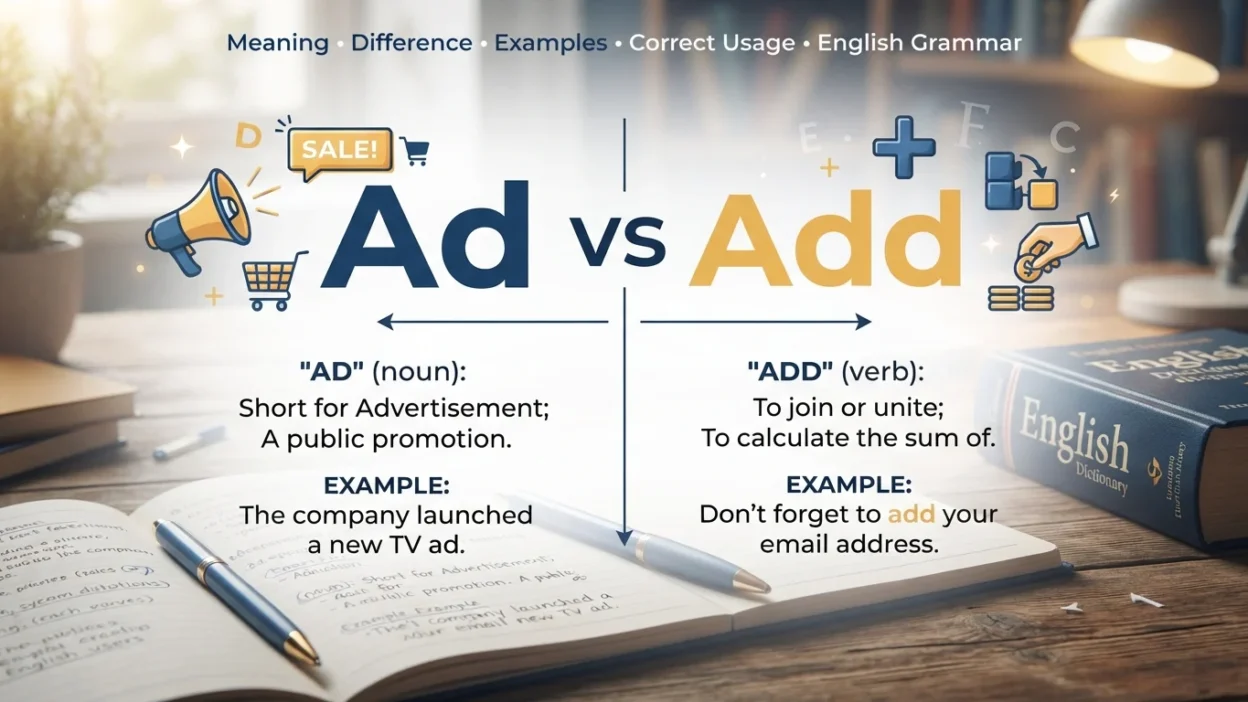
If you are confused by ad vs add, you are not alone. These two words sound exactly the same in most varieties of English, but they have completely different meanings and uses. Ad is usually a shortened form of advertisement, while add is a verb meaning to put something together with something else or increase a quantity. For example, “I saw an ad online” and “Please add some sugar to the tea.”
Understanding the difference is important because ad and add are homophones: they have the same pronunciation but different spellings and meanings. This guide explains both words in simple English, with clear examples, a comparison table, common mistakes, and an easy memory trick. if you are a student, ESL learner, beginner, or general reader, you will learn exactly when to use ad and when to use add.
Quick Answer
Ad is a shortened form of advertisement, a message designed to promote or sell something. Add is a verb meaning to put something together with something else, increase an amount, or include additional information. They sound alike but have different meanings and spellings.
Why Do People Confuse “Ad” and “Add”?
People often confuse ad and add because they are pronounced the same.
They are homophones, which are words that sound alike but have different meanings and spellings.
Compare:
- Ad → advertisement
- Add → put something with something else
The extra d in add is important. Changing the spelling can completely change the meaning of a sentence.
What Does “Ad” Mean?
Ad is an informal, shortened form of advertisement.
An advertisement is something used to promote a product, service, event, company, job, or idea.
Examples of “Ad”
- I saw an ad for a new phone.
- There was an ad on television.
- This website has too many ads.
- She clicked on an ad for a clothing store.
- The company posted an ad for a new employee.
Ad is common in everyday English, especially in casual conversation and digital contexts.
“Ad” as a Noun
Ad is normally used as a noun.
I watched an ad before the video started.
Here, ad means advertisement.
What Does “Add” Mean?
Add is a verb with several closely related meanings.
It can mean:
- To put one thing together with another.
- To increase an amount.
- To include something extra.
- To calculate a total.
- To say something more.
Examples of “Add”
- Please add some salt to the soup.
- Add five and three to get eight.
- She added another paragraph to the report.
- You can add your name to the list.
- His comment added value to the discussion.
Unlike ad, add is an action word.
Ad vs Add: Comparison Table
| Feature | Ad | Add |
|---|---|---|
| Meaning | Short form of advertisement | Put together, include, or increase |
| Part of speech | Usually a noun | Verb |
| Pronunciation | /æd/ | /æd/ |
| Spelling | One “d” | Two “d”s |
| Example | I saw an ad online. | Add some water. |
| Related word | Advertisement | Addition |
| Main idea | Promotion | Combining or increasing |
When Should You Use “Ad”?
Use ad when you are talking about an advertisement.
Common situations include:
- Online advertising
- Television commercials
- Newspaper advertisements
- Social media promotions
- Product promotions
- Job advertisements
- Website advertisements
Examples
I saw an ad for a new restaurant.
The company created an ad for its latest product.
Did you see that ad on Instagram?
A useful test is to replace ad with advertisement. If the sentence still makes sense, ad is probably correct.
When Should You Use “Add”?
Use add when you mean put something with something else, increase something, or include something.
Examples
Add two more chairs to the room.
Please add your email address to the form.
The teacher added an important point.
Add milk to your coffee if you like.
You can often connect add with the word addition.
If the sentence describes an action involving something being included or increased, add is likely the correct word.
10+ Examples of Ad vs Add
Here are examples that show the difference clearly.
- I saw an ad for a new laptop.
Here, ad means advertisement. - Please add your phone number to the form.
Here, add means include. - That ad was very funny.
The word refers to an advertisement. - Add some sugar to the coffee.
The word describes putting something into something else. - The website displays several ads.
Ads means advertisements. - Can you add these numbers?
Add means calculate their total. - I clicked on an ad by mistake.
Ad refers to promotional content. - She added another example to her essay.
Added means included. - The company published an ad in the newspaper.
Ad means advertisement. - Add two tablespoons of oil.
Add means put something into something else. - We need to add more information.
Add means include additional information. - I don’t like this ad.
Ad means advertisement. - The new feature adds useful functionality.
Adds means increases or provides something extra. - He found an ad for an apartment.
Ad means advertisement.
Common Mistakes With “Ad” and “Add”
Mistake 1: Using “add” for an advertisement
I saw an add for a new car.
I saw an ad for a new car.
Because the word means advertisement, use ad.
Mistake 2: Using “ad” for the verb
Please ad some sugar.
Please add some sugar.
Because the sentence describes an action of putting something in, use add.
Mistake 3: Confusing “add” with “addition”
The spelling connection can help:
- add
- addition
- additional
All relate to the idea of putting something extra or increasing something.
Meanwhile:
- ad
- advertisement
are connected to promotion.
Easy Memory Trick for Ad vs Add
Remember:
AD = ADVERTISEMENT
Both begin with the same letters:
AD → Advertisement
For ADD, think:
ADD = put something extra in
The second D can remind you that something extra is being included.
Simple Rule
Ad = advertisement
Add = include or increase
If you can replace the word with advertisement, choose ad.
If you can replace it with include, combine, or increase, choose add.
American vs British English
The meanings and spellings of ad and add are essentially the same in American and British English.
Both varieties use:
- ad as a common shortened form of advertisement
- add as the verb meaning to include, combine, or increase
The main difference is that British English also commonly uses advert as a shortened form of advertisement, especially in informal contexts.
For example:
- American English: I saw an ad for the job.
- British English: I saw an advert for the job.
- Both: Please add your name to the list.
Similar Words
Advertisement
A message designed to promote or sell something.
The company released a new advertisement.
Advert
A shortened form of advertisement, particularly common in British English.
I saw an advert for a holiday package.
Commercial
An advertisement, especially one shown on television, radio, or another broadcast medium.
That television commercial was memorable.
Addition
The act or result of adding something.
The addition of new members strengthened the team.
Additional
Extra or more.
Please provide additional information.
Final Verdict
Ad and add sound alike, but they are not interchangeable.
Use ad when you mean advertisement:
I saw an ad online.
Use add when you mean include, combine, increase, or calculate:
Please add your name to the list.
The easiest way to remember the difference is AD = ADVERTISEMENT and ADD = include something extra.
Frequently Asked Questions
Is “ad” short for advertisement?
Yes. Ad is a common informal abbreviation of advertisement.
Is “add” a verb?
Yes. Add is primarily a verb. It can mean to combine quantities, include something, or increase an amount.
Are “ad” and “add” pronounced the same?
Yes. In standard English pronunciation, ad and add are homophones and are pronounced the same.
What is the plural of “ad”?
The plural of ad is ads.
I saw several ads on the website.
What is the past tense of “add”?
The past tense is added.
She added more information to the report.
Is “advert” the same as “ad”?
Yes. Both can mean advertisement. Advert is especially common in British English, while ad is widely used in both American and British English.
Should I write “add” or “ad” for an advertisement?
Write ad.
I saw an ad for a new phone.
Do not write add when you mean advertisement.
Remember This
Ad = advertisement
Add = include, combine, or increase
Think:
I saw an AD. → advertisement
I ADD something. → include something
One extra d makes the spelling different and signals a completely different word.
Conclusion
The difference between ad vs add is simple once you connect each word with its meaning. Ad is a shortened form of advertisement, while add is a verb used when something is included, combined, increased, or calculated. Although both words sound the same, their spelling and grammatical roles are different.
When writing, check what you mean before choosing the spelling. If you are talking about a promotion, advertisement, or commercial message, use ad. If you are talking about putting something together, including information, or increasing a quantity, use add. Remembering AD = advertisement makes this common spelling confusion much easier to avoid.

David Henry is a language enthusiast and content writer specializing in synonyms, vocabulary, and word meanings. He creates clear, engaging resources that help readers improve their writing, communication, and English skills.