
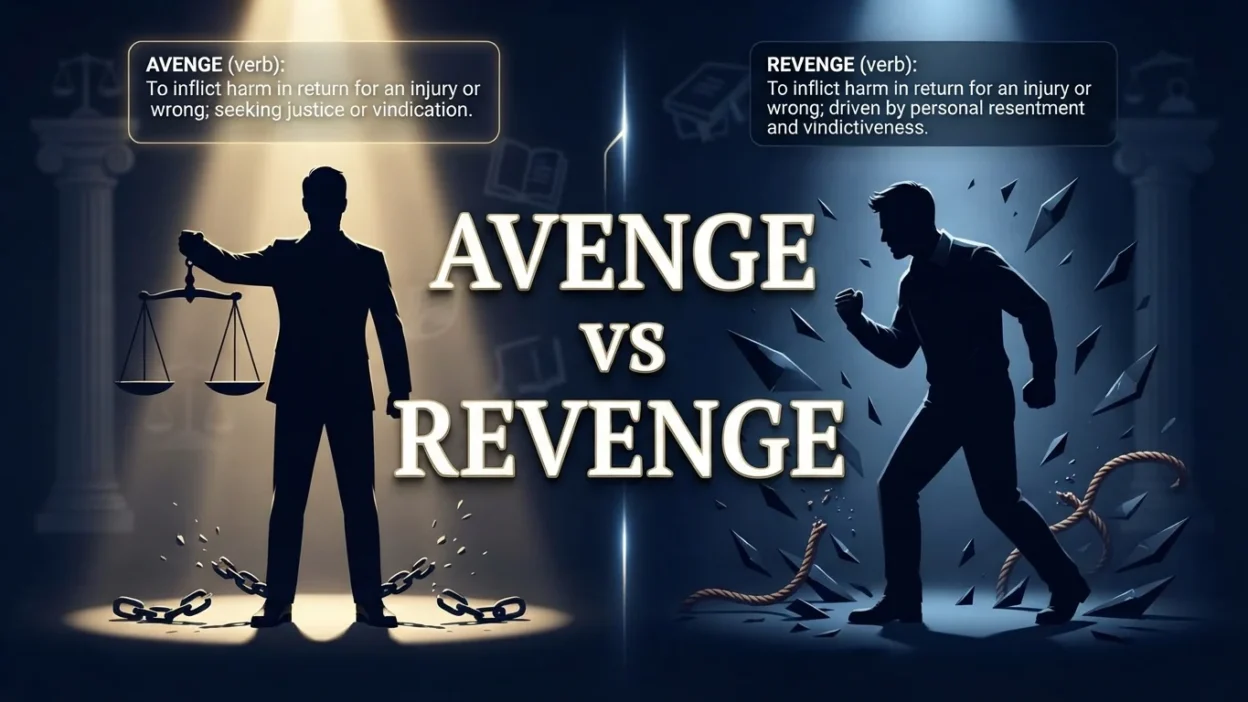
English has many words that seem to mean the same thing but are used differently. Avenge and revenge are two such words. Both are connected with responding to harm or wrongdoing, but their grammar, tone, and typical usage are different.
The key difference is that avenge is usually a verb, while revenge is most commonly a noun. We say “She wants to avenge her brother,” but “She wants revenge for her brother.” The words can also differ in meaning: avenge often suggests taking action on behalf of someone who was wronged, while revenge commonly focuses on punishing someone for a wrong done to you or someone else.
Quick Answer
Avenge is mainly a verb meaning to punish or take action against someone for a wrong, often on behalf of another person. Revenge is mainly a noun meaning punishment or retaliation for a wrong. For example: “He vowed to avenge his friend” and “He wanted revenge.”
Why Do People Confuse Avenge and Revenge?
People confuse these words because both involve responding to wrongdoing, injury, or unfair treatment. Their meanings overlap, especially when talking about stories, conflicts, crimes, or personal disputes.
The biggest difference is grammatical:
- Avenge → usually a verb
- Revenge → usually a noun
- Avenge someone → take action because someone was wronged
- Take revenge → retaliate or punish someone for a wrong
Compare:
She wanted to avenge her brother.
She wanted revenge for her brother.
Both sentences describe a response to wrongdoing, but their structures are different.
What Does “Avenge” Mean?
Avenge is a verb meaning to take action to punish or respond to someone who has caused harm or committed a wrong.
It often means seeking justice or retaliation for another person.
Examples of “Avenge”
- He vowed to avenge his father’s death.
- She returned to avenge her sister.
- The hero fought to avenge his fallen comrades.
- They wanted to avenge the injustice.
A useful pattern is:
avenge + person/thing
For example:
He wanted to avenge his friend.
You can also say:
She wanted to avenge her brother’s death.
Here, avenge describes the action of responding to a wrong.
What Does “Revenge” Mean?
Revenge is most commonly a noun meaning an act of retaliation or punishment carried out because someone has been harmed or treated unfairly.
It often refers to the desire or action of getting back at someone.
Examples of “Revenge”
- He wanted revenge.
- She took revenge on her rival.
- They planned their revenge carefully.
- He was motivated by revenge.
Common expressions include:
- take revenge
- seek revenge
- get revenge
- want revenge
- revenge on someone
- revenge for something
For example:
She took revenge on the person who betrayed her.
Avenge vs Revenge: Comparison Table
| Feature | Avenge | Revenge |
|---|---|---|
| Main grammatical role | Verb | Noun |
| Basic meaning | Take action against a wrong | Retaliation or punishment for a wrong |
| Common structure | Avenge someone/something | Take/seek/get revenge |
| Example | He avenged his brother. | He took revenge for his brother. |
| Focus | The act of responding to a wrong | The retaliation or desire for retaliation |
| Typical tone | Often formal or dramatic | Common in everyday and dramatic contexts |
| Related adjective | — | Revengeful / vengeful |
When Should You Use “Avenge”?
Use avenge when you need a verb describing the action of responding to a wrong.
Use “avenge” when:
- Someone is taking action after another person has been wronged.
- You are describing an act of retaliation.
- You want a more formal or dramatic expression.
- The sentence needs a verb.
Example:
The warrior returned to avenge his fallen brother.
Another common structure is:
avenge + someone’s death
Example:
She swore to avenge her mother’s death.
When Should You Use “Revenge”?
Use revenge when you are talking about retaliation as a thing, goal, feeling, or action.
Use “revenge” when:
- Someone wants retaliation.
- Someone takes retaliation against another person.
- You are using expressions such as “take revenge” or “seek revenge.”
- The sentence needs a noun.
Example:
He was looking for revenge after being betrayed.
You can also use revenge in the expression:
They took revenge on their enemy.
Avenge vs Revenge: 12 Examples
1. Avenge
The hero returned to avenge his brother.
2. Revenge
The hero returned because he wanted revenge for his brother.
3. Avenge
She vowed to avenge her father’s death.
4. Revenge
She vowed to take revenge for her father’s death.
5. Avenge
The team hoped to avenge their earlier defeat.
Here, avenge means to make up for or respond to a previous defeat.
6. Revenge
He wanted revenge after losing the match.
7. Avenge
The character fights to avenge his fallen comrades.
8. Revenge
The character is driven by a desire for revenge.
9. Avenge
They returned to avenge the injustice.
10. Revenge
They planned to take revenge on their enemies.
11. Avenge
The detective tried to avenge the victim.
12. Revenge
The detective was not interested in revenge.
These examples show why you cannot always replace one word with the other without changing the sentence structure.
Common Mistakes With Avenge and Revenge
Mistake 1: Treating “revenge” like “avenge”
Incorrect:
He decided to revenge his brother.
A more natural standard construction is:
He decided to avenge his brother.
Or:
He decided to take revenge for his brother.
Mistake 2: Forgetting “take” with revenge
Incorrect:
She revenge on her enemy.
Correct:
She took revenge on her enemy.
Mistake 3: Using the wrong preposition
A common pattern is:
take revenge on someone
And:
take revenge for something
For example:
He took revenge on his rival for the betrayal.
Mistake 4: Thinking the words are completely interchangeable
They are closely related, but their grammatical roles and common sentence patterns differ.
Memory Trick: Avenge vs Revenge
Try this simple trick:
Avenge = Action
Both start with A, so think of A = Action.
Avenge = to take action against a wrong.
Revenge = Retaliation
Think of revenge as the retaliation itself.
Revenge = the act or desire to get back at someone.
Remember:
Avenge someone. Take revenge on someone.
American vs British English
The basic distinction between avenge and revenge is generally the same in American and British English.
In both varieties:
- avenge is primarily a verb.
- revenge is primarily a noun.
- take revenge is a common expression.
- avenge someone’s death is a standard phrase.
There can be differences in vocabulary preferences between American and British English generally, but this particular distinction does not normally change based on the variety of English.
Similar Words to Avenge and Revenge
Several related words can appear in similar contexts, but they are not exact replacements.
Retaliate
Retaliate means to respond to an attack, injury, or harmful action.
The army threatened to retaliate.
Punish
Punish means to impose a penalty because someone has done something wrong.
The court may punish the offender.
Repay
Repay can mean to return something, but it can also mean responding to an action, either positively or negatively.
He wanted to repay the insult.
Get even
Get even is an informal expression meaning to retaliate.
She wanted to get even with him.
Retaliation
Retaliation is a noun meaning an action taken in response to harm or an attack.
The attack was described as retaliation.
Vengeance
Vengeance is a strong or formal word for punishment or revenge.
He was seeking vengeance.
Final Verdict
Avenge and revenge are closely related, but they are not normally used in exactly the same way.
Use avenge when you need a verb:
She avenged her brother.
Use revenge when you need a noun:
She wanted revenge for her brother.
The easiest structures to remember are:
avenge + someone/something
take revenge on + someone
take revenge for + something
Learning these patterns will help you use both words naturally.
FAQs About Avenge vs Revenge
Is “avenge” a verb or a noun?
Avenge is a verb. It means to take action in response to a wrong or to punish someone for wrongdoing, often on behalf of another person.
Is “revenge” a verb or a noun?
Revenge is primarily a noun. It refers to retaliation or punishment in response to a wrong. Common expressions include “take revenge” and “seek revenge.”
What is the difference between “avenge” and “revenge”?
Avenge describes the action of responding to a wrong, while revenge usually describes the retaliation itself or the desire for it.
Can I say “revenge someone”?
In standard modern English, “revenge someone” is not the usual construction. Say “avenge someone” or “take revenge on someone.”
Do you avenge someone or take revenge on someone?
Both are possible, but they use different structures:
Avenge someone
Take revenge on someone
For example: “He avenged his friend” and “He took revenge on his enemy.”
Is “avenge” always about another person?
Not always. Avenge can also be used with a wrong, defeat, injury, or similar event. For example, “The team avenged its earlier defeat.”
Is revenge always negative?
The word revenge usually refers to retaliation or punishment rather than reconciliation. Whether a particular act of revenge is justified is a matter of context and judgment, not part of the word’s basic definition.
Remember This
- Avenge = verb
- Revenge = noun
- Avenge someone
- Avenge a wrong
- Take revenge on someone
- Take revenge for something
- Seek revenge
- Get revenge
Quick memory sentence:
Avenge is the action; revenge is the retaliation.
Conclusion
Although avenge and revenge are closely connected, understanding their grammar makes the difference much easier. Avenge is mainly a verb used for taking action against a wrong, while revenge is mainly a noun referring to retaliation or the desire for retaliation.
When you’re unsure, look at the sentence structure. If you need a verb, avenge may be the right choice. If you are talking about retaliation as a thing or goal, revenge is usually appropriate. Remember the simple patterns—avenge someone and take revenge on someone—and you will avoid most common mistakes.

David Henry is a language enthusiast and content writer specializing in synonyms, vocabulary, and word meanings. He creates clear, engaging resources that help readers improve their writing, communication, and English skills.