
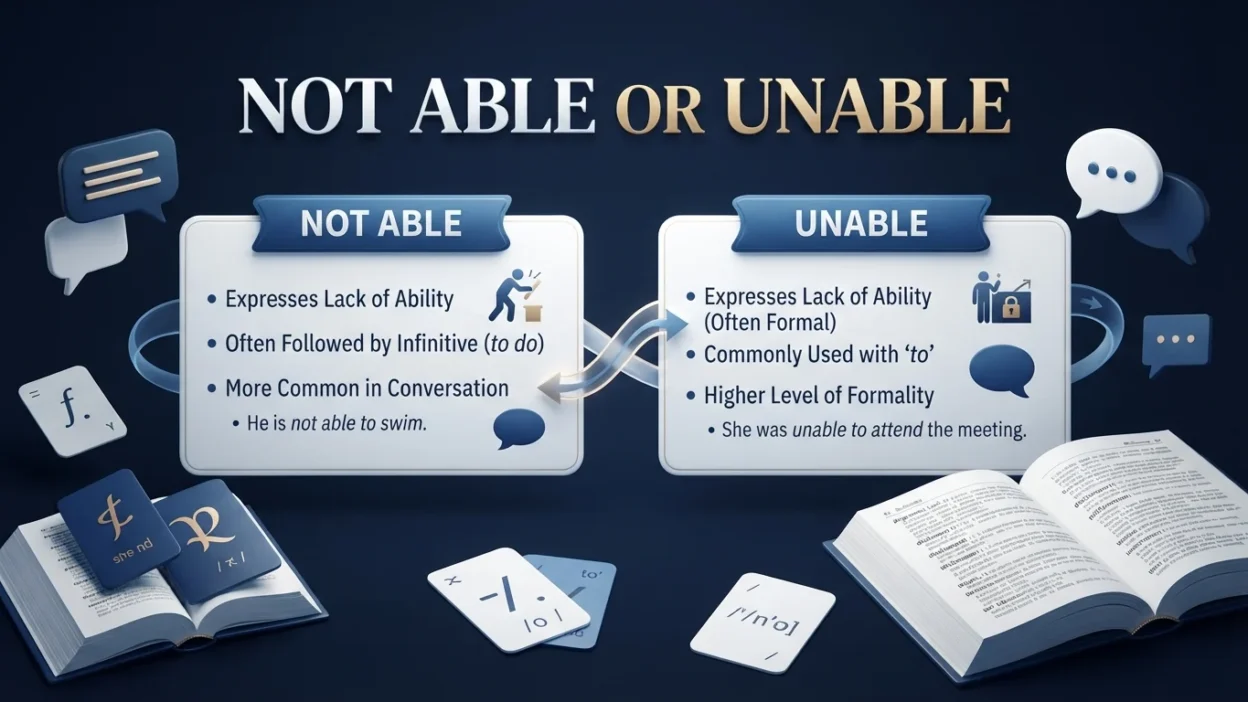
If you are unsure if to say “not able” or “unable,” you are not alone. Both expressions describe a lack of ability or the inability to do something, and in many sentences they can mean almost the same thing. However, they differ slightly in tone, structure, and emphasis.
“Unable” is a single adjective and is often more concise and formal, while “not able” uses the adjective “able” with the negative word “not.” In everyday English, both can be correct, but the best choice depends on the sentence and the meaning you want to express. Understanding this small difference can help you write more naturally and choose the right expression in formal and informal situations.
Quick Answer
“Not able” and “unable” both mean that someone cannot do something. “Unable” is generally shorter and somewhat more formal, while “not able” can sound more conversational and may emphasize the situation or contrast. For example, “I was unable to attend” and “I was not able to attend” are both grammatically correct.
Why Do People Confuse “Not Able” and “Unable”?
The confusion comes from their very similar meanings.
- Not able = not capable of doing something
- Unable = not capable of doing something
Both are commonly followed by to + verb:
- I am not able to help.
- I am unable to help.
The main difference is usually style and emphasis, rather than basic meaning.
What Does “Not Able” Mean?
Not able means that someone does not have the ability, opportunity, or possibility to do something.
It follows this common pattern:
subject + be + not able + to + verb
Examples:
- I am not able to come today.
- She was not able to finish the project.
- We are not able to accept your request.
“Not able” can be useful when you want to sound natural and conversational or when you want to emphasize the negative form.
What Does “Unable” Mean?
Unable is an adjective meaning not able to do something.
It normally follows a form of be and is followed by to + verb:
subject + be + unable + to + verb
Examples:
- I am unable to attend the meeting.
- He was unable to answer the question.
- They were unable to complete the task.
“Unable” is concise and is especially common in formal writing, official notices, business communication, and professional contexts.
Not Able vs Unable: Comparison Table
| Feature | Not Able | Unable |
|---|---|---|
| Meaning | Cannot do something | Cannot do something |
| Grammar | Not + adjective | Adjective |
| Common structure | be not able to + verb | be unable to + verb |
| Tone | Natural, conversational | More concise and formal |
| Example | I am not able to attend. | I am unable to attend. |
| Common use | Everyday speech and writing | Formal and professional contexts |
| Emphasis | Can emphasize the negative | States inability directly |
When Should You Use “Not Able”?
Use not able when you want a natural expression of inability, especially in ordinary conversation.
Examples
- I’m not able to come tonight.
- She is not able to drive yet.
- We were not able to find the address.
- He is not able to work today.
It can also be useful when not is part of a larger contrast:
I’m not able to join the meeting today, but I may be able to join tomorrow.
Here, the contrast between not able and able is particularly clear.
When Should You Use “Unable”?
Use unable when you want a shorter, more formal, or professional expression.
Examples
- I was unable to attend the meeting.
- The team was unable to complete the task.
- She was unable to provide the required documents.
- We are unable to process your request.
For example, in a formal email, this often sounds polished:
Unfortunately, I was unable to attend the meeting.
In casual conversation, however, you might naturally say:
Sorry, I wasn’t able to come.
12 Examples of “Not Able” and “Unable”
- I am not able to help you right now.
This is a natural way to explain that you cannot help at the moment. - I am unable to help you right now.
This has the same basic meaning but sounds more formal. - She was not able to finish her homework.
She could not complete it. - She was unable to finish her homework.
This gives the same information in a more concise way. - We are not able to attend the event.
This is natural in everyday communication. - We are unable to attend the event.
This is suitable for a more formal message. - He was not able to open the door.
Something prevented him from opening it. - He was unable to open the door.
This expresses his inability directly. - The company is not able to offer refunds.
A straightforward explanation of a company policy. - The company is unable to offer refunds.
A concise and formal version. - They were not able to reach an agreement.
They could not agree. - They were unable to reach an agreement.
The meaning is essentially the same, with a slightly more formal tone.
Common Mistakes With “Not Able” and “Unable”
1. Using “unable” without the verb “be”
Incorrect:
I unable to attend.
Correct:
I am unable to attend.
“Unable” is an adjective, so it normally needs a suitable form of be.
2. Forgetting “to” after “able”
Incorrect:
I am able finish it.
Correct:
I am able to finish it.
The same applies to “unable”:
She is unable to attend.
3. Using “not unable” when you mean “unable”
Not unable technically means “not incapable,” which can create a different meaning.
Compare:
- I am unable to attend. = I cannot attend.
- I am not unable to attend. = I am not incapable of attending.
The second sentence is unusual and may not communicate what you intend.
4. Thinking “unable” is always better
“Unable” is not automatically more correct.
Both are grammatical:
I was not able to attend.
I was unable to attend.
Choose according to context and style.
Memory Trick
Think of it this way:
Not able = not + able
Unable = un + able
Both point to the same basic idea: cannot do something.
A simple memory rule is:
Everyday or conversational → “not able”
Concise or formal → “unable”
This is a guideline, not a strict grammar rule.
American vs British English
Both “not able” and “unable” are standard in both American and British English.
There is no major difference in meaning between the two varieties of English.
For example, both American and British speakers can say:
I wasn’t able to attend.
or:
I was unable to attend.
The choice is more closely related to context, tone, and personal style than to American versus British English.
Similar Words
Several expressions are related to not able and unable:
- Cannot / can’t — means that something is not possible or someone lacks the ability to do it.
- Incapable — means lacking the ability or capacity to do something; it can sound stronger.
- Unskilled — means lacking a particular skill.
- Powerless — means lacking the power or control needed to act.
- Unavailable — means not available, which is different from being unable.
- Impossible — describes something that cannot be done or cannot happen.
For example:
I am unable to attend.
does not necessarily mean:
I am incapable of attending.
The first describes a particular inability in a situation, while the second can suggest a more general lack of capacity.
Final Verdict
“Not able” and “unable” are both correct expressions of inability. The difference is mainly one of style and emphasis.
Use “not able to” for a natural, conversational expression, especially when you want to emphasize the negative or create a contrast.
Use “unable to” when you want a concise expression that often fits formal, professional, or official writing.
FAQs
Is “not able” grammatically correct?
Yes. “Not able” is grammatically correct when used appropriately, such as in “I am not able to attend.”
Is “unable” more formal than “not able”?
Generally, “unable” can sound more formal or concise, while “not able” is very natural in everyday English. The difference is one of style rather than correctness.
Can I use “not able to” instead of “unable to”?
Yes. In many contexts, the two expressions are interchangeable.
I was not able to attend.
I was unable to attend.
Both are correct.
Is “unable” the same as “cannot”?
They are closely related, but their grammar differs. “Cannot” is a modal verb, while “unable” is an adjective.
I cannot attend.
I am unable to attend.
Which is better in formal writing: “unable” or “not able”?
“Unable” often provides a more concise formal style, but “not able” is also grammatically correct and can be appropriate depending on the sentence.
Can “unable” be followed directly by a verb?
Usually, no. Use unable to + base verb:
She was unable to attend.
Not:
She was unable attend.
Does “not able” always mean “unable”?
Usually, they communicate the same basic idea, but context can affect emphasis. “Not able” can also be useful when contrasting someone’s current inability with a future or different ability.
Remember This
Not able and unable both mean that someone cannot do something.
- Not able to + verb → natural and conversational
- Unable to + verb → concise and often more formal
- Both are grammatically correct.
- Both work in American and British English.
- Do not forget to before the main verb.
Conclusion
The expressions “not able” and “unable” are very similar because both describe an inability to do something. In most situations, you can use either one without changing the basic meaning. The main difference is the way the sentence sounds: “not able” can feel more conversational, while “unable” is often more concise and formal.
When choosing between them, consider your audience and the situation. For everyday conversation, “not able to” is perfectly natural. For formal emails, reports, notices, and professional communication, “unable to” is often a convenient choice. Most importantly, remember the correct structure: be + not able to + verb or be + unable to + verb.

Daniel Jack is a language enthusiast and content writer who specializes in synonyms, vocabulary, and word meanings. He creates clear, engaging resources that help readers improve communication and expand their English skills.