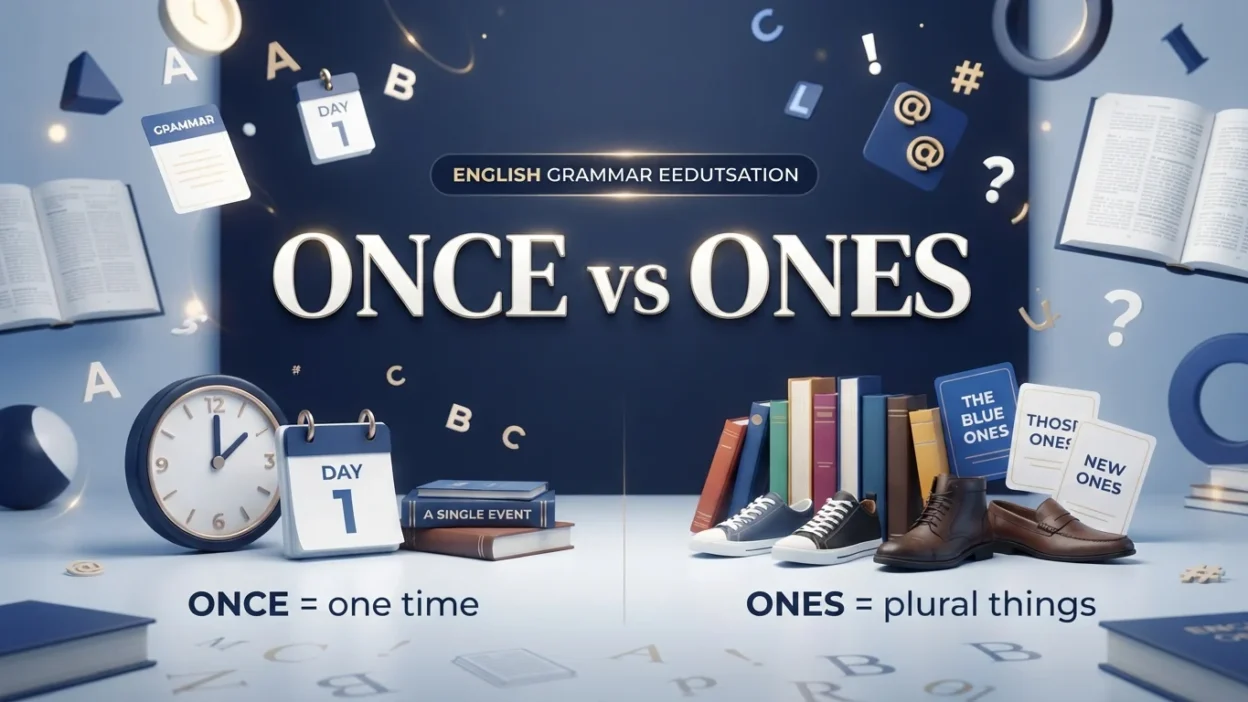
“Once” and “ones” look and sound somewhat similar, but they have completely different meanings and grammatical uses. Once can refer to a single occasion, a time in the past, or something that happens after another event. Ones is the plural form of one and is used to refer to people or things already mentioned.
For example, you might say, “I visited London once,” meaning one time. But in “I prefer the blue shoes to the black ones,” ones replaces the repeated noun “shoes.” Understanding this small difference can make your English clearer and help you avoid a common spelling and grammar mistake.
Quick Answer
Once means one time, formerly, or after something happens. Ones is the plural form of one and replaces a plural noun that has already been mentioned. For example, “I called her once” means one time, while “I like the red ones” means the red items.
Why Do People Confuse “Once” and “Ones”?
The confusion usually comes from their similar spelling and pronunciation.
- Once ends with the letter c and is pronounced /wʌns/.
- Ones ends with s and is pronounced /wʌnz/.
- Once commonly relates to time or sequence.
- Ones refers to multiple people or things.
Compare:
- I have been there once.
- I prefer the larger ones.
The first sentence talks about how many times something happened. The second uses ones instead of repeating a plural noun.
What Does “Once” Mean?
Once is an adverb that commonly means one time. It can also mean formerly or as soon as/after, depending on the sentence.
Once Meaning “One Time”
Use once when something happens one time.
- I have visited Canada once.
- She called me once yesterday.
- We met once before.
Once Meaning “Formerly”
Once can describe something that was true in the past but may not be true now.
- He was once a teacher.
- This building was once a hotel.
- She once lived in Paris.
Once Meaning “After” or “As Soon As”
Once can introduce a condition or time relationship.
- Once you finish your homework, you can play.
- I will call you once I arrive.
- Once the rain stops, we can leave.
What Does “Ones” Mean?
Ones is the plural form of one when one is being used as a pronoun to replace a previously mentioned plural noun.
For example:
I like the red flowers, but I prefer the white ones.
Here, ones means white flowers. It prevents the speaker from unnecessarily repeating the noun.
More examples:
- These shoes are cheaper than those ones.
- I want the small cookies, not the large ones.
- Which books are yours—the old ones or the new ones?
Important Note About “Ones”
Ones normally needs a reference to something plural that is already understood from the context.
- I like the blue ones.
→ “Ones” could mean blue shirts, blue shoes, blue bags, etc., depending on the context.
Once vs Ones: Comparison Table
| Word | Meaning | Grammar | Example |
|---|---|---|---|
| once | one time | Adverb | I visited once. |
| once | formerly | Adverb | He was once famous. |
| once | after/as soon as | Conjunction | Once you arrive, call me. |
| ones | plural replacement for a noun | Pronoun | I like the red ones. |
When Should You Use “Once” or “Ones”?
Use once when you are talking about time, frequency, the past, or a condition.
I have seen that movie once.
Use ones when you are referring to multiple people or things without repeating the plural noun.
I like the expensive shoes, but I will buy the cheaper ones.
A Simple Test
Ask yourself:
Am I talking about “one time”?
Use once.
Am I replacing a plural noun?
Use ones.
12+ Examples of “Once” and “Ones”
Examples with “Once”
- I have been to Dubai once.
- She called me once last night.
- We met once at a conference.
- He was once a professional athlete.
- This house was once a school.
- Once you understand the rule, the exercise becomes easier.
- I will send the file once I finish editing it.
Examples with “Ones”
- I like the black shoes more than the brown ones.
- Please choose the fresh apples instead of the old ones.
- These bags are stronger than those ones.
- Which cookies do you want—the chocolate ones or the vanilla ones?
- The new phones are faster than the old ones.
- I prefer the smaller boxes because the large ones are too heavy.
Common Mistakes with “Once” and “Ones”
Mistake 1: Using “ones” for one time
I went there ones.
I went there once.
The correct word is once because the sentence means “one time.”
Mistake 2: Using “once” to replace plural nouns
I like the blue once.
I like the blue ones.
Here, ones replaces a plural noun such as “shirts,” “shoes,” or “bags.”
Mistake 3: Confusing “once” with “one”
Once and one are related in meaning but are not interchangeable.
- I saw him once.
- I saw one person.
The first sentence tells us how many times. The second tells us how many people.
Mistake 4: Adding an unnecessary “ones”
Sometimes the noun does not need to be replaced.
I bought three ones apples.
I bought three apples.
Use ones when it naturally replaces a noun, not simply because the sentence contains the number one.
Memory Trick: “Once” = Time, “Ones” = Things
A quick way to remember the difference is:
ONCE → TIME
Think: once = one time
ONES → THINGS
Think: ones = more than one thing
For example:
- I went there once. → time
- I bought the red ones. → things
Remembering this simple distinction can prevent many spelling mistakes.
American vs British English
The distinction between once and ones is essentially the same in American and British English.
Both varieties use:
- once for one time, former situations, and certain time/condition clauses.
- ones as the plural form used to replace a previously mentioned noun.
For example, both American and British English use:
I have seen it once.
and:
I prefer the blue ones.
The difference is therefore not mainly a matter of American versus British usage.
Similar Words
Several words are related to once or ones, but they have different functions.
One
One can refer to a single person or thing.
I need one ticket.
Ones
Ones refers to multiple people or things when replacing a plural noun.
I like the red ones.
Twice
Twice means two times.
I have visited twice.
Sometimes
Sometimes means occasionally.
I sometimes walk to work.
Formerly
Formerly means in the past.
The building was formerly a library.
Once Again
Once again means another time.
Please explain it once again.
Final Verdict
Once and ones have different grammatical roles.
Use once when you mean one time, formerly, or after/as soon as in a time or condition expression.
Use ones when you need the plural form of one to replace a previously mentioned plural noun.
The easiest distinction is:
Once = time or sequence
Ones = plural things or people
FAQs About Once vs Ones
Is “once” singular or plural?
Once is not a singular or plural noun. It is commonly used as an adverb meaning “one time,” although it can also function as a conjunction in expressions such as “once you arrive.”
What is the difference between “once” and “ones”?
Once usually refers to time or sequence, while ones is used to replace a plural noun.
I called once.
I like the blue ones.
Is “ones” a correct word?
Yes. Ones is the plural form of one when one functions as a pronoun.
I prefer the new ones.
Does “once” mean one time?
Yes. One of the most common meanings of once is one time.
I have seen that movie once.
Can “once” mean “formerly”?
Yes. Once can mean that something was true in the past.
She was once a student here.
When should I use “ones”?
Use ones when you want to avoid repeating a plural noun that is already clear from the context.
The red shoes are cheaper than the black ones.
Is “ones” the plural of “one”?
Yes, when one is functioning as a pronoun to replace a noun.
I like this shirt, but I prefer the blue one.
I like these shirts, but I prefer the blue ones.
Is “once” the same as “one”?
No. One usually identifies a single person or thing, while once commonly means one time.
I bought one book.
I read it once.
Remember This
- Once = one time
- Once = formerly
- Once = after/as soon as, in certain contexts
- Ones = plural replacement for a noun
- Once is connected with time
- Ones is connected with multiple things or people
Conclusion
The difference between once and ones becomes easy when you focus on their jobs in a sentence. Once is generally connected with time, frequency, past situations, or a condition. Ones refers to multiple people or things and prevents unnecessary repetition of a plural noun.
When you are unsure, ask yourself what you are trying to say. If you mean one time, choose once. If you are replacing a plural noun such as “shoes,” “books,” or “people,” choose ones. With a little practice, this common English distinction will become natural.

Amber Amy is a passionate writer at SynonymLot, dedicated to helping readers discover better words, expand their vocabulary, and improve their writing through clear, accurate, and easy-to-understand synonym guides.