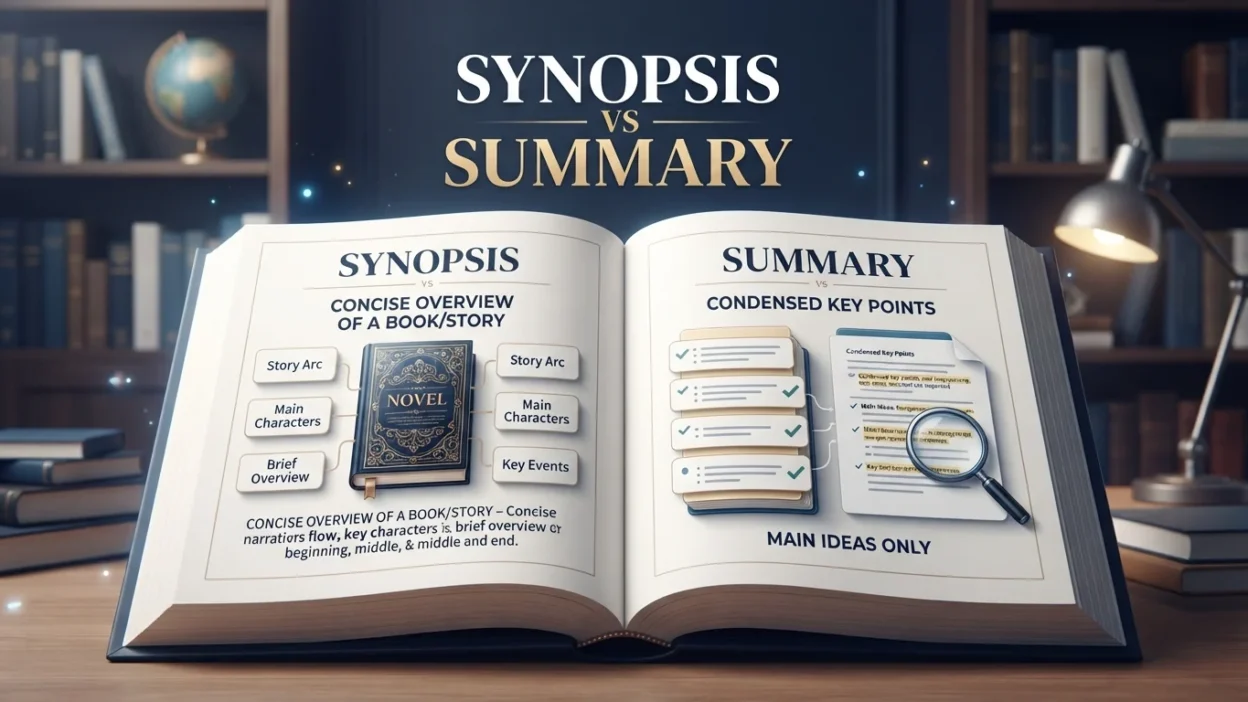
If you are wondering about “synopsis vs summary,” the two words are closely related, but they are not always interchangeable. Both give a shorter version of a longer piece of content, such as a book, article, movie, report, or story. However, a synopsis usually presents the main storyline or overall content in a concise, organized form, while a summary gives the key points or essential information in a shorter version.
Understanding the difference between synopsis and summary is useful for students, writers, readers, and ESL learners. A teacher may ask for a summary of a chapter, while a publisher may request a synopsis of a novel. Although both focus on important information rather than minor details, their purpose, structure, and typical uses can differ. This guide explains synopsis vs summary in simple English, with clear examples and practical tips.
Quick Answer
A synopsis is a concise overview of the main plot, ideas, or content of a work, often used to describe what the work is about. A summary condenses the most important points of a text or speech. A synopsis often gives an overall structured view, while a summary focuses on essential information.
Why Do People Confuse Synopsis and Summary?
People confuse synopsis and summary because both involve shortening a longer work.
For example, if you read a 300-page novel, you can create a much shorter version that explains its major events. You might call this a summary or a synopsis depending on its purpose.
The main difference is usually focus and context:
- A summary highlights the essential points or information.
- A synopsis provides a concise overview of the whole work.
- A summary is common in academic and everyday contexts.
- A synopsis is especially common for books, films, plays, research works, and proposals.
- A synopsis of a story often describes the major plot and outcome.
What Does “Synopsis” Mean?
A synopsis is a brief statement or condensed overview of the main points or storyline of a longer work.
It gives the reader a clear idea of what the complete work contains without requiring them to read or watch the entire thing.
Simple Definition of Synopsis
Synopsis = a brief overview of the main content or plot of a work.
For a novel, a synopsis may introduce the main character, central conflict, major events, and resolution.
Examples of “Synopsis”
- The publisher requested a synopsis of the novel.
- The website provides a short synopsis of the movie.
- She wrote a one-page synopsis of her research project.
A synopsis can be particularly useful when someone needs to understand the overall structure of a work quickly.
What Does “Summary” Mean?
A summary is a shortened version of a longer text, speech, event, or idea that includes its most important information.
A summary removes unnecessary details while keeping the central message or key points.
Simple Definition of Summary
Summary = a shortened version containing the most important points.
For example, after reading a long article, you might write a paragraph explaining its main arguments and conclusions.
Examples of “Summary”
- Please write a summary of the chapter.
- The report includes a summary of the findings.
- Can you give me a summary of the meeting?
- I read a summary of the article before class.
Synopsis vs Summary: Comparison Table
| Feature | Synopsis | Summary |
|---|---|---|
| Basic meaning | Brief overview of a work | Shortened version of important information |
| Main focus | Overall content, plot, or structure | Main points and essential ideas |
| Common use | Books, films, plays, proposals, research | Articles, chapters, meetings, reports, speeches |
| Length | Usually concise | Can range from a few sentences to several paragraphs |
| Storytelling | Often follows the main storyline | May focus mainly on key events or ideas |
| Purpose | Give an overview of what a work contains | Communicate the essential information |
| Detail | Selective overview | Key information without unnecessary details |
| Example | Synopsis of a novel | Summary of a chapter |
When Should You Use “Synopsis” and “Summary”?
Use “Synopsis” When You Are Describing a Whole Work
Synopsis works well when introducing a novel, film, play, research project, or other substantial work.
The author submitted a synopsis of her novel to the publisher.
Use “Summary” When You Are Condensing Information
Use summary when you want to reduce a text, conversation, speech, report, or chapter to its essential points.
The student wrote a summary of the article.
A Simple Rule
Ask yourself:
“Am I giving an overview of the work, or am I reducing information to its key points?”
An overview often fits synopsis, while a condensed presentation of key information often fits summary.
Synopsis vs Summary: 12 Examples
1. Novel
The publisher asked for a synopsis of the novel.
A synopsis gives an overview of the story, including its major developments.
2. School Chapter
Write a summary of Chapter 5.
Here, summary is natural because the student needs to present the chapter’s essential information.
3. Movie
The website contains a short synopsis of the movie.
This tells readers what the movie is about.
4. Meeting
Maria sent everyone a summary of the meeting.
A meeting is normally summarized by listing its important discussions and decisions.
5. Research Project
The researcher prepared a synopsis of the proposed study.
Here, synopsis means a concise overview of the planned work.
6. News Article
Can you give me a summary of the article?
The speaker wants the important information without reading the entire article.
7. Theater Play
The program includes a synopsis of the play.
The synopsis helps the audience understand the basic storyline.
8. Lecture
I wrote a summary of today’s lecture.
The summary records the main ideas presented by the teacher.
9. Book Proposal
The writer submitted a synopsis of her book.
The synopsis provides an overview for someone evaluating the proposed book.
10. Business Report
The manager gave a summary of the report.
The summary presents the report’s most important findings.
11. Story
The teacher asked us to write a synopsis of the story.
This can describe the main characters, conflict, major events, and ending.
12. Conversation
Let me give you a summary of our conversation.
Summary is natural because the speaker is reducing a longer discussion to its important points.
Common Mistakes With Synopsis and Summary
Mistake 1: Assuming They Always Mean Exactly the Same Thing
Although the words overlap, they can have different typical uses.
Better approach: Consider the purpose of the shortened text.
Mistake 2: Using “Synopsis” for Every Short Text
Not every short explanation is a synopsis.
I wrote a synopsis of yesterday’s lunch.
This sounds unusual unless there is a special context.
More natural:
I wrote a summary of yesterday’s discussion.
Mistake 3: Thinking a Synopsis Must Always Be About Fiction
A synopsis can describe more than a novel or movie. It can also provide an overview of research, proposals, projects, and other substantial works.
Mistake 4: Thinking a Summary Must Include Every Detail
A summary should focus on the important information, not reproduce the original text.
Mistake 5: Copying the Original Text
A good summary normally expresses the important ideas in your own words rather than simply copying sentences from the source.
A Simple Memory Trick
Remember:
Synopsis = See the whole work briefly.
Summary = Save the main information.
Another useful shortcut is:
Synopsis → overview
Summary → key points
This is not an absolute rule, because the meanings overlap, but it is a helpful way for beginners to remember the usual distinction.
Synopsis vs Summary in American and British English
There is no major American-versus-British difference in the basic meanings of synopsis and summary.
Both words are used in American and British English.
For example:
- American English: “Read the summary of the report.”
- British English: “Read the summary of the report.”
Likewise, synopsis can be used for books, films, plays, research, and other works in both varieties of English.
The difference is mainly about context and purpose, rather than national variety.
Similar Words to Synopsis and Summary
Several related words can sometimes be used in similar contexts.
Overview
An overview gives a general picture of a subject.
The introduction provides an overview of the project.
Abstract
An abstract is a concise description of a research paper or academic work, usually presenting its purpose, methods, results, and conclusions.
Read the abstract before deciding whether to study the full paper.
Outline
An outline presents the main structure or points of a work, often in an organized list.
The student prepared an outline before writing the essay.
Brief
A brief is a short presentation of important information, often prepared for a particular purpose.
The lawyer gave the team a brief on the case.
Digest
A digest is a shortened presentation of important information from a larger body of material.
The newsletter contains a digest of recent developments.
Final Verdict: Synopsis or Summary?
Synopsis and summary are closely related words, and there is some overlap between them.
Use synopsis when you want to give a concise overview of a larger work, especially a novel, film, play, research project, or proposal.
Use summary when you want to condense a text, speech, meeting, report, chapter, or discussion into its essential information.
The easiest distinction is:
A synopsis gives an overview; a summary gives the main points.
However, context matters, and some situations allow either word.
Frequently Asked Questions
Is a synopsis the same as a summary?
Not exactly. Both are condensed versions of longer material, but a synopsis generally gives an overall view of a work, while a summary focuses on its most important information or ideas.
What is the difference between a synopsis and a summary?
A synopsis usually provides a concise overview of an entire work, while a summary presents the essential points of a text, speech, event, or other material.
Is a synopsis longer than a summary?
Not necessarily. There is no universal length rule. Both can be very short, and their appropriate length depends on the purpose and context.
Can I use “summary” instead of “synopsis”?
Sometimes. The words overlap, but synopsis may sound more appropriate when describing the overall content or plot of a book, film, play, or proposal.
Is a movie description a synopsis or summary?
A short description of a movie is commonly called a synopsis, especially when it introduces the movie’s main storyline. A summary can also describe the movie’s important events.
What is a synopsis in academic writing?
In academic contexts, a synopsis can be a concise overview of a research project, thesis, dissertation, or proposed study. Its exact format depends on the institution and purpose.
What is the difference between an abstract and a synopsis?
An abstract is especially associated with academic and research writing and usually summarizes the purpose, methods, findings, and conclusions of a study. A synopsis is a broader term for a concise overview of a work.
Can a synopsis include the ending?
Yes. A synopsis can include major plot developments and the ending, particularly when it is intended to give an evaluator a complete overview of a story.
Remember This
- Synopsis = a brief overview of a larger work.
- Summary = a shortened presentation of the main information.
- A novel, film, or play can have a synopsis.
- A chapter, article, meeting, or lecture can have a summary.
- The two words overlap, so context determines which one sounds more natural.
- Synopsis → overall picture
- Summary → essential points
Conclusion
The difference between synopsis vs summary is mainly one of focus and common usage. A synopsis gives readers a concise overview of a complete work, often describing its central storyline, structure, or subject. A summary reduces longer material to its most important information and is widely used for articles, chapters, reports, lectures, meetings, and discussions.
For everyday English, remember the simple distinction: a synopsis gives an overview, while a summary gives the key points. Once you understand this difference, choosing between the two becomes much easier. When in doubt, look at the purpose of the shortened text and the type of material you are describing.

David Henry is a language enthusiast and content writer specializing in synonyms, vocabulary, and word meanings. He creates clear, engaging resources that help readers improve their writing, communication, and English skills.