Introduction:
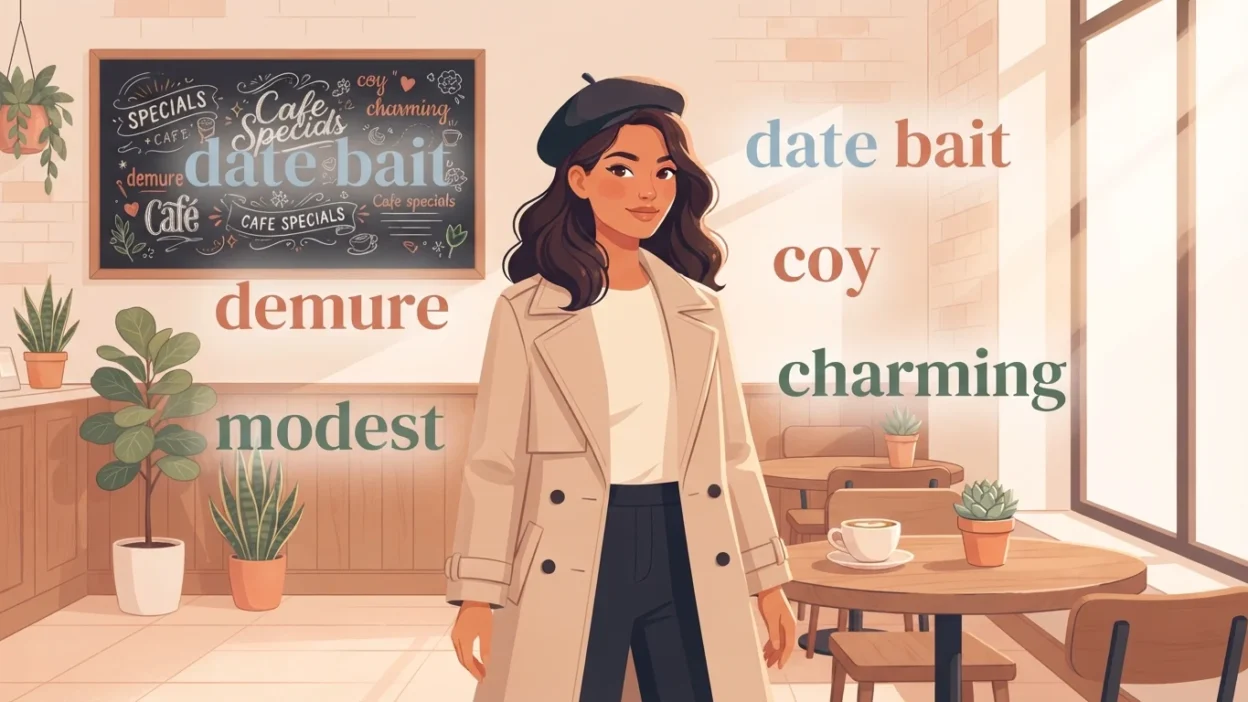
The phrase “date bait” is a piece of American slang that describes someone who is attractive and appealing to potential romantic partners. It refers to a person who others find enticing and would like to ask out on a date. Think of it as someone who naturally draws romantic attention—they’re the kind of person others notice across a crowded room.
For ESL learners and writers, understanding this term opens up a fascinating world of vocabulary. While “date bait” isn’t the most formal term, it helps us think about how we describe people’s appeal and charm. In this article, we’ll explore the meaning of “demure,” a word often used to describe a specific type of quiet, modest attraction, and provide 30+ synonyms to expand your vocabulary.
Understanding “Demure” in Simple English
Demure (pronounced di-MYOOR) describes someone who is quiet, shy, and modest in their behavior or appearance. If you picture someone who speaks softly, dresses modestly, and doesn’t draw attention to themselves, you’re imagining a demure person.
Here’s what makes someone demure:
- They are polite and reserved
- They often seem modest or shy
- They dress in a way that isn’t flashy or revealing
- Their behavior is typically calm and unassuming
Tone and Usage Context
Historically, “demure” was used as a compliment for women who were quiet and modest. Today, while it can describe anyone, the word often carries a nuanced meaning. It can be genuine (truly shy and modest) or it can describe someone who is pretending to be shy and innocent in a coy, playful way. Context is everything! If you say someone gave a “demure smile,” you might mean they smiled in a gentle, slightly shy way—or perhaps a teasing, knowing way.
30 Synonyms of Demure
Here are 30 synonyms for “demure,” each with its own shade of meaning:
| # | Word | Simple Meaning | Example Sentence | Best Usage Context |
|---|---|---|---|---|
| 1 | Modest | Not showing off; humble | “She wore a modest dress that covered her shoulders.” | Describing clothing, behavior, or personality |
| 2 | Reserved | Tends to keep thoughts and feelings to themselves | “He was quiet and reserved at the party, watching more than talking.” | Professional and social situations |
| 3 | Shy | Nervous or timid around others | “The shy student never raised her hand in class.” | Describing social anxiety or discomfort |
| 4 | Coy | Pretending to be shy or modest in a playful way | “She gave him a coy smile, then looked away quickly.” | Flirting or playful social situations |
| 5 | Bashful | Easily embarrassed in social situations | “The boy was bashful when meeting new people.” | Describing children or people in new situations |
| 6 | Retiring | Quiet and preferring to avoid attention | “The retiring professor avoided parties and public speaking.” | Professional and formal descriptions |
| 7 | Meek | Gentle, quiet, and obedient | “The meek employee never complained about extra work.” | Can suggest weakness; use carefully |
| 8 | Unassuming | Not showing off one’s abilities or achievements | “The unassuming chef never mentioned her awards.” | Professional and personal settings |
| 9 | Prim | Formal, proper, and slightly strict in behavior | “She sat with her hands folded in a prim manner.” | Humorous or slightly critical context |
| 10 | Prudish | Very easily shocked by anything sexual or improper | “His prudish aunt covered his eyes during romantic scenes.” | Critical or humorous contexts |
| 11 | Reticent | Not talking much about thoughts or feelings | “He was reticent about his childhood experiences.” | Formal writing and professional contexts |
| 12 | Quiet | Making little or no noise; not talking much | “She was a quiet person who listened more than she spoke.” | Everyday conversation |
| 13 | Sedate | Calm, dignified, and unhurried | “The sedate dinner party lasted four hours.” | Formal or humorous contexts |
| 14 | Diffident | Lacking confidence; shy and hesitant | “He approached the job interview with a diffident manner.” | Formal writing |
| 15 | Timid | Lacking courage or confidence | “The timid dog hid under the bed during storms.” | Both people and animals |
| 16 | Decorous | Behaving in a correct and proper way | “The guests maintained a decorous silence during the speech.” | Formal situations |
| 17 | Ladylike | Behaving in a way traditionally expected of a woman | “Her grandmother taught her to sit in a ladylike manner.” | Traditional or slightly outdated contexts |
| 18 | Mousy | Quiet, shy, and unremarkable; often describes appearance | “She was a mousy woman who went unnoticed at work.” | Often used negatively |
| 19 | Humble | Not thinking you’re better than others | “Despite his fame, he remained humble.” | Describing personal qualities and values |
| 20 | Proper | Behaving in a correct and accepted way | “The proper young man always said ‘please’ and ‘thank you.'” | Formal and traditional contexts |
| 21 | Strait-laced | Very strict and proper in behavior | “The strait-laced principal banned colorful hair.” | Critical or humorous contexts |
| 22 | Prissy | Too proper and easily upset by things not seen as correct | “Don’t be so prissy—it’s just a small bug!” | Critical or playful contexts |
| 23 | Blushing | Shy or embarrassed, often shown by a red face | “The blushing bride walked down the aisle.” | Romantic or social situations |
| 24 | Unassertive | Not expressing opinions confidently | “His unassertive nature made it easy for others to decide for him.” | Professional contexts |
| 25 | Overmodest | Too shy or modest to the point of being unrealistic | “Her overmodest response to the award was endearing.” | Describing extreme modesty |
| 26 | Niminy-piminy | Affectedly refined and delicate (informal) | “His niminy-piminy way of eating annoyed his friends.” | Humorous or playful contexts |
| 27 | Priggish | Self-righteously proper and moral | “The priggish character lectured everyone about manners.” | Critical contexts |
| 28 | Backward in coming forward | Very shy; unwilling to speak up (slang) | “He’s a bit backward in coming forward at meetings.” | Informal or British contexts |
| 29 | Arch | Playfully mischievous or coy | “She gave him an arch smile over her shoulder.” | Flirting or playful situations |
| 30 | Coyish | Slightly coy; somewhat playfully shy | “Her coyish manner attracted many admirers.” | Informal contexts |
How to Choose the Right Synonym
Group 1: For Genuine Shyness & Modesty
Use: Modest, reserved, shy, bashful, retiring, unassuming, humble, quiet, reticent, diffident, timid
These words describe people who are truly quiet, humble, or lacking in confidence. They’re neutral to positive in tone and appropriate in most contexts.
Group 2: For Pretending to Be Shy (Playful Coyness)
Use: Coy, arch, coyish
These words suggest that someone is pretending to be shy in a teasing or flirtatious way. It’s a more playful, slightly mischievous form of demure behavior.
Group 3: For Being Very Proper (Sometimes Too Proper)
Use: Prim, proper, prudish, strait-laced, prissy, decorous, sedate
These words describe people who follow rules of behavior very strictly. They can be neutral or slightly negative depending on context.
Group 4: For Critical or Humorous Descriptions
Use: Prudish, prissy, strait-laced, niminy-piminy, mousy, priggish
These words often carry a slightly critical or humorous tone and are used to describe people who are too proper or shy.
How to Choose the Right Synonym: Quick Guide
When choosing between these synonyms, think about your intent:
- Do you want to be polite and neutral? Choose words like modest, reserved, or quiet.
- Are you describing someone who’s playfully flirting? Choose coy or arch.
- Are you being slightly critical? Choose priggish, prudish, or mousy.
- Is it a formal context? Choose reticent, decorous, or diffident.
- Is it informal or humorous? Choose niminy-piminy or coyish.
Conclusion
“Date bait” might be an informal term for someone attractive and appealing, but understanding its related words—especially “demure”—can dramatically improve your vocabulary. A demure person may be genuinely shy and modest, or they may be playfully coy. The 30 synonyms listed here give you a rich palette of words to describe different shades of quiet, modest, and reserved behavior.
Remember, choosing the right word depends on your tone (polite, critical, playful), your audience (formal, informal), and your intent (describing genuine shyness or pretended coyness). By mastering these distinctions, you’ll become a more precise and confident communicator—whether you’re writing, studying, or simply having a conversation.

Daniel Jack is a language enthusiast and content writer who specializes in synonyms, vocabulary, and word meanings. He creates clear, engaging resources that help readers improve communication and expand their English skills.