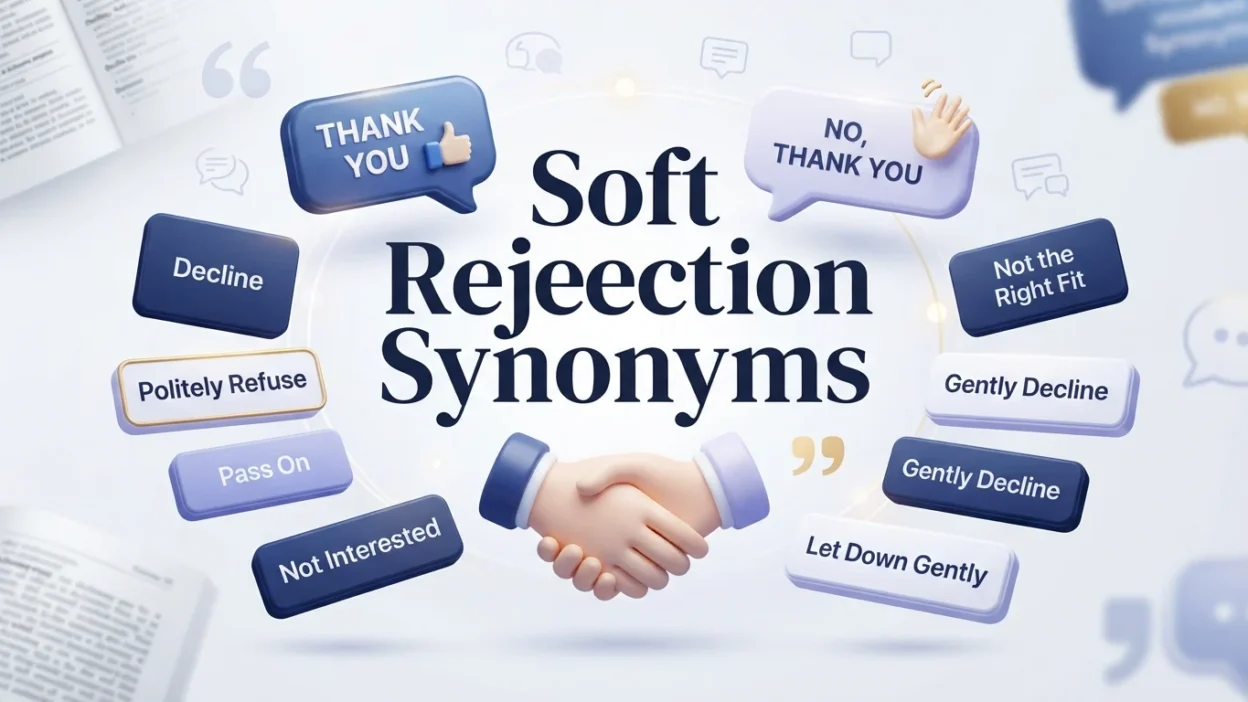
Finding the right words to say “no” can be difficult. A direct rejection may sound too cold, while an overly vague response can create confusion. That is why understanding soft rejection synonyms can help you communicate clearly while remaining kind and respectful.
A soft rejection is a gentle way of declining something without sounding unnecessarily harsh. It can be used when turning down a date, invitation, job opportunity, request, proposal, collaboration, or personal relationship. The goal is usually to communicate “no” while reducing the emotional impact.
For students, ESL learners, writers, and content creators, learning different ways to express rejection is especially useful. The right phrase can make a message sound polite, professional, friendly, distant, or empathetic depending on the situation.
What Does “Soft Rejection” Mean?
Soft rejection means declining something in a gentle, indirect, or considerate way.
Instead of saying:
“No, I don’t want this.”
You might say:
“I appreciate the offer, but I don’t think it’s the right fit for me.”
Both sentences communicate rejection, but the second one sounds more respectful and less confrontational.
Soft rejection does not always mean avoiding the word “no.” Sometimes a clear “no” combined with a polite explanation is actually the most respectful approach.
Simple Definition
Soft rejection: A polite or gentle way of refusing, declining, or turning down something.
Tone of Soft Rejection
Soft rejection can sound:
- Polite
- Gentle
- Respectful
- Diplomatic
- Considerate
- Friendly
- Professional
- Indirect
- Empathetic
The best expression depends on the relationship and situation.
30 Soft Rejection Synonyms and Expressions
There is no single perfect synonym for soft rejection because the phrase describes a communication style rather than one specific emotion. The following words and expressions can be used to communicate a gentle refusal.
1. Decline
Meaning: To politely refuse an offer, invitation, or opportunity.
Example: “Thank you for the invitation, but I’ll have to decline.”
Best usage: Professional situations, invitations, offers, and formal communication.
2. Turn down
Meaning: To refuse or reject an offer, request, or opportunity.
Example: “She decided to turn down the job offer.”
Best usage: Everyday conversations and professional situations.
3. Politely refuse
Meaning: To say no in a respectful and considerate manner.
Example: “He politely refused the invitation.”
Best usage: When you want to emphasize respectful communication.
4. Gently decline
Meaning: To refuse something without sounding harsh or unfriendly.
Example: “I’ll have to gently decline your proposal.”
Best usage: Sensitive personal or professional situations.
5. Say no politely
Meaning: To refuse something while maintaining a respectful tone.
Example: “She knew she had to say no politely.”
Best usage: Everyday communication and advice about boundaries.
6. Pass on
Meaning: To decide not to accept or participate in something.
Example: “Thanks for the invitation, but I think I’ll pass on this one.”
Best usage: Casual conversations and informal invitations.
7. Politely decline
Meaning: To refuse an offer or request in a courteous way.
Example: “I politely declined the invitation.”
Best usage: Formal emails, workplace communication, and social situations.
8. Not accept
Meaning: To choose not to receive, agree to, or participate in something.
Example: “I appreciate the offer, but I’m not able to accept it.”
Best usage: Neutral and professional communication.
9. Refuse gently
Meaning: To reject something while trying not to hurt or offend someone.
Example: “She refused gently because she didn’t want to hurt his feelings.”
Best usage: Personal and emotionally sensitive situations.
10. Express disinterest
Meaning: To communicate that you are not interested in something.
Example: “He expressed his disinterest in pursuing the relationship.”
Best usage: Dating, relationships, opportunities, and formal writing.
11. Indicate a lack of interest
Meaning: To show that you are not interested without making an aggressive rejection.
Example: “Her response indicated a lack of interest in the proposal.”
Best usage: Formal or analytical writing.
12. Let someone down gently
Meaning: To reject or disappoint someone in a kind way.
Example: “She tried to let him down gently.”
Best usage: Romantic relationships and emotionally sensitive situations.
13. Decline gracefully
Meaning: To refuse something calmly, politely, and respectfully.
Example: “He declined the offer gracefully.”
Best usage: Professional and social situations.
14. Give a gentle no
Meaning: To clearly reject something without being harsh.
Example: “She gave him a gentle no and thanked him for understanding.”
Best usage: Casual and personal conversations.
15. Politely pass
Meaning: To choose not to participate or accept something.
Example: “I appreciate the opportunity, but I’ll politely pass.”
Best usage: Informal offers, invitations, and opportunities.
16. Take a pass
Meaning: To decide not to accept or participate in something.
Example: “Thanks for asking, but I’m going to take a pass.”
Best usage: Casual American English.
17. Decline the offer
Meaning: To formally or politely refuse an offer.
Example: “After careful consideration, I decided to decline the offer.”
Best usage: Jobs, business opportunities, proposals, and formal communication.
18. Not be interested
Meaning: To communicate that something does not appeal to you.
Example: “Thanks, but I’m not interested.”
Best usage: Direct but still relatively polite personal rejection.
19. Not be the right fit
Meaning: To say that something or someone is unsuitable without directly blaming them.
Example: “I appreciate the opportunity, but I don’t think this position is the right fit for me.”
Best usage: Jobs, relationships, collaborations, and professional opportunities.
20. Not feel the same way
Meaning: To explain that your feelings are different from another person’s feelings.
Example: “You’re wonderful, but I’m sorry that I don’t feel the same way.”
Best usage: Romantic or emotional situations.
21. Keep things platonic
Meaning: To indicate that you want a relationship to remain non-romantic.
Example: “I really value our friendship and would prefer to keep things platonic.”
Best usage: Romantic advances between friends or acquaintances.
22. Decline the invitation
Meaning: To politely say that you will not attend an event or gathering.
Example: “Thank you for inviting me, but I’ll have to decline the invitation.”
Best usage: Social and professional invitations.
23. Withdraw interest
Meaning: To stop showing interest in an opportunity, person, or proposal.
Example: “After reviewing the details, she decided to withdraw her interest.”
Best usage: Formal and professional communication.
24. Step back
Meaning: To create distance or choose not to continue with something.
Example: “I think it’s best for me to step back from this opportunity.”
Best usage: Personal, professional, and emotionally sensitive situations.
25. Suggest otherwise
Meaning: To indirectly communicate that you do not agree or are not interested.
Example: “His response seemed to suggest otherwise.”
Best usage: Indirect communication and descriptive writing.
26. Express reservations
Meaning: To communicate doubts or concerns about accepting something.
Example: “She expressed reservations about moving forward with the proposal.”
Best usage: Professional, academic, and formal contexts.
27. Defer
Meaning: To delay making a decision or accepting something.
Example: “I’d prefer to defer my decision until next week.”
Best usage: Formal and professional situations.
Note: “Defer” is not always a rejection. It can simply mean delaying a decision.
28. Decline for now
Meaning: To say no at the present time without necessarily rejecting something permanently.
Example: “I’ll have to decline for now, but thank you for thinking of me.”
Best usage: Opportunities, invitations, and requests that might be reconsidered later.
29. Say it’s not the right time
Meaning: To explain that you cannot accept something because the timing is unsuitable.
Example: “I appreciate the offer, but this isn’t the right time for me.”
Best usage: Career opportunities, relationships, projects, and personal requests.
30. Thank someone but decline
Meaning: To acknowledge someone’s offer or interest before politely refusing it.
Example: “Thank you for asking, but I’m going to decline.”
Best usage: Almost any situation where you want your rejection to sound appreciative and respectful.
Soft Rejection Synonyms Comparison Table
Different expressions of rejection communicate different levels of directness. Choosing the right one can make your message more effective.
| Expression | Tone | Directness | Best Context |
|---|---|---|---|
| Decline | Polite | Medium | Professional |
| Turn down | Neutral | Medium | Everyday |
| Politely refuse | Respectful | High | General |
| Gently decline | Gentle | Medium | Sensitive situations |
| Pass on | Casual | Medium | Informal |
| Let someone down gently | Empathetic | Low | Relationships |
| Not the right fit | Diplomatic | Low | Work/dating |
| Not feel the same way | Gentle | Medium | Romance |
| Keep things platonic | Clear | High | Friendship/dating |
| Express reservations | Formal | Low | Business |
| Decline for now | Flexible | Medium | Opportunities |
| Step back | Indirect | Low | Personal/professional |
| Take a pass | Casual | Medium | Informal |
| Not interested | Direct | High | General |
| Thank someone but decline | Courteous | Medium | Almost any context |
Soft Rejection Synonyms for Different Situations
The best synonym depends heavily on context. A phrase that works in a business email may sound unnatural in a romantic conversation.
Soft Rejection in Dating
When rejecting romantic interest, kindness and clarity are important.
Good expressions include:
- “I don’t feel the same way.”
- “I’d rather keep things platonic.”
- “I really value our friendship.”
- “I don’t think we’re the right match.”
- “I’m not looking for a relationship right now.”
- “I appreciate your honesty, but I don’t feel a romantic connection.”
Avoid giving false hope if you already know that you are not interested.
Soft Rejection in Professional Situations
Professional rejection usually needs to be polite, concise, and clear.
Useful expressions include:
- “I appreciate the offer, but I’ll have to decline.”
- “I don’t think this opportunity is the right fit for me.”
- “Thank you for considering me, but I’m unable to accept.”
- “I’ve decided to pursue another opportunity.”
- “I appreciate the invitation, but I’ll have to pass.”
These phrases communicate a decision without unnecessary negativity.
Soft Rejection in Emails
A professional email can soften rejection by beginning with appreciation.
For example:
“Thank you for reaching out and for considering me. After careful consideration, I’ve decided to decline the opportunity at this time.”
This approach works because it acknowledges the other person’s effort before communicating the decision.
Soft Rejection in Friendships
Friendship situations often require warmth rather than formality.
You might say:
- “Thanks for asking, but I’ll pass this time.”
- “I appreciate the invitation, but I can’t make it.”
- “I’d rather keep things as friends.”
- “I’m not comfortable with that, but I hope you understand.”
The goal is to maintain the relationship while still expressing your boundary.
Soft Rejection Synonyms for ESL Learners
English learners may notice that native speakers often use indirect expressions when they want to reject something politely.
For example:
Direct:
“No, I don’t want the job.”
Softer:
“Thank you for the offer, but I don’t think the position is the right fit for me.”
Another example:
Direct:
“I don’t like you romantically.”
Softer:
“You’re a great person, but I don’t feel the same way.”
The second versions are not necessarily less honest. They simply use more considerate language.
How to Choose the Right Soft Rejection Synonym
Choosing the right expression depends on four main factors: relationship, context, clarity, and tone.
For Professional Situations
Choose:
- Decline
- Politely decline
- Decline the offer
- Not the right fit
- Express reservations
These sound professional and controlled.
For Romantic Situations
Choose:
- Not feel the same way
- Keep things platonic
- Not the right match
- Not looking for a relationship
- Let someone down gently
These can communicate rejection while recognizing the emotional nature of the situation.
For Casual Conversations
Choose:
- Pass on
- Take a pass
- Politely pass
- Say no politely
- Decline for now
These expressions usually sound natural in everyday speech.
For Formal Writing
Choose:
- Decline
- Express reservations
- Withdraw interest
- Defer
- Indicate a lack of interest
These are more appropriate for formal documents and professional communication.
Soft Rejection vs. Direct Rejection
Soft rejection and direct rejection have different communication styles.
Soft Rejection
“I appreciate the invitation, but I don’t think I’ll be able to join.”
Direct Rejection
“No, I won’t come.”
The soft version sounds more considerate, while the direct version is shorter and clearer.
Neither approach is always better. In situations involving personal boundaries, safety, or repeated unwanted requests, a direct rejection may be more appropriate.
Is “No” Always a Soft Rejection?
Not necessarily.
The word “no” is direct. However, it can become softer when combined with appreciation or a brief explanation.
For example:
“No, thank you.”
is generally more polite than:
“No.”
Similarly:
“Thank you for asking, but no, I’m not interested.”
is clear while remaining respectful.
The key is to avoid creating unnecessary ambiguity.
Why Use Soft Rejection Language?
Soft rejection can be useful because it helps:
- Reduce unnecessary conflict.
- Show respect for another person’s feelings.
- Maintain professional relationships.
- Protect friendships.
- Communicate boundaries politely.
- Make difficult conversations easier.
- Sound more diplomatic in writing.
- Avoid unnecessarily harsh language.
However, being gentle should not mean being misleading.
If your answer is definitely no, avoid phrases that create unrealistic expectations.
For example, saying:
“Maybe someday.”
when you know you are not interested can create confusion.
A better approach is:
“I appreciate your interest, but I don’t feel the same way.”
Common Mistakes When Giving a Soft Rejection
1. Being Too Vague
Saying:
“We’ll see.”
may sound like a future possibility rather than a rejection.
If you mean no, communicate that clearly.
2. Giving Too Many Excuses
A long list of excuses can sound dishonest or invite the other person to solve each problem.
A short explanation is often enough.
3. Being Overly Apologetic
You can be kind without repeatedly saying sorry.
For example:
“Thank you for understanding, but I’ll have to decline.”
is often sufficient.
4. Giving False Hope
Avoid promising future consideration if you know you will not change your mind.
5. Sounding Cold
A short response such as “Not interested” may be appropriate in some situations, but adding a small amount of courtesy can make communication smoother.
Quick Guide: Which Soft Rejection Should You Use?
If you need to reject an invitation, try:
“Thank you for the invitation, but I’ll have to decline.”
If you need to reject a job offer, try:
“I appreciate the offer, but I’ve decided to pursue another opportunity.”
If you need to reject a romantic advance, try:
“You’re a wonderful person, but I don’t feel the same way.”
If you need to reject a business proposal, try:
“Thank you for the proposal. After consideration, I’ve decided not to move forward.”
If you need to reject a friend’s request, try:
“I appreciate you asking, but I’ll have to pass this time.”
Final Thoughts on Soft Rejection Synonyms
Understanding soft rejection synonyms gives you more control over how you communicate difficult decisions. Instead of relying on a blunt “no,” you can choose expressions such as decline, pass on, not the right fit, let someone down gently, express reservations, or not feel the same way.
The most important point is to match the expression to the situation. Professional settings often require formal language such as “decline” or “not the right fit,” while personal situations may benefit from warmer phrases such as “I don’t feel the same way” or “I’d rather keep things platonic.”
A good soft rejection should be kind but clear. Being considerate does not require you to hide your decision or give someone false hope. The best wording communicates your boundary while treating the other person with respect.

Daniel Jack is a language enthusiast and content writer who specializes in synonyms, vocabulary, and word meanings. He creates clear, engaging resources that help readers improve communication and expand their English skills.