
English has many words that seem similar but express different ideas. Assume, presume, and infer are three such words. All three relate to what we think or believe, but they differ in how we reach a conclusion. Understanding these differences will help you choose the right word in everyday conversations, academic writing, professional communication, and English exams.
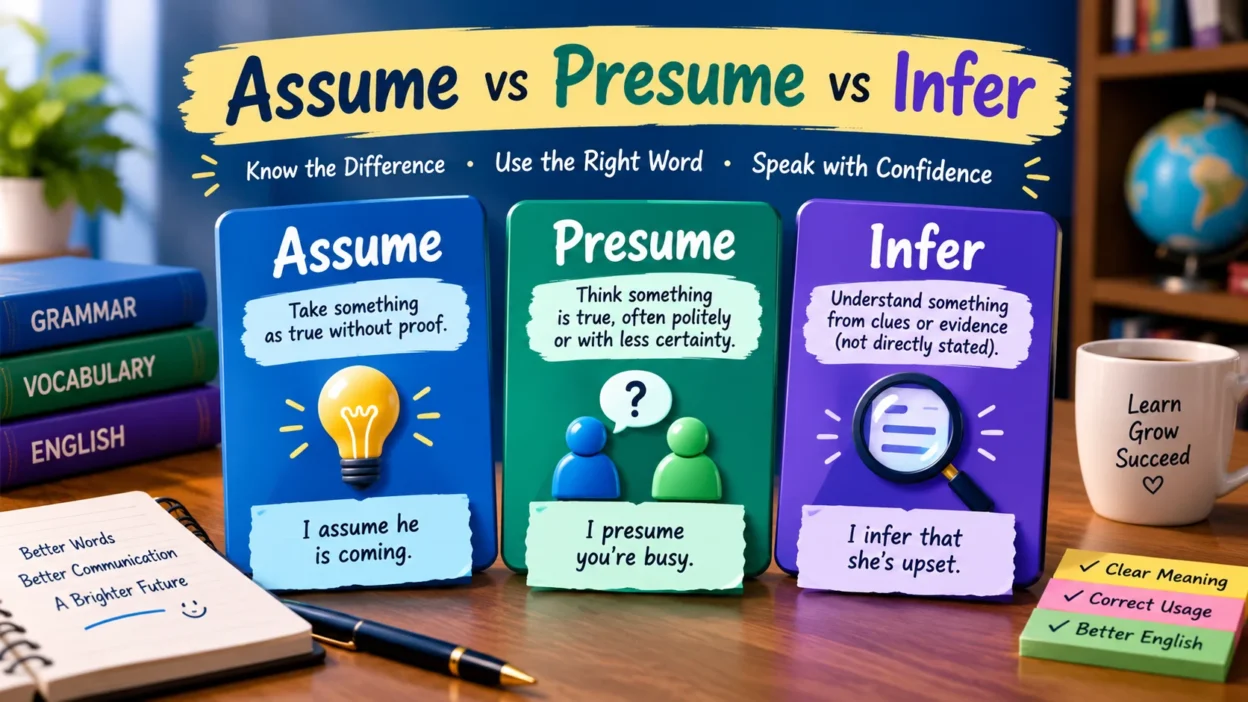
The main difference is that assume means to accept something as true without checking all the facts, presume means to believe something is likely to be true based on a reasonable expectation or some evidence, and infer means to reach a conclusion from available facts, clues, or evidence. Although assume and presume can sometimes be used interchangeably, infer describes a different process: drawing a conclusion rather than accepting or expecting something to be true. In this guide, you will learn the meaning of each word, see practical examples, compare their usage, and discover simple ways to remember the differences.
Quick Answer: Assume vs Presume vs Infer
Assume means to believe something is true without having enough proof. Presume means to believe something is likely or reasonable based on expectations, circumstances, or some evidence. Infer means to reach a conclusion using clues, facts, or evidence. For example, you assume someone is busy, presume they are busy because they have a full schedule, and infer they are busy after seeing their calendar.
Why Do People Confuse Assume, Presume, and Infer?
People often confuse these words because they all describe thinking about something that may not be directly known. In everyday English, speakers sometimes use assume and presume in similar situations. Infer is also related because it involves deciding what is probably true.
However, the three words emphasize different mental processes.
- Assume: You accept something as true without confirming it.
- Presume: You consider something likely or reasonable, often because of expectations, circumstances, or supporting evidence.
- Infer: You use available information to reach a conclusion.
Imagine your friend has not replied to your message.
- You assume your friend is ignoring you.
- You presume your friend is busy because they are usually at work at this time.
- You infer your friend may be busy after noticing that they are in a meeting.
The distinction is not always absolute. Context matters, especially when comparing assume and presume.
1. What Does Assume Mean?
Assume means to accept or believe something as true without checking IF it is actually true. An assumption may be reasonable, but it can also be incorrect because it is not fully supported by evidence.
People make assumptions in everyday life, at work, and in academic discussions. The word is especially useful when describing an unverified belief or an idea accepted as a starting point.
Simple Definition of Assume
To assume is to believe something is true without confirming it.
Examples of Assume
- I assumed you knew about the meeting.
- She assumed the shop was open because the lights were on.
- Do not assume that everyone agrees with you.
- He assumed I was angry because I did not speak.
- We assumed the journey would take two hours.
In each example, someone accepts an idea as true without necessarily checking the facts.
When Should You Use Assume?
Use assume when you want to emphasize that someone believes something without sufficient confirmation.
For example:
- “I assumed you had already eaten.” The speaker did not check.
- “Never assume that a difficult task is impossible.” The sentence warns against accepting an idea without testing it.
- “The calculation assumes that prices remain constant.” In this context, assume means accepting a condition as true for the purpose of reasoning.
Key point: An assumption can be correct or incorrect. The word itself does not tell us if the belief is true.
2. What Does Presume Mean?
Presume means to believe something is likely to be true or to accept it as true based on reasonable expectations, circumstances, or some evidence. It can sound slightly more formal than assume, although both words are common in everyday English.
Presume often suggests that a person has a reason for believing something, even if that reason does not provide complete proof. However, presume does not always require strong evidence.
Simple Definition of Presume
To presume is to consider something true or likely based on what seems reasonable or expected.
Examples of Presume
- I presume you have already met our new teacher.
- We presumed the train would arrive on time.
- The law generally presumes a person innocent until proven guilty.
- I presume you are here for the interview.
- She presumed that the invitation included her family.
The context helps explain why the speaker considers the belief reasonable or likely.
When Should You Use Presume?
Use presume when you want to express a reasonable expectation, a belief based on circumstances, or a conclusion that is accepted unless something shows otherwise.
For example:
- “I presume you would like some tea.” The speaker expects this may be the listener’s preference.
- “We presumed the road was safe because it had recently been repaired.” The belief is based on circumstances, although it might still be wrong.
- “The court presumes innocence until guilt is established.” This illustrates a formal use of presume.
Presume also appears in the expression presume to do something, meaning to act as if you have the right or permission to do it.
Example: “I would not presume to tell you how to do your job.”
Key point: Presume often suggests a reasonable expectation or some basis for belief, but it does not guarantee that the belief is correct.
3. What Does Infer Mean?
Infer means to reach a conclusion from facts, clues, observations, or other available information. Instead of simply accepting an idea, you use information to work out what is likely to be true.
Infer is particularly common in reading comprehension, academic writing, scientific reasoning, and everyday situations where people interpret clues.
Simple Definition of Infer
To infer is to use evidence or clues to reach a conclusion.
Examples of Infer
- From her expression, I inferred that she was disappointed.
- The detective inferred that the suspect had entered through the back door.
- We can infer from the results that the treatment may have helped.
- The reader inferred that the character was afraid.
- I inferred from his silence that he did not want to answer.
In these examples, the person reaches a conclusion by interpreting information rather than simply accepting an unsupported belief.
When Should You Use Infer?
Use infer when you want to describe drawing a conclusion from available evidence.
For example:
- “The ground is wet, so I infer that it rained recently.” The wet ground is a clue.
- “From the author’s description, readers can infer that the character feels lonely.” Readers interpret details in the text.
- “Scientists inferred a possible connection from the data.” The conclusion comes from examining evidence.
Remember that an inference is not necessarily correct. Evidence can be incomplete, misleading, or interpreted incorrectly.
Key point: Infer focuses on the process of reasoning from information to a conclusion.
Assume vs Presume vs Infer: Comparison Table
| Feature | Assume | Presume | Infer |
|---|---|---|---|
| Basic meaning | Accept something as true | Believe something is likely or reasonable | Reach a conclusion from information |
| Main focus | An unverified belief | An expectation or supported belief | Reasoning from clues or evidence |
| Evidence | May be absent or limited | Often some basis or expectation | Information is used to draw a conclusion |
| Certainty | Can vary | Can vary | Can vary |
| Common use | Everyday beliefs and starting conditions | Expectations and formal contexts | Analysis, interpretation, and reasoning |
| Example | I assumed she was home. | I presumed she was home because her car was outside. | I inferred she was home from the lights and sounds inside. |
The most important difference is that assume and presume describe accepting or expecting something to be true, while infer describes reaching a conclusion from information.
When Should You Use Each Word?
Choosing the correct word becomes easier when you focus on what the person is doing.
Use Assume When You Have Not Confirmed Something
Choose assume when someone accepts an idea without checking it.
Example: “I assumed the office closed at five.”
The speaker believed the office closed at five but had not confirmed the hours.
Use Presume When Something Seems Likely or Reasonable
Choose presume when a belief is based on an expectation, circumstance, or some supporting information.
Example: “I presume the office is closed because all the lights are off.”
The speaker has a reason for the belief, although the office might still be open.
Use Infer When You Draw a Conclusion from Clues
Choose infer when you use available information to work out what is probably true.
Example: “I inferred that the office was closed after seeing the locked doors and reading the notice.”
The speaker reaches a conclusion by interpreting evidence.
Can Assume and Presume Be Used Interchangeably?
Yes, sometimes. Both words can describe accepting something as true without complete confirmation.
For example:
- “I assume you are ready.”
- “I presume you are ready.”
Both sentences are grammatically correct. Presume may sound more formal or suggest a reasonable expectation, but the exact difference depends on context.
Infer is generally not interchangeable with either word when the intended meaning is drawing a conclusion from evidence.
12 Examples of Assume vs Presume vs Infer
The following examples show how the three words work in everyday English.
Example 1: A Missed Phone Call
- Assume: I assumed she was sleeping because she did not answer.
- Presume: I presumed she was sleeping because she usually naps at that time.
- Infer: I inferred that she might be sleeping after seeing that her phone was on silent and her bedroom lights were off.
Example 2: A Classroom
- Assume: The teacher assumed everyone had finished the homework.
- Presume: The teacher presumed most students had finished because the assignment was due yesterday.
- Infer: The teacher inferred that several students had struggled after reviewing their incomplete answers.
Example 3: The Weather
- Assume: We assumed it would rain today.
- Presume: We presumed it would rain because the forecast predicted showers.
- Infer: We inferred that it had rained overnight because the streets were wet.
Example 4: A Workplace
- Assume: I assumed my manager had read the report.
- Presume: I presumed my manager had read the report because she mentioned its main points.
- Infer: I inferred that my manager had read the report from her detailed comments.
Example 5: A Restaurant
- Assume: We assumed the restaurant was open.
- Presume: We presumed the restaurant was open because its website listed today’s hours.
- Infer: We inferred that the restaurant was open after seeing customers enter through the front door.
Example 6: A Friend’s Mood
- Assume: He assumed his friend was upset with him.
- Presume: He presumed his friend was upset because they had argued earlier.
- Infer: He inferred that his friend was upset after noticing her silence and worried expression.
Example 7: Reading a Story
- Assume: I assumed the main character was honest.
- Presume: I presumed the main character was honest because the narrator described him as trustworthy.
- Infer: I inferred that the main character was hiding something from his unusual behavior.
Example 8: An Examination
- Assume: She assumed the test would be easy.
- Presume: She presumed the test would be manageable because it covered familiar topics.
- Infer: She inferred that the test was difficult after seeing many unanswered questions from other students.
Example 9: A Package Delivery
- Assume: I assumed the package had arrived.
- Presume: I presumed the package had arrived because the tracking page showed it was out for delivery.
- Infer: I inferred that the package had arrived after finding it beside the front door.
Example 10: A Meeting
- Assume: We assumed the meeting had been canceled.
- Presume: We presumed the meeting had been canceled because the organizer had sent a cancellation notice.
- Infer: We inferred that the meeting had been canceled after noticing that the room was empty and the calendar invitation had disappeared.
Example 11: A Student’s Performance
- Assume: The coach assumed the student had not practiced.
- Presume: The coach presumed the student had practiced because he attended every training session.
- Infer: The coach inferred that the student needed more practice after observing repeated mistakes.
Example 12: A Scientific Observation
- Assume: The researcher assumed the equipment was working correctly.
- Presume: The researcher presumed the equipment was working because it had passed a recent inspection.
- Infer: The researcher inferred that the temperature had increased after comparing the recorded measurements.
These examples illustrate common patterns, not rigid rules. In real conversations, a single situation may support more than one word depending on what the speaker wants to emphasize.
Common Mistakes When Using Assume, Presume, and Infer
Mistake 1: Thinking Assume Always Means Guessing Without Any Evidence
Assume often refers to an unverified belief, but it can also mean accepting a condition for reasoning or planning.
Incorrect explanation: “Assume always means making a careless guess.”
Better explanation: “Assume means accepting something as true without fully confirming it.”
Example: “For this calculation, assume that the temperature remains constant.”
This is a deliberate starting condition, not necessarily a careless guess.
Mistake 2: Thinking Presume Always Requires Strong Evidence
Presume can suggest a reasonable basis for belief, but it does not always require strong evidence.
Example: “I presume you are ready to leave.”
The speaker may simply be expressing an expectation.
Mistake 3: Using Infer When You Mean Assume
Incorrect: “I inferred that everyone would arrive at nine,” when the speaker merely expected everyone to arrive at nine without examining any clues.
Better: “I assumed everyone would arrive at nine.”
Use infer when the conclusion comes from interpreting information.
Mistake 4: Believing an Inference Must Be Correct
An inference is a conclusion drawn from available information, not a guarantee of truth.
Example: “I inferred that he was angry because he was quiet, but he was actually tired.”
The conclusion was understandable but incorrect.
Mistake 5: Treating Assume and Presume as Completely Different
The meanings overlap. It is useful to understand their typical differences, but context can make either word appropriate.
Example: “I assume you understand” and “I presume you understand” can both be correct.
A Simple Memory Trick to Remember the Difference
Use these three short reminders:
- Assume = Accept. You accept an idea as true without fully checking it.
- Presume = Expect. You expect something to be true because it seems reasonable or likely.
- Infer = Interpret. You interpret information and use it to reach a conclusion.
Here is another way to remember them:
Assume a belief, presume an expectation, infer a conclusion.
Imagine finding a wet umbrella beside your front door.
- You assume your brother left it there.
- You presume he left it there because he usually carries an umbrella when it rains.
- You infer that he came home recently after noticing his wet shoes and the umbrella by the door.
The words are related, but each highlights a different way of thinking.
American vs British English: Is There a Difference?
Assume, presume, and infer have broadly the same core meanings in American and British English. The distinction between accepting an idea, considering it likely, and drawing a conclusion is not a major difference between the two varieties.
There may be differences in tone or preference depending on the speaker and context.
- Assume is widely used in everyday speech in both varieties.
- Presume is also common in both, particularly in formal statements, polite expressions, and discussions of reasonable expectations.
- Infer is used in both varieties for drawing conclusions from evidence or information.
For example, both an American and a British English speaker can naturally say, “I infer from the evidence that he was present.”
The main lesson is to choose the word based on its meaning rather than trying to memorize separate American and British rules.
Similar Words: Guess, Deduce, Conclude, and Imply
Several related words can help you express different kinds of thinking more precisely.
Assume vs Guess
Guess means to offer an answer or opinion when you are uncertain. Assume means to accept something as true, often without checking.
Example:
- “I guessed the answer.” I tried to supply an answer despite uncertainty.
- “I assumed the answer was correct.” I accepted the answer as true.
Presume vs Suppose
Suppose means to think something may be true or to imagine a possibility. Presume often suggests an expectation or a belief considered reasonable.
Example:
- “I suppose he is at home.” I think it is possible or likely.
- “I presume he is at home.” I consider it likely or reasonable to believe.
The meanings can overlap, and the difference may be subtle.
Infer vs Deduce
Infer means to reach a conclusion from information or clues. Deduce often emphasizes reasoning from facts, rules, or premises to a conclusion.
Example:
- “I inferred from her expression that she was worried.”
- “I deduced the missing number by applying the mathematical rule.”
Deduce often suggests a more systematic reasoning process, although the words sometimes overlap.
Infer vs Conclude
Conclude means to reach a final judgment or decision after considering information. Infer emphasizes drawing a conclusion from clues or evidence.
Example:
- “After reviewing the evidence, the committee concluded that the plan was impractical.”
- “From the unusual results, the researcher inferred that something had changed.”
Infer vs Imply
These words are especially easy to confuse.
Infer describes what a listener or reader works out. Imply describes what a speaker or writer suggests without stating it directly.
Example:
- “The teacher implied that I needed more practice.” The teacher suggested it indirectly.
- “I inferred from the teacher’s comments that I needed more practice.” I understood the suggestion.
A simple reminder is: Speakers imply; listeners infer. This is a helpful general rule, although context can vary.
Final Verdict: Which Word Should You Choose?
Choose assume when you accept something as true without fully checking it. Choose presume when you believe something is likely or reasonable based on expectations, circumstances, or some evidence. Choose infer when you draw a conclusion by interpreting facts, clues, or observations.
For example, if your colleague has not arrived, you might assume they are late, presume they are delayed because of traffic, or infer that they are delayed after seeing a traffic alert and receiving a message from them.
The most useful distinction is between accepting a belief and reasoning from information. Assume and presume focus on what you accept or expect to be true. Infer focuses on how you reach a conclusion. Once you understand that difference, choosing the correct word becomes much easier.
FAQs:
1. What is the main difference between assume, presume, and infer?
Assume means to accept something as true without full confirmation. Presume means to consider something likely or reasonable. Infer means to reach a conclusion from available evidence or clues.
2. Is presume stronger than assume?
Not necessarily. Presume often suggests a reasonable expectation or some supporting basis, while assume can suggest an unverified belief. However, the difference is flexible, and neither word always expresses greater certainty.
3. Can assume and presume be used interchangeably?
Yes, in some contexts. For example, “I assume you are ready” and “I presume you are ready” can both be correct. Presume may sound more formal or suggest an expectation, depending on the situation.
4. What is the difference between infer and assume?
To assume is to accept something as true without fully confirming it. To infer is to reach a conclusion by interpreting available information. An assumption can be a starting belief, while an inference is a conclusion drawn from clues or evidence.
5. What is an example of infer in a sentence?
“From the wet pavement and dark clouds, I inferred that it had recently rained.” The speaker uses observations to reach a conclusion.
6. What is the difference between infer and imply?
Infer means to reach a conclusion from information. Imply means to suggest something indirectly. A speaker may imply an idea, and a listener may infer its meaning.
7. Are assume, presume, and infer synonyms?
They are related words, but they are not exact synonyms. Assume and presume overlap in meaning, while infer specifically emphasizes reaching a conclusion from information. Replacing one word with another can change the intended meaning.
8. Which word should I use in English exams: assume, presume, or infer?
Look at the context. Use assume for an unverified belief, presume for a reasonable expectation or belief, and infer when evidence or clues lead to a conclusion. In reading comprehension questions, infer commonly asks you to identify something supported by the text but not stated directly.
Remember This
- Assume: Accept something as true without fully confirming it.
- Presume: Believe something is likely or reasonable.
- Infer: Reach a conclusion from facts, clues, or evidence.
If you remember only one thing, remember this: assume a belief, presume an expectation, infer a conclusion.
Conclusion
Assume, presume, and infer are useful English words that describe related but different ways of thinking. Assume focuses on accepting an idea without full confirmation, presume often expresses a reasonable expectation, and infer describes reaching a conclusion from available information. Although assume and presume sometimes overlap, infer usually emphasizes the process of reasoning from clues or evidence.
To use these words confidently, pay attention to the situation and the speaker’s intention. Ask yourself if you are accepting an idea, expecting something to be true, or drawing a conclusion from information. With regular practice and attention to context, you will be able to distinguish assume vs presume vs infer more naturally in conversations, writing, and English exams.

Alexander Eric is the Administrator of SynonymLot, dedicated to providing accurate synonyms, vocabulary resources, and language tools. He enjoys helping readers improve writing, communication, and English word knowledge daily.