
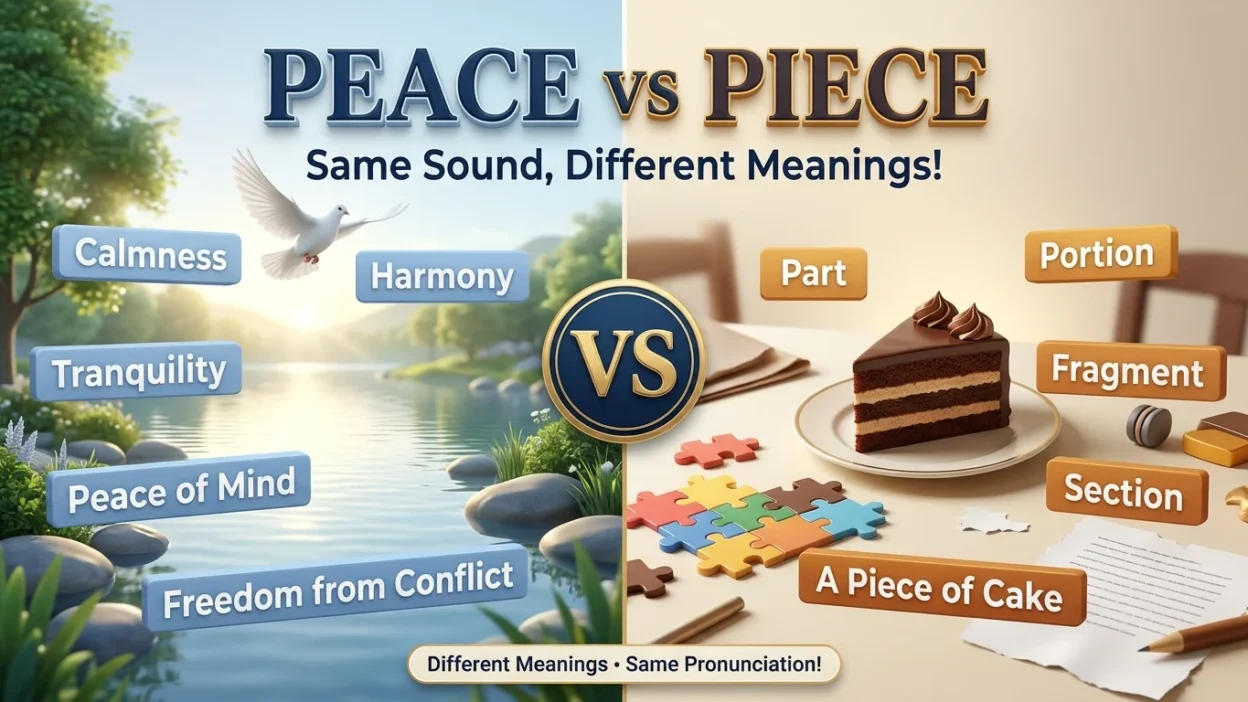
Have you ever confused peace vs. piece when writing an email, completing an English assignment, or sending a message? These two words sound exactly the same, but they have completely different meanings. Understanding the difference between peace and piece will help you avoid common spelling mistakes and communicate more clearly.
The word peace refers to calmness, harmony, or freedom from conflict. For example, “Everyone wants peace in the world.” In contrast, piece means a part of something, an individual item, or a portion of a whole. For example, “Can I have a piece of cake?” Although their pronunciation is identical, their spelling and usage depend on the meaning you want to express.
In this guide, you will learn the definitions of peace and piece, discover when to use each word, explore practical examples, and find simple tricks to remember the difference. Whether you are a student, an ESL learner, or someone who wants to improve everyday writing, this explanation will make the distinction easy to understand.
Quick Answer: What Is the Difference Between Peace and Piece?
Peace means freedom from conflict, violence, or disturbance, or a state of calmness. Piece means a part, portion, or individual item of something. Both words are pronounced the same way, making them homophones. Use peace when discussing harmony or tranquility and piece when referring to a part or item.
Why Do People Confuse Peace and Piece?
People often confuse these words because they are homophones. Homophones are words that sound alike but have different meanings and spellings.
Peace and piece share the same pronunciation: /piːs/. The final sound is like the “s” in sun.
However, their meanings are different:
- Peace: Calmness, harmony, or the absence of war.
- Piece: A portion, part, or individual item.
For example:
- Correct: “I need some peace and quiet.”
- Correct: “I ate a piece of bread.”
The surrounding words usually make it clear which spelling is appropriate.
What Does Peace Mean?
Peace is a noun that describes a state of calmness, harmony, or freedom from fighting and conflict. It can refer to relationships between people, countries, communities, or even an individual’s mind.
Common meanings of peace
- Freedom from war: Two countries are living in peace.
- Calmness and tranquility: She enjoys peace and quiet.
- Harmony: The family wants to live together in peace.
- Inner calm: Meditation gives him peace of mind.
- An end to conflict: The leaders signed a peace agreement.
Example sentences with peace
- Everyone deserves to live in peace.
- The two countries finally reached a peace agreement.
- I need some peace and quiet after a busy day.
- Spending time in nature brings me peace.
- The community hopes for peace after the conflict.
- She made peace with her past.
- We should treat others with kindness and promote peace.
- His kind words gave me peace of mind.
Common phrases with peace
- Peace of mind: A feeling of comfort without worry.
- Peace and quiet: A calm environment without noise or disturbance.
- World peace: A world without war or major conflict.
- Rest in peace: A respectful expression used when someone has died.
- Make peace: To end an argument or disagreement.
What Does Piece Mean?
Piece is a noun that usually means a part of something larger. It can also refer to an individual object, an item of writing, a work of art, or a musical composition.
Common meanings of piece
- A portion of food: A piece of pizza.
- A part of an object: A piece of broken glass.
- An individual item: A piece of furniture.
- A work of art or music: A beautiful piece of music.
- A written work: She published a piece about education.
- An item of clothing or equipment: A piece of protective gear.
Example sentences with piece
- Would you like a piece of chocolate?
- I found a piece of paper on the floor.
- She wrote a piece about climate change.
- He played a beautiful piece of music.
- Please give me a piece of advice.
- One piece of the puzzle is missing.
- We need to buy a new piece of furniture.
- The artist created an impressive piece of artwork.
Common phrases with piece
- A piece of cake: Something very easy to do.
- A piece of advice: One helpful suggestion.
- A piece of paper: A sheet or fragment of paper.
- A piece of work: A task or creation; informally, it can also describe a difficult person.
- Piece by piece: Gradually, one part at a time.
- Give someone a piece of your mind: To express anger or strong disapproval.
Peace vs. Piece: Comparison Table
| Feature | Peace | Piece |
|---|---|---|
| Meaning | Calmness, harmony, or freedom from conflict | A part, portion, or individual item |
| Part of speech | Usually a noun | Usually a noun |
| Pronunciation | /piːs/ | /piːs/ |
| Spelling | Ends in -eace | Ends in -iece |
| Common phrases | Peace of mind, world peace | Piece of cake, piece of advice |
| Example | We hope for peace. | I ate a piece of cake. |
| Memory clue | Peace brings calm | A piece is a part |
The main difference is meaning, not pronunciation. Choose the spelling that matches what you want to say.
When Should You Use Peace or Piece?
Use the meaning of your sentence to decide which word is correct.
Use peace when talking about calmness or harmony
Choose peace when discussing a lack of conflict, a quiet environment, emotional comfort, or friendly relationships.
Examples:
- “The neighbors want peace and quiet.”
- “The agreement brought peace to the region.”
- “Reading helps me find peace of mind.”
Quick test: If your sentence is about calmness, harmony, or the absence of conflict, use peace.
Use piece when talking about a part or item
Choose piece when referring to a portion of food, a fragment, an object, or a creative work.
Examples:
- “She gave me a piece of cake.”
- “I need a piece of paper.”
- “He composed a piece of music.”
Quick test: If you can replace the word with part, portion, or item, use piece.
12 Examples of Peace vs. Piece in Sentences
These examples show how context determines the correct spelling.
- Peace: Everyone hopes for peace after the war.
- Piece: I would like another piece of bread.
- Peace: She enjoys the peace of the countryside.
- Piece: He picked up a piece of broken glass.
- Peace: The discussion helped them make peace.
- Piece: This piece of furniture is very expensive.
- Peace: Meditation gives me peace of mind.
- Piece: I read an interesting piece about science.
- Peace: The children played together in peace.
- Piece: Each student received a piece of paper.
- Peace: The leaders are working toward world peace.
- Piece: Please put the puzzle together piece by piece.
Peace and piece in the same sentence
You can use both words together when the context calls for them.
- “After eating a piece of cake, I sat down in peace.”
- “The artist created a piece of art that represents peace.”
- “She wanted peace and quiet while finishing her piece of writing.”
These examples are useful because they demonstrate that the words are not interchangeable, even though they sound alike.
Common Mistakes When Using Peace and Piece
1. Writing “piece” when you mean calmness
Incorrect: “I need some piece and quiet.”
Correct: “I need some peace and quiet.”
The expression refers to calmness, so peace is the correct word.
2. Writing “peace” when you mean a portion
Incorrect: “Can I have a peace of pizza?”
Correct: “Can I have a piece of pizza?”
You are asking for a portion of food, so use piece.
3. Confusing “peace of mind” and “piece of mind”
- Peace of mind means a feeling of reassurance or freedom from worry.
- A piece of your mind is an idiom meaning that you express your anger or disapproval to someone.
Examples:
- “Knowing the door is locked gives me peace of mind.”
- “I gave him a piece of my mind for being so rude.”
Both expressions are correct, but they have different meanings.
4. Assuming the words have different pronunciations
Peace and piece are pronounced identically in standard English. You cannot reliably distinguish them by sound alone; you must consider their meanings and spellings.
Memory Trick: How to Remember Peace vs. Piece
Use these simple memory tricks to keep the words straight.
PEACE = Calm and harmony
Think of a peaceful garden, a quiet room, or a world without war. The word peace is associated with tranquility.
PIECE = Part of a whole
Think of a puzzle piece, a piece of cake, or a piece of paper. A piece is one part or item.
Another useful trick is to remember this sentence:
“I want peace, and I want a piece of cake.”
It uses both words correctly and connects each spelling to its meaning.
Peace vs. Piece in American and British English
There is no spelling difference between American and British English for these two words.
| Variety | Correct spelling | Example |
|---|---|---|
| American English | Peace / Piece | We hope for peace. / I ate a piece of cake. |
| British English | Peace / Piece | We hope for peace. / I ate a piece of cake. |
Both words have the same meanings and standard pronunciations in American and British English. The distinction is based on context, not regional spelling.
Similar Words to Peace and Piece
Learning related words can help you understand each word more clearly.
Words related to peace
- Harmony: A state of agreement or peaceful coexistence.
- Tranquility: A condition of calmness and quiet.
- Serenity: A feeling or state of peacefulness.
- Reconciliation: The restoration of friendly relations after disagreement.
- Nonviolence: The practice of avoiding violence.
These words may overlap with peace, but they are not always interchangeable.
Words related to piece
- Part: One section of a larger whole.
- Portion: A share or amount of something.
- Fragment: A small or broken part.
- Section: A distinct part of something.
- Item: An individual object or entry.
For example, a fragment usually suggests something broken or incomplete, while a portion often refers to an amount of food or another divisible substance.
Final Verdict: Peace or Piece?
Both peace and piece are correct English words, but they serve different purposes.
- Choose peace for calmness, harmony, freedom from war, or emotional tranquility.
- Choose piece for a part, portion, object, or individual work.
Remember that these words are homophones: they sound the same but have different spellings and meanings. When you are unsure, look at the surrounding sentence and ask whether you mean calmness or a part of something.
Frequently Asked Questions
1. What is the main difference between peace and piece?
Peace means calmness, harmony, or freedom from conflict. Piece means a part, portion, or individual item. For example, “We want peace” refers to harmony, while “I ate a piece of cake” refers to a portion of food.
2. Are peace and piece pronounced the same?
Yes. Peace and piece are homophones and have the same standard pronunciation, /piːs/. Their different spellings represent different meanings, so context helps you determine which word is correct.
3. Is it “peace of mind” or “piece of mind”?
Peace of mind is correct when you mean reassurance or freedom from worry. However, a piece of your mind is also correct when referring to expressing anger or disapproval to someone.
4. Is it “a peace of cake” or “a piece of cake”?
The correct expression is “a piece of cake.” It can refer literally to a portion of cake or figuratively to something very easy to do.
Example: “The English test was a piece of cake.”
5. Can peace and piece be used in the same sentence?
Yes. For example, “She enjoyed a piece of chocolate in peace.” Here, piece means a portion of chocolate, while peace means a calm or undisturbed state.
6. Which word means the opposite of war: peace or piece?
Peace is the correct choice. It commonly refers to a state in which there is no war or active conflict. Piece refers to a part or item and does not have that meaning.
7. Do American and British English spell peace and piece differently?
No. Both American and British English use the spellings peace and piece. Their meanings and standard pronunciations are also the same in both varieties.
Remember This
- Peace = calmness, harmony, and freedom from conflict.
- Piece = a part, portion, or individual item.
- Both words sound the same but have different meanings.
- Use peace of mind for reassurance and a piece of cake for a portion or something easy.
- Always choose the spelling that matches your intended meaning.
Conclusion
Understanding the difference between peace and piece is simple once you connect each word with its meaning. Peace describes harmony, tranquility, and freedom from conflict, while piece refers to a part, portion, or individual object. Although the words sound identical, their meanings make them easy to distinguish in context.
With regular practice, you can use both words confidently in conversations, school assignments, emails, and everyday writing. Remember the simple rule: peace is about calmness, while a piece is part of something. This small spelling distinction can make your English clearer and help you avoid common homophone mistakes.

David Henry is a language enthusiast and content writer specializing in synonyms, vocabulary, and word meanings. He creates clear, engaging resources that help readers improve their writing, communication, and English skills.