
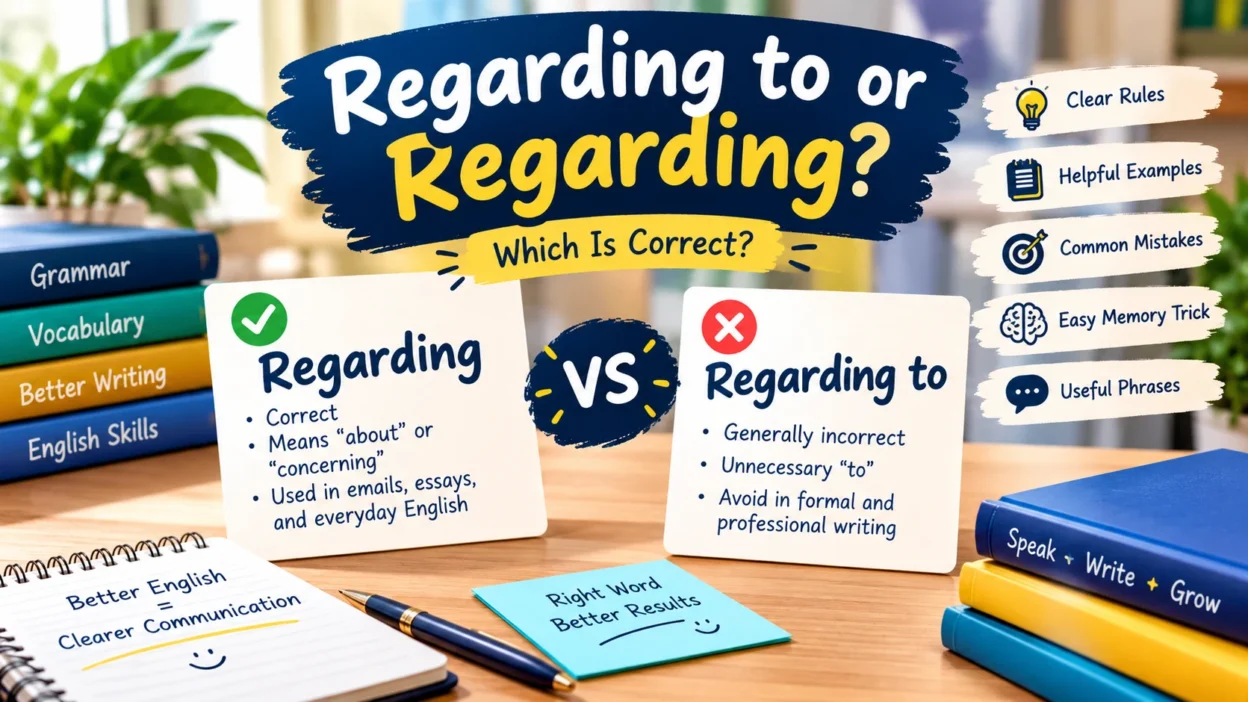
Choosing between “regarding to” and “regarding” can be confusing, especially for English learners. Both expressions may sound natural at first, but “regarding” is the correct standard expression when introducing a topic. “Regarding to” is generally grammatically incorrect in standard English.
You can use “regardig” in emails, business letters, academic writing, conversations, and everyday communication. It means “about,” “concerning,” or “in relation to.” For example, “I am writing rearding your application” is correct, while “I am writing rearding to your application” is incorrect.
The confusion happens because English has several expressions that take the preposition “to,” such as “with regard to,” “in relation to,” and “according to.” Learners sometimes combine these expressions with “regarding” by mistake. Understanding the difference will help you write more clearly and communicate professionally.
Quick Answer: Regarding To or Regarding?
“Regarding” is correct, while “regarding to” is generally incorrect in standard English. Use “regarding” when talking or writing about a subject. For example, say “I have a question regarding your order,” not “I have a question regarding to your order.” If you need “to,” use the complete phrase “with regard to.”
Why Do People Confuse “Regarding To” and “Regarding”?
People often confuse these expressions because they have similar meanings and structures.
The main reason is that English contains several phrases used to introduce a topic, including:
- Regarding your request
- With regard to your request
- In regard to your request
- In relation to your request
- Concerning your request
These expressions all refer to a subject or matter, but their grammatical structures differ.
For example, “regarding” works directly before a noun phrase. It does not normally need another preposition.
- Correct: We received your message regarding the meeting.
- Incorrect: We received your message regarding to the meeting.
1. What Does “Regarding” Mean?
Regarding is a preposition meaning “about,” “concerning,” or “in connection with” something.
It introduces the subject of a sentence or explains what a message, question, decision, or discussion concerns.
Examples of “Regarding”
- I am contacting you regarding your recent order.
- She asked several questions regarding the new policy.
- We received an email regarding the upcoming event.
- Please read the instructions regarding payment.
- The manager spoke to us regarding the schedule.
When Should You Use “Regarding”?
Use “regarding” when you want to identify the topic of a conversation, email, document, question, or decision.
It is particularly useful in formal and professional communication, although it can also appear in everyday English.
Simple replacement: If you can replace “regarding” with “about” without changing the main meaning, “regarding” is probably appropriate.
Example:
- Regarding your application, we need additional information.
- About your application, we need additional information.
Both are understandable, although “regarding” sounds more formal.
2. What Does “Regarding To” Mean?
“Regarding to” is not the standard grammatical form for expressing “about” or “concerning.” It usually results from combining two different grammatical patterns.
For example:
- Incorrect: I am writing regarding to your complaint.
- Correct: I am writing regarding your complaint.
- Correct: I am writing with regard to your complaint.
The word “regarding” already introduces the topic, so adding “to” after it is unnecessary and generally incorrect.
Why Is “Regarding To” Incorrect?
The issue is not the meaning but the grammatical structure. “Regarding” functions as a preposition and can take a noun phrase directly.
For example:
- Regarding the project
- Regarding your question
- Regarding the payment
- Regarding the new rules
You do not need to add “to” between “regarding” and the noun phrase.
Regarding vs. Regarding To: Comparison Table
| Feature | Regarding | Regarding to |
|---|---|---|
| Standard grammar | Correct | Generally incorrect |
| Meaning | About or concerning | Intended to mean about |
| Formal writing | Appropriate | Avoid |
| Business emails | Appropriate | Incorrect in standard usage |
| Academic writing | Appropriate | Avoid |
| Example | Regarding your request | Regarding to your request |
Remember: Use “regarding” by itself, or choose the complete phrase “with regard to.”
When Should You Use Each Expression?
Use “Regarding” for a Topic
Use “regarding” directly before the subject you want to discuss.
Examples:
- I have a question regarding your services.
- The teacher sent a notice regarding the examination.
- We need further details regarding the project.
Use “With Regard To” for a Topic
“With regard to” is another correct expression meaning “about” or “concerning.”
Examples:
- With regard to your application, we will contact you soon.
- With regard to the budget, we need more information.
- With regard to your question, the answer is yes.
Use “In Regard To” as an Alternative
“In regard to” is also standard English, although “regarding” is often more concise.
Examples:
- In regard to your complaint, we have completed our investigation.
- In regard to the meeting, please confirm your availability.
Quick Usage Guide
| If you want to say… | Use this |
|---|---|
| About your order | Regarding your order |
| Concerning your order | With regard to your order |
| In connection with your order | In relation to your order |
| Based on a source or instruction | According to the instructions |
12 Examples of “Regarding” in Sentences
Here are practical examples showing how to use “regarding” correctly in different situations.
- Business email: I am writing regarding your recent inquiry.
- Education: The teacher explained the rules regarding the examination.
- Workplace: We have a meeting regarding the new project.
- Customer service: I need assistance regarding my account.
- Personal communication: She called me regarding our weekend plans.
- Academic writing: The researcher published a report regarding climate change.
- Finance: The bank sent a letter regarding my loan application.
- Travel: We received an update regarding our flight.
- Healthcare: The nurse provided information regarding the appointment.
- Government: The department issued a statement regarding the new regulations.
- Technology: The company released an update regarding data security.
- Everyday conversation: Do you have any questions regarding the homework?
Each sentence uses “regarding” directly before the topic. None requires the additional word “to.”
Common Mistakes to Avoid
English learners sometimes make the following mistakes when using “regarding.”
Mistake 1: Adding “To” After “Regarding”
Incorrect: Please contact us regarding to your reservation.
Correct: Please contact us regarding your reservation.
Mistake 2: Mixing Two Expressions
Incorrect: With regarding to your request, we will respond soon.
Correct: With regard to your request, we will respond soon.
You can also write: “Regarding your request, we will respond soon.”
Mistake 3: Confusing “Regarding” With “According To”
These phrases have different meanings.
- Regarding the report, I have a question. (About the report.)
- According to the report, sales increased. (The report states that sales increased.)
Mistake 4: Using Unnecessarily Complicated Language
Wordy: I am contacting you regarding the matter of your recent application.
Simpler: I am contacting you regarding your recent application.
Clear and concise writing is often more effective.
Memory Trick: How to Remember the Correct Form
Use this simple rule:
Regarding + topic = correct.
With regard + to + topic = correct.
Regarding + to + topic = generally incorrect.
Remember these examples:
- Regarding the meeting.
- With regard to the meeting.
- Not: Regarding to the meeting.
If you remember that “regarding” works on its own, you can avoid this common grammatical mistake.
American vs. British English
There is no meaningful difference between American and British English in this usage. In both varieties, “regarding” is standard, while “regarding to” is generally considered incorrect when it means “about” or “concerning.”
| American English | British English |
|---|---|
| Regarding your application | Regarding your application |
| With regard to your application | With regard to your application |
| In regard to your application | In regard to your application |
| Regarding to your application | Generally incorrect |
You can confidently use “regarding” in professional communication in either variety of English.
Similar Words and Expressions
Several words and phrases can replace “regarding,” depending on the sentence and level of formality.
| Word or phrase | Meaning | Example |
|---|---|---|
| About | Concerning a subject | I called about your order. |
| Concerning | Related to a subject | We received a letter concerning the issue. |
| Regarding | About or in connection with | I emailed you regarding the meeting. |
| With regard to | In connection with | With regard to your request, we agree. |
| In regard to | About or concerning | In regard to the payment, please call us. |
| In relation to | Connected with | We need details in relation to the case. |
| As for | Introducing a particular subject | As for your question, I agree. |
| Concerning | Dealing with a particular matter | The policy concerning refunds has changed. |
| According to | As stated by a source | According to the manager, the office is closed. |
Be careful with “according to.” Unlike “regarding,” it generally introduces the source of information rather than simply naming a topic.
Final Verdict: Regarding To or Regarding?
“Regarding” is the correct choice in standard English when you mean “about” or “concerning.” Do not normally write “regarding to.”
Use “with regard to” if you want a phrase that includes “to.” Both “regarding” and “with regard to” are suitable for formal writing, workplace emails, academic assignments, and everyday communication.
For most situations, “regarding” is the shorter and simpler option.
Frequently Asked Questions
1. Is “regarding to” grammatically correct?
Generally, no. When you mean “about” or “concerning,” use “regarding” without “to.” For example, write “regarding your application,” not “regarding to your application.”
2. Should I write “regarding” or “regarding to” in an email?
Use “regarding” in professional emails. For example, “I am writing regarding the meeting scheduled for Monday” is correct and professional.
3. Is “with regard to” correct?
Yes. “With regard to” is a standard expression meaning “about” or “concerning.” For example, “With regard to your request, we will respond shortly.”
4. What is the difference between “regarding” and “with regard to”?
Both expressions introduce a topic. “Regarding” is a single preposition, while “with regard to” is a multiword expression. For example, “Regarding the budget” and “With regard to the budget” are both correct.
5. Can I use “regarding” in formal writing?
Yes. “Regarding” is appropriate in business letters, academic writing, official notices, reports, and professional emails.
6. Is “regarding” the same as “about”?
They have similar meanings, but their tone can differ. “About” is common in everyday conversation, while “regarding” often sounds more formal.
7. Is “regarding to” ever used by native English speakers?
You may encounter it in informal writing or speech, including as a grammatical mistake or a nonstandard construction. However, it should be avoided in standard written English when you mean “about.”
Remember This
- Correct: Regarding your question.
- Correct: With regard to your question.
- Incorrect in standard usage: Regarding to your question.
The easiest rule is to use “regarding” alone when introducing a subject. If you want to include “to,” use the complete phrase “with regard to.”
Conclusion
The difference between “regarding” and “regarding to” is simple once you understand their grammatical structures. “Regarding” is correct when you want to introduce a subject, explain a concern, or refer to a particular matter. It works naturally in professional emails, academic writing, and everyday communication.
On the other hand, “regarding to” is generally incorrect in standard English when used to mean “about” or “concerning.” Choose “with regard to” if you need an expression containing “to.” By remembering these patterns and practicing the examples, you can write more clearly, avoid common preposition errors, and communicate with greater confidence.

Alexander Eric is the Administrator of SynonymLot, dedicated to providing accurate synonyms, vocabulary resources, and language tools. He enjoys helping readers improve writing, communication, and English word knowledge daily.