
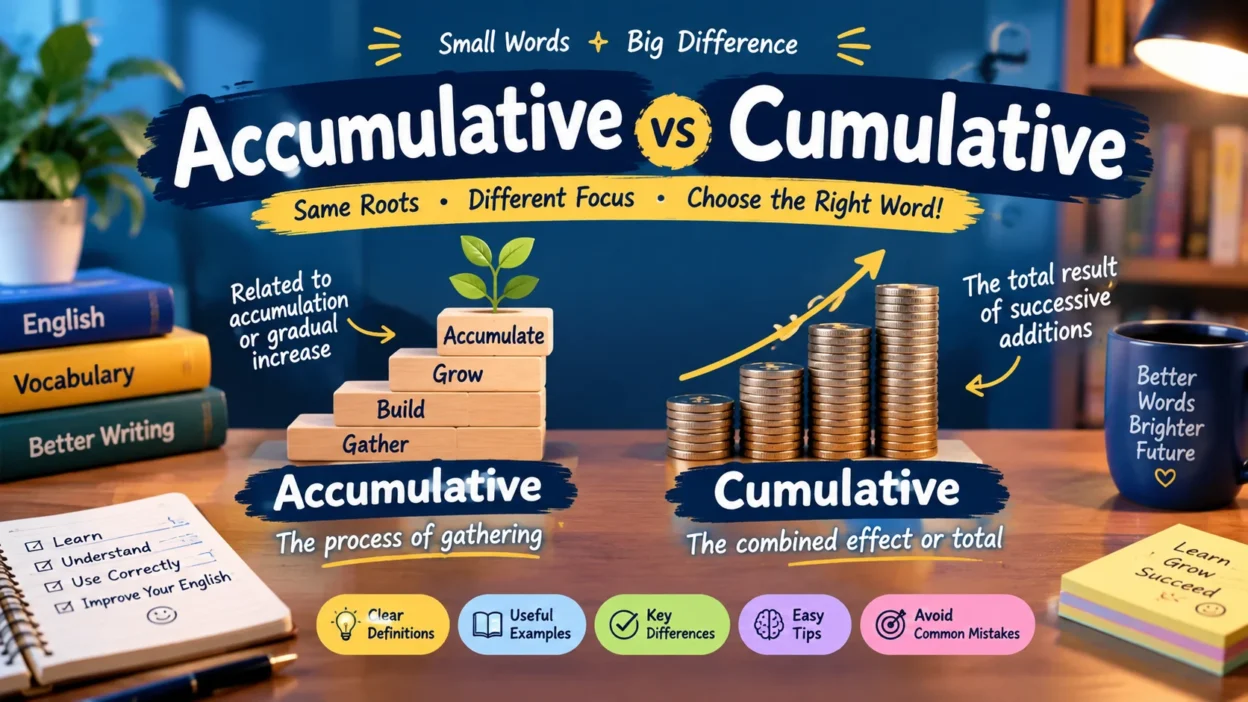
If you are confused by accumulative vs cumulative, you are not alone. Both words describe something that increases by adding amounts over time, but they are not always used in exactly the same way. Accumulative usually describes something that is capable of accumulating or that results from gradual accumulation, while cumulative emphasizes the total effect or amount built up through successive additions.
In everyday English, cumulative is much more common, especially when discussing totals, effects, knowledge, evidence, costs, scores, or changes over time. Accumulative is less common and is often used when focusing on the process or tendency of gathering. Understanding this small difference can help you choose the more natural word in academic, professional, and everyday writing.
Quick Answer
Cumulative means increasing by successive additions, with the emphasis on the total amount or combined effect. Accumulative means related to accumulation or tending to accumulate. In most situations involving a growing total or combined effect, cumulative is the more natural choice.
Why Do People Confuse Accumulative and Cumulative?
The confusion comes from the fact that both words are connected to the verb accumulate, which means “to gather or collect gradually.”
They can sometimes appear in similar contexts:
- cumulative costs = costs added together over time
- accumulative process = a process involving gradual accumulation
However, their usual emphasis differs.
Cumulative commonly focuses on the total result of successive additions.
Accumulative commonly focuses on the act, process, or tendency of accumulating.
For example:
The cumulative effect of the changes was significant.
Here, the focus is on the combined result.
What Does “Accumulative” Mean?
Accumulative is an adjective meaning related to accumulation or tending to accumulate gradually.
It comes from accumulate, meaning to gather or build up over time.
Simple meaning
Accumulative = involving or producing gradual accumulation.
It is useful when you want to describe something that gathers, builds, or increases through accumulation.
Examples
- The process has an accumulative effect.
- The company experienced an accumulative increase in resources.
- Small savings can have an accumulative benefit over many years.
Although these sentences are understandable, cumulative may sound more natural in many contexts.
What Does “Cumulative” Mean?
Cumulative is an adjective meaning increasing as additional amounts are added together.
Simple meaning
Cumulative = growing through repeated additions, with the total building over time.
It is extremely common in academic, financial, scientific, medical, and everyday contexts.
Examples
- The cumulative cost reached $5,000.
- Students benefit from the cumulative effect of regular practice.
- The cumulative score was calculated after five rounds.
- The research provides cumulative evidence supporting the conclusion.
The key idea is that separate amounts, effects, or pieces are combined into an overall total or effect.
Accumulative vs Cumulative: Comparison Table
| Feature | Accumulative | Cumulative |
|---|---|---|
| Basic meaning | Related to gradual accumulation | Increasing through successive additions |
| Main focus | Process or tendency of gathering | Combined total or effect |
| Commonness | Less common | Much more common |
| Typical use | Accumulative process/effect | Cumulative total/effect/cost |
| Common contexts | General or technical descriptions | Academic, financial, scientific, everyday |
| Example | An accumulative process | A cumulative total |
| Natural choice for a growing total | Sometimes | Usually |
When Should You Use “Accumulative”?
Use accumulative when your sentence focuses on something that involves accumulation or tends to build up gradually.
Examples include:
- accumulative process
- accumulative effect
- accumulative growth
- accumulative change
However, always consider whether cumulative would communicate the idea more naturally.
Example
The company followed an accumulative approach to resource development.
The sentence emphasizes a gradual process of gathering resources.
When Should You Use “Cumulative”?
Use cumulative when you mean that several additions combine into a larger total or overall effect.
Common expressions include:
- cumulative effect
- cumulative total
- cumulative score
- cumulative cost
- cumulative impact
- cumulative evidence
- cumulative growth
- cumulative change
- cumulative experience
- cumulative knowledge
Example
The cumulative cost of the repairs was higher than expected.
The individual repair costs were added together to produce a total.
10+ Examples of Accumulative and Cumulative
Examples with “Accumulative”
- The project has an accumulative effect on local resources.
- The organization uses an accumulative approach to gathering data.
- Small improvements can create an accumulative benefit.
- The process has an accumulative nature.
- The company noticed an accumulative increase in its resources.
Examples with “Cumulative”
- The cumulative cost of the project exceeded the original estimate.
- Her cumulative experience helped her solve the problem.
- The cumulative effect of the changes was substantial.
- Students develop cumulative knowledge throughout their education.
- The team recorded a cumulative score of 850 points.
- The report examines the cumulative impact of pollution.
- The cumulative evidence supports the proposed explanation.
- The company calculated its cumulative revenue for the year.
- Regular practice has a cumulative benefit over time.
Common Mistakes
Mistake 1: Treating the words as completely interchangeable
Although they overlap in meaning, they do not always have the same emphasis.
Better:
The cumulative effect was considerable.
This clearly means that several effects combined into an overall result.
Mistake 2: Using “accumulative” for every growing total
When you are talking about a total that results from adding several amounts, cumulative is generally the more natural choice.
Instead of:
The accumulative cost was $10,000.
Prefer:
The cumulative cost was $10,000.
Mistake 3: Assuming “cumulative” only refers to numbers
Cumulative can describe much more than numerical totals.
You can have:
- cumulative knowledge
- cumulative experience
- cumulative evidence
- cumulative impact
- cumulative effects
- cumulative learning
Mistake 4: Confusing “cumulative” with “continuous”
These words are not identical.
Continuous means something happens without interruption.
Cumulative means something builds through successive additions.
For example:
The machine operated continuously for six hours.
But:
The cumulative cost increased after each repair.
Memory Trick
A simple way to remember the difference is:
Cumulative = Combine → Count the total.
Think of cumulative as several pieces being added together.
For example:
$10 + $20 + $30 = $60 cumulative total
For accumulative, think:
Accumulate = gather gradually.
So, if you are emphasizing the building process, “accumulative” may fit. If you are emphasizing the combined result, “cumulative” is usually the clearer choice.
American vs British English
There is no major American-versus-British spelling difference between accumulative and cumulative.
Both forms are used in American and British English.
However, cumulative is generally the more familiar and widely used word in standard English, particularly in phrases such as:
- cumulative total
- cumulative effect
- cumulative evidence
- cumulative score
- cumulative cost
The choice is therefore usually about meaning and natural usage, not regional spelling.
Similar Words
Several related words can also cause confusion.
Accumulated
Accumulated describes something that has already been gathered or built up.
The company has accumulated significant savings.
Accumulating
Accumulating describes something that is currently gathering or increasing.
Dust is accumulating on the shelves.
Cumulative
Cumulative describes something that increases through successive additions.
The cumulative effect became noticeable.
Total
Total refers to the complete amount after everything has been added.
The total cost was $2,000.
Combined
Combined means brought together.
The combined results of the studies were useful.
Final Verdict
Accumulative and cumulative are closely related, but cumulative is usually the better choice when you mean that separate amounts, effects, or pieces build into a total or overall result.
Use accumulative when you specifically want to describe something related to or characterized by gradual accumulation. Because cumulative is more common, it will often sound more natural in everyday, academic, business, and professional writing.
FAQs
Is “accumulative” a correct word?
Yes. Accumulative is a valid English adjective. It describes something related to accumulation or something that tends to accumulate.
Is “cumulative” more common than “accumulative”?
Yes. Cumulative is generally much more common, especially in phrases such as “cumulative effect,” “cumulative cost,” and “cumulative total.”
What is the difference between accumulative and cumulative?
Accumulative emphasizes accumulation as a process or tendency, while cumulative usually emphasizes the total or combined effect produced by successive additions.
Should I say “cumulative cost” or “accumulative cost”?
Cumulative cost is generally the more natural expression when you mean the total cost built from several individual costs.
Is “cumulative effect” correct?
Yes. Cumulative effect is a common expression meaning the overall effect produced by several factors or events over time.
Can “cumulative” describe knowledge?
Yes. Cumulative knowledge refers to knowledge that builds progressively as new information is added to what was already learned.
Are accumulative and cumulative synonyms?
They are closely related, and they can overlap in some contexts, but they are not always interchangeable. Cumulative commonly emphasizes the combined total or effect, while accumulative emphasizes accumulation.
Which word should English learners usually choose?
When describing a growing total, combined effect, score, cost, body of evidence, or amount of knowledge, cumulative is usually the more natural choice.
Remember This
- Accumulative = related to or tending toward gradual accumulation.
- Cumulative = increasing through successive additions.
- Cumulative is much more common in standard usage.
- Use cumulative total for a total formed by adding amounts.
- Use cumulative effect for an overall effect produced by several factors.
- Think “cumulative = combined total.”
Conclusion
The difference between accumulative vs cumulative is subtle but useful. Both words are connected with gradual accumulation, but cumulative is normally used when separate amounts, effects, or pieces build into a larger total or overall result. It is the natural choice in many common expressions, including “cumulative cost,” “cumulative effect,” and “cumulative evidence.”
Accumulative is still a correct word, but it is less common and often places more attention on the process or tendency of accumulating. When you are unsure which word to use, consider if you are describing a process of gathering or the combined result of what has been gathered.

David Henry is a language enthusiast and content writer specializing in synonyms, vocabulary, and word meanings. He creates clear, engaging resources that help readers improve their writing, communication, and English skills.