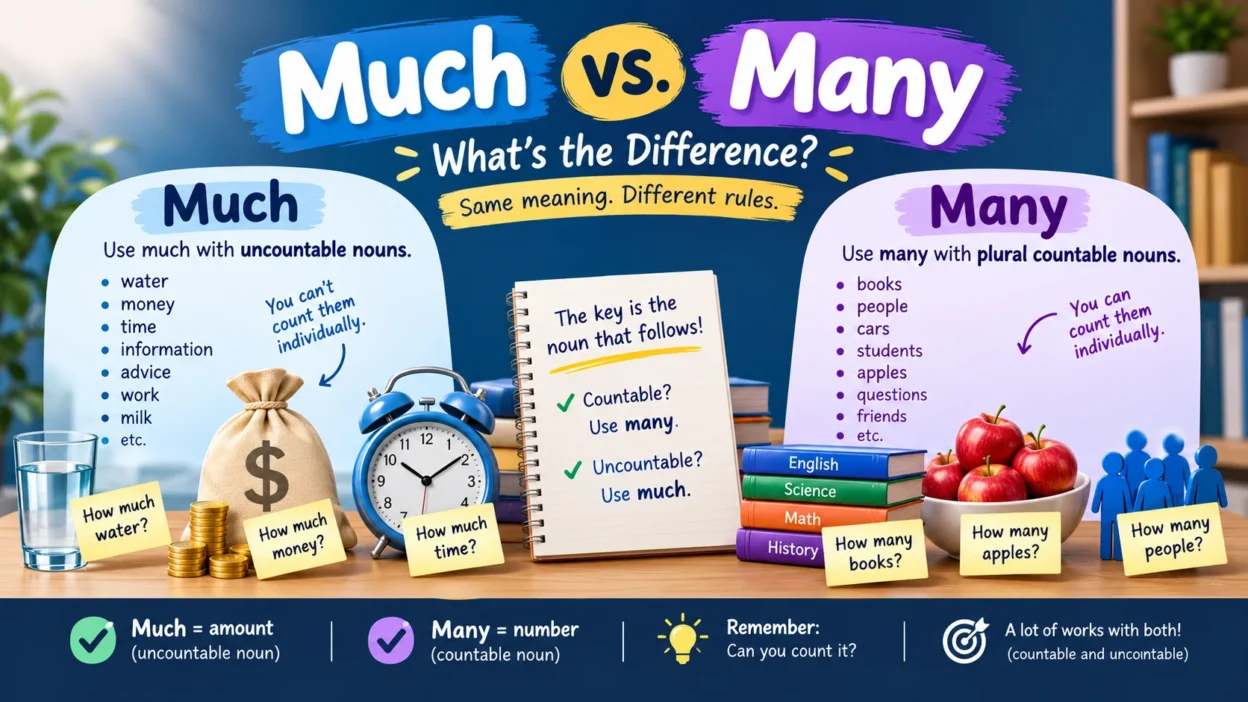
The words much and many are both used to talk about quantities, but they are not interchangeable in most situations. Understanding the difference between much and many can help you speak and write English more naturally. Although both words describe amounts, the key difference is if the noun is countable or uncountable.
Use much with uncountable nouns, such as water, money, time, and information. Use many with countable plural nouns, such as books, students, apples, and questions. For example, you would say “How much water do you drink?” but “How many glasses of water do you drink?” Water is uncountable in this context, while glasses are countable.
Learning this simple rule makes it easier to form correct questions, negative sentences, and everyday expressions. In this guide, you will learn how much and many work, explore common mistakes, compare their uses, and practice with examples that make the difference easy to remember.
Quick Answer: Much vs. Many
Much is used with uncountable nouns that cannot normally be counted individually, such as time, money, milk, and advice. Many is used with countable plural nouns, such as books, people, cars, and ideas. Say “much time” but “many hours.” The noun determines which word is correct.
Why Do People Confuse Much and Many?
People often confuse much and many because both words refer to quantity. Their meanings are similar, but their grammatical uses are different.
The main challenge is understanding the difference between countable and uncountable nouns.
- Countable nouns refer to things you can count individually: one chair, two chairs, three chairs.
- Uncountable nouns refer to substances, concepts, or quantities that are not usually counted as individual units: water, furniture, knowledge, and patience.
For example:
- Correct: How much money do you have?
- Correct: How many coins do you have?
Money is generally uncountable, but coins are countable.
What Does Much Mean?
Much is a determiner or quantifier used with uncountable nouns to ask about or describe the quantity of something.
It commonly appears in questions and negative sentences. It can also be used in affirmative sentences, particularly in formal writing and expressions such as “so much” and “too much.”
Examples of Much
- How much milk do we need?
- I don’t have much time today.
- There isn’t much sugar left.
- She has too much work to finish.
- Thank you so much for your help.
When Should You Use Much?
Use much when the noun refers to an uncountable amount, substance, or concept.
Common uncountable nouns include:
- Time: much time, too much time
- Money: much money, not much money
- Water: much water, how much water
- Information: much information, so much information
- Work: much work, too much work
- Advice: much advice, not much advice
- Energy: much energy, so much energy
- Patience: much patience, not much patience
Remember that some nouns that represent individual items in other contexts may be uncountable when used to describe a general substance or concept.
What Does Many Mean?
Many is a determiner or quantifier used with plural countable nouns. It refers to a large or unspecified number of people, objects, or things.
It is common in questions, negative sentences, and affirmative statements.
Examples of Many
- How many students are in your class?
- I don’t have many friends in this city.
- Many people enjoy reading.
- She has many interesting ideas.
- There are too many cars on the road.
When Should You Use Many?
Use many when the noun can be counted individually and is plural.
Common countable nouns include:
- Books: many books
- People: many people
- Students: many students
- Questions: many questions
- Apples: many apples
- Cars: many cars
- Friends: many friends
- Problems: many problems
For example, you can count one book, two books, and three books. Therefore, “many books” is correct.
Much vs. Many: Comparison Table
| Feature | Much | Many |
|---|---|---|
| Main use | Uncountable nouns | Plural countable nouns |
| Refers to | Amount | Number |
| Common questions | How much? | How many? |
| Example | Much water | Many bottles |
| Negative sentence | I don’t have much time. | I don’t have many hours. |
| With “too” | Too much noise | Too many people |
| With “so” | So much effort | So many mistakes |
| With “as” | As much money as | As many books as |
The easiest way to choose between them is to identify the noun first. If you can count the items individually, use many. If the noun is uncountable in that context, use much.
When Should You Use Much or Many?
1. Use Much for Uncountable Nouns
Use much when referring to an amount that is not normally divided into individual countable items.
Examples:
- How much coffee would you like?
- We don’t have much information.
- He spent too much money.
- There isn’t much traffic today.
2. Use Many for Plural Countable Nouns
Use many when referring to individual items or people that can be counted.
Examples:
- How many cups of coffee did you drink?
- We received many applications.
- She owns many dresses.
- How many people attended the event?
3. Use Much in Negative Sentences
Much is especially natural in negative sentences.
Examples:
- I don’t have much free time.
- He doesn’t eat much meat.
- There isn’t much milk in the fridge.
4. Use Many in Questions and Negative Sentences
Many is natural in questions and negative statements involving countable nouns.
Examples:
- How many days are left?
- We don’t have many options.
- Are there many shops nearby?
5. Use Much and Many With “Too” and “So”
Both words can express excess or a large quantity.
- There is too much noise.
- There are too many people.
- We have so much work to do.
- She has so many books.
15 Examples of Much vs. Many in Sentences
Here are 15 practical examples to help you understand the difference.
- Much: How much water do you drink every day?
- Many: How many glasses of water do you drink every day?
- Much: I don’t have much money this week.
- Many: I have many expenses this month.
- Much: There isn’t much food in the kitchen.
- Many: There are many dishes on the table.
- Much: How much time do we have?
- Many: How many minutes are left?
- Much: She doesn’t need much help.
- Many: She has many helpful friends.
- Much: There is too much noise outside.
- Many: There are too many cars on this street.
- Much: We learned so much information today.
- Many: The teacher asked many questions.
- Much and many: How much rice and how many potatoes should I cook?
Notice how the noun changes the correct choice, even when the two examples refer to related things.
Common Mistakes With Much and Many
English learners sometimes use much and many incorrectly because they focus on the meaning rather than the grammatical form of the noun.
Mistake 1: Using Many With an Uncountable Noun
Incorrect: I don’t have many money.
Correct: I don’t have much money.
Why? Money is generally uncountable in this sentence.
Mistake 2: Using Much With a Plural Countable Noun
Incorrect: How much books do you have?
Correct: How many books do you have?
Why? Books can be counted individually.
Mistake 3: Forgetting the Plural Form
Incorrect: There are many student in the classroom.
Correct: There are many students in the classroom.
Why? Many normally takes a plural countable noun.
Mistake 4: Assuming Much Is Never Used in Affirmative Sentences
Incorrect rule: Much can only be used in negative sentences.
Correct examples:
- We have so much work to do.
- She has much experience in this field.
- Thank you very much.
Much is less common in ordinary affirmative statements such as “I have much money.” In everyday conversation, “I have a lot of money” sounds more natural.
Mistake 5: Confusing the Noun With Its Container
Incorrect: How much bottles do you need?
Correct: How many bottles do you need?
Why? Bottles are countable, even when they contain uncountable substances such as milk or water.
Memory Trick: How to Remember Much vs. Many
Use this simple trick:
- Much = amount. Think of water, time, money, and milk.
- Many = number. Think of books, people, cars, and apples.
Ask yourself: “Can I count this noun as individual items?”
If yes, use many with the plural noun. If not, much is usually the correct choice.
For example:
- How much water? Water is uncountable.
- How many bottles? Bottles are countable.
- How much time? Time is uncountable.
- How many hours? Hours are countable.
Much vs. Many in American and British English
The basic grammar rule is the same in American and British English: use much with uncountable nouns and many with plural countable nouns.
However, everyday usage can vary slightly by context.
In both varieties, speakers commonly use a lot of or lots of in affirmative sentences.
- American English: I have a lot of homework.
- British English: I have a lot of homework.
Both varieties also commonly use much and many in questions and negative sentences.
- How much money do you need?
- How many people are coming?
- I don’t have much time.
- We don’t have many chairs.
There is no general American-versus-British rule that changes when to use much or many.
Similar Words and Expressions
Several expressions can replace much or many, depending on the noun and sentence.
A Lot Of
A lot of works with both uncountable and plural countable nouns. It is especially common in everyday affirmative sentences.
- I have a lot of work.
- She has a lot of friends.
Lots Of
Lots of is an informal alternative to a lot of.
- There is lots of food.
- Lots of people attended the concert.
Plenty Of
Plenty of suggests that there is enough or more than enough of something.
- We have plenty of time.
- There are plenty of opportunities.
A Little
A little is used with uncountable nouns to describe a small amount.
- I have a little money.
- Add a little salt.
A Few
A few is used with plural countable nouns to describe a small number.
- I have a few questions.
- She bought a few apples.
How Much vs. How Many
Use how much to ask about an amount and how many to ask about a number.
- How much flour do we need?
- How many bags of flour do we need?
Frequently Asked Questions
1. What is the main difference between much and many?
Much is used with uncountable nouns, such as water, time, and money. Many is used with plural countable nouns, such as books, students, and cars.
2. Should I say “how much people” or “how many people”?
Say “how many people” because people is the plural form of the countable noun person.
Example: How many people are coming to dinner?
3. Is it “much money” or “many money”?
The correct expression is “much money.” Money is normally uncountable when referring to a general amount.
Example: I don’t have much money with me.
4. Can I use much in a positive sentence?
Yes. Much is correct in affirmative sentences, especially with expressions such as “so much,” “too much,” and “very much.” It can also occur in formal writing.
Examples: Thank you very much. We have so much to learn.
5. Is “a lot of” used with both much and many nouns?
Yes. A lot of can be used with uncountable nouns and plural countable nouns.
Examples: a lot of water, a lot of books.
6. Is it “too much work” or “too many work”?
The correct expression is “too much work” because work is generally uncountable when it refers to a task or workload.
Example: I have too much work to finish today.
7. Is it “so much people” or “so many people”?
The correct expression is “so many people” because people is a plural countable noun.
Example: So many people came to the festival.
8. Can much and many be used in questions?
Yes. Both are commonly used to ask about quantities.
- How much sugar do you need?
- How many spoons do you need?
Remember This
- Much + uncountable noun: much water, much time, much information.
- Many + plural countable noun: many books, many hours, many questions.
- How much? asks about an amount.
- How many? asks about a number.
- A lot of works with both countable and uncountable nouns.
Conclusion
The difference between much and many is simple once you understand countable and uncountable nouns. Use much when referring to an amount of something that is not normally counted individually, such as money, water, time, or information. Use many when referring to a number of countable items or people, such as books, students, questions, or cars.
To improve your English, pay attention to the noun that follows much or many. Practicing with everyday examples and asking yourself if a noun can be counted will help you choose the correct expression more confidently. With regular practice, this rule will become a natural part of your speaking and writing.

David Henry is a language enthusiast and content writer specializing in synonyms, vocabulary, and word meanings. He creates clear, engaging resources that help readers improve their writing, communication, and English skills.